

One by U2 is among the most emotionally powerful rock songs of the 1990s.
It was written in October 1990 during the Achtung Baby sessions in Berlin, at a moment when the band was close to breaking apart.
Affiliate Disclosure: As an Amazon Associate I earn from qualifying purchases. This helps support the site at no extra cost to you.
| Song | One |
| Artist | U2 |
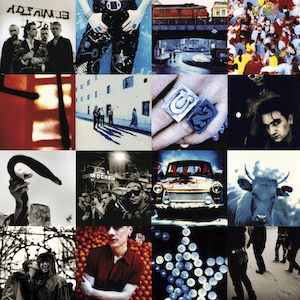
| Album | Achtung Baby (1991) |
| Written by | Bono, The Edge, Adam Clayton, Larry Mullen Jr. |
| Produced by | Daniel Lanois, Brian Eno |
| Released | 1992 (single) |
| Genre | Alternative Rock, Post-Punk |
| Record Label | Island Records |
| Chart Peak | #10 US Billboard Hot 100 |
Table of Contents
Background and History
U2 formed in Dublin, Ireland in 1976.
The band features Bono on vocals, The Edge on guitar, Adam Clayton on bass, and Larry Mullen Jr. on drums.
Their 1980s work built them into a global arena rock force.
By 1990, the band wanted to reinvent their sound entirely.
The song was written when The Edge found a chord progression that brought the divided band back together in the studio.
The Recording Story
Producers Daniel Lanois and Brian Eno were at the board when the song came together.
The chord sequence took shape first.
Bono wrote the vocal melody and lyrics over it rapidly.
The lyric explores tolerance, conflict, and the gap between loving someone and being able to sustain that love.
The phrase “we get to carry each other” frames mutual support as privilege rather than obligation.
That emotional precision connected it to other deeply personal 90s recordings like Tears in Heaven by Eric Clapton and Cryin’ by Aerosmith.
Chart Success
The song reached number ten on the US Billboard Hot 100 in 1992.
It performed more strongly in Europe, reaching the top five in multiple countries.
Three separate music videos were filmed, each exploring different visual approaches to the lyric’s themes of tolerance and unity.
The most widely seen version features the band performing live.
Achtung Baby reached number 1 in the United States, the United Kingdom, and Australia.
The album was certified multi-platinum worldwide and is now recognized as among the greatest rock albums of the decade.
Lasting Legacy
This tune has become a standard at benefit concerts and political movements worldwide.
Bono performed it at major AIDS awareness events throughout the 1990s and 2000s.
It has been covered by dozens of artists across multiple genres.
Mary J. Blige recorded a notable version with U2 that reached a new audience entirely.
Rolling Stone ranked it among the greatest songs in rock history.
It remains U2’s most requested and most covered song, more than three decades after its release.
The song continues to surface at moments of national and international mourning, its message of connection carrying weight that time has not reduced.
Watch the Official Video
Frequently Asked Questions
FAQ
- What inspired this song by U2?
The Edge found a chord progression during a tense session in Berlin in October 1990, and Bono wrote the vocal and lyric quickly, the song arriving at a moment when the band was close to breaking up entirely.
- What album is it from?
It is from Achtung Baby, released in November 1991 on Island Records, produced by Daniel Lanois and Brian Eno, and now considered one of the defining rock albums of the decade.
- Did it reach number one?
It peaked at number ten on the US Billboard Hot 100, performing more strongly in Europe, while the parent album Achtung Baby reached number 1 in the United States, the United Kingdom, and Australia.
- Why is the lyric unusual for a love song?
The lyric addresses conflict within a relationship rather than celebrating it, with the key phrase being ‘we get to carry each other’ rather than ‘we have to,’ framing mutual support as privilege rather than burden.
- Has it been covered by other artists?
Yes. Mary J. Blige recorded a notable version with U2 that introduced it to a new audience, and it has been covered across multiple genres, reflecting its broad emotional range.
You Might Also Like
One by U2 stands as proof that the most lasting anthems come from moments of crisis, not calculation, born from a near-breakup in a Berlin studio and carrying its emotional weight intact more than thirty years later.