

Maneater by Hall & Oates is one of the most commercially successful singles of the 1980s.
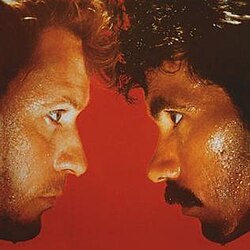
It spent four weeks at number one on the Billboard Hot 100 and became the defining track of their 1982 album H2O.
Affiliate Disclosure: I am an Amazon affiliate and if you purchase through any amazon links on this site i may earn a small commission at no extra charge to you.
Written by Daryl Hall, John Oates, and Sara Allen, Maneater was released as the lead single from H2O in October 1982.
It reached number one on the Billboard Hot 100 and remained there for four consecutive weeks.
Produced by Daryl Hall, John Oates, and Neil Kernon, H2O sold over two million copies in the United States.
It remains one of the duo’s best-selling albums.
| Song Title | Maneater |
| Artist | Hall & Oates |
| Album | H2O (1982) |
| Released | 1982 (single) |
| Written By | Daryl Hall, John Oates, Sara Allen |
| Producer | Daryl Hall, John Oates, Neil Kernon |
| Label | RCA Records |
| Chart Peak | #1 US Billboard Hot 100 |
Table of Contents
- What Is Maneater About?
- The Vibe: Genre, Mood, and Search Intent
- Behind the Lyrics: The Story of Maneater
- Technical Corner: Instruments and Production
- Legacy and Charts: Why This Classic Still Matters
- Listener’s Note: A Personal Take
- Watch: Maneater by Hall & Oates
- Collector’s Corner: Own a Piece of Rock History
- Frequently Asked Questions About Maneater
- You Might Also Like
What Is Maneater About?
Daryl Hall clarified in multiple interviews that Maneater is not about a seductive woman.
The target of the song is New York City itself.
Hall wrote the lyric as a portrait of the city’s cutthroat, materialistic culture in the early 1980s.
The figure in the song is a metaphor for the city and for the people consumed by its appetite for wealth and status.
She only comes out at night.
The world is not right.
Those opening lines establish a place of darkness and moral ambiguity rather than a specific person.
The song presents ambition as a predator.
It warns that chasing money and status will consume anyone who gets too close.
The message is sharp but the music wraps it in something irresistible.
That tension between the groove and the warning is what gives the track its lasting power.
The Vibe: Genre, Mood, and Search Intent
The opening bassline announces a record that means business from the first bar.
- Genre: Pop Rock, R&B, Soft Rock
- Mood: Seductive, Dark, Cautionary
- Tempo: Midtempo (~100 BPM)
- Best For: 1980s pop rock playlists, MTV era classics, R&B-influenced rock collections
- Similar To: Hall & Oates “I Can’t Go for That”, Michael Jackson “Billie Jean”, Toto “Africa”
- Fans Also Search: Hall & Oates discography, H2O album, Daryl Hall vocals, 1982 Billboard hits
Behind the Lyrics: The Story of Maneater
Daryl Hall, John Oates, and Sara Allen wrote the song during the H2O sessions in 1982.
Hall had originally conceived the track with a reggae influence.
The arrangement was completely reworked before recording began, and none of that reggae feel survived into the final version.
What replaced it was a polished pop-rock production with a hypnotic menace that suited the subject matter far better.
Hall described the song as a commentary on New York during the go-go years of early-1980s materialism.
The city was in transition.
Wall Street was rising.
Wealth was becoming visible and aspirational in ways it had not been in previous decades.
Maneater captured that shift and turned it into something you could dance to.
The saxophone solo by Charles DeChant was added late in the recording process and became one of the track’s most identifiable elements.
The single was released in October 1982 and reached number one on the Billboard Hot 100 by November.
It stayed there for four consecutive weeks.
Technical Corner: Instruments and Production
The production on this recording is immaculate and deliberate.
Every element serves a purpose.
The bass guitar carries the main melodic hook of the song and sits prominently at the centre of the stereo field.
That placement is the foundation of the track’s hypnotic quality.
Daryl Hall’s vocal performance is controlled and precise.
He delivers the cautionary lyric with a cool authority that suits the subject matter perfectly.
Charles DeChant’s saxophone solo arrives in the instrumental break and adds a jazz-inflected sophistication to the arrangement.
The synth-driven backdrop gives the recording its distinctly 1982 sound while the underlying musicianship gives it a depth that has kept it relevant for decades.
Neil Kernon’s production work alongside Hall and Oates keeps the arrangement focused and the bass prominent throughout.
Legacy and Charts: Why This Classic Still Matters
Maneater debuted on the Billboard Hot 100 in October 1982 and reached number one in late November.
It spent four consecutive weeks at the top of the chart.
The track drove H2O to platinum certification and established Hall & Oates as the best-selling duo in American music history at that time.
The song has been used in films, television programmes, and advertising campaigns for over four decades.
Its association with ambition, seduction, and the dangers of excess has made it a recurring cultural reference.
Radio stations continue to programme it alongside the other essential singles of the decade.
It remains one of the most recognisable recordings of the early 1980s.
Listener’s Note: A Personal Take
The bass hook is the entire argument for this record.
Everything else — the saxophone, the synths, Hall’s vocal — exists to support what that bass establishes in the opening four bars.
Most pop songs lead with the melody or the lyric.
This one leads with the rhythm, and you are already committed before the first verse arrives.
That is a difficult thing to accomplish.
Hall and Oates did it without apparent effort.
Watch: Maneater by Hall & Oates
Collector’s Corner: Own a Piece of Rock History
Hall & Oates: H2O (1982)
Own the album that gave the world Maneater.
Original RCA Records pressings and remastered editions available.
Frequently Asked Questions About Maneater
Who wrote Maneater?
It was written by Daryl Hall, John Oates, and Sara Allen.
Allen, who was in a long-term relationship with Hall, co-wrote several of the duo’s most successful songs during this period.
What is Maneater about?
Despite widespread interpretation of the song as being about a femme fatale, Daryl Hall stated clearly that the song is about New York City.
It is a commentary on 1980s urban materialism and the way ambition can consume people who pursue wealth without restraint.
What album is it on?
It appears on H2O, Hall & Oates’ ninth studio album, released in 1982 on RCA Records.
H2O sold over two million copies in the United States.
Who produced the recording?
It was produced by Daryl Hall, John Oates, and Neil Kernon.
Kernon had previously worked with artists including Rush before joining the H2O sessions.
How long did it stay at number one?
Maneater spent four consecutive weeks at number one on the US Billboard Hot 100.
It is one of the biggest chart runs in Hall & Oates’ career.
Who plays saxophone on the track?
The saxophone solo was performed by Charles DeChant, a long-time member of the Hall & Oates band.
The solo was added late in the recording process and became one of the track’s most distinctive elements.
Was the song originally written as a reggae track?
Yes.
Daryl Hall originally conceived the track with a reggae influence, but the arrangement was completely reworked before recording.
Is it still performed live?
Yes.
The song is a consistent part of Hall & Oates’ live performances and one of the most reliably crowd-pleasing moments in their set.
You Might Also Like
Foreigner: I Want to Know What Love Is (1984)
The power ballad that became Foreigner’s biggest commercial hit and demonstrated the emotional range of Mick Jones as a songwriter.
Both recordings reached number one and became defining songs of their respective artists’ careers in the early 1980s.
Dire Straits: Money for Nothing (1985)
Another mid-1980s recording that used social commentary as its lyrical foundation while delivering something undeniably catchy.
Both songs critiqued the materialism of the decade from within it.
Judas Priest: Breaking the Law (1980)
The heavy metal anthem from the same era that channelled economic frustration into a track as immediate and unforgettable as its chorus.
Both recordings distilled the anxieties of their time into music that outlasted the decade that produced them.
Decades on, Maneater by Hall & Oates endures as one of the most precisely crafted pop-rock recordings in American music history, a song that wrapped sharp social commentary in a groove so compelling it still demands attention.