

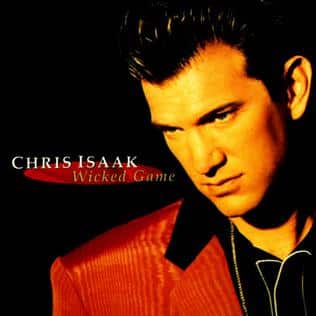
Wicked Game by Chris Isaak reached number six on the US Billboard Hot 100 in early 1991 after David Lynch placed it in the film Wild at Heart, transforming a forgotten album track into one of the most distinctive pop hits of the decade.
Written and recorded by Isaak for his 1989 album Heart Shaped World, the song had initially passed without commercial notice before the Lynch connection and a striking music video directed by Herb Ritts made it unavoidable.
Affiliate Disclosure: As an Amazon Associate I earn from qualifying purchases. This helps support the site at no extra cost to you.
| Song | Wicked Game |
| Artist | Chris Isaak |
| Album | Heart Shaped World (1989) |
| Written by | Chris Isaak |
| Produced by | Erik Jacobsen |
| Released | 1990 (re-release) |
| Genre | Rockabilly, Alternative Rock, Sophisti-Pop |
| Chart Peak | #6 US Billboard Hot 100, #10 UK Singles Chart |
Table of Contents
Background and History
Chris Isaak was born in Stockton, California in 1956 and developed a style rooted in the rockabilly and country sounds of the 1950s, particularly the recordings of Roy Orbison and Buddy Holly.
He signed to Warner Bros. Records and released three albums before Heart Shaped World, none of which had produced significant commercial success despite consistent critical attention.
Producer Erik Jacobsen, who had previously worked with The Lovin’ Spoonful, produced Heart Shaped World with Isaak’s backing band Silvertone.
Wicked Game was recorded as a slow, atmospheric love song built on a repeating guitar figure and Isaak’s falsetto vocal.
Warner Bros. released the album in 1989 to modest sales, and the single was promoted without finding significant radio traction at the time.
Wicked Game and the Film Connection
David Lynch selected Wicked Game for his 1990 film Wild at Heart, a Palme d’Or-winning road movie starring Nicolas Cage and Laura Dern.
Lynch used the song in a pivotal scene, and its placement in a widely seen film introduced the track to audiences who had not encountered the album in 1989.
The Lynch connection prompted Warner Bros. to re-release the single in Europe and then in the United States, where it found radio support it had not received on its original release.
The pattern of a rock song breaking commercially through film placement would recur throughout the 1990s, but Wicked Game was among the earliest and most dramatic examples of an album track’s commercial trajectory being reversed by a director’s choice.
A similar dynamic later drove the commercial breakthrough of Eric Clapton’s Tears in Heaven, where the song’s emotional weight connected through film and television exposure rather than pure radio promotion.
Wicked Game and the Music Video
Wicked Game‘s music video was directed by photographer Herb Ritts, who shot it in black and white on a beach in Kauai, Hawaii.
The video features Isaak and supermodel Helena Christensen in a series of sensual images set against ocean waves and dark sand.
Ritts’s photography background gave the video a still-image quality that stood apart from the kinetic, performance-driven aesthetic common to rock videos of the period.
MTV placed the video in heavy rotation, and its visual distinctiveness drove sustained airplay well beyond what radio alone had produced for the original release.
The combination of Lynch’s film placement and the Ritts video created two separate cultural moments that together built the song’s commercial momentum in a way that neither could have achieved independently.
Wicked Game and the Charts
Wicked Game reached number six on the US Billboard Hot 100 in February 1991, over a year after the album’s original release.
It peaked at number ten on the UK Singles Chart and performed strongly across European markets where the Wild at Heart film had received significant attention.
Heart Shaped World was re-certified gold and platinum in multiple territories following the single’s success, making the album one of the more unusual commercial recoveries in rock of the period.
The song’s chart performance placed it alongside ballad-driven rock hits of the era while remaining sonically distinct from the grunge and hard rock that dominated album-oriented radio in 1991.
Warner Bros. capitalized on the success with a dedicated compilation album titled Wicked Game in 1991, which collected tracks from across Isaak’s catalog and introduced his earlier work to the new audience the single had generated.
Lasting Legacy of Wicked Game
Wicked Game remains Chris Isaak’s most recognized song and the track that most clearly demonstrates his ability to translate a 1950s romantic aesthetic into a fully contemporary production.
Its commercial path, from unnoticed album track to top ten hit through the intervention of a filmmaker and a fashion photographer, became a case study in how non-traditional exposure could build commercial momentum for a song that radio had initially declined to champion.
The song has been covered hundreds of times, with versions by HIM, James Vincent McMorrow, and dozens of others demonstrating how completely the composition translates across different arrangements and styles.
Its use in advertising, film, and television has continued steadily across three decades, generating revenue and new listeners well beyond the original 1991 commercial peak.
The Herb Ritts video is consistently cited in discussions of the most visually effective music videos of its era, and its influence on the aesthetic language of rock video is evident in the work of fashion-oriented directors who followed.
More than thirty years after its unlikely chart breakthrough, Wicked Game endures as the definitive recording of Chris Isaak’s career and one of the most atmospherically distinctive pop songs of the early 1990s.
Watch the Official Video
Frequently Asked Questions
FAQ
- Who wrote Wicked Game?
- Chris Isaak wrote the song entirely himself. He recorded it for his 1989 album Heart Shaped World with producer Erik Jacobsen and his backing band Silvertone, drawing on the atmospheric rockabilly and pop balladry of artists like Roy Orbison who had influenced his songwriting from early in his career.
- How did the song become a hit?
- Director David Lynch selected Wicked Game for his 1990 film Wild at Heart, which won the Palme d’Or at Cannes. The film placement prompted Warner Bros. to re-release the single, and MTV’s rotation of the Herb Ritts-directed video built additional momentum that drove the song to number six on the US Billboard Hot 100 in early 1991.
- Who directed the music video?
- Herb Ritts directed the video, shot in black and white on a beach in Kauai, Hawaii. Ritts was primarily known as a fashion photographer, and his still-image sensibility gave the video a visual quality that stood apart from the performance-oriented videos common in rock at the time.
- Who is Helena Christensen?
- Helena Christensen is a Danish supermodel and photographer who appeared opposite Isaak in the Wicked Game video. She was one of the most prominent models of the early 1990s, and her presence in the video contributed to its visual impact and MTV rotation.
- What other famous covers exist?
- Finnish rock band HIM recorded one of the most well-known covers, which introduced the song to a younger European rock audience in the early 2000s. Irish singer James Vincent McMorrow’s stripped acoustic version also gained significant attention, and the song has been covered hundreds of times across multiple genres.
You Might Also Like
Rescued from commercial obscurity by a Palme d’Or-winning director and made visually iconic by a fashion photographer, Wicked Game stands as the most unlikely chart breakthrough of the early 1990s and the song that proved Chris Isaak’s atmospheric rockabilly could reach a mainstream audience given the right exposure.