
Neil Young Neil Young album represents one of the most fascinating debuts in rock history, released on November 12, 1968, his 23rd birthday.
The self-titled first solo effort marked Young’s bold step away from Buffalo Springfield into an unpredictable solo career.
What makes this album particularly significant is its troubled birth through the controversial Haeco-CSG encoding disaster and Young’s relentless pursuit of sonic perfection.
Despite never charting on the Billboard 200, the Neil Young Neil Young album established the template for five decades of groundbreaking music to follow.
The self-titled first solo effort marked Young’s bold step away from Buffalo Springfield into an unpredictable solo career.
What makes this album particularly significant is its troubled birth through the controversial Haeco-CSG encoding disaster and Young’s relentless pursuit of sonic perfection.
Despite never charting on the Billboard 200, the Neil Young Neil Young album established the template for five decades of groundbreaking music to follow.
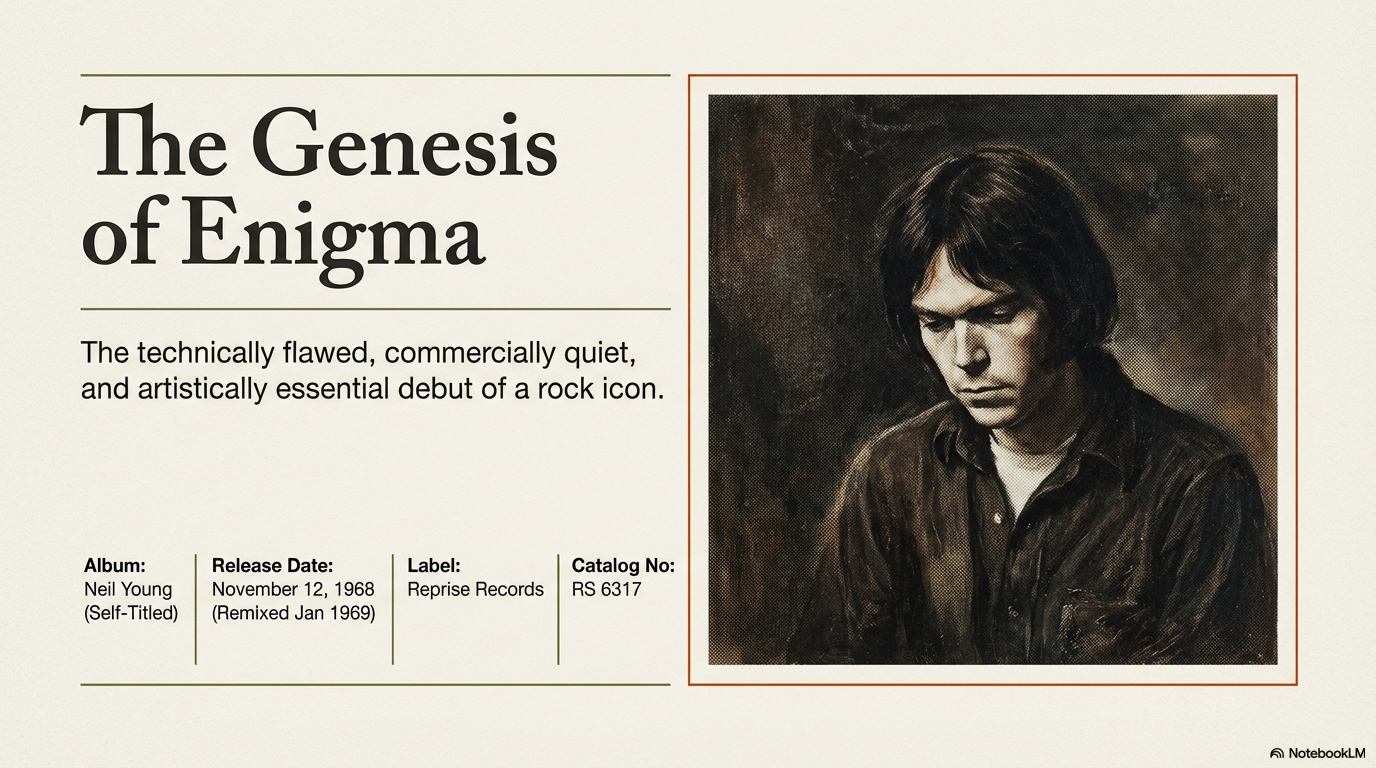
Table of Contents
- From Buffalo Springfield Breakup to the Reprise Deal
- Recording Sessions and Production Details
- The Haeco-CSG Controversy That Nearly Destroyed the Album
- Track-by-Track Analysis: Neil Young Neil Young Album Deep Dive
- Musicians and Personnel: Neil Young Neil Young Album Credits
- Guitar Innovations and the Birth of Neil’s Signature Sound
- Singles, Chart Performance, and Critical Reception
- Album Artwork: The “No Name” Cover Mystery
- Live Promotion and Coffeehouse Tours
- Legacy and Influence: Neil Young Neil Young Album in Perspective
- Final Thoughts on This Essential Debut
Own the Album That Started It All
Experience the raw talent and experimental spirit that launched Neil Young’s legendary solo career with this remastered edition.
From Buffalo Springfield Breakup to the Reprise Deal
Buffalo Springfield splintered for good in early 1968, leaving Neil Young at a critical crossroads.
The band had achieved modest success but constant internal tensions made continuation impossible.
Young wasted no time mourning the breakup.
Instead, he immediately hired Elliot Roberts as his manager.
Roberts was already managing Joni Mitchell and would continue guiding Young’s career until his death in 2019.
Roberts moved quickly to secure a solo contract with Reprise Records, a division of Warner Brothers.
The deal gave Young the artistic freedom he craved without the compromises that plagued Buffalo Springfield.
Recording sessions began in August 1968, just months after the final Springfield breakup.
Young entered the studio with a clear vision but no idea how difficult bringing it to life would become.
The band had achieved modest success but constant internal tensions made continuation impossible.
Young wasted no time mourning the breakup.
Instead, he immediately hired Elliot Roberts as his manager.
Roberts was already managing Joni Mitchell and would continue guiding Young’s career until his death in 2019.
Roberts moved quickly to secure a solo contract with Reprise Records, a division of Warner Brothers.
The deal gave Young the artistic freedom he craved without the compromises that plagued Buffalo Springfield.
Recording sessions began in August 1968, just months after the final Springfield breakup.
Young entered the studio with a clear vision but no idea how difficult bringing it to life would become.
Meeting David Briggs: A Partnership for the Ages
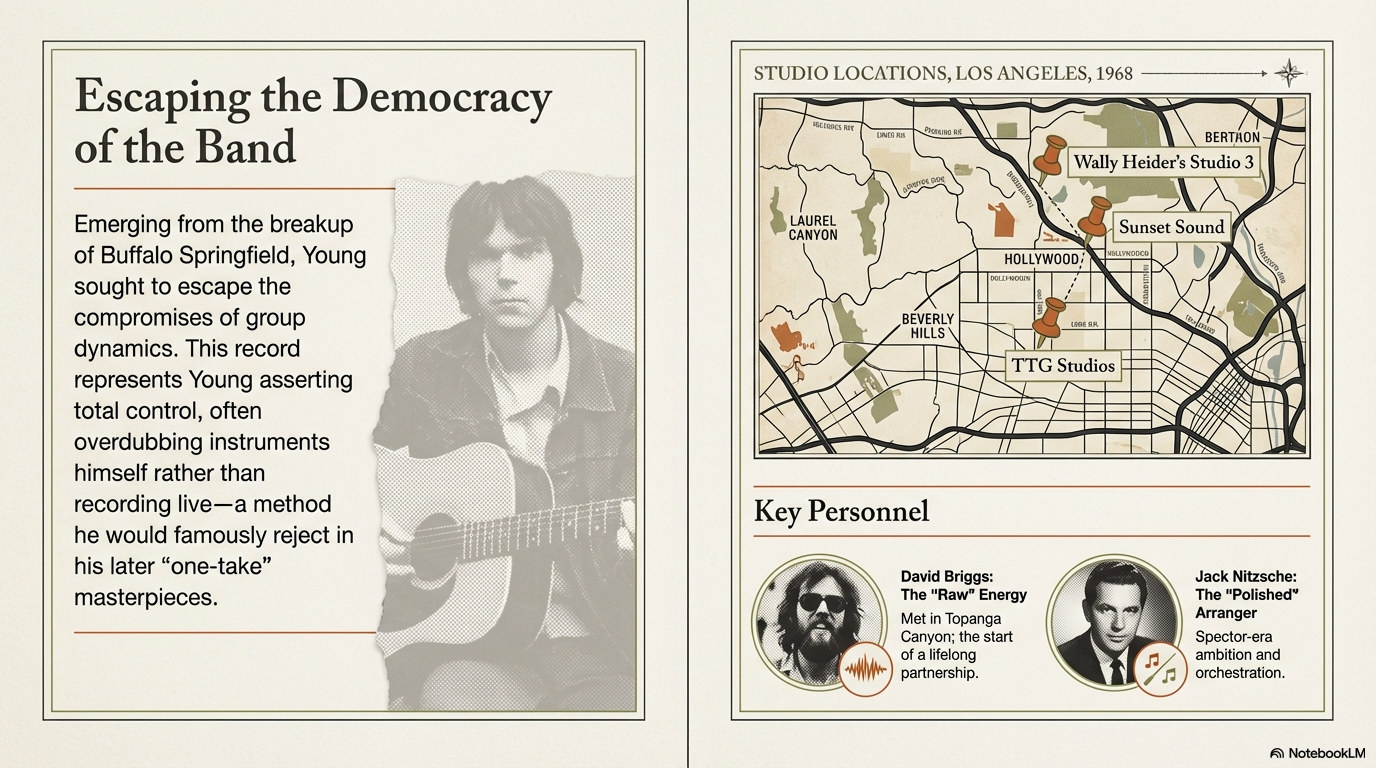
The album marks Neil Young’s first collaboration with record producer David Briggs.
Young met Briggs in Topanga Canyon when Briggs offered him a ride.
Briggs was living in Stephen Stills’ old house at the time.
This chance encounter launched one of rock’s most productive artist-producer relationships.
Briggs co-produced the album with Young and would continue working with him until Briggs’ passing in 1995.
Their partnership shaped the sound of 1970s classic rock in profound ways.
Briggs brought technical expertise but also understood Young’s need for spontaneity and emotional authenticity.
Young met Briggs in Topanga Canyon when Briggs offered him a ride.
Briggs was living in Stephen Stills’ old house at the time.
This chance encounter launched one of rock’s most productive artist-producer relationships.
Briggs co-produced the album with Young and would continue working with him until Briggs’ passing in 1995.
Their partnership shaped the sound of 1970s classic rock in profound ways.
Briggs brought technical expertise but also understood Young’s need for spontaneity and emotional authenticity.
Recording Sessions and Production Details
The bulk of recording took place between August and October 1968 across multiple Los Angeles studios.
Young and Briggs utilized Wally Heider Studios, TTG Studios, and Sunset Sound Recorders.
The album was recorded in just two weeks, an incredibly tight timeline by today’s standards.
However, the recording process itself departed dramatically from what Young would later prefer.
Young relied heavily on overdubbing rather than live performance.
This meant recording individual instruments on different days and layering them together.
In a 1970 Rolling Stone interview, Young explained the painstaking process behind “I’ve Been Waiting for You.”
He admitted all the instruments were played on different days.
This overdubbing approach became the album’s Achilles heel in Young’s eyes.
Young and Briggs utilized Wally Heider Studios, TTG Studios, and Sunset Sound Recorders.
The album was recorded in just two weeks, an incredibly tight timeline by today’s standards.
However, the recording process itself departed dramatically from what Young would later prefer.
Young relied heavily on overdubbing rather than live performance.
This meant recording individual instruments on different days and layering them together.
In a 1970 Rolling Stone interview, Young explained the painstaking process behind “I’ve Been Waiting for You.”
He admitted all the instruments were played on different days.
This overdubbing approach became the album’s Achilles heel in Young’s eyes.
Young’s Dissatisfaction with Studio Overdubbing
Young later called this his worst album because it wasn’t played live.
He told Rolling Stone in 1970 that the sound doesn’t come from the studio but from musicians playing together.
“Playing live is very exciting, especially the guitars really get me off,” Young explained.
“Everybody playing at once is really groovy.”
This experience fundamentally shaped his future recording philosophy.
After the Gold Rush and subsequent albums emphasized live performance over technical perfection.
The lesson learned from his debut became a guiding principle for his entire career.
Young wanted listeners to hear musicians playing together, not isolated tracks assembled like puzzle pieces.
He told Rolling Stone in 1970 that the sound doesn’t come from the studio but from musicians playing together.
“Playing live is very exciting, especially the guitars really get me off,” Young explained.
“Everybody playing at once is really groovy.”
This experience fundamentally shaped his future recording philosophy.
After the Gold Rush and subsequent albums emphasized live performance over technical perfection.
The lesson learned from his debut became a guiding principle for his entire career.
Young wanted listeners to hear musicians playing together, not isolated tracks assembled like puzzle pieces.
The Haeco-CSG Controversy That Nearly Destroyed the Album
The first release used the Haeco-CSG encoding system without Young’s knowledge or approval.
Haeco-CSG stood for Holzer Audio Engineering-Compatible Stereo Generator.
The technology was developed to make stereo records compatible with mono record players.
Record companies embraced it because they could manufacture a single version for both stereo and mono systems.
However, the process had a devastating side effect.
It degraded the sound quality by phase-shifting the right channel up to 120 degrees.
When Young heard the released album, he was horrified.
“The first mix was awful,” he said in a September 1969 Cash Box interview.
“I was trying to bury my voice, because I didn’t like the way it sounded.”
Haeco-CSG stood for Holzer Audio Engineering-Compatible Stereo Generator.
The technology was developed to make stereo records compatible with mono record players.
Record companies embraced it because they could manufacture a single version for both stereo and mono systems.
However, the process had a devastating side effect.
It degraded the sound quality by phase-shifting the right channel up to 120 degrees.
When Young heard the released album, he was horrified.
“The first mix was awful,” he said in a September 1969 Cash Box interview.
“I was trying to bury my voice, because I didn’t like the way it sounded.”
The Remix and Re-release
Young demanded the album be remixed and re-released without Haeco-CSG processing.
Rolling Stone announced the remix in its December 13, 1969 issue.
The late summer 1969 re-release removed the problematic encoding from all tracks.
Additionally, three songs received complete remixes.
“If I Could Have Her Tonight,” “Here We Are in the Years,” and “What Did You Do to My Life?” were completely redone.
These new mixes replaced the originals on the master tapes.
The album cover was changed to include “Neil Young” printed across the top.
This helped buyers distinguish the improved version from the original “CSG mix.”
However, the original jackets lasted longer than the first pressing, creating confusion.
Many copies of the remixed album appeared in the original “no name” sleeve.
Rolling Stone announced the remix in its December 13, 1969 issue.
The late summer 1969 re-release removed the problematic encoding from all tracks.
Additionally, three songs received complete remixes.
“If I Could Have Her Tonight,” “Here We Are in the Years,” and “What Did You Do to My Life?” were completely redone.
These new mixes replaced the originals on the master tapes.
The album cover was changed to include “Neil Young” printed across the top.
This helped buyers distinguish the improved version from the original “CSG mix.”
However, the original jackets lasted longer than the first pressing, creating confusion.
Many copies of the remixed album appeared in the original “no name” sleeve.
Collector’s Items and Pressing Variations
Original pressings with the CSG mix are now rare collector’s items.
Interestingly, some collectors prefer the original mix despite Young’s objections.
They argue the remix diminished certain songs, particularly “Here We Are in the Years.”
Adding to the confusion, a pressing plant accidentally used the wrong stamper in the early 1970s.
The CSG mix briefly reappeared on side two of some pressings.
The remastered version released in 2009 as part of the Neil Young Archives Original Release Series uses the non-CSG version.
High-resolution digital files of both mixes are available through the Neil Young Archives website.
Subscribers can compare the original CSG mix with the corrected version Young approved.
Interestingly, some collectors prefer the original mix despite Young’s objections.
They argue the remix diminished certain songs, particularly “Here We Are in the Years.”
Adding to the confusion, a pressing plant accidentally used the wrong stamper in the early 1970s.
The CSG mix briefly reappeared on side two of some pressings.
The remastered version released in 2009 as part of the Neil Young Archives Original Release Series uses the non-CSG version.
High-resolution digital files of both mixes are available through the Neil Young Archives website.
Subscribers can compare the original CSG mix with the corrected version Young approved.
Track-by-Track Analysis: Neil Young Neil Young Album Deep Dive
The Neil Young Neil Young album contains ten tracks spanning just 36 minutes.
Every song was written by Young except “String Quartet from Whiskey Boot Hill” by Jack Nitzsche.
The album showcases remarkable stylistic diversity from the opening notes.
Every song was written by Young except “String Quartet from Whiskey Boot Hill” by Jack Nitzsche.
The album showcases remarkable stylistic diversity from the opening notes.
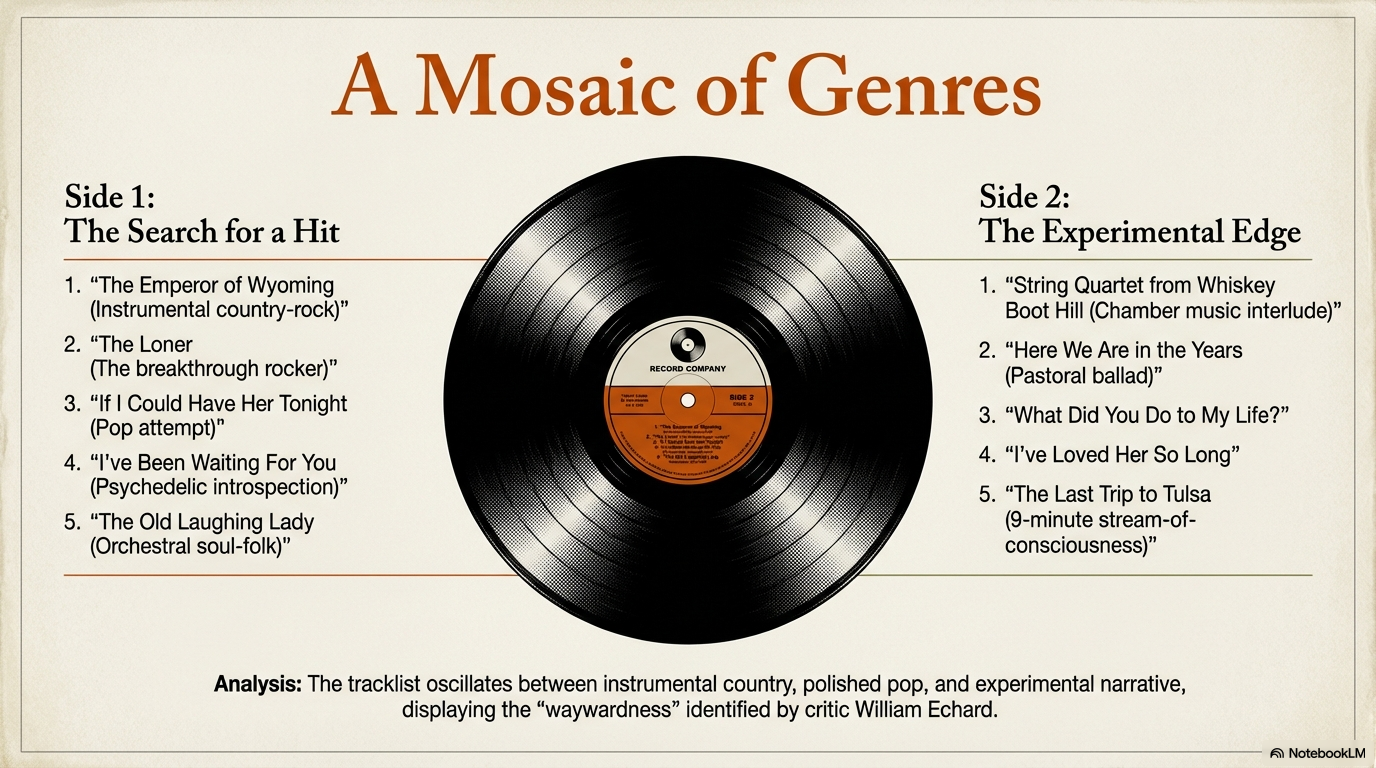
Side One: From Country to Classic Rock
“The Emperor of Wyoming” opens the album with a surprise.
Rather than announcing his arrival with a statement piece, Young chose a breezy country instrumental.
The track features Young on guitar with Jim Messina on bass and George Grantham on drums.
String arrangements add sophistication to the country-rock foundation.
It was recorded at Wally Heider Recording Studios on August 23, 1968.
The song signals Young’s willingness to defy expectations from the very first track.
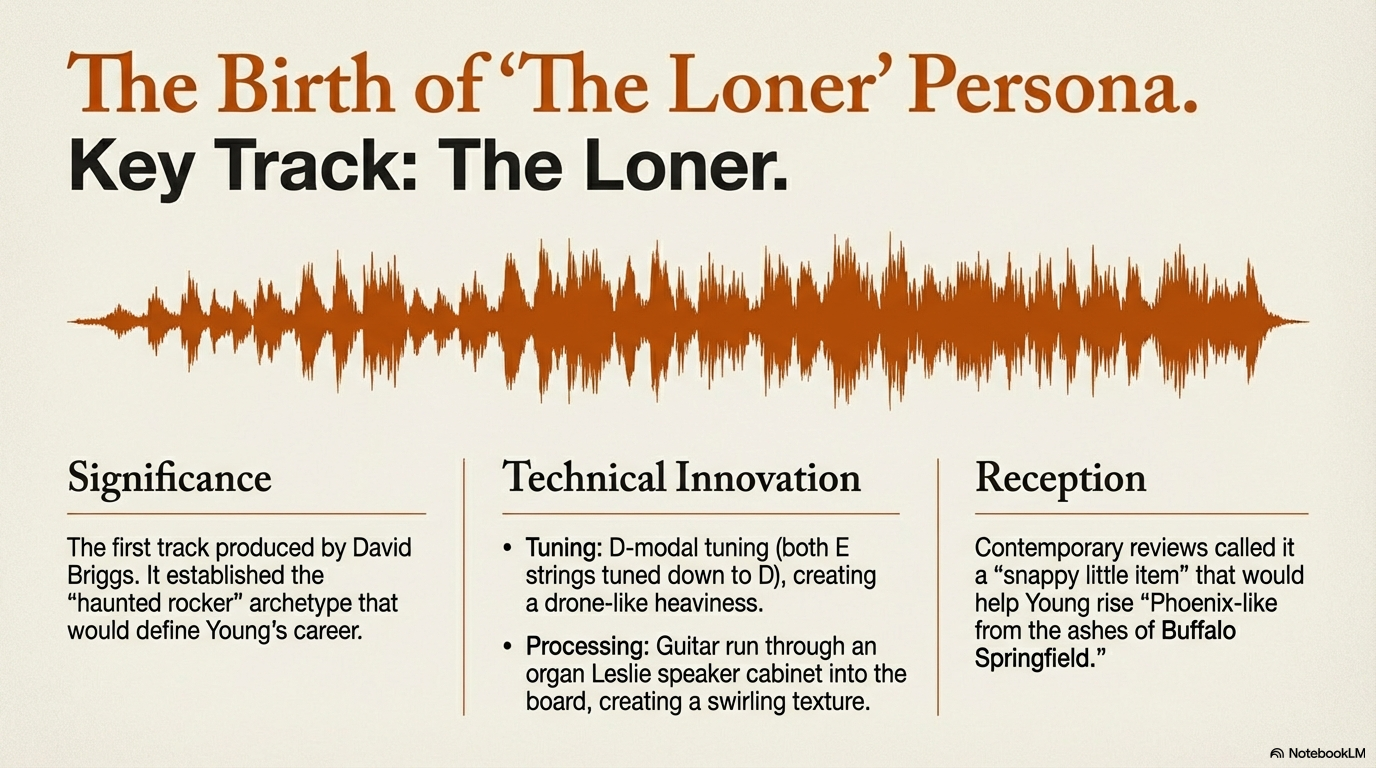
“The Loner” follows as the album’s polar opposite and greatest triumph.
This guitar-driven rock anthem became Young’s first solo single.
The track employs Double Drop D tuning, which Young learned from Stephen Stills during their Buffalo Springfield days.
In this tuning, both E strings are tuned down to D, creating D-A-D-G-B-D.
Producer David Briggs created the song’s “psycho guitar noises” by running Young’s guitar through a Leslie speaker.
This technique produced the signature fuzztoned rave-up sound that presaged his work on Everybody Knows This Is Nowhere.
The musicians were Neil Young on guitar, pipe organ, and vocals; Jim Messina on bass; and George Grantham on drums.
Recording took place at TTG Recording Studios on September 28, 1968.
Young acknowledged in a 1973 radio interview: “On my first album, I like ‘The Loner.'”
“I felt like I was getting into something different there, starting to.”
An early review described it as a “snappy little item should send Young rising Phoenix-like from the ashes of the Buffalo Springfield.”
This praise boosted Young’s confidence in his solo career tremendously.
“If I Could Have Her Tonight” showcases Young’s tender side with beautiful balladry.
The track takes cues from his Buffalo Springfield work but stands on its own merits.
It was one of the three songs completely remixed for the 1969 re-release.
“I’ve Been Waiting for You” features one of Young’s greatest arrangements on the entire album.
The instrumental centerpieces, particularly the fuzz guitar, make it a standout.
Despite being underrated, it ranks among the album’s most potent tracks.
Young himself singled it out in 1970 as “the only one that sounds like it got off.”
All the different-day overdubs somehow coalesced into something special on this one track.
“The Old Laughing Lady” is the album’s oldest song, written three years prior to recording.
Young wrote it while playing coffee houses in Michigan before joining Buffalo Springfield.
The famous story involves Young writing the lyrics on napkins in a Detroit coffee shop called Chess Mate.
He and his bandmates had to wait almost a day after someone drove off with part of their car.
The song uses the D-modal tuning that Young favored during this period.
Recording took place in Hollywood with Jack Nitzsche arranging the strings.
Ry Cooder also contributed to the session.
Rather than announcing his arrival with a statement piece, Young chose a breezy country instrumental.
The track features Young on guitar with Jim Messina on bass and George Grantham on drums.
String arrangements add sophistication to the country-rock foundation.
It was recorded at Wally Heider Recording Studios on August 23, 1968.
The song signals Young’s willingness to defy expectations from the very first track.
“The Loner” follows as the album’s polar opposite and greatest triumph.
This guitar-driven rock anthem became Young’s first solo single.
The track employs Double Drop D tuning, which Young learned from Stephen Stills during their Buffalo Springfield days.
In this tuning, both E strings are tuned down to D, creating D-A-D-G-B-D.
Producer David Briggs created the song’s “psycho guitar noises” by running Young’s guitar through a Leslie speaker.
This technique produced the signature fuzztoned rave-up sound that presaged his work on Everybody Knows This Is Nowhere.
The musicians were Neil Young on guitar, pipe organ, and vocals; Jim Messina on bass; and George Grantham on drums.
Recording took place at TTG Recording Studios on September 28, 1968.
Young acknowledged in a 1973 radio interview: “On my first album, I like ‘The Loner.'”
“I felt like I was getting into something different there, starting to.”
An early review described it as a “snappy little item should send Young rising Phoenix-like from the ashes of the Buffalo Springfield.”
This praise boosted Young’s confidence in his solo career tremendously.
“If I Could Have Her Tonight” showcases Young’s tender side with beautiful balladry.
The track takes cues from his Buffalo Springfield work but stands on its own merits.
It was one of the three songs completely remixed for the 1969 re-release.
“I’ve Been Waiting for You” features one of Young’s greatest arrangements on the entire album.
The instrumental centerpieces, particularly the fuzz guitar, make it a standout.
Despite being underrated, it ranks among the album’s most potent tracks.
Young himself singled it out in 1970 as “the only one that sounds like it got off.”
All the different-day overdubs somehow coalesced into something special on this one track.
“The Old Laughing Lady” is the album’s oldest song, written three years prior to recording.
Young wrote it while playing coffee houses in Michigan before joining Buffalo Springfield.
The famous story involves Young writing the lyrics on napkins in a Detroit coffee shop called Chess Mate.
He and his bandmates had to wait almost a day after someone drove off with part of their car.
The song uses the D-modal tuning that Young favored during this period.
Recording took place in Hollywood with Jack Nitzsche arranging the strings.
Ry Cooder also contributed to the session.
Side Two: Experimentation and Intimacy
“String Quartet from Whiskey Boot Hill” opens side two with another instrumental surprise.
Written by arranger Jack Nitzsche, the track provides an elegant, classical interlude.
An unknown string quartet recorded it at Sunset Sound on October 17, 1968.
Nitzsche, Ry Cooder, and Young shared production duties.
“Here We Are in the Years” delivers surprisingly sentimental country-pop.
The idealized view of country life brought comparisons to Paul McCartney’s early solo work.
Jazzy and baroque touches from session musicians elevate the arrangement.
The song received a complete remix for the 1969 re-release.
Some collectors believe the original CSG mix actually sounds better for this particular track.
“What Did You Do to My Life?” is a romantic pop song with fuzzy guitars.
It may have suffered from the CSG remix, sounding slightly shrill to some ears.
The track nonetheless showcases Young’s ability to write compelling love songs with edge.
“I’ve Loved Her So Long” represents Young’s closest approach to Motown soul.
Backing singers Merry Clayton and Brenda Holloway add soulful touches unlike anything else in Young’s discography.
Clayton would famously provide the searing vocals on the Rolling Stones’ “Gimme Shelter” the following year.
Holloway was a Motown veteran with hits of her own.
Their contributions give the album a unique stylistic breadth.
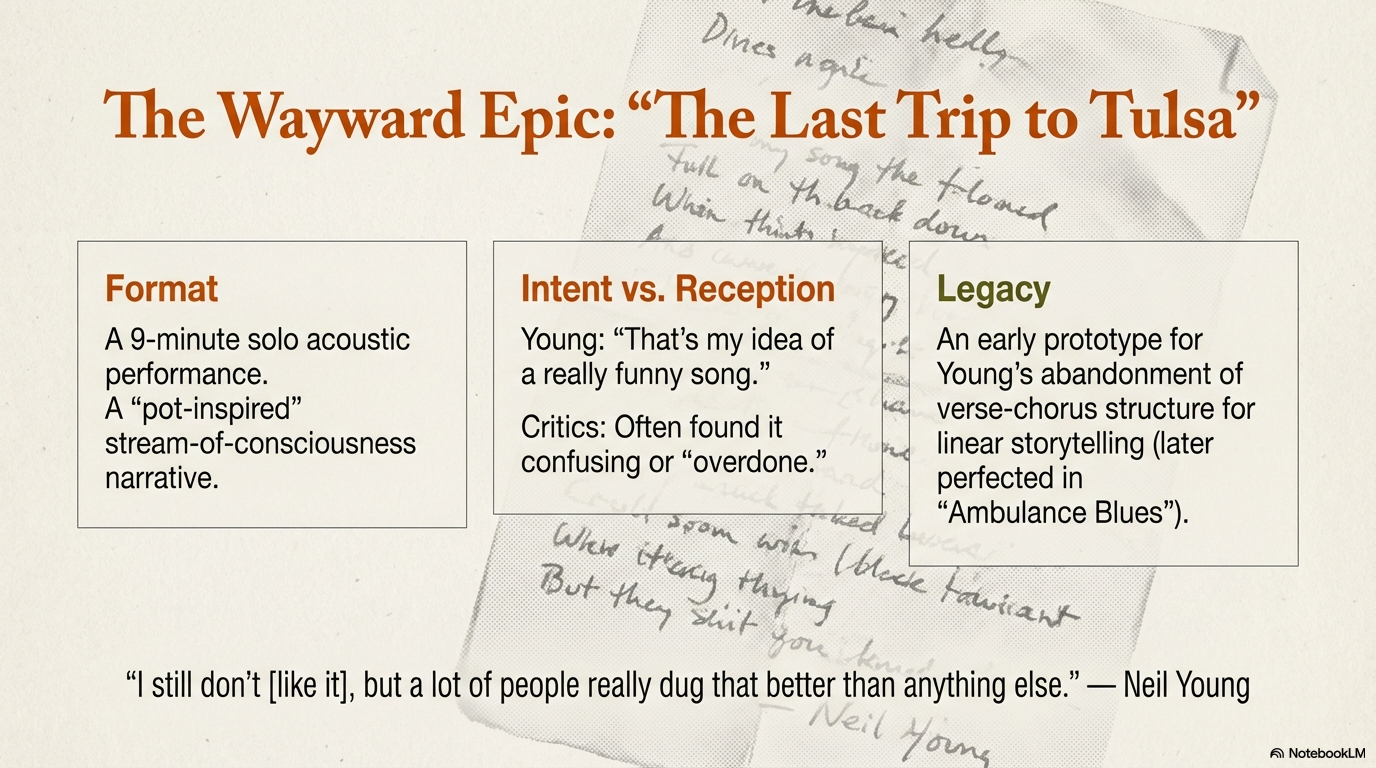
“The Last Trip to Tulsa” closes the album with a ten-minute stream-of-consciousness epic.
The rambling narrative rendered in dream imagery suggests Bob Dylan on a bad trip.
Young intended it to be humorous, a fact lost on many listeners.
To help him relax for the vocal take, Briggs famously provided Young with Olympia beer.
The track presages the dark acoustic epics Young would perfect on On the Beach years later.
Written by arranger Jack Nitzsche, the track provides an elegant, classical interlude.
An unknown string quartet recorded it at Sunset Sound on October 17, 1968.
Nitzsche, Ry Cooder, and Young shared production duties.
“Here We Are in the Years” delivers surprisingly sentimental country-pop.
The idealized view of country life brought comparisons to Paul McCartney’s early solo work.
Jazzy and baroque touches from session musicians elevate the arrangement.
The song received a complete remix for the 1969 re-release.
Some collectors believe the original CSG mix actually sounds better for this particular track.
“What Did You Do to My Life?” is a romantic pop song with fuzzy guitars.
It may have suffered from the CSG remix, sounding slightly shrill to some ears.
The track nonetheless showcases Young’s ability to write compelling love songs with edge.
“I’ve Loved Her So Long” represents Young’s closest approach to Motown soul.
Backing singers Merry Clayton and Brenda Holloway add soulful touches unlike anything else in Young’s discography.
Clayton would famously provide the searing vocals on the Rolling Stones’ “Gimme Shelter” the following year.
Holloway was a Motown veteran with hits of her own.
Their contributions give the album a unique stylistic breadth.
“The Last Trip to Tulsa” closes the album with a ten-minute stream-of-consciousness epic.
The rambling narrative rendered in dream imagery suggests Bob Dylan on a bad trip.
Young intended it to be humorous, a fact lost on many listeners.
To help him relax for the vocal take, Briggs famously provided Young with Olympia beer.
The track presages the dark acoustic epics Young would perfect on On the Beach years later.
Musicians and Personnel: Neil Young Neil Young Album Credits
Neil Young handled vocals, guitar, and pipe organ throughout the Neil Young Neil Young album.
However, the project featured an impressive array of Los Angeles session talent.
However, the project featured an impressive array of Los Angeles session talent.

Core Band Members
Jim Messina played bass on several tracks including “The Loner” and “The Emperor of Wyoming.”
Messina had been a member of Buffalo Springfield during its later days.
He would soon co-found Poco with Richie Furay, another Springfield alum.
George Grantham handled drums on multiple songs.
Like Messina, Grantham would join Poco shortly after these sessions.
Their work together on this album helped establish their musical chemistry.
Messina had been a member of Buffalo Springfield during its later days.
He would soon co-found Poco with Richie Furay, another Springfield alum.
George Grantham handled drums on multiple songs.
Like Messina, Grantham would join Poco shortly after these sessions.
Their work together on this album helped establish their musical chemistry.
Session Legends and Special Contributors
Jack Nitzsche served as arranger and producer on several tracks.
Nitzsche brought sophisticated string arrangements to songs like “The Old Laughing Lady.”
He also composed “String Quartet from Whiskey Boot Hill.”
His contributions added texture and depth beyond typical rock arrangements.
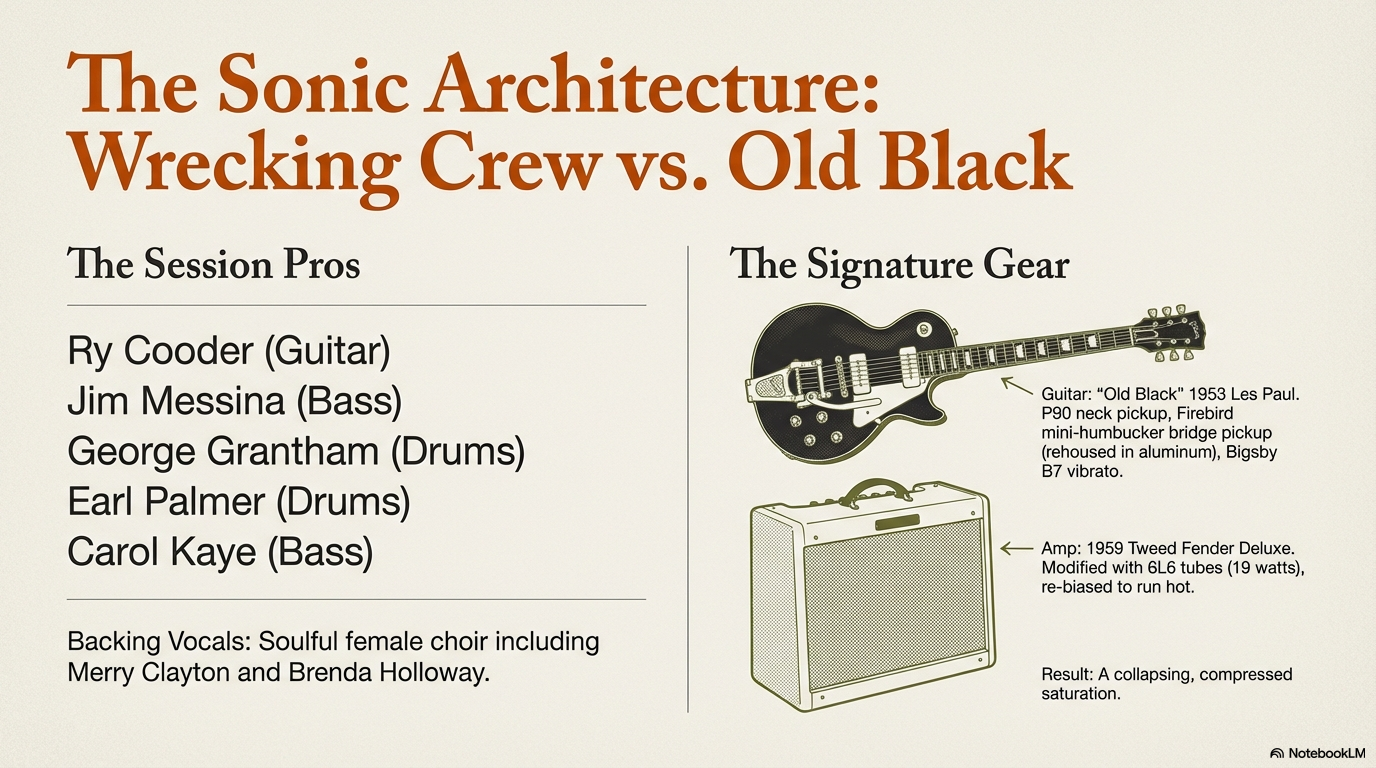
Ry Cooder, the legendary slide guitarist and blues revivalist, contributed to multiple sessions.
Cooder had previously worked with Taj Mahal and Captain Beefheart.
Despite his presence, the album features minimal blues elements.
Cooder’s guitar work doesn’t stand out prominently in the final mixes.
Merry Clayton and Brenda Holloway provided backing vocals on “I’ve Loved Her So Long.”
Clayton’s powerful voice would soon grace the Rolling Stones’ “Gimme Shelter.”
Holloway brought Motown credentials, having scored hits like “Every Little Bit Hurts.”
Their soulful contributions give the album a unique stylistic breadth.
Seasoned Wrecking Crew veterans Carol Kaye and Hal Blaine may have contributed to some sessions.
The Wrecking Crew was the elite group of LA session musicians behind countless hits.
Their potential involvement underscores the professional caliber of the production.
David Blumberg arranged strings for “The Loner.”
Young met Blumberg through producer David Briggs.
The organ on “I’ve Been Waiting for You” was recorded at a church in Glendale, California.
Young would return to this same church to record organ parts for “Country Girl” on Déjà Vu.
Nitzsche brought sophisticated string arrangements to songs like “The Old Laughing Lady.”
He also composed “String Quartet from Whiskey Boot Hill.”
His contributions added texture and depth beyond typical rock arrangements.
Ry Cooder, the legendary slide guitarist and blues revivalist, contributed to multiple sessions.
Cooder had previously worked with Taj Mahal and Captain Beefheart.
Despite his presence, the album features minimal blues elements.
Cooder’s guitar work doesn’t stand out prominently in the final mixes.
Merry Clayton and Brenda Holloway provided backing vocals on “I’ve Loved Her So Long.”
Clayton’s powerful voice would soon grace the Rolling Stones’ “Gimme Shelter.”
Holloway brought Motown credentials, having scored hits like “Every Little Bit Hurts.”
Their soulful contributions give the album a unique stylistic breadth.
Seasoned Wrecking Crew veterans Carol Kaye and Hal Blaine may have contributed to some sessions.
The Wrecking Crew was the elite group of LA session musicians behind countless hits.
Their potential involvement underscores the professional caliber of the production.
David Blumberg arranged strings for “The Loner.”
Young met Blumberg through producer David Briggs.
The organ on “I’ve Been Waiting for You” was recorded at a church in Glendale, California.
Young would return to this same church to record organ parts for “Country Girl” on Déjà Vu.
Guitar Innovations and the Birth of Neil’s Signature Sound
The album marks critical developments in Neil Young’s guitar style and sonic identity.
His use of alternate tunings and unconventional amplification techniques established patterns for his entire career.
His use of alternate tunings and unconventional amplification techniques established patterns for his entire career.
D-Modal Tuning and Double Drop D
D-modal tuning, which Young calls Double Drop D, appears prominently on “The Loner” and “The Old Laughing Lady.”
The tuning involves dropping both E strings down to D, creating D-A-D-G-B-D.
Young learned this tuning from Stephen Stills, who used it on Buffalo Springfield’s “Bluebird.”
In live performances, Young explained the tuning process to audiences.
“You tune the E strings on each end down to D,” he would say.
“Leave the other ones where they are and play as if nothing ever happened.”
“And you get D-modal. Everything sounds different because it’s tuned different.”
The tuning creates drone effects and opens up unique chord voicings.
It became a cornerstone of Young’s sound on classics like “Cinnamon Girl,” “Down by the River,” and “Cortez the Killer.”
In later years, Young sometimes dropped the entire tuning down a whole step to accommodate his aging voice.
This created Double Drop C tuning for songs like “Don’t Let It Bring You Down.”
The tuning involves dropping both E strings down to D, creating D-A-D-G-B-D.
Young learned this tuning from Stephen Stills, who used it on Buffalo Springfield’s “Bluebird.”
In live performances, Young explained the tuning process to audiences.
“You tune the E strings on each end down to D,” he would say.
“Leave the other ones where they are and play as if nothing ever happened.”
“And you get D-modal. Everything sounds different because it’s tuned different.”
The tuning creates drone effects and opens up unique chord voicings.
It became a cornerstone of Young’s sound on classics like “Cinnamon Girl,” “Down by the River,” and “Cortez the Killer.”
In later years, Young sometimes dropped the entire tuning down a whole step to accommodate his aging voice.
This created Double Drop C tuning for songs like “Don’t Let It Bring You Down.”
The Leslie Speaker Trick
The guitar sound on “The Loner” came from an inspired production choice.
Instead of using a traditional guitar amplifier, Briggs ran Young’s guitar through a Leslie speaker.
Leslie speakers were designed for Hammond organs, featuring rotating horns that create a distinctive swirling effect.
The result was a fuzztoned rave-up sound unlike anything in rock at the time.
This “psycho guitar noise” presaged the raw, distorted tones Young would perfect with Crazy Horse.
The technique demonstrated Young and Briggs’ willingness to experiment with unconventional approaches.
Instead of using a traditional guitar amplifier, Briggs ran Young’s guitar through a Leslie speaker.
Leslie speakers were designed for Hammond organs, featuring rotating horns that create a distinctive swirling effect.
The result was a fuzztoned rave-up sound unlike anything in rock at the time.
This “psycho guitar noise” presaged the raw, distorted tones Young would perfect with Crazy Horse.
The technique demonstrated Young and Briggs’ willingness to experiment with unconventional approaches.
Early Use of Old Black
Young’s legendary 1953 Gibson Les Paul “Old Black” likely made its first recorded appearance on this album.
The guitar features a mini-humbucker from a 1972 Firebird and a Bigsby vibrato.
Young had originally purchased it as a Gold Top but painted it black.
The guitar’s toggle switch allows the signal to bypass the pots for a direct, raw tone.
Old Black would become inseparable from Young’s electric sound.
Combined with his 1959 Tweed Fender Deluxe amplifier pushed to extreme volumes, it created his signature distorted tone.
The Fender Deluxe was only a 15-watt amp, but Young cranked it to ungodly volumes.
This caused the amp to collapse and saturate, producing a unique compressed distortion.
These sonic innovations on his debut album laid the groundwork for decades of instantly recognizable guitar work.
The guitar features a mini-humbucker from a 1972 Firebird and a Bigsby vibrato.
Young had originally purchased it as a Gold Top but painted it black.
The guitar’s toggle switch allows the signal to bypass the pots for a direct, raw tone.
Old Black would become inseparable from Young’s electric sound.
Combined with his 1959 Tweed Fender Deluxe amplifier pushed to extreme volumes, it created his signature distorted tone.
The Fender Deluxe was only a 15-watt amp, but Young cranked it to ungodly volumes.
This caused the amp to collapse and saturate, producing a unique compressed distortion.
These sonic innovations on his debut album laid the groundwork for decades of instantly recognizable guitar work.
Singles, Chart Performance, and Critical Reception
“The Loner” was released as the album’s only single in February 1969.
The B-side was “Sugar Mountain,” recorded live at the Canterbury House in Ann Arbor, Michigan.
Remarkably, “Sugar Mountain” never appeared on the original album despite becoming a fan favorite.
It would later surface on the 1977 compilation Decade and the 2008 Archives release Sugar Mountain – Live at Canterbury House 1968.
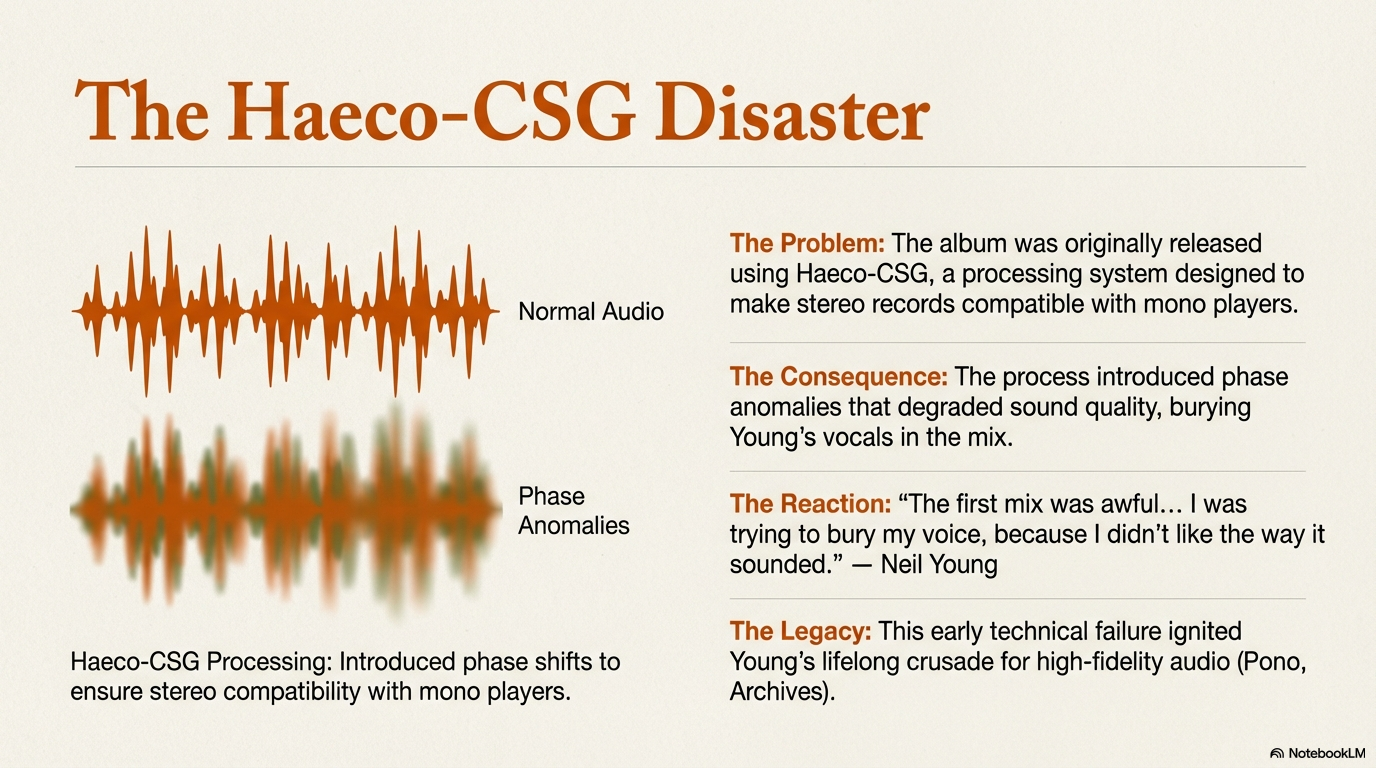
“The Loner” completely missed the Billboard Hot 100 chart.
The album itself never charted on the Billboard 200 either during its initial release or re-release.
This commercial failure disappointed Reprise Records and concerned Young’s management.
However, over time, “The Loner” became a staple of Young’s live performances and classic rock radio.
Its cultural impact far exceeded its initial chart performance.
The B-side was “Sugar Mountain,” recorded live at the Canterbury House in Ann Arbor, Michigan.
Remarkably, “Sugar Mountain” never appeared on the original album despite becoming a fan favorite.
It would later surface on the 1977 compilation Decade and the 2008 Archives release Sugar Mountain – Live at Canterbury House 1968.
“The Loner” completely missed the Billboard Hot 100 chart.
The album itself never charted on the Billboard 200 either during its initial release or re-release.
This commercial failure disappointed Reprise Records and concerned Young’s management.
However, over time, “The Loner” became a staple of Young’s live performances and classic rock radio.
Its cultural impact far exceeded its initial chart performance.
Contemporary Critical Response
Rolling Stone offered mixed but generally positive reviews.
They praised “The Loner” specifically: “‘The Loner’ is a contemporary lament that features a nice blending of Neil’s guitar with strings in non-obtrusive fashion.”
The review continued: “allowing Young’s balanced ice-pick vocal to chip effectively at the listener.”
Cash Box found “tremendous power in the instrumentals and [Young’s] vocal.”
Overall, critics recognized Young’s talent but found the album uneven.
Many felt it was an interesting introduction rather than a fully realized statement.
The overdubbed production seemed to mute the raw energy present in Buffalo Springfield’s best moments.
They praised “The Loner” specifically: “‘The Loner’ is a contemporary lament that features a nice blending of Neil’s guitar with strings in non-obtrusive fashion.”
The review continued: “allowing Young’s balanced ice-pick vocal to chip effectively at the listener.”
Cash Box found “tremendous power in the instrumentals and [Young’s] vocal.”
Overall, critics recognized Young’s talent but found the album uneven.
Many felt it was an interesting introduction rather than a fully realized statement.
The overdubbed production seemed to mute the raw energy present in Buffalo Springfield’s best moments.
Retrospective Assessments
AllMusic’s retrospective review described it as “an uneven, low-key introduction to Young’s solo career.”
However, they acknowledged its importance in establishing Young’s artistic direction.
Progrography’s review noted it was “more or less an extension of his work with Buffalo Springfield.”
They compared it favorably to Joni Mitchell’s debut, noting both featured similar painted portraits.
The review concluded that while good, Young “really found his voice on the albums that followed.”
Modern critics recognize the album as essential for understanding Young’s evolution.
The experimentation with styles pointed toward his future willingness to pursue any musical direction.
The album’s commercial failure freed Young from expectations, allowing him to follow his muse without compromise.
Today, the album has amassed over 12.8 million streams on Spotify.
Young’s Greatest Hits compilation has surpassed 1.6 billion Spotify streams.
This long-tail success demonstrates how the debut’s influence grew steadily over five decades.
However, they acknowledged its importance in establishing Young’s artistic direction.
Progrography’s review noted it was “more or less an extension of his work with Buffalo Springfield.”
They compared it favorably to Joni Mitchell’s debut, noting both featured similar painted portraits.
The review concluded that while good, Young “really found his voice on the albums that followed.”
Modern critics recognize the album as essential for understanding Young’s evolution.
The experimentation with styles pointed toward his future willingness to pursue any musical direction.
The album’s commercial failure freed Young from expectations, allowing him to follow his muse without compromise.
Today, the album has amassed over 12.8 million streams on Spotify.
Young’s Greatest Hits compilation has surpassed 1.6 billion Spotify streams.
This long-tail success demonstrates how the debut’s influence grew steadily over five decades.
Album Artwork: The “No Name” Cover Mystery
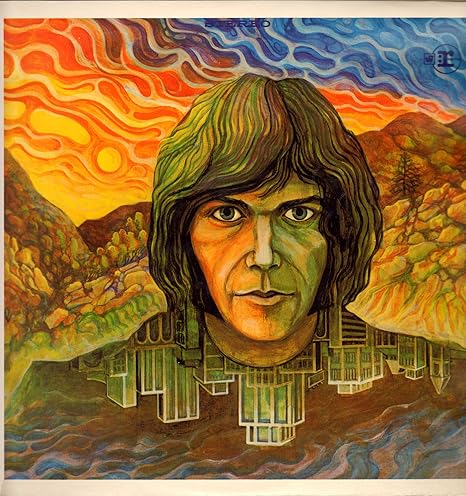
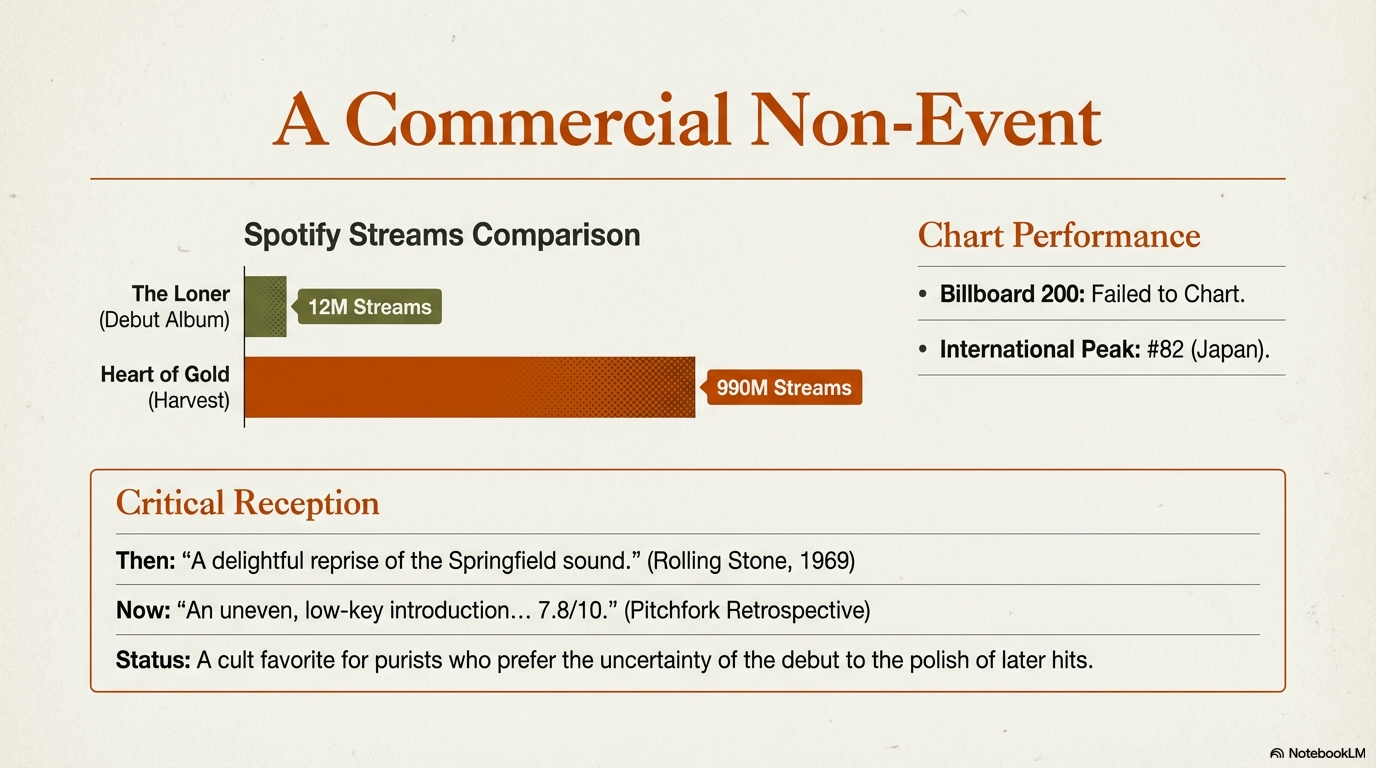
The original album cover featured only a painted portrait of Young against a plain background.
No text appeared anywhere on the front cover, earning it the nickname “the no name cover.”
This minimalist approach was unusual for 1968 when most albums prominently displayed artist and album names.
The painting itself captured Young with long hair and a contemplative expression.
The artistic choice reflected Young’s desire to let the music speak for itself.
No text appeared anywhere on the front cover, earning it the nickname “the no name cover.”
This minimalist approach was unusual for 1968 when most albums prominently displayed artist and album names.
The painting itself captured Young with long hair and a contemplative expression.
The artistic choice reflected Young’s desire to let the music speak for itself.
The Cover Modification
When the album was remixed and re-released in 1969, the cover was modified.
The words “Neil Young” were added in white text across the top of the painting.
This helped buyers distinguish the improved sonic version from the problematic CSG mix.
However, the original jackets outlasted the first pressing.
Many copies of the remixed album ended up in the original “no name” sleeve.
This created lasting confusion for collectors trying to identify which version they owned.
The only reliable way to determine the mix is through careful listening or checking the matrix numbers in the deadwax.
The no-name original covers are now sought-after collector’s items themselves.
The words “Neil Young” were added in white text across the top of the painting.
This helped buyers distinguish the improved sonic version from the problematic CSG mix.
However, the original jackets outlasted the first pressing.
Many copies of the remixed album ended up in the original “no name” sleeve.
This created lasting confusion for collectors trying to identify which version they owned.
The only reliable way to determine the mix is through careful listening or checking the matrix numbers in the deadwax.
The no-name original covers are now sought-after collector’s items themselves.
Live Promotion and Coffeehouse Tours
Young promoted the album through intimate solo acoustic performances rather than electric band shows.
Elliot Roberts organized a tour of coffeehouses and folk venues across North America.
These appearances showcased Young’s songwriting and musicianship in their purest form.
Elliot Roberts organized a tour of coffeehouses and folk venues across North America.
These appearances showcased Young’s songwriting and musicianship in their purest form.
Key Performance Venues
In late October 1968, Young appeared nightly for a full week at The Bitter End in Greenwich Village.
He served as the opening act for Joni Mitchell, his manager’s other major client.
These shows introduced Young to the New York folk scene and music critics.
In November 1968, Young played three dates at the Canterbury House in Ann Arbor, Michigan.
The performances on November 9-10 were recorded and later released as Sugar Mountain – Live at Canterbury House 1968.
This archive release captures Young at his most vulnerable and intimate.
The recording of “Sugar Mountain” from these shows became the B-side to “The Loner” single.
In late January and early February 1969, Young performed a week of shows at Le Hibou Coffee House in Ottawa.
This was followed by another week at the Riverboat Coffee House in Toronto.
These Canadian shows reconnected Young with his roots.
He would later memorialize this period in the lyrics of “Ambulance Blues” on On the Beach.
Compilations from the Riverboat performances were released as Live at the Riverboat 1969 in 2009.
He served as the opening act for Joni Mitchell, his manager’s other major client.
These shows introduced Young to the New York folk scene and music critics.
In November 1968, Young played three dates at the Canterbury House in Ann Arbor, Michigan.
The performances on November 9-10 were recorded and later released as Sugar Mountain – Live at Canterbury House 1968.
This archive release captures Young at his most vulnerable and intimate.
The recording of “Sugar Mountain” from these shows became the B-side to “The Loner” single.
In late January and early February 1969, Young performed a week of shows at Le Hibou Coffee House in Ottawa.
This was followed by another week at the Riverboat Coffee House in Toronto.
These Canadian shows reconnected Young with his roots.
He would later memorialize this period in the lyrics of “Ambulance Blues” on On the Beach.
Compilations from the Riverboat performances were released as Live at the Riverboat 1969 in 2009.
The Transition to Crazy Horse
In February 1969, Young began touring with Crazy Horse.
This marked a dramatic shift from solo acoustic performances to full-band electric rock.
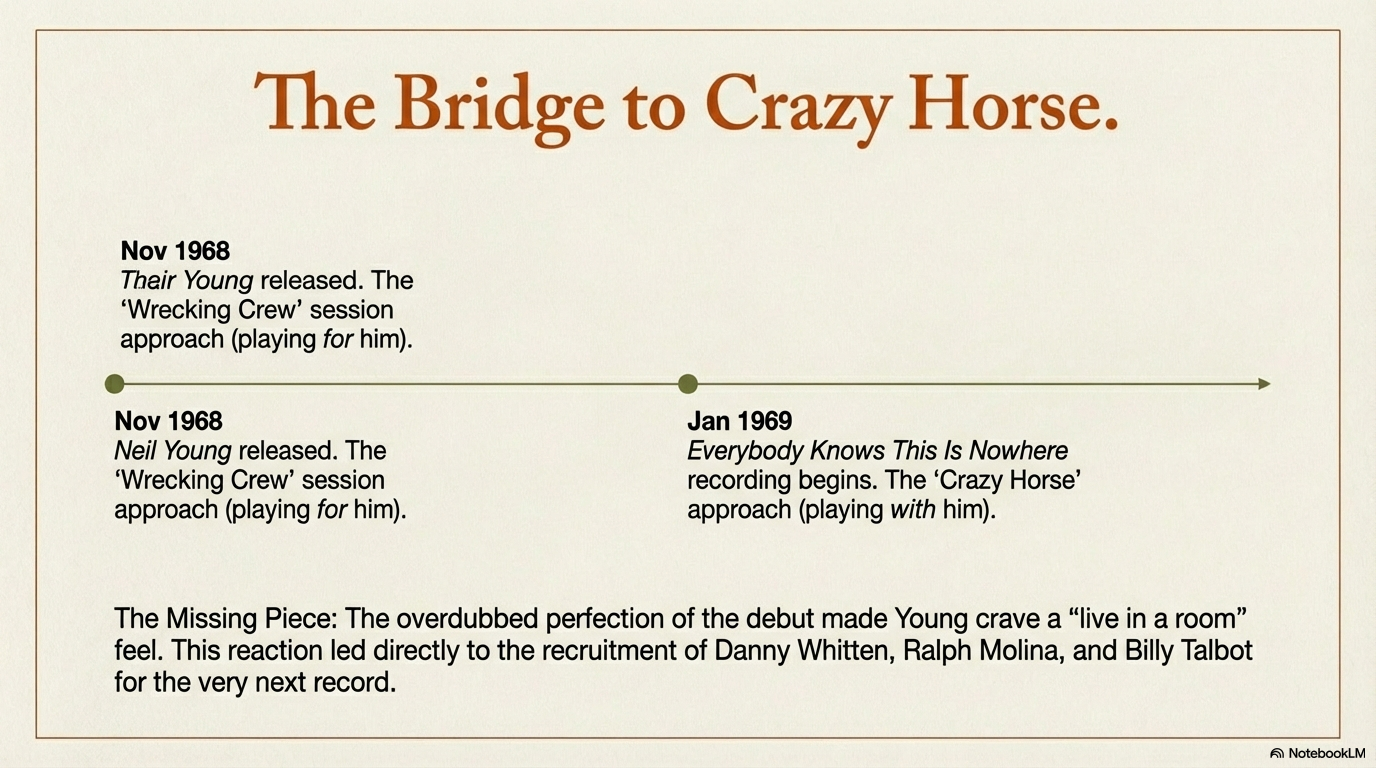
Young had already begun recording Everybody Knows This Is Nowhere with Crazy Horse in January 1969.
The new direction would bring immediate commercial success that eluded his debut.
The experience of playing live with a band reaffirmed Young’s preference for spontaneous group performance over studio overdubbing.
This lesson learned from the debut album’s production would shape his approach for decades to come.
This marked a dramatic shift from solo acoustic performances to full-band electric rock.
Young had already begun recording Everybody Knows This Is Nowhere with Crazy Horse in January 1969.
The new direction would bring immediate commercial success that eluded his debut.
The experience of playing live with a band reaffirmed Young’s preference for spontaneous group performance over studio overdubbing.
This lesson learned from the debut album’s production would shape his approach for decades to come.
Legacy and Influence: Neil Young Neil Young Album in Perspective
The Neil Young Neil Young album’s legacy extends far beyond its commercial performance.
It established Young as a solo artist willing to follow his own path regardless of trends or expectations.
It established Young as a solo artist willing to follow his own path regardless of trends or expectations.
The Template for a Wayward Career
Scholars describe Young’s career as fundamentally “wayward,” following his own path contrary to established norms.
The debut album perfectly exemplifies this approach.
Opening with a country instrumental when listeners expected a rock statement showed fearless unpredictability.
The album’s stylistic diversity from country to rock to soul to experimental epics presaged Young’s genre-hopping throughout his career.
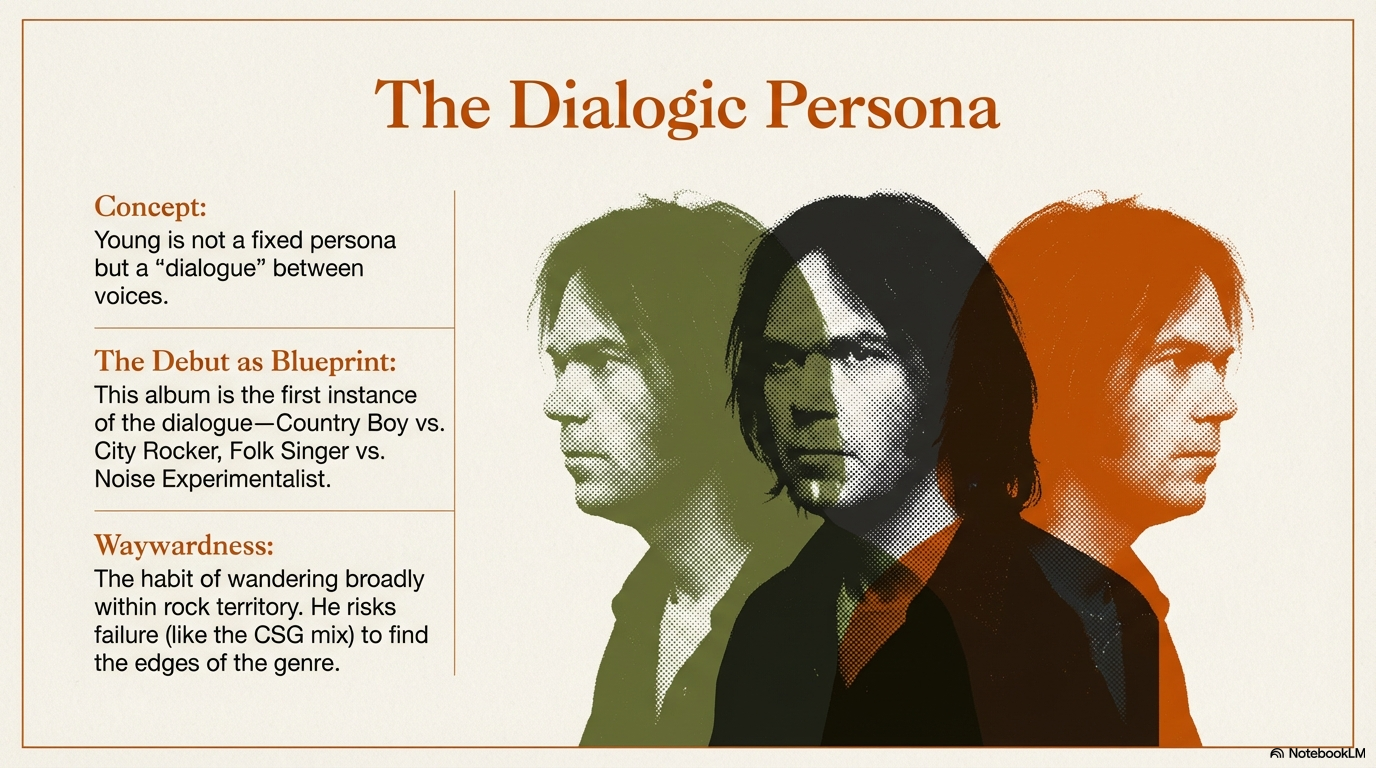
Academic analysis suggests Young operates in “intermusical dialogues” between rock’s core and experimental departures.
The debut demonstrates this dynamic tension between centripetal forces pulling toward rock’s center and centrifugal forces pushing toward the margins.
This pattern would repeat across albums like Trans, Everybody’s Rockin’, and Landing on Water.
Each time, Young would return to his rock foundation on subsequent releases.
The debut taught him he could experiment freely without losing his essential identity.
The debut album perfectly exemplifies this approach.
Opening with a country instrumental when listeners expected a rock statement showed fearless unpredictability.
The album’s stylistic diversity from country to rock to soul to experimental epics presaged Young’s genre-hopping throughout his career.
Academic analysis suggests Young operates in “intermusical dialogues” between rock’s core and experimental departures.
The debut demonstrates this dynamic tension between centripetal forces pulling toward rock’s center and centrifugal forces pushing toward the margins.
This pattern would repeat across albums like Trans, Everybody’s Rockin’, and Landing on Water.
Each time, Young would return to his rock foundation on subsequent releases.
The debut taught him he could experiment freely without losing his essential identity.
Influence on Other Artists
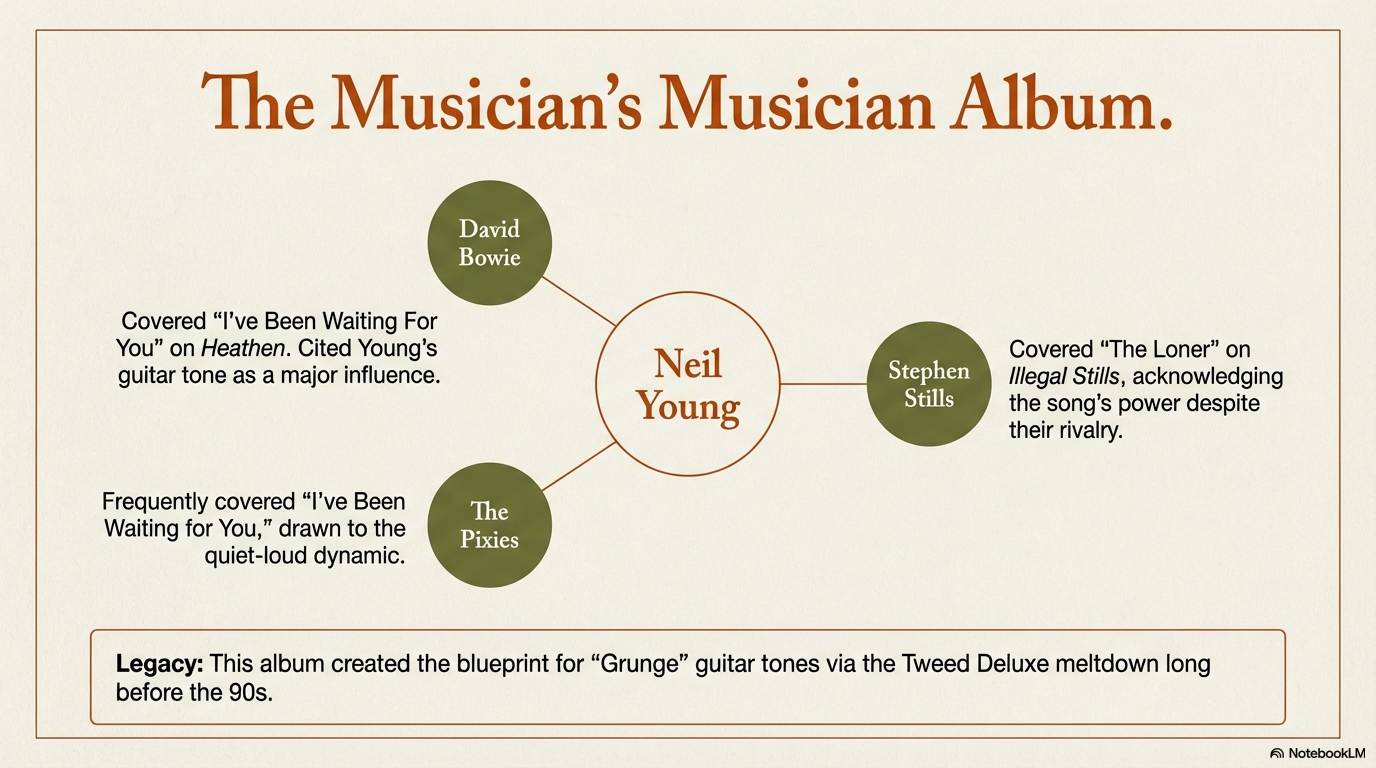
Stephen Stills covered “The Loner” on his 1976 album Illegal Stills.
Ironically, many assumed Young wrote the song about Stills, though Young never confirmed this.
Stills’ version became one of his album’s strongest tracks.
Countless artists have cited Young’s debut as influential for its raw honesty and refusal to polish every edge.
The lo-fi aesthetic Young embraced after rejecting overdubbing influenced alternative rock and indie movements decades later.
Bands like Sonic Youth, Dinosaur Jr., and Pavement drew inspiration from Young’s embrace of imperfection.
His willingness to leave rough edges and prioritize emotion over technical perfection became a template.
Ironically, many assumed Young wrote the song about Stills, though Young never confirmed this.
Stills’ version became one of his album’s strongest tracks.
Countless artists have cited Young’s debut as influential for its raw honesty and refusal to polish every edge.
The lo-fi aesthetic Young embraced after rejecting overdubbing influenced alternative rock and indie movements decades later.
Bands like Sonic Youth, Dinosaur Jr., and Pavement drew inspiration from Young’s embrace of imperfection.
His willingness to leave rough edges and prioritize emotion over technical perfection became a template.
The Archives and High-Resolution Preservation
Young remastered the album for HDCD-encoded compact disc release on July 14, 2009.
This was part of the Neil Young Archives Original Release Series.
Audiophile vinyl was released in December 2009, both individually and as part of a limited box set.
The box set containing Young’s first four LPs was limited to 1000 copies.
The remaster was also released as Disc 1 of a 4-CD box set in the US in 2009 and Europe in 2012.
High-resolution digital files in 24-bit/96kHz FLAC format are available through the Neil Young Archives website.
Young’s obsession with audio quality means both the CSG and non-CSG mixes are preserved for comparison.
This allows fans and scholars to study the Haeco-CSG controversy firsthand.
The availability in multiple formats ensures the album remains accessible to new generations.
This was part of the Neil Young Archives Original Release Series.
Audiophile vinyl was released in December 2009, both individually and as part of a limited box set.
The box set containing Young’s first four LPs was limited to 1000 copies.
The remaster was also released as Disc 1 of a 4-CD box set in the US in 2009 and Europe in 2012.
High-resolution digital files in 24-bit/96kHz FLAC format are available through the Neil Young Archives website.
Young’s obsession with audio quality means both the CSG and non-CSG mixes are preserved for comparison.
This allows fans and scholars to study the Haeco-CSG controversy firsthand.
The availability in multiple formats ensures the album remains accessible to new generations.
Place in Young’s Discography
Most critics rank the debut album in the middle tier of Young’s vast catalog.
It lacks the immediate impact of Harvest or After the Gold Rush.
It doesn’t match the raw power of Rust Never Sleeps or the dark intensity of Tonight’s the Night.
However, it remains essential listening for understanding Young’s artistic evolution.
The album shows Young testing different approaches and discovering what resonated.
The lessons learned particularly regarding live performance versus overdubbing shaped his greatest works.
For completists and serious fans, it’s indispensable.
The album captures Young at a pivotal moment between Buffalo Springfield and Crazy Horse.
It documents an artist finding his voice and establishing independence.
Those qualities make it historically significant even if not his strongest artistic statement.
It lacks the immediate impact of Harvest or After the Gold Rush.
It doesn’t match the raw power of Rust Never Sleeps or the dark intensity of Tonight’s the Night.
However, it remains essential listening for understanding Young’s artistic evolution.
The album shows Young testing different approaches and discovering what resonated.
The lessons learned particularly regarding live performance versus overdubbing shaped his greatest works.
For completists and serious fans, it’s indispensable.
The album captures Young at a pivotal moment between Buffalo Springfield and Crazy Horse.
It documents an artist finding his voice and establishing independence.
Those qualities make it historically significant even if not his strongest artistic statement.
Final Thoughts on This Essential Debut
The Neil Young Neil Young album stands as a fascinating snapshot of an artist in transition.
Released on his 23rd birthday, it captured Young stepping out from Buffalo Springfield’s shadow into uncharted territory.
The Haeco-CSG controversy nearly destroyed the album but instead taught Young invaluable lessons about artistic control.
His dissatisfaction with overdubbing led him to embrace live performance, shaping his greatest albums to come.
The stylistic diversity from country instrumentals to rock anthems to experimental epics established Young’s unpredictable creative pattern.
Over five decades, he would continue defying expectations and following his muse regardless of commercial considerations.
Released on his 23rd birthday, it captured Young stepping out from Buffalo Springfield’s shadow into uncharted territory.
The Haeco-CSG controversy nearly destroyed the album but instead taught Young invaluable lessons about artistic control.
His dissatisfaction with overdubbing led him to embrace live performance, shaping his greatest albums to come.
The stylistic diversity from country instrumentals to rock anthems to experimental epics established Young’s unpredictable creative pattern.
Over five decades, he would continue defying expectations and following his muse regardless of commercial considerations.
While it never charted during its initial release, the album has achieved cult status.
Modern streaming numbers over 12 million plays demonstrate its enduring appeal.
Songs like “The Loner” and “I’ve Been Waiting for You” remain concert staples.
The album’s influence extends beyond its immediate musical content.
It established Young’s independent artistic vision and willingness to learn from mistakes.
For fans exploring Young’s catalog, this debut provides crucial context for understanding his evolution.
It shows where he started, what he rejected, and what he embraced moving forward.
The remastered versions available today finally present the album as Young intended.
Free from Haeco-CSG encoding, listeners can hear the arrangements and performances clearly.
Whether you’re a longtime fan revisiting this early work or a newcomer exploring classic rock artists, the album rewards careful listening.
Its historical significance and musical merit make it essential, even if Young himself considers it flawed.
The Neil Young Neil Young album launched one of rock’s most remarkable careers and remains an important touchstone in the genre’s history.
Modern streaming numbers over 12 million plays demonstrate its enduring appeal.
Songs like “The Loner” and “I’ve Been Waiting for You” remain concert staples.
The album’s influence extends beyond its immediate musical content.
It established Young’s independent artistic vision and willingness to learn from mistakes.
For fans exploring Young’s catalog, this debut provides crucial context for understanding his evolution.
It shows where he started, what he rejected, and what he embraced moving forward.
The remastered versions available today finally present the album as Young intended.
Free from Haeco-CSG encoding, listeners can hear the arrangements and performances clearly.
Whether you’re a longtime fan revisiting this early work or a newcomer exploring classic rock artists, the album rewards careful listening.
Its historical significance and musical merit make it essential, even if Young himself considers it flawed.
The Neil Young Neil Young album launched one of rock’s most remarkable careers and remains an important touchstone in the genre’s history.