

Buffalo Springfield For What Its Worth: The Story Behind Stephen Stills’ Protest Anthem
Buffalo Springfield For What Its Worth became one of the most powerful protest anthems ever recorded, reaching No. 7 on the Billboard Hot 100 in 1967.
Stephen Stills wrote this iconic track in just 15 minutes after witnessing the Sunset Strip curfew riots, where nearly 1,000 young demonstrators clashed with Los Angeles police over their right to gather.
You’re about to discover the real story behind this misunderstood masterpiece, the revolutionary recording techniques that created its haunting sound, and why this song continues to inspire social movements nearly six decades later.
Released in December 1966, the song emerged from a turbulent moment when Los Angeles authorities imposed 10 p.m. curfews and threatened to demolish the legendary Pandora’s Box nightclub on the Sunset Strip.
This deep dive reveals the untold details about Neil Young’s signature guitar harmonics, the accidental title that never appears in the lyrics, and the fascinating journey from regional hit to the Grammy Hall of Fame.
Buffalo Springfield For What Its Worth stands as the band’s only Top 10 hit and the defining moment of their brief but explosive two-year career.
🎸 Experience Buffalo Springfield For What Its Worth in Audiophile Quality
Limited remastered pressings of the debut album selling fast.
Hear Stephen Stills’ protest anthem exactly as recorded at Columbia Studios in 1966.
Don’t miss your chance to own this sonic masterpiece of folk-rock history.

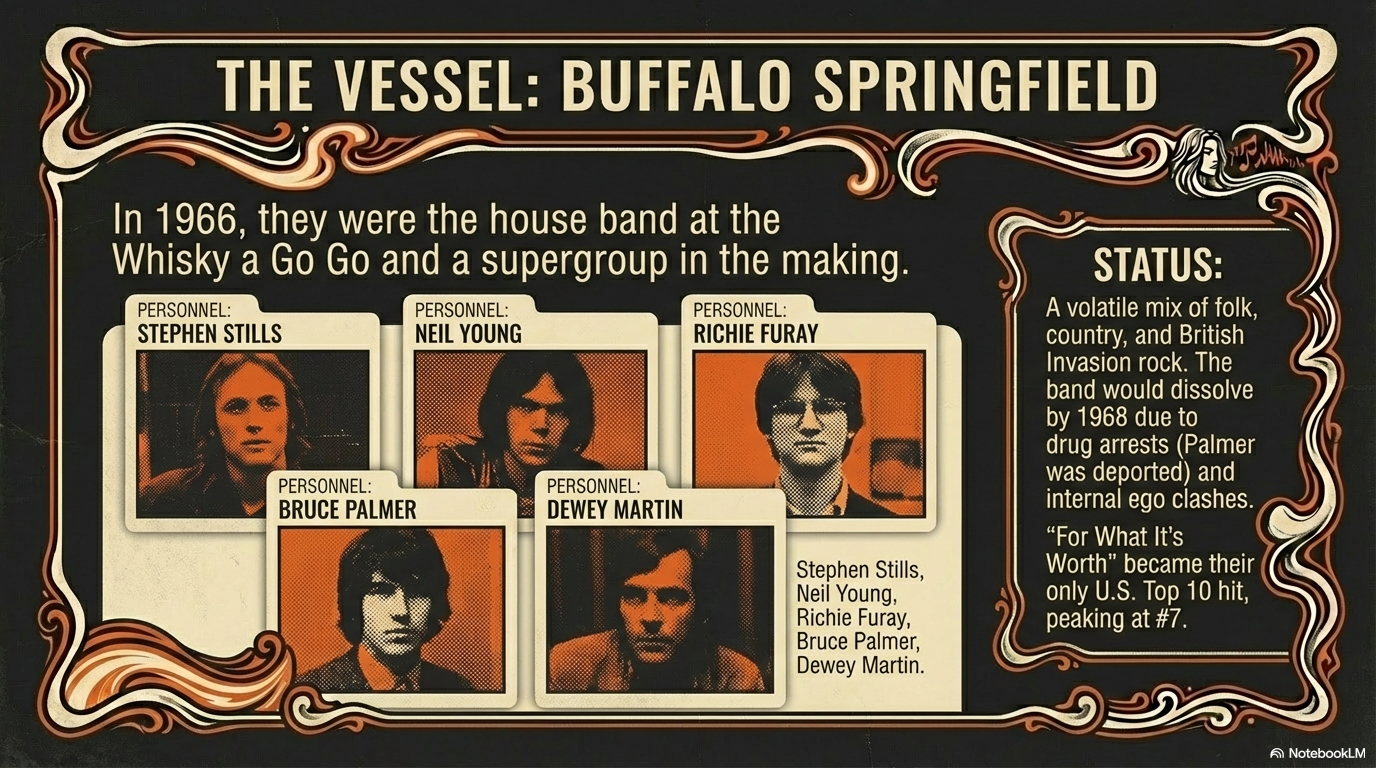
The original Buffalo Springfield lineup in 1966: Stephen Stills, Neil Young, Richie Furay, Bruce Palmer, and Dewey Martin
🎵 “For What It’s Worth” Quick Facts
- Artist: Buffalo Springfield
- Album: Buffalo Springfield (1966)
- Released: December 1966
- Written By: Stephen Stills
- Produced By: Charles Greene and Brian Stone
- Recorded: December 5, 1966
- Studio: Columbia Studios, Hollywood
- Length: 2:37
- Genre: Folk Rock, Psychedelic Rock
- Chart Peak: #7 Billboard Hot 100
- Year-End Rank: #27 of 1967
- Notable For: Neil Young’s guitar harmonics, protest anthem status
📋 Table of Contents [+]
What Is Buffalo Springfield For What Its Worth About?
Buffalo Springfield For What Its Worth tells the story of a confrontation between Los Angeles police and young people on the Sunset Strip in November 1966, not the Vietnam War as commonly believed.
The song captures a specific moment when nearly 1,000 demonstrators gathered to protest strict 10 p.m. curfew laws that authorities imposed to curb traffic congestion caused by music fans flocking to legendary clubs like the Whisky a Go Go.
Stephen Stills witnessed these events firsthand and transformed what he called a “cop dance” into one of rock music’s most enduring protest anthems.
The urgency and tension in the lyrics reflect the clash between authority and the counterculture movement that was sweeping through Los Angeles in the mid-1960s.
The Sunset Strip Curfew Riots of 1966
On November 12, 1966, the tension that had been building on the Sunset Strip finally erupted into open confrontation.
Local businesses and residents had successfully lobbied for strict curfew enforcement, arguing that young “flower children” were creating traffic problems and disturbing the peace.
The flashpoint came when authorities announced plans to demolish Pandora’s Box, a popular nightclub where teenagers gathered to listen to live music and socialize.
Among the demonstrators that night were future Hollywood stars Jack Nicholson and Peter Fonda, highlighting how this conflict united the entire Los Angeles counterculture community.
Police in riot gear moved to disperse the crowd, creating dramatic scenes of young people being arrested and forcibly removed from the street.
Stephen Stills arrived on the scene with fellow Buffalo Springfield member Richie Furay and immediately recognized the historical significance of what he was witnessing.
The visual of police officers facing off against unarmed young people protesting for their right to gather would become the central image of the song.
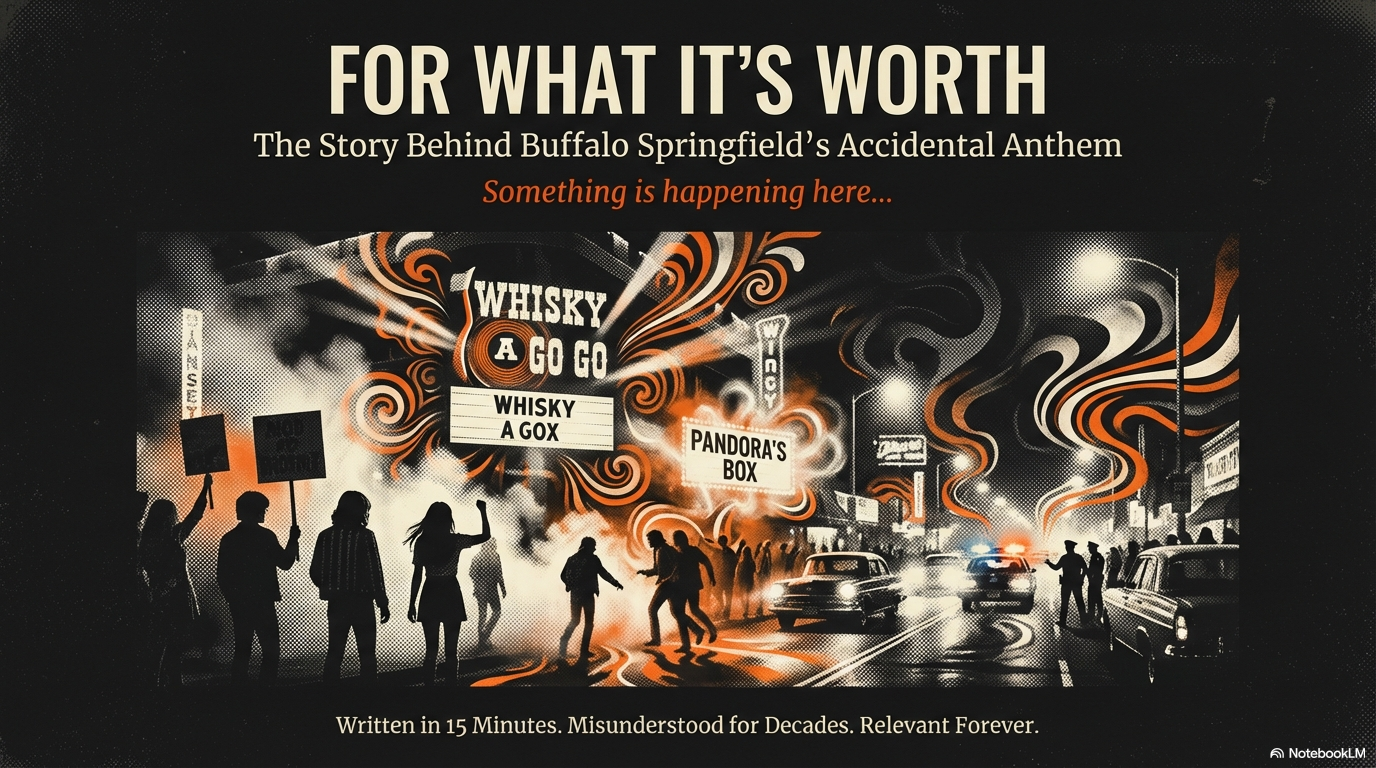
The November 1966 Sunset Strip riots: demonstrators gathered outside Pandora’s Box to protest curfew laws and the club’s demolition
The Vietnam War Misconception
Many listeners assumed Buffalo Springfield For What Its Worth was written as an anti-Vietnam War protest song, particularly because it reached its peak popularity in 1967 when anti-war sentiment was intensifying.
The song’s broad lyrics about “battle lines being drawn” and “a man with a gun” seemed to fit perfectly with the growing opposition to the war.
Stephen Stills has consistently corrected this misconception in interviews, explaining that he wrote specifically about the local conflict on the Sunset Strip.
However, Stills acknowledged that the song’s power comes from its ability to speak to any situation where authority clashes with citizens demanding their rights.
This universal quality transformed the track from a local protest song into an anthem that could be applied to virtually any social justice movement.
💡 Did You Know?
Stephen Stills wrote Buffalo Springfield For What Its Worth in just 15 minutes on his guitar after returning home from witnessing the Sunset Strip riots. He brought the song to a recording session the very next day, December 5, 1966, at Columbia Studios in Hollywood. The entire track was recorded in a single session, capturing the raw urgency and emotion Stills felt while watching young people face off against police. This spontaneous creative process gave the song an authentic, immediate quality that studio polish could never have achieved.
Who Wrote Buffalo Springfield For What Its Worth?
Stephen Stills wrote Buffalo Springfield For What Its Worth alone, though he shares songwriting credits with the entire band on the original release.
Stills composed both the music and lyrics in a single 15-minute burst of creativity after witnessing the Sunset Strip confrontations.
The speed of composition reflects the immediacy and urgency of the events he had just experienced.
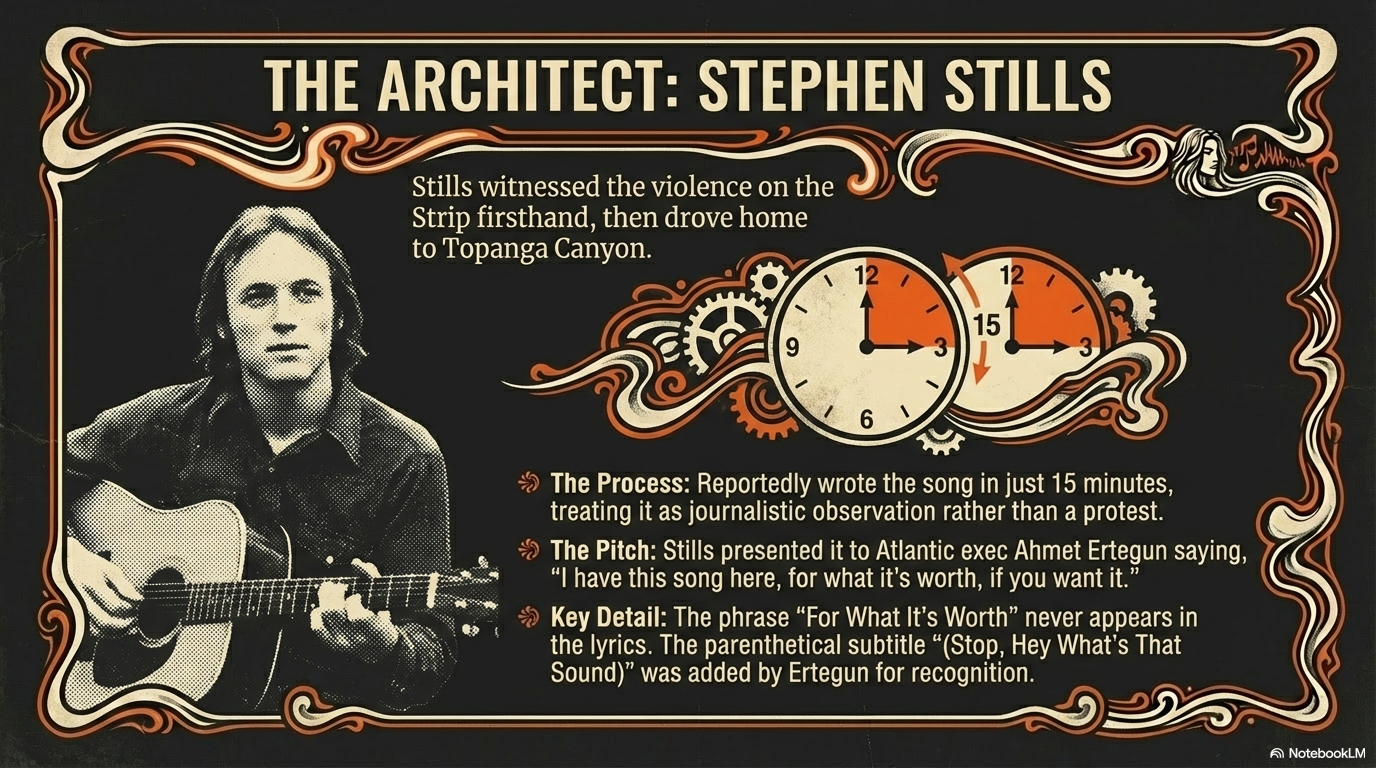
Stephen Stills, the architect of For What It’s Worth, performing with Buffalo Springfield in 1966
Stephen Stills’ 15-Minute Writing Session
After leaving the Sunset Strip on November 12, 1966, Stills went home and immediately picked up his guitar.
The opening riff came to him instantly, followed by the iconic opening line about something happening that wasn’t quite clear.
Stills later described the writing process as almost involuntary, with the words and melody flowing out of him as he processed what he had witnessed.
The folk-rock structure with its steady, march-like rhythm perfectly captured the tension of the standoff between protesters and police.
By the time he finished writing, Stills knew he had created something special and immediately called the band to arrange a recording session.
The next day, Buffalo Springfield gathered at Columbia Studios to record the track that would become their defining moment.
Buffalo Springfield in Late 1966
Buffalo Springfield had only been together for about a year when Stephen Stills wrote For What Its Worth in November 1966.
The band formed in Los Angeles in April 1966 when Stephen Stills and Richie Furay reunited with Neil Young, whom they knew from their folk music days.
Along with bassist Bruce Palmer and drummer Dewey Martin, they created a unique sound that blended folk, rock, country, and emerging psychedelic influences.
Their debut album had been released in October 1966 to modest sales and limited radio airplay.
The band was struggling to break through in a crowded Los Angeles music scene dominated by The Byrds, The Doors, and other established acts.
For What Its Worth would change everything, giving Buffalo Springfield the commercial breakthrough that had eluded them.
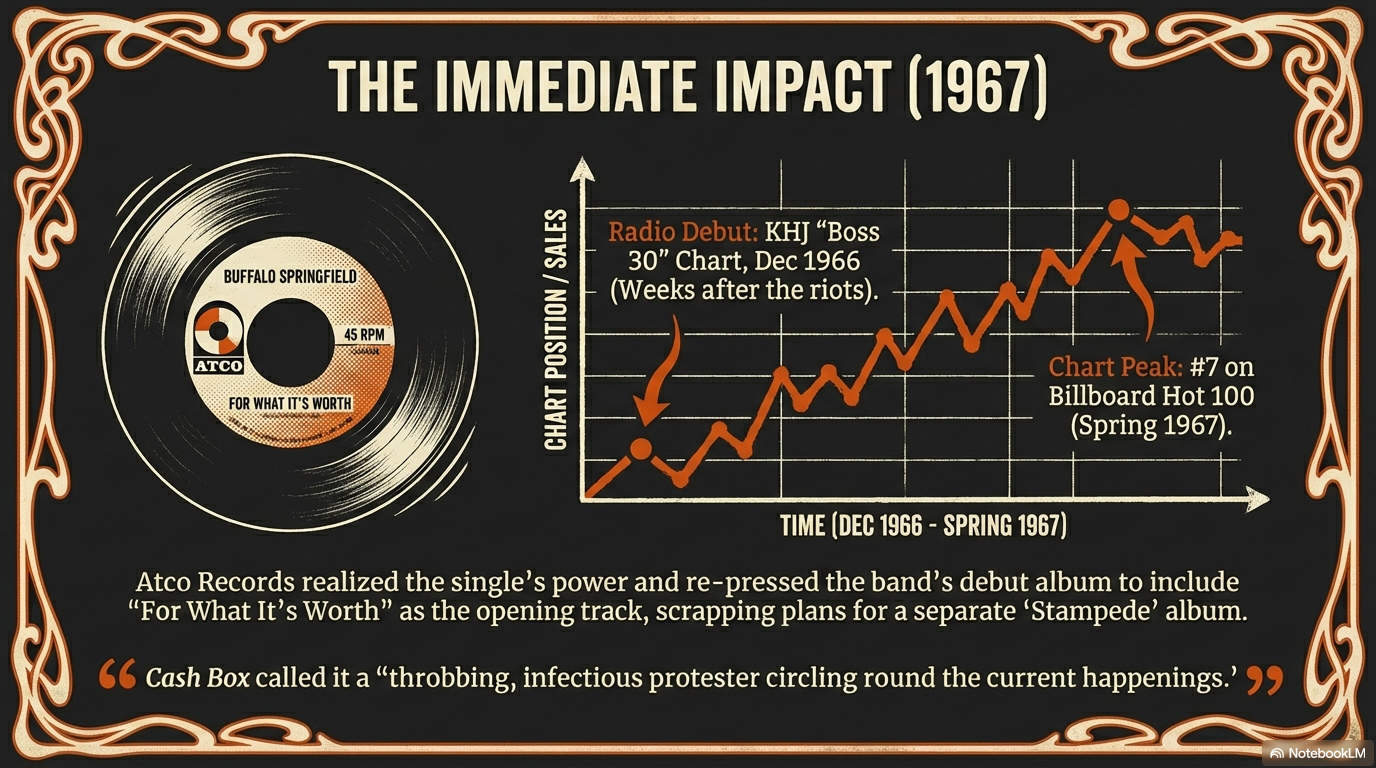
The song’s success forced Atco Records to recall and reissue the debut album with the track added as the new opening song, replacing “Stampede” in the original sequence.
Complete Musical Breakdown of Buffalo Springfield For What Its Worth
Buffalo Springfield For What Its Worth showcases a deceptively simple folk-rock arrangement that conceals sophisticated musical choices and revolutionary guitar techniques.
The song’s moderate tempo and steady rhythm create a march-like quality that reinforces the protest anthem nature of the lyrics.
Song Structure and Composition
The track follows a traditional verse-chorus structure but uses subtle variations to maintain interest throughout its 2:37 running time.
Stephen Stills’ acoustic guitar provides the rhythmic foundation with a steady strumming pattern that never wavers.
The bass line moves deliberately, creating a sense of forward momentum that mirrors the advancing police line described in the lyrics.
Dewey Martin’s drums maintain a simple but effective pattern, using restraint rather than flash to serve the song’s message.
The arrangement leaves space for the vocals to breathe, ensuring that every word of Stills’ warning reaches the listener clearly.
Each verse builds slightly in intensity, with subtle additions in the instrumentation creating a sense of escalating tension.
The song’s structure mirrors the progression of the actual riot, starting with uncertainty and building to confrontation.
Neil Young’s Revolutionary Guitar Harmonics
Neil Young’s lead guitar work on Buffalo Springfield For What Its Worth introduced a technique that would become one of the most recognizable sounds in rock music.
Young used natural harmonics on his electric guitar, creating a bell-like, ethereal quality that cut through the mix like a clarion call.
These harmonics, played at the 12th fret and other nodal points on the guitar neck, produced high-pitched, pure tones that sounded almost supernatural.
The technique required precise finger placement and touch, making it difficult to execute consistently but creating an unforgettable sonic signature when done correctly.
Young’s harmonics appear throughout the song, particularly during the instrumental breaks, adding an element of tension and unease.
This guitar approach influenced countless musicians who tried to recreate the sound, making it one of the most imitated guitar techniques of the late 1960s.
The harmonics also served a compositional purpose, creating a sonic representation of the confusion and otherworldly quality of the riot scene.
Stephen Stills’ Vocal Performance
Stephen Stills delivers the vocals on Buffalo Springfield For What Its Worth with remarkable restraint and control.
Rather than shouting or forcing emotion, Stills adopts an almost conversational tone that makes the warning in the lyrics more powerful.
His vocal range on the track is relatively limited, staying within a comfortable middle register that allows for clear enunciation of every word.
The doubled vocals in the chorus add depth and urgency without overwhelming the listener.
Stills’ phrasing emphasizes key words, particularly “stop” and “what’s that sound,” creating memorable hooks that stick in the listener’s mind.
Background vocals from Richie Furay and other band members provide subtle harmonies that enhance without dominating.
The overall vocal approach creates an intimate, direct connection with the listener, as if Stills is personally warning them about dangerous developments.
When Was Buffalo Springfield For What Its Worth Recorded?
Buffalo Springfield For What Its Worth was recorded on December 5, 1966, just days after Stephen Stills witnessed the Sunset Strip riots.
The remarkably quick turnaround from inspiration to finished recording captured the raw energy and urgency of the moment.
Inside Columbia Studios: December 5, 1966
Columbia Studios in Hollywood served as the recording location for this historic session.
The studio, located at 6121 Sunset Boulevard, was conveniently situated near the very streets where the riots had taken place.
Buffalo Springfield arrived with the song barely rehearsed, having learned it only the night before from Stephen Stills’ demonstration.
The band worked with producers Charles Greene and Brian Stone, who recognized immediately that they had something special.
The basic tracks were recorded live with the full band playing together, capturing the collective energy of the performance.
Neil Young overdubbed his signature guitar harmonics after the initial recording, carefully crafting the parts to maximize their impact.
The entire recording process took less than a full day, with mixing completed shortly afterward.
Revolutionary Production Techniques
The production of Buffalo Springfield For What Its Worth employed a minimalist approach that served the song’s message perfectly.
Engineers kept the arrangement sparse, allowing each instrument to occupy its own sonic space in the mix.
The acoustic guitar sits prominently in the center, with the electric guitar harmonics panned slightly to create stereo width.
Bass and drums remain locked in the pocket, providing steady forward momentum without calling attention to themselves.
Minimal reverb and echo were used, giving the recording an intimate, immediate quality that made listeners feel like they were in the room with the band.
This dry, direct sound was unusual for 1966, when many producers were adding layers of studio effects to create more elaborate productions.
The stripped-down approach ensured that Stephen Stills’ vocals and lyrics remained the focal point throughout.
How the Song Got Its Name
The title Buffalo Springfield For What Its Worth has one of the most unusual origins in rock music history.
The phrase “for what it’s worth” never appears anywhere in the song’s lyrics, making it one of the rare cases where a title is completely absent from the actual content.
Stephen Stills used the phrase casually when presenting the song to Atlantic Records executive Ahmet Ertegun, saying “I have this song here, for what it’s worth, if you want it.”
Ertegun recognized the commercial problem: radio listeners wouldn’t know how to request a song they could only identify by its opening line.
To solve this issue, Ertegun added the subtitle “Stop, Hey What’s That Sound” in parentheses, giving radio audiences a searchable phrase.
The main title “For What It’s Worth” remained, creating the unusual situation where most people know the song by a phrase that isn’t in it.
This naming quirk has become part of the song’s legend, adding to its mystique and making it one of the most distinctive titles in the rock canon.
What Do the Lyrics Mean?
Buffalo Springfield For What Its Worth uses deliberately ambiguous lyrics that allow listeners to apply the song to virtually any conflict between authority and those demanding rights.
The opening lines establish an atmosphere of confusion and uncertainty, with “something happening here” that isn’t quite clear.
Core Themes: Authority vs. Freedom
The central theme of Buffalo Springfield For What Its Worth revolves around the tension between law enforcement and citizens exercising their right to peacefully assemble.
References to “battle lines being drawn” suggest the militarization of what should be a civilian space.
The image of “a man with a gun over there” creates a sense of threat and danger directed at unarmed young people.
The repeated warning to “stop, hey, what’s that sound” serves as both a literal description of police actions and a metaphorical alarm bell about dangerous developments.
Lines about paranoia striking deep and creeping into your life reflect the psychological impact of living under surveillance and potential violence.
The call to “step out of line” and face consequences highlights how authority demands conformity and punishes dissent.
Throughout the lyrics, Stephen Stills maintains an observational rather than overtly political stance, reporting what he sees rather than explicitly taking sides.
The Power of Ambiguity
The genius of Buffalo Springfield For What Its Worth lies in Stephen Stills’ decision to keep the lyrics broad enough to transcend the specific Sunset Strip context.
By avoiding specific references to Los Angeles, the Sunset Strip, or even the 1960s, Stills created a template that could be applied to countless situations.
This universality explains why the song has been adopted by protest movements from the Vietnam War era through Black Lives Matter demonstrations in 2020.
Stephen Stills has stated in interviews that he intentionally wrote lyrics that captured the feeling of the moment rather than specific details.
The emotional truth of young people facing armed authority resonates regardless of the particular political context.
Various artists who have covered the song have found it remarkably adaptable to their own causes, from civil rights to women’s rights to anti-war movements.
This flexibility has ensured the song’s relevance across six decades, making it one of the most enduring protest anthems ever written.
How Did Buffalo Springfield For What Its Worth Perform on the Charts?
Buffalo Springfield For What Its Worth achieved remarkable commercial success, becoming the band’s only Top 10 hit and their signature song.
Released as a single in December 1966, the track began as a regional hit in Los Angeles before spreading to other markets.
The song entered the Billboard Hot 100 in January 1967 and spent 15 weeks on the chart.
It peaked at No. 7 in March 1967, an impressive achievement for a band that had struggled to gain radio airplay with previous releases.
By the end of 1967, Buffalo Springfield For What Its Worth ranked as the No. 27 song of the year on Billboard’s year-end chart.
The track appeared alongside legendary hits from Aretha Franklin, The Beatles, The Monkees, and The Supremes on the year-end list.
Radio programmers initially hesitated to play the song due to concerns about its protest content, but listener demand forced them to add it to rotation.
The commercial success of Buffalo Springfield For What Its Worth forced Atco Records to recall and reissue the band’s debut album with the track added.
This reissued album, with For What Its Worth as the opening track, sold significantly better than the original release.
The song’s chart performance launched Buffalo Springfield into the mainstream, leading to television appearances and higher-profile concert bookings.
In Canada, the track performed even better, reaching the Top 5 and remaining on the charts for months.
Internationally, the song found success in the UK, Australia, and other markets where the counterculture movement was gaining strength.
Why Is Buffalo Springfield For What Its Worth So Popular?
Buffalo Springfield For What Its Worth has maintained its relevance for nearly six decades because it captures universal themes of authority, freedom, and social justice.
The song’s enduring popularity stems from its ability to speak to each new generation facing its own conflicts with established power.
Timeless Relevance Across Generations
Each era has found new meaning in Buffalo Springfield For What Its Worth, applying it to the pressing social issues of the time.
The Vietnam War generation adopted it as an anti-war anthem, despite Stephen Stills’ insistence that he wrote it about the Sunset Strip.
During the 1980s and 1990s, the song became a nostalgic touchstone for baby boomers remembering their youth.
The 2000s saw renewed interest as the song appeared in films and television shows set during the 1960s.
In 2020, a new generation discovered Buffalo Springfield For What Its Worth during Black Lives Matter protests following George Floyd’s death.
Billy Porter and Stephen Stills recorded a “Something Happening Here Remix” for the 2020 Democratic National Convention, updating the song for modern activism.
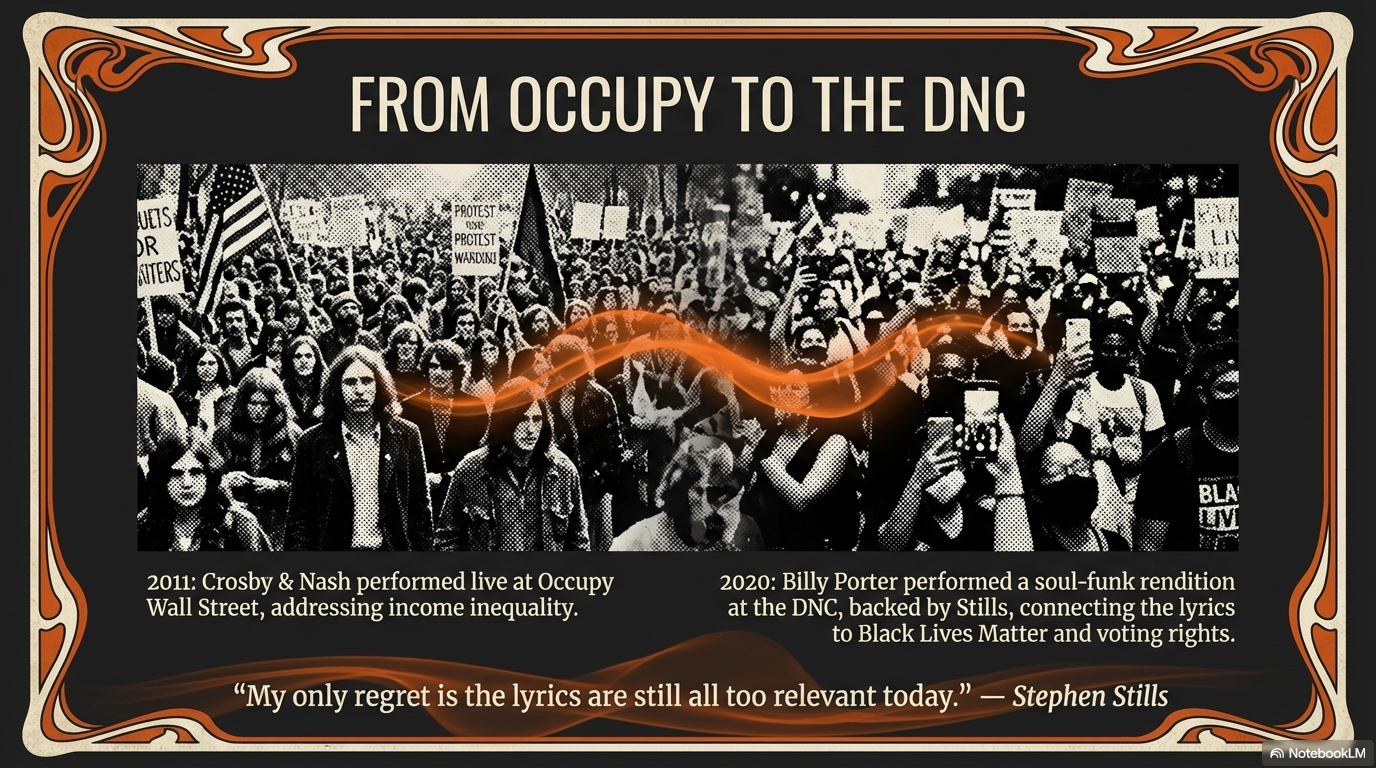
Stephen Stills and Billy Porter performed an updated version of For What It’s Worth at the 2020 Democratic National Convention, connecting 1960s activism to modern social justice movements
Stevie Nicks recorded a powerful version in 2022, reinterpreting the song as a women’s rights anthem following the overturning of Roe v. Wade.
These modern interpretations demonstrate that the song’s core message about standing up to authority remains as relevant as ever.
Cinematic Shorthand for the 1960s
Buffalo Springfield For What Its Worth became the go-to song for filmmakers wanting to establish 1960s counterculture atmosphere.
The track appears in Forrest Gump during scenes depicting anti-war protests and social upheaval.
Tropic Thunder uses the song to satirize Vietnam War films, playing on its association with that era.
Lord of War features the track during sequences set in the turbulent political landscape of the 1960s and 1970s.
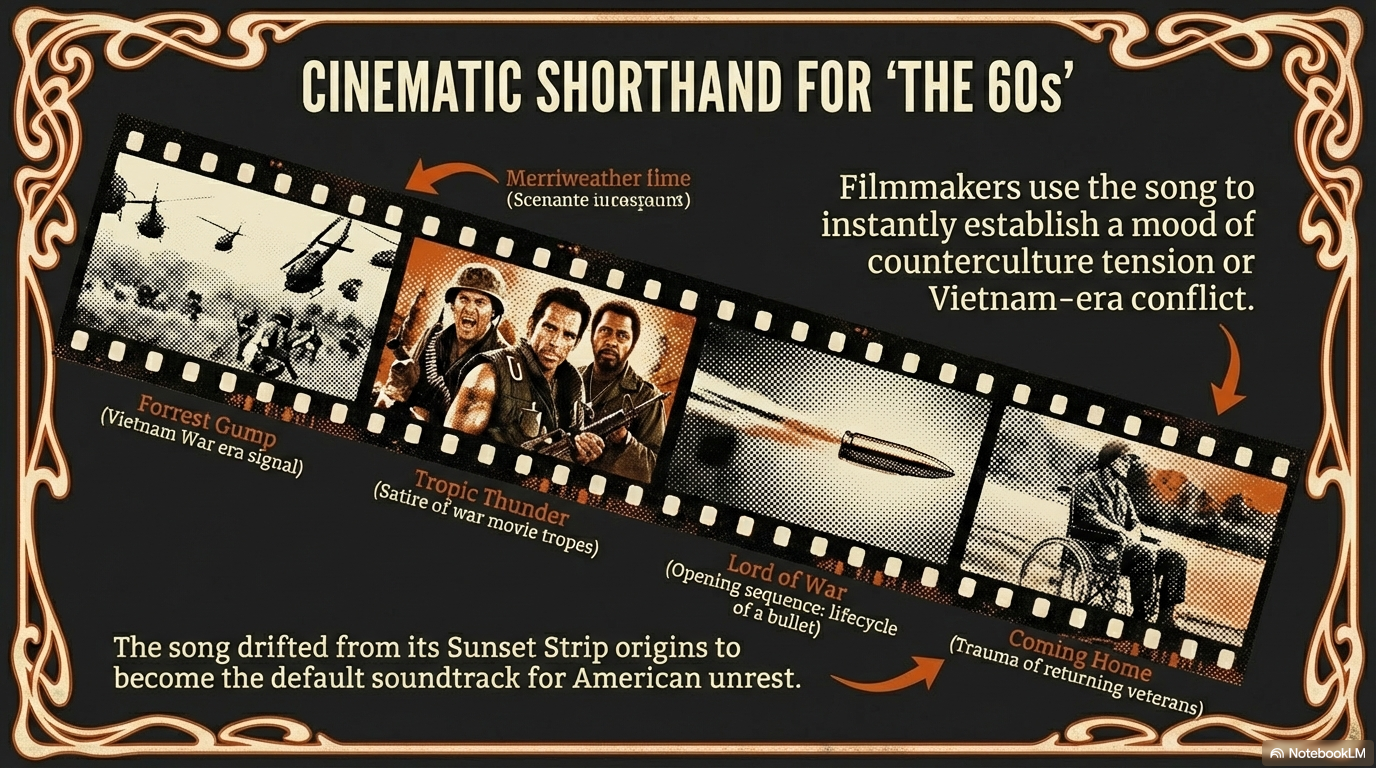
Buffalo Springfield For What It’s Worth became cinematic shorthand for the 1960s, appearing in films like Forrest Gump, Tropic Thunder, and Lord of War
Coming Home, Born on the Fourth of July, and numerous other Vietnam War-related films include the song in their soundtracks.
Television shows ranging from The Wonder Years to That ’70s Show have used Buffalo Springfield For What Its Worth to evoke period atmosphere.
Documentaries about the 1960s counterculture movement almost invariably feature the song as a key musical touchstone.
This ubiquity in film and television has introduced the song to generations who weren’t alive during its original release.
Notable Covers and Modern Interpretations
Buffalo Springfield For What Its Worth has been covered by an extraordinarily diverse range of artists across multiple genres.
The Staple Singers recorded one of the earliest covers in 1967, giving the song a soulful, gospel-influenced interpretation.
Cher’s 1969 version, recorded at the legendary 3614 Jackson Highway studio, brought a forceful rock edge to the track.
South African singer Miriam Makeba recorded the song, applying its message to the anti-apartheid struggle.
Rush, the Canadian progressive rock trio, performed Buffalo Springfield For What Its Worth at their Rock and Roll Hall of Fame induction ceremony.
Ozzy Osbourne released a heavy metal interpretation that reimagined the folk-rock original with distorted guitars and pounding drums.
Queensrÿche recorded a version that emphasized the paranoia and tension in the original lyrics.
Public Enemy sampled the song for their track “He Got Game” in 1998, with Stephen Stills appearing on guest vocals.
This hip-hop interpretation introduced Buffalo Springfield For What Its Worth to urban audiences who might never have heard the original.
Stevie Nicks’ 2022 cover transformed the song into a rallying cry for women’s reproductive rights, demonstrating its continued adaptability.
Each of these interpretations finds something different in Stephen Stills’ original composition, proving the depth and flexibility of the song’s core message.
Live Performances and Stage Evolution
Buffalo Springfield For What Its Worth became an instant concert staple after its commercial breakthrough in early 1967.
The band performed the song at virtually every show during 1967 and early 1968, usually placing it late in the set to maximize audience impact.
Live versions typically extended beyond the 2:37 studio recording, with Neil Young taking extended guitar solos during the instrumental breaks.
Stephen Stills would sometimes introduce the song by explaining its origins in the Sunset Strip riots, educating audiences about the true meaning.
The Monterey Pop Festival in June 1967 featured a powerful performance of Buffalo Springfield For What Its Worth that was unfortunately not included in the documentary film.
Audience reactions were consistently strong, with crowds often joining in on the “stop, hey, what’s that sound” refrain.
After Buffalo Springfield disbanded in 1968, both Stephen Stills and Neil Young performed the song as solo artists.
Crosby, Stills, Nash & Young included Buffalo Springfield For What Its Worth in their concert repertoire, introducing it to even larger audiences in the 1970s.
The 2011 Buffalo Springfield reunion tour featured the song as a centerpiece, with Stills and Young trading guitar solos.
Modern performances by Stephen Stills continue to draw enthusiastic responses, particularly from audiences who remember the song from its original era.
Complete Credits and Personnel
Performed by Buffalo Springfield:
Stephen Stills (Lead Vocals, Rhythm Guitar, Bass Guitar)
Neil Young (Lead Guitar, Guitar Harmonics, Backing Vocals)
Richie Furay (Rhythm Guitar, Backing Vocals)
Bruce Palmer (Bass Guitar)
Dewey Martin (Drums, Backing Vocals)
Written by:
Stephen Stills (Music and Lyrics)
Production:
Charles Greene (Producer)
Brian Stone (Producer)
Recording Engineers (Columbia Studios)
Recording Details:
Recorded: December 5, 1966
Studio: Columbia Studios, Hollywood, California
Album: Buffalo Springfield
Label: Atco Records
Released: December 1966 (Single)
Length: 2:37
Chart Peak: No. 7 Billboard Hot 100
Year-End Rank: No. 27 of 1967
The reissued Buffalo Springfield debut album cover featuring For What It’s Worth as the opening track, replacing the original “Stampede” sequencing
Your Buffalo Springfield For What Its Worth Questions Answered
🔢 Discover More Buffalo Springfield Classics
Explore our complete Buffalo Springfield album review or check out Buffalo Springfield Again: A Transition to Psychedelia.
Learn about the members of Buffalo Springfield and where they are now, or dive into Neil Young’s 2026 tour schedule.
Why Buffalo Springfield For What Its Worth Changed Music Forever
Buffalo Springfield For What Its Worth transformed a local Los Angeles conflict into a universal anthem that has resonated across six decades of social change.
Stephen Stills’ genius lay in crafting lyrics broad enough to apply to any situation where authority clashes with citizens demanding their rights.
The song’s enduring power comes from its restraint, using understatement rather than bombast to deliver its warning about dangerous developments in society.
Neil Young’s revolutionary guitar harmonics created a sonic signature that influenced countless musicians and became inseparable from the song’s message.
From the Sunset Strip to Vietnam War protests to Black Lives Matter demonstrations, each generation has found new meaning in Buffalo Springfield For What Its Worth.
The track’s journey from regional hit to Grammy Hall of Fame inductee proves that authentic art addressing real human concerns will always find an audience.
As long as people face the challenge of standing up to authority, Buffalo Springfield For What Its Worth will remain relevant, reminding us that paranoia strikes deep and the battle lines continue to be drawn.
Buffalo Springfield For What Its Worth stands as proof that a song written in 15 minutes about a local conflict can achieve immortality when it captures universal truths about freedom, justice, and the human spirit.
Ready to experience Buffalo Springfield For What Its Worth in audiophile quality?
Grab the remastered edition of Buffalo Springfield or explore our complete guide to the What’s That Sound box set!
Discover more folk-rock legends with Crosby, Stills & Nash or Neil Young’s Everybody Knows This Is Nowhere.