

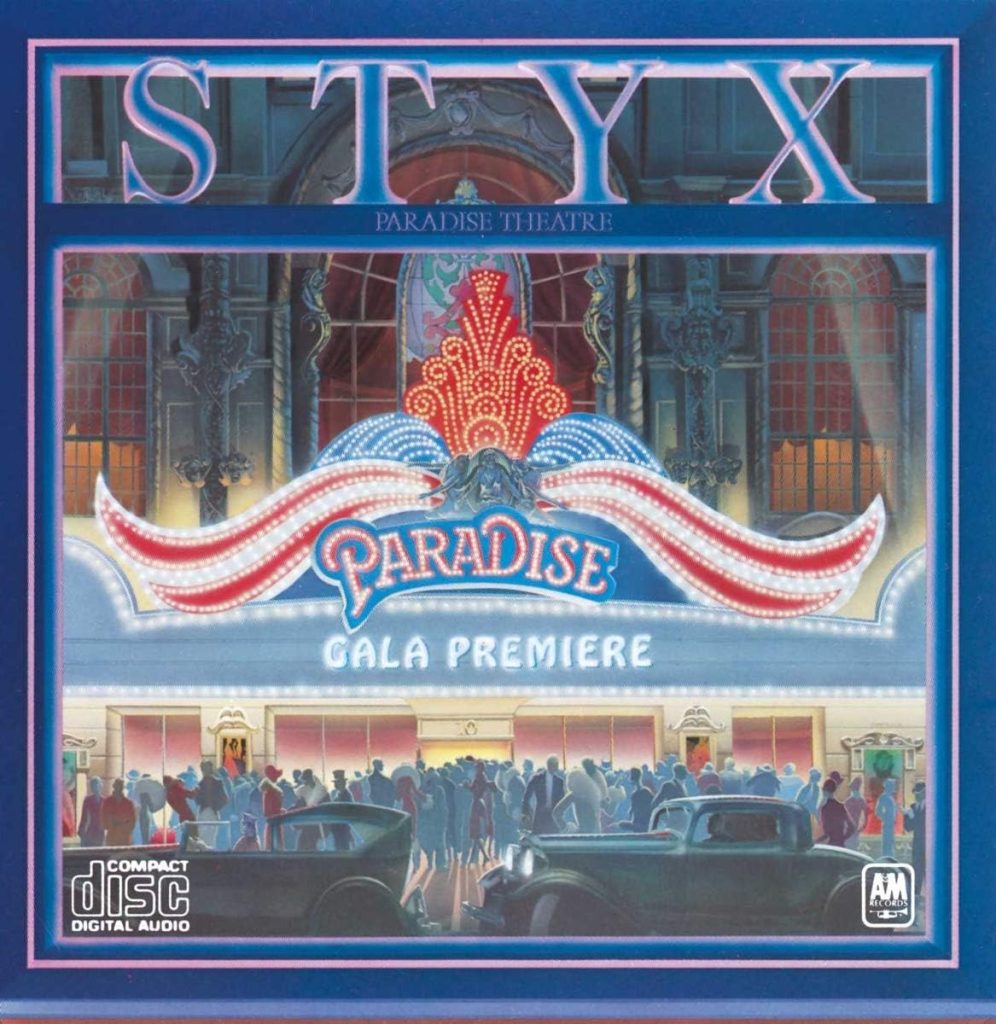
The styx paradise theatre album hit record stores in January 1981 and immediately changed the band’s trajectory.
This concept album about a crumbling Chicago movie palace became Styx’s first number one record.
It proved that prog-rock theatricality could still dominate the charts in the age of new wave.
Quick Navigation
Quick Navigation
The Concept Behind Styx Paradise Theatre
Dennis DeYoung conceived the album as a metaphor for American decline.
The Paradise Theatre was a real venue in Chicago that opened during the Roaring Twenties and closed in the recession-plagued 1950s.
DeYoung saw parallels between that era and Ronald Reagan’s America in 1981.
Economic uncertainty, industrial collapse, and fading optimism defined both periods.
The album’s narrative follows the theater from its grand opening through its inevitable decay.
Songs like “A.D. 1928” and “A.D. 1958” bookend the story with instrumental passages that evoke their respective eras.
This conceptual framework gave the band creative focus after the harder rock direction of Pieces of Eight.
DeYoung’s vision won out over Tommy Shaw’s preference for straightforward rock songs.
The Best of Times: A Power Ballad Masterpiece
“The Best of Times” became the album’s emotional centerpiece.
DeYoung wrote it about his father’s death, channeling personal grief into universal themes of memory and loss.
The song climbed to number three on the Billboard Hot 100.
Its arrangement builds from intimate piano verses to a soaring orchestral climax.
DeYoung’s vocal performance remains one of his finest on record.
There’s genuine emotion in every line, no theatrical posturing.
The live performances of this song became legendary moments at Styx concerts.
Audiences connected with its message about appreciating the present before it becomes the past.
Too Much Time on My Hands and Arena Rock Dominance
Tommy Shaw’s “Too Much Time on My Hands” provided the album’s uptempo counterbalance.
The song addressed unemployment and boredom with a catchy, radio-friendly hook.
It reached number nine on the charts and became a MTV staple.
Shaw’s guitar work drives the track with precision and energy.
The synthesizer riff remains instantly recognizable four decades later.
James Young’s guitar contributions added texture without overwhelming Shaw’s lead.
The song fit perfectly into the album’s thematic structure while standing alone as a hit single.
It proved the members of Styx could balance concept and accessibility.
Styx Paradise Theatre and the Number One Achievement
Paradise Theatre debuted at number one on the Billboard 200 in February 1981.
It stayed at the top for three consecutive weeks.
The album eventually sold over three million copies in the United States alone.
This commercial triumph validated the band’s artistic choices after years of critical dismissal.
Rock critics had written off Styx as bloated and pretentious throughout the late 1970s.
Paradise Theatre forced those same critics to acknowledge the band’s popular appeal.
The success came at a crucial moment for album-oriented rock.
New wave and punk were reshaping the musical landscape, but Styx proved there was still room for ambitious concept albums.
Production and Musical Innovation
The band recorded Paradise Theatre at River Sound Studios in New York.
They brought in producer Gary Loizzo, who had worked on The Grand Illusion.
The production quality represents a significant leap forward from their previous work.
Synthesizers blend seamlessly with traditional rock instrumentation.
The mix gives each instrument clarity without sacrificing power or warmth.
Chuck Panozzo’s bass work anchors songs like “Rockin’ the Paradise” with muscular grooves.
John Panozzo’s drumming adapted perfectly to both ballads and rockers.
The album sounds expansive without becoming cluttered, intimate without losing its arena-rock punch.
Modern remasters have only enhanced the original production’s strengths.
Why Styx Paradise Theatre Endures
This album captured a specific moment in American culture.
The early Reagan years brought uncertainty masked by optimistic rhetoric.
DeYoung’s theatrical vision spoke to audiences looking for meaning beyond simple escapism.
The songs remain relevant because economic anxiety never really went away.
“The Best of Times” still resonates at weddings and graduations.
“Too Much Time on My Hands” still describes modern unemployment and alienation.
The complete album works as a unified statement rather than just a collection of hit singles.
For fans discovering Styx decades later, Paradise Theatre shows the band at their commercial and creative peak.
It’s ambitious without being inaccessible, emotional without being maudlin, and timeless in its exploration of decline and resilience.
Five decades into their career, styx paradise theatre remains the defining achievement in a catalog full of remarkable albums.
Affiliate Disclosure: As an Amazon Associate, I earn from qualifying purchases. This means that if you click on a link to a classic rock album or piece of gear on this site and make a purchase, I may receive a small commission at no extra cost to you. This helps support classicrockartists.com and allows me to keep providing deep-dive content on the legends of rock. Thank you for your support!