

Hawkwind: The Cosmic Pioneers of Space Rock
Hawkwind are one of the most enduring and influential bands in British rock history, forging a sound so radical and otherworldly that they effectively invented an entire genre.
Formed in London in 1969, the band fused psychedelic rock, proto-punk energy, and science fiction mythology into a sonic universe unlike anything their contemporaries had attempted.
For over five decades, Hawkwind have defied commercial logic, lineup turbulence, and critical indifference to remain one of rock’s most committed and creatively restless collectives.
Their influence stretches across metal, punk, electronic music, and the alternative underground, touching everyone from Motörhead to Radiohead.
Driven by the singular vision of guitarist and founder Dave Brock, Hawkwind transformed free festival culture into a full-blown cosmic movement.
This is the definitive story of Hawkwind, the band that took rock music into deep space and never fully came back.
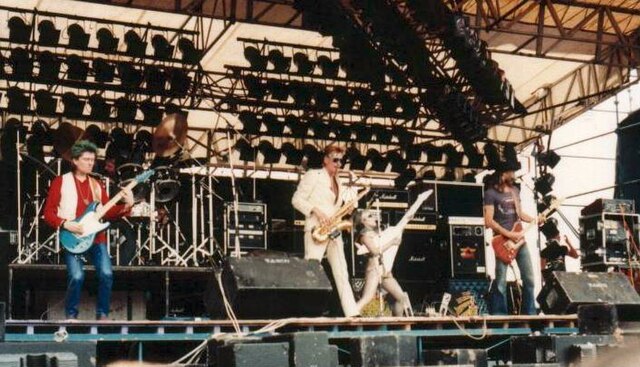
Table of Contents (Click to Expand)
- Early Life and Origins of Dave Brock
- First Steps: The Rockfield and the London Free School Scene
- Hawkwind’s Peak Era: Space Ritual and the Cosmic Zenith
- Career Challenges: Lineup Chaos and Commercial Struggles
- The Revival: Hawkwind’s Enduring Comeback
- Recognition and Legacy
- Essential Hawkwind Discography
- Frequently Asked Questions About Hawkwind
Early Life and Origins of Dave Brock
The story of Hawkwind begins, inevitably, with David Brock, born on August 20, 1941, in Isleworth, Middlesex, England.
Brock grew up in postwar Britain, a world still scarred by conflict and dreaming of something beyond the grey austerity of everyday life.
He taught himself guitar as a teenager, absorbing the skiffle and early rock and roll sounds that were electrifying British youth in the late 1950s.
His early musical influences included Buddy Holly, Chuck Berry, and the emerging British blues scene.
Before founding Hawkwind, Brock spent several years as a busker on the streets of London and across Europe.
That experience as a street musician gave him a deeply populist attitude toward music and audiences.
He believed music should be free and accessible to everyone, a philosophy that would define Hawkwind’s entire ethos.
By the late 1960s, Brock was embedded in the London counterculture scene, frequenting the UFO Club and absorbing the radical ideas of the era.
He was drawn not just to music, but to science fiction literature, which would become the conceptual backbone of everything he created.
Writers like Michael Moorcock and science fiction’s exploration of alternate realities resonated deeply with his artistic vision.
First Steps: The Rockfield and the London Free School Scene
Hawkwind coalesced in 1969 under the original name Group X, later briefly known as Hawkwind Zoo before settling on Hawkwind.
The founding lineup around Brock included Nik Turner on saxophone and vocals, Terry Ollis on drums, Dik Mik on electronics, and John Harrison on bass.
From the very beginning, the band had a radical approach that set them apart from the blues-rock bands dominating the London scene.
They incorporated synthesizers, tape loops, and electronic noise at a time when most rock bands were still relying purely on guitars.
Their live performances were designed as immersive experiences, featuring light shows, dancers, and a sensory overload of sound and vision.
The band became deeply embedded in the British free festival circuit, playing events like the Windsor Free Festival and Glastonbury for free.
Their commitment to playing free festivals for no charge made them heroes of the British counterculture and built a ferociously loyal fanbase.
They signed to United Artists Records and released their self-titled debut album in 1970, a record of swirling, exploratory psychedelia.
The debut received modest attention but clearly announced that something genuinely new and strange had arrived in British music.
Hawkwind’s Peak Era: Space Ritual and the Cosmic Zenith
The early 1970s represented the creative and commercial apex of Hawkwind’s career, a period of extraordinary artistic ambition and cultural impact.
The 1971 album In Search of Space was a landmark record, earning the band serious critical recognition for the first time.
It came packaged with an elaborate booklet titled the Hawkwind Log, an in-universe science fiction document that expanded the band’s cosmic mythology.
The record reached number 18 on the UK Albums Chart and confirmed that Hawkwind were no mere cult curiosity but a genuine artistic force.
In 1972, a crucial new member joined the band: a young, raw-voiced bass player named Lemmy Kilmister.
Lemmy brought a thunderous, distorted bass sound and a punk-before-punk attitude that electrified the band’s already intense live performances.
His arrival coincided with Hawkwind’s greatest commercial moment: the surprise UK number one single “Silver Machine,” released in June 1972.
Lemmy sang lead vocals on “Silver Machine,” and his raw, magnetic charisma was a major factor in the song’s unlikely chart success.
“Silver Machine” reached number three on the UK Singles Chart, a staggering mainstream achievement for a band so resolutely uncommercial.
The single opened doors to mainstream audiences while simultaneously alarming those audiences with Hawkwind’s relentlessly avant-garde live show.
Also joining the band at this time was saxophonist and dancer Stacia Blake, whose theatrical stage presence amplified the band’s ritualistic, immersive performances.
The 1973 album Space Ritual is widely regarded as the pinnacle of Hawkwind’s recorded output and one of the great live albums in rock history.
Recorded across multiple dates on their 1972 UK tour, the double album captures the full, overwhelming power of the Hawkwind live experience.
It reached number nine on the UK Albums Chart, their highest charting album, and stands as an enduring masterpiece of space rock.
Science fiction author Michael Moorcock had by now become a close collaborator, contributing lyrics and spoken word passages to multiple recordings.
Moorcock’s Eternal Champion mythology and his Elric of Melniboné stories became deeply intertwined with Hawkwind’s lyrical and conceptual universe.
The band’s 1973 and 1974 performances at the Roundhouse in London became legendary events in the annals of British counterculture.
Furthermore, the band played an iconic set at the Isle of Wight Festival in 1970 alongside Jimi Hendrix and The Doors, exposing them to a massive audience.
Their 1974 album Hall of the Mountain Grill introduced keyboard player Simon House, whose classical training added new layers of sophistication to their sound.
The mid-1970s albums Warrior on the Edge of Time (1975) showed the band at their most conceptually ambitious and musically polished.
Significantly, Hawkwind were also pioneers of the “space rock” genre, a term that became attached to their sound and has never really left.
Their use of synthesizers, drones, and repetitive hypnotic riffs predated and influenced the krautrock movement emerging simultaneously in Germany.
Bands like Neu! and Can were exploring similar sonic territory, but Hawkwind arrived at it through a distinctly British psychedelic lens.
Their live performances during this peak era were described by attendees as genuinely transcendent, blurring the line between concert and ritual.
The band’s dedication to their fans and their free festival roots never wavered, even as their music grew more elaborate and ambitious.
Career Challenges: Lineup Chaos and Commercial Struggles
Hawkwind’s career has been punctuated by an almost bewildering number of lineup changes, making them one of rock’s most unstable yet somehow most persistent bands.
The first major departure came in 1975 when Lemmy was dismissed from the band after being arrested at the Canadian border for drug possession.
His exit was a significant blow, as his bass playing and vocals had been central to the band’s most commercially successful period.
Lemmy went on to form Motörhead, one of the most influential heavy metal bands in history, taking Hawkwind’s raw energy into even heavier territory.
In contrast to Motörhead’s rising star, Hawkwind faced a difficult second half of the 1970s as punk rock swept away the progressive and space rock scenes.
The band struggled to maintain commercial momentum, cycling through numerous musicians while Brock remained the sole constant presence.
One of the most notable musicians to pass through the Hawkwind orbit was legendary drummer Ginger Baker, who brought his formidable percussive power to the band during the 1980s.
Baker’s presence underlined the high regard in which serious rock musicians held Hawkwind, even during the band’s most commercially difficult years.
Robert Calvert, the band’s poet and vocalist, suffered from serious mental illness throughout his time with Hawkwind, which affected the band deeply.
Calvert’s manic episodes were both a creative catalyst and a source of genuine personal tragedy for everyone involved with the band.
His death from a heart attack in 1988 was a deeply felt loss for the wider Hawkwind community and British alternative culture.
The band’s relationship with major labels also became increasingly strained, as their refusal to compromise their sound made them difficult commercial propositions.
Legal disputes over the Hawkwind name at various points in the late 1970s and 1980s further complicated the band’s identity and continuity.
Despite these difficulties, Brock consistently kept some version of Hawkwind active, releasing albums and touring throughout even the band’s most troubled years.
The Revival: Hawkwind’s Enduring Comeback
Hawkwind’s revival began in earnest in the 1980s as the band found new audiences among the emerging metal and new wave underground scenes.
Their appearance at the 1982 Monsters of Rock festival at Donington Park introduced them to a new generation of heavy rock fans.
The 1980s saw Hawkwind produce some surprisingly strong studio records, including Levitation (1980) and Sonic Attack (1981).
These albums demonstrated that the band’s creative instincts remained intact even as the commercial landscape became increasingly hostile to their style.
The 1990s brought another wave of renewed interest, driven partly by the rave and techno scenes that had absorbed so much of Hawkwind’s electronic influence.
Younger musicians openly cited Hawkwind as a foundational influence, bringing the band to the attention of audiences who had been born after their peak years.
The band’s association with the Glastonbury Festival also deepened over the decades, with Hawkwind becoming a beloved institution on the festival circuit.
Dave Brock consistently refreshed the band’s lineup with talented younger musicians, keeping the sound contemporary without abandoning the core Hawkwind identity.
Their official website became a hub for a dedicated global fanbase, demonstrating the band’s ability to adapt to the digital age.
The 2000s and 2010s saw Hawkwind continue to release new studio material and tour extensively, maintaining a level of activity that shamed many younger bands.
Albums like Onward (2012) and Road to Utopia (2020) showed that Brock’s creative vision remained vivid and undiminished after five decades.
The band’s YouTube music channel has made their vast catalog accessible to new listeners around the world.
Furthermore, anniversary tours and retrospective box sets have reintroduced the band’s peak-era work to contemporary audiences with remarkable success.
Recognition and Legacy
Hawkwind’s legacy is difficult to overstate, precisely because it operates so far below the surface of mainstream rock history.
They are the band that every musician’s musician seems to cite, a secret ingredient in the DNA of decades of alternative music.
Their influence on heavy metal is profound, with Motörhead, Iron Maiden, and countless others tracing direct lines back to Hawkwind’s sonic innovations.
The electronic and ambient music world owes an enormous debt to Hawkwind’s pioneering use of synthesizers and electronic textures in a rock context.
Bands like Radiohead, Spiritualized, and the entire shoegaze and post-rock movements absorbed Hawkwind’s techniques into their own sonic vocabularies.
Punk rock also carries Hawkwind’s fingerprints: their free festival ethos, anti-establishment politics, and raw energy directly influenced the punk generation.
The 1970s space rock and krautrock scenes that Hawkwind helped define are now recognized as foundational to modern experimental music.
In 2020, Dave Brock received an Ivor Novello Award for Outstanding Contribution to British Music, a formal acknowledgment of his five decades of innovation.
Although Hawkwind have never received a Rock and Roll Hall of Fame nomination, their absence is widely regarded as one of that institution’s more glaring oversights.
Their “Silver Machine” remains one of the most recognizable singles of the early 1970s rock era, instantly identifiable by its soaring, motorik energy.
Significantly, the ClassicRockArtists.com community continues to celebrate Hawkwind as one of the most important bands in the history of British rock music.
Essential Hawkwind Discography
- Hawkwind (1970): The debut album, a swirling introduction to the band’s psychedelic vision, featuring extended electronic explorations that announced a new kind of rock.
- In Search of Space (1971): A breakthrough record that reached the UK top 20 and established the band’s science fiction mythology with its legendary Hawkwind Log booklet.
- Doremi Fasol Latido (1972): The studio companion to the live Space Ritual recordings, featuring some of the band’s most hypnotic and drone-heavy compositions.
- Space Ritual (1973): Widely considered Hawkwind’s masterpiece, this landmark double live album captured the full, overwhelming power of their theatrical cosmic performances.
- Hall of the Mountain Grill (1974): A richly textured studio album introducing keyboard player Simon House, expanding the band’s sonic palette considerably.
- Warrior on the Edge of Time (1975): The peak of the band’s collaboration with science fiction author Michael Moorcock, a conceptually ambitious and musically sophisticated landmark.
- Astounding Sounds, Amazing Music (1976): A transitional album that showed the band experimenting with new directions following the departure of key members.
- Levitation (1980): A strong early 1980s entry that demonstrated the band’s resilience and continued creative drive despite significant lineup changes.
- Sonic Attack (1981): A harder, more aggressive album that found Hawkwind connecting with the emerging metal audience of the early 1980s.
- Road to Utopia (2020): A late-career statement that proved Dave Brock’s creative vision remained potent and vital after more than five decades of music-making.
Explore the full Hawkwind catalog and bring their cosmic sound into your collection: Browse Hawkwind Albums on Amazon.
Frequently Asked Questions About Hawkwind
What genre is Hawkwind?
Hawkwind are the founding architects of space rock, a genre that blends psychedelic rock with electronic music, science fiction themes, and hypnotic, repetitive rhythmic structures.
Their music also incorporates elements of progressive rock, proto-punk, and ambient music, making them genuinely difficult to categorize within any single genre.
Was Lemmy from Motörhead in Hawkwind?
Yes, Lemmy Kilmister was a member of Hawkwind from 1972 to 1975, playing bass and singing lead vocals on their biggest hit, Silver Machine.
He was dismissed from the band in 1975 and subsequently formed Motörhead, taking Hawkwind’s raw energy into the realm of heavy metal.
What is Hawkwind’s most famous song?
Silver Machine, released in 1972, is by far Hawkwind’s most commercially successful and widely recognized song, reaching number three on the UK Singles Chart.
It remains a classic rock radio staple and is one of the defining singles of early 1970s British rock music.
Is Hawkwind still active?
Yes, Hawkwind remain an active band under the continued leadership of founding member and guitarist Dave Brock, who has kept the group going for over fifty years.
The band continues to tour and record new music, releasing their most recent studio album Road to Utopia in 2020.
Who are Hawkwind’s biggest musical influences?
Hawkwind’s music was shaped by a diverse range of influences including psychedelic rock pioneers like Pink Floyd, the free jazz experimentation of artists like Sun Ra, and the science fiction literature of writers like Michael Moorcock.
Early electronic music and the avant-garde experiments of composers like Karlheinz Stockhausen also left a clear imprint on the Hawkwind sound.
From their origins in the London counterculture of 1969 to their continued presence on stages around the world today, Hawkwind remain a testament to the power of uncompromising artistic vision, and the story of Hawkwind is far from over.