

Steve Jordan: Drummer, Producer, and the Rolling Stones’ New Heartbeat
Steve Jordan is one of the most accomplished, versatile, and deeply respected musicians in the history of American rock and roll.
Born on January 14, 1957, in the Bronx, New York City, he has built an extraordinary career spanning more than five decades of recorded music and live performance.
From the stages of Saturday Night Live to the Late Night with David Letterman band, from the touring circuit of the Blues Brothers to the recording rooms of Keith Richards, his groove has powered some of the most iconic music of the last half-century.
He is a Grammy Award-winning producer, a co-writer and long-time creative partner of Keith Richards, and the man personally chosen by the late Charlie Watts to carry the Rolling Stones forward.
Few careers in popular music combine sideman excellence, production mastery, and rock and roll legacy quite the way Steve Jordan’s does.
☰ Table of Contents (Click to Expand)
- Steve Jordan: Early Life in the Bronx
- The Saturday Night Live Era and the Blues Brothers
- Late Night with Letterman and the Eyewitness Years
- Steve Jordan, Keith Richards, and the X-Pensive Winos
- The Rise of a World-Class Producer
- Career Challenge: Stepping Into Charlie Watts’ Chair
- Joining the Rolling Stones and Hackney Diamonds
- Recognition and Legacy
- Steve Jordan: Essential Discography
- Frequently Asked Questions About Steve Jordan
Steve Jordan: Early Life in the Bronx
Steve Jordan grew up in New York City, raised in the Bronx in a household where music was a constant presence.
He attended the Fiorello H. LaGuardia High School of Music and Art, one of New York’s most celebrated performing arts schools, graduating in 1974.
From his earliest years, Jordan showed an ear that reached well beyond his age.
His first record collection included the Coasters, Chubby Checker, and Henry Mancini’s Peter Gunn soundtrack, and by the time he was eight years old he had been beating on pots and pans with a clear intention to become a drummer.
His father gave him a defining early challenge: learn to play jazz legend Art Blakey‘s “Blues March” before anything else.
That assignment shaped everything that followed, giving Jordan both technical dexterity and an instinctive feel for melody within rhythm.
He was drawn equally to jazz and soul and funk drumming, absorbing the work of Al Jackson Jr., Jabo Starks, Clyde Stubblefield, and Billy Higgins.
These players taught him that the greatest drummers serve the song with economy and pocket, not flash.
By his early teens, Jordan was already playing at a level that turned professional heads across New York City.
The Saturday Night Live Era and the Blues Brothers
The first truly significant break in Jordan’s career came before he had finished high school.
As a teenager, he became an honorary member of Stevie Wonder‘s band, WonderLove, a connection that placed him immediately among elite company.
In 1976, he filled in as substitute drummer for the New York jazz-funk group Stuff and toured with Joe Cocker on his American dates.
By the late 1970s, Jordan had earned the drum chair in the Saturday Night Live house band, one of the most visible television gigs in the country at the time.
When John Belushi and Dan Aykroyd launched The Blues Brothers as a touring act, Jordan was behind the kit.
He recorded on their resulting albums, credited under the nickname Steve “Getdwa” Jordan.
Their 1978 debut Briefcase Full of Blues became a surprise platinum smash, selling over three million copies in the United States.
Jordan did not, however, appear in the 1980 film of the same name.
These years placed Jordan at the creative and professional center of New York’s music scene, surrounded by producers, bandleaders, and players who would define the next two decades of American popular music.
Late Night with Letterman and the Eyewitness Years
When Paul Shaffer assembled the house band for NBC’s new Late Night with David Letterman in 1982, Steve Jordan was his original drummer.
The band, formally known as the World’s Most Dangerous Band, became a weekly national institution.
Jordan held that chair from 1982 to 1986, appearing on camera every weeknight and recording with a roster of guests that read like a who’s who of American music.
That kind of exposure was invaluable, and Jordan used it to build industry relationships that would serve him for decades.
Simultaneously, he joined the jazz-funk band Eyewitness, a project led by guitarist Steve Khan, alongside bassist Anthony Jackson and percussionist Manolo Badrena.
Eyewitness deepened Jordan’s jazz credibility at the same time his television work was raising his commercial profile.
In 1986, Jordan and fellow Shaffer alumnus Anton Fig appeared on the Rolling Stones’ Dirty Work, with Jordan contributing percussion on the record.
That session planted the seed for one of the most important partnerships in classic rock’s 1980s chapter.
Steve Jordan, Keith Richards, and the X-Pensive Winos
The collaboration that would define Steve Jordan’s peak era began with a session that has since entered rock and roll legend.
Following his appearance on Dirty Work, Keith Richards invited Jordan to play drums on Aretha Franklin‘s recording of the Stones’ classic Jumpin’ Jack Flash, which Richards was producing for the 1986 Whoopi Goldberg film of the same name.
In the studio, Richards and Jordan clicked immediately.
Richards was at a crossroads with the Rolling Stones.
Relations with Mick Jagger had grown strained during the mid-1980s, and when Jagger declined to tour in support of Dirty Work in 1986, Richards made the decision to launch a solo record for the first time in his career.
He called on Jordan.
The two began writing and recording together, assembling a loose collective of musicians they dubbed the X-Pensive Winos.
The result was Talk Is Cheap, released in October 1988.
Jordan co-wrote and co-produced the entire record alongside Richards, making his contribution far more than that of a hired hand.
Recorded at Air Studios Montserrat and Le Studio in Montreal, the album was strikingly raw, rooted in Richards’ garage-rock instincts and shaped by Jordan’s deep pocket and sense of arrangement.
The lead single “Take It So Hard” reached number three on Billboard’s Mainstream Rock Tracks chart.
Critics embraced the record as the most vital thing either man had released in years.
Richards himself said of Jordan simply: “What a drummer.”
Importantly, Richards noted that the X-Pensive Winos operated differently from the Stones, in ways that energized him creatively.
The band would not let Richards stop when he lost his thread, pushing forward with the kind of momentum that generated the album’s best ideas.
Jordan followed the album with a 1988 live tour in support of Talk Is Cheap, performing across the United States alongside Richards and the full Winos lineup.
The Hollywood Palladium show on December 15, 1988, was filmed and later released as a concert document of that era.
The partnership continued into the 1990s.
In 1992, Jordan co-wrote and co-produced Richards’ second solo album, Main Offender, extending their creative alliance and reaffirming Jordan’s role as Richards’ most trusted musical collaborator.
Richards and Jordan would return together again in 2015 with Crosseyed Heart, Richards’ third solo effort, on which Jordan again co-produced and played drums.
Across these three records, Jordan functioned as the rhythmic architect of Richards’ solo identity, a creative partner in the truest sense of the term.
Beyond the X-Pensive Winos, the same years saw Jordan become one of the most sought-after session drummers on the planet.
He recorded with an astonishing range of artists, including Bob Dylan, Neil Young, Don Henley, Sheryl Crow, Stevie Nicks, John Mellencamp, and B.B. King.
He played drums on Alicia Keys‘ “If I Ain’t Got You” and on Bruce Springsteen‘s Devils and Dust, two records from entirely different sonic worlds, each carrying his unmistakable feel.
In 2006, Eric Clapton hand-picked Jordan for his European Tour, which included seven sold-out nights at London’s Royal Albert Hall.
Jordan remained in Clapton’s band through the North American dates in 2007.
At every stop, with every artist, Jordan’s approach remained the same: serve the song, hold the pocket, and never play more than the music requires.
Modern Drummer described him as one of the funkiest drummers of all time.
That reputation was earned not through any single flashy performance, but through a consistent, decades-long commitment to musical truth.
The Rise of a World-Class Producer
Jordan’s evolution into one of music’s premier producers was not accidental.
As he has explained, he stepped into the producer role because he was frustrated by outside engineers who failed to capture his drum sounds properly in the studio.
So he took control of the room himself, and never looked back.
He won his first Grammy Award for producing Robert Cray‘s album Take Your Shoes Off.
He received a Grammy nomination for producing Buddy Guy‘s Bring ‘Em In.
In 2009, he earned another nomination for his work on the soundtrack to the film Cadillac Records.
His most commercially celebrated production was Continuum, the 2006 John Mayer album that won the Grammy Award for Best Pop Vocal Album.
Jordan and Mayer had also formed the John Mayer Trio in 2005, a blues-rock power trio completed by bassist Pino Palladino.
The trio released the live album Try! in November 2005, featuring blues covers and original compositions co-written by Jordan, Mayer, and Palladino.
He also produced John Scofield‘s That’s What I Say, Herbie Hancock‘s Possibilities, and two albums with Patti Scialfa.
On the personal creative side, Jordan formed the band The Verbs with his wife Meegan Voss.
The group released And Now… The Verbs in 2007 and a follow-up called Trip, with Pino Palladino on bass and Japanese guitarist Tamio Okuda on lead guitar.
In 2003, Jordan shared his drumming philosophy through an instructional DVD called The Groove Is Here, featuring commentary from Levon Helm, Keith Richards, and Jackson Browne.
Furthermore, he served as musical director and lead performer in the 2005 documentary Make It Funky!, a film tracing the history of New Orleans music and its global influence.
Career Challenge: Stepping Into Charlie Watts’ Chair
On August 5, 2021, the music world received news that sent a shock through the Rolling Stones community.
Charlie Watts, the Rolling Stones’ drummer for 58 years, had undergone a heart procedure and would not be available for the band’s resuming US No Filter Tour.
Steve Jordan was named as his temporary replacement.
Jordan had spoken to both Richards and Mick Jagger, who told him it was a work in progress and that Watts planned to return.
He sent Watts a personal note, promising to keep his seat warm until his return.
He described his initial feeling as akin to rock and roll fantasy camp.
Then, on August 24, 2021, Charlie Watts passed away at the Royal Brompton Hospital in London at the age of 80.
Jordan described Watts’ death as a complete and utter shock.
He had known Watts for forty years, and the loss was deeply personal.
Speaking to Vanity Fair, Jordan was candid: “There are people that don’t understand that I lost a friend.” He made clear he would have preferred circumstances to be entirely different.
What made the transition bearable was that Watts himself had prepared it.
As far back as the 1980s, Watts had told Richards that if he ever needed another drummer, Jordan was his man.
Richards later reflected that moving forward “would have been a lot harder without Charlie’s blessing.”
Jordan accepted the full-time role with clear eyes and deep respect for the chair he was taking over.
He acknowledged plainly that many observers had underestimated the difficulty of the role: sitting in that chair and playing that music is no simple task.
Joining the Rolling Stones and Hackney Diamonds
Steve Jordan joined the touring lineup of the Rolling Stones for the completion of the No Filter Tour in 2021, alongside Mick Jagger, Keith Richards, and Ronnie Wood.
The band began a full new tour in 2022 with Jordan at the kit.
Critics and fans noted that Jordan brought a driving energy to the live show that honored Watts’ legacy while carrying its own character.
In late 2022 and through 2023, the band entered the studio with producer Andrew Watt to record what would become their most celebrated album in decades.
Hackney Diamonds, released on October 20, 2023, became the Rolling Stones’ first album of original material since 2005’s A Bigger Bang.
Jordan played drums on all tracks except “Mess It Up,” “Live by the Sword,” and “Rolling Stone Blues,” which feature Charlie Watts’ drumming from 2019 sessions recorded before his death.
The album’s lead single, “Angry,” announced the Stones’ return with strut and confidence, with Jordan’s punchy, rhythmically assured playing driving the track from start to finish.
Hackney Diamonds debuted at number one in twenty countries, including the United Kingdom, Australia, Germany, and the Netherlands.
Rolling Stone magazine called it the band’s strongest album in roughly half a century.
Variety observed that Jordan understood precisely what the drummer in the Rolling Stones should sound like, and delivered it so convincingly that his playing was at times indistinguishable from Watts’ own.
The Hackney Diamonds Tour ran from April 28, 2024 to July 21, 2024, with Jordan behind the kit for every show.
In December 2025, the band’s live legacy was honored further with the Rolling Stones IMAX concert film, bringing their history to a new generation of fans on the biggest screens available.
Recognition and Legacy
Across more than five decades, Steve Jordan has accumulated a body of work that makes a compelling case for his place among the greatest musicians of his generation.
As a producer, he holds Grammy wins for Robert Cray’s Take Your Shoes Off and John Mayer’s Continuum, alongside nominations for work with Buddy Guy and the Cadillac Records soundtrack.
As a drummer, he has appeared on recordings by artists as varied as Bob Dylan, Alicia Keys, Bruce Springsteen, Eric Clapton, Neil Young, James Taylor, and Sheryl Crow, to name only a fraction of his credits.
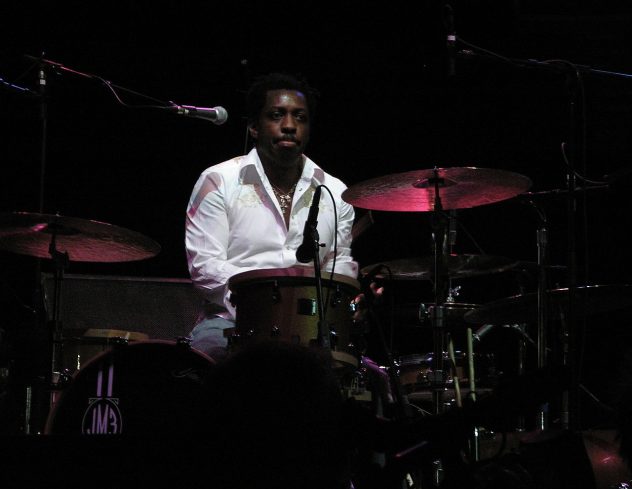
He plays Gretsch drums and Paiste cymbals, tools he has wielded on some of the most beloved recordings of the past four decades.
Modern Drummer has cited him as one of the funkiest drummers of all time.
His instructional DVD The Groove Is Here, released in 2003, distills his playing philosophy into a candid format, featuring performances and reflections from Richards, Levon Helm, and Jackson Browne.
His legacy rests on a principle he has articulated throughout his career: great drumming is about listening, serving, and holding the groove without ego.
Watch Steve Jordan’s personality and musical instincts on full display in the video below, as he hears Incubus for the very first time:
Steve Jordan reacts to hearing Incubus for the first time.
Steve Jordan: Essential Discography
The following albums represent the most essential recordings in Steve Jordan’s extraordinary career, spanning his roles as drummer, co-writer, and producer.
- Briefcase Full of Blues (Blues Brothers, 1978): The debut of the Belushi and Aykroyd touring act, on which Jordan played drums under the credit Steve “Getdwa” Jordan; it sold over three million copies in the United States.
- Talk Is Cheap (Keith Richards, 1988): Richards’ debut solo album, co-written and co-produced by Jordan, widely regarded as one of the finest rock records of the decade.
- Main Offender (Keith Richards, 1992): The second Richards and Jordan collaboration, further cementing one of rock’s most productive creative partnerships.
- Take Your Shoes Off (Robert Cray, 1999): Jordan’s Grammy Award-winning production, a blues masterwork that earned him his first Recording Academy prize.
- Try! (John Mayer Trio, 2005): The live debut of the blues-rock trio Jordan formed with John Mayer and Pino Palladino, featuring both covers and originals co-written by Jordan.
- Continuum (John Mayer, 2006): Produced by Jordan, this Grammy-winning album became one of the finest guitar-rock records of the 2000s.
- Crosseyed Heart (Keith Richards, 2015): Jordan’s third production collaboration with Richards, proof of a musical bond that had endured for thirty years.
- Hackney Diamonds (The Rolling Stones, 2023): Jordan’s landmark arrival as the Rolling Stones’ drummer on record, a number-one album in twenty countries and the band’s most celebrated work in fifty years.
For Jordan’s complete credits, visit his Wikipedia discography page.
Shop Rolling Stones Albums and Merch: Browse the full collection on Amazon.
As an Amazon affiliate I make a small commission on any purchases made through this link at no extra cost to you. I thank you in advance.
Frequently Asked Questions About Steve Jordan
Is Steve Jordan officially a member of the Rolling Stones?
As of the release of Hackney Diamonds in 2023 and the subsequent world tour in 2024, Steve Jordan functions as the Rolling Stones’ drummer on both studio recordings and live performances.
He is not formally listed as an official band member in the way the original lineup were, but he played drums on all but three tracks on Hackney Diamonds and completed the full Hackney Diamonds Tour alongside Mick Jagger, Keith Richards, and Ronnie Wood.
Why did Steve Jordan replace Charlie Watts?
Charlie Watts stepped aside in August 2021 due to a heart procedure, and Jordan was announced as his temporary replacement for the US No Filter Tour.
Watts died on August 24, 2021, and Jordan accepted the full-time role out of deep respect for Watts, their 40-year friendship, and his long-standing relationship with the band through Keith Richards.
Crucially, Watts himself had told Richards decades earlier that Jordan was his recommended successor if anything should ever happen to him.
What albums has Steve Jordan produced?
Jordan has produced an impressive range of records, including Talk Is Cheap and Main Offender with Keith Richards, Continuum for John Mayer, Take Your Shoes Off for Robert Cray, and work with John Scofield, Herbie Hancock, Patti Scialfa, and Buddy Guy, among many others.
When did Steve Jordan first work with Keith Richards?
Jordan first appeared on a Rolling Stones project in 1986, playing percussion on Dirty Work.
He then drummed on Aretha Franklin’s version of Jumpin’ Jack Flash, which Richards produced that same year, and the two quickly began writing and recording what became Talk Is Cheap in 1988.
What drum kit does Steve Jordan play?
Steve Jordan plays Gretsch drums and Paiste cymbals, instruments he has used across decades of studio sessions and live performances around the world.
His equipment choices reflect his broader values as a musician: warmth, resonance, and a vintage quality that suits the rock, blues, and soul music that has shaped the career of Steve Jordan from the Bronx to the main stage of the Rolling Stones.