
Slash: The Definitive Biography of Rock’s Most Iconic Guitarist
Slash, born Saul Hudson on July 23, 1965, in Hampstead, London, is widely regarded as one of the greatest rock guitarists who ever lived.
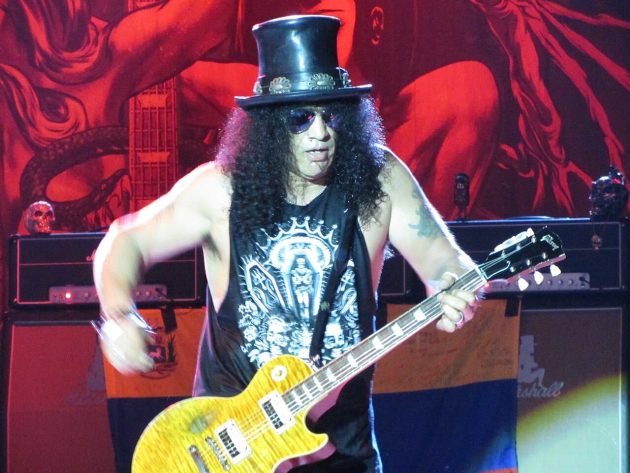
His top hat, amber Gibson Les Paul, and cascading solos turned him into a global icon before he was 25 years old.
As the lead guitarist of Guns N’ Roses, he helped create some of the most immediately recognizable songs in the history of hard rock.
The riffs he conjured on Appetite for Destruction rewrote the rules of the genre and put the Sunset Strip back on the world’s radar at a moment when many had written it off.
His playing is equal parts blues roots, raw aggression, and melodic instinct, a combination that very few guitarists in any era have managed to match.
He is a dual citizen of the United Kingdom and the United States, raised in Los Angeles from the age of six, yet proudly connected to his British heritage throughout his life.
Over four decades of recording and touring, he has played stadiums on every continent, collaborated with rock royalty, and survived personal battles that would have ended far lesser careers.
From the stripped-back fury of Appetite for Destruction to the blues-drenched grandeur of his 2024 album Orgy of the Damned, the catalog of Slash only grows deeper and more essential with every passing year.
This is the full story of the boy from London who became rock music’s most enduring guitar hero.
▶ Table of Contents (Click to Expand)
- Slash: Early Life and Musical Awakening
- Hollywood Rose and the Road to Guns N’ Roses
- Guns N’ Roses: The Rise to Global Stardom
- The Albums That Defined an Era
- Career Challenges and the Departure from GN’R
- Slash’s Post-GNR Projects: Snakepit and Velvet Revolver
- Slash Featuring Myles Kennedy and the Conspirators
- The Not in This Lifetime Reunion
- Recent Work and the Dirty Bats
- Slash’s Recognition, Awards, and Legacy
- Essential Discography
- Frequently Asked Questions
Slash: Early Life and Musical Awakening
Saul Hudson was born on July 23, 1965, in Hampstead, a leafy district in north London, England.
His mother, Ola Hudson, was an African American costume designer whose impressive client list included David Bowie, John Lennon, and the Pointer Sisters.
His father, Anthony Hudson, was an English artist who designed album covers for legends such as Joni Mitchell and Neil Young.
Growing up in a household where creativity and music were everyday currency, the young Saul absorbed blues and rock sounds long before he ever touched a guitar.
The nickname that would define his career came from actor Seymour Cassel, father of a childhood friend, who noted that Saul was always rushing from place to place.
In 1971, his family relocated to Los Angeles, eventually settling in Laurel Canyon, one of the city’s most artistically fertile and bohemian neighborhoods.
His parents separated when he was nine, and he moved in with his mother as she continued building a formidable reputation in the fashion and entertainment industries.
At middle school, Slash met Steven Adler, and the two bonded instantly over BMX bike racing before music came along to change both of their lives permanently.
In 1979, the pair hatched a plan to form a band, with Adler claiming the role of guitarist and Slash reluctantly opting to pick up the bass.
That changed the moment Slash walked into the Fairfax Music School and heard teacher Robert Wolin tear into “Brown Sugar” by the Rolling Stones, followed by a Cream song that stopped him cold.
He later recalled it as an immediate, life-altering revelation, switching from bass to guitar on the spot and never once looking back.
His grandmother handed him an old Spanish acoustic guitar with only a single string intact, and with that humble instrument, one of rock’s most consequential careers quietly began.
His grandmother had also been the one to introduce him to the blues at an early age, turning him on to the deep roots that would inform every note he ever played.
He abandoned school and devoted himself entirely to the guitar, practicing for up to twelve hours a day with an almost frightening single-mindedness.
In 1981, he co-founded his first official band, Tidus Sloan, playing instrumental covers of classic rock songs with a group of schoolmates.
By 1983, Slash and Adler, who had since switched to drums, formed Road Crew, pushing their abilities further along the cutthroat Los Angeles club circuit.
Hollywood Rose and the Road to Guns N’ Roses
The Los Angeles rock scene in the early 1980s was one of the most competitive in the world, with hundreds of acts fighting for stage time on the Sunset Strip each week.
Bands like Mötley Crüe had already established the Strip as the global capital of hard rock excess and ambition, raising the bar for every new act that dared to compete.
In 1983, Slash joined Hollywood Rose, a raw and electrifying band fronted by a volatile young vocalist named Axl Rose and featuring guitarist Izzy Stradlin.
The chemistry between Slash’s blues-rooted guitar instincts and Axl’s ferocious, operatic voice was unmistakable from the very first rehearsal.
After Hollywood Rose dissolved, Slash briefly played with a band called Black Sheep and made an unsuccessful audition for glam metal act Poison, a band he would later openly mock in interviews.
Axl Rose and Izzy Stradlin came calling once more, and in June 1985, alongside bassist Duff McKagan and drummer Steven Adler, Guns N’ Roses was officially formed.
The five-piece lineup brought together a collection of personalities with no real comparable chemistry anywhere else in hard rock at that particular moment.
They played sweaty nightclubs on the Strip and opened for larger acts, building a ferocious reputation for live performances that were as dangerous as they were thrilling.
Record labels quickly took notice, and by late 1986 the band entered the studio with producer Mike Clink to record their debut album.
Guns N’ Roses: The Rise to Global Stardom
When Appetite for Destruction was released on July 21, 1987, it did not immediately storm the charts.
After relentless touring and heavy MTV rotation, the album climbed the Billboard 200, eventually reaching number one and cementing its status as the best-selling debut album in American history, with over 30 million copies sold worldwide.
“Welcome to the Jungle” announced the band to the world with a riff that felt like the city itself was snarling, a statement of intent that no one could ignore.
“Sweet Child O’ Mine” became the band’s only number-one single on the Billboard Hot 100 and remains one of the most analyzed and beloved guitar intros in the history of the instrument.
Slash has said that the iconic circular riff was never intended as a song intro at all, but was simply a finger exercise he stumbled upon while warming up during rehearsal.
Total Guitar ranked that riff at number one on their “100 Greatest Riffs” list in 2004, a designation that captured its unique place in the popular imagination.
“Paradise City” became an enduring stadium anthem, its extended build and explosive finale capable of turning any arena into a communal explosion of emotion.
“Mr. Brownstone” showcased Slash’s genius for a riff that feels physically propulsive, a rhythmic lock with Adler’s drumming that very few rock recordings have ever matched.
“Rocket Queen” closed the debut with a raw, emotionally charged guitar solo that Axl Rose himself once described as one of the most honest and exposed moments on the entire record.
“Nightrain” and “It’s So Easy” were further proof that every corner of that debut record held something explosive and fully formed.
Axl Rose articulated Slash’s special appeal in a 1988 MTV interview, saying he played “from the heart rather than just trying to be the fastest,” and admitted he would sometimes sit at the front of the stage just to absorb Slash’s solos up close.
Furthermore, Slash’s session work expanded his reputation well beyond the GN’R universe during this period.
He played lead guitar on Michael Jackson’s “Give In to Me” from the 1991 album Dangerous, and later performed with Jackson at the 1995 MTV Video Music Awards on “Black or White.”
He also contributed to Lenny Kravitz’s funk-rocker “Always on the Run,” adding his signature tone to one of that era’s most celebrated rock singles outside the Guns N’ Roses catalog.
The Albums That Defined an Era
Following the explosive success of the debut, G N’ R Lies arrived in November 1988, a raw acoustic-electric hybrid that sold over five million copies in the United States alone.
“Patience” was the acoustic centerpiece of that release, with Slash’s restrained and melodic acoustic guitar work proving to anyone who had doubts that he was far more than a hard rock riff machine.
In September 1991, Guns N’ Roses simultaneously released Use Your Illusion I and Use Your Illusion II, a double-album statement that occupied both the top two spots on the Billboard 200 in its opening week.
Together, those albums contained some of the most ambitious material in hard rock history, stretching from fully orchestrated epics to stripped-back blues-punk directness.
“November Rain” stands as one of the most cinematic and emotionally overwhelming hard rock ballads ever committed to tape, and Guitar World ranked Slash’s solo in that song at number six on their “100 Greatest Guitar Solos” list in 2008.
“Estranged” was a nine-minute opus that stretched the boundaries of what a rock song could structurally and emotionally sustain, with Slash’s guitar building a landscape of longing and loss that few players could have navigated.
“You Could Be Mine” appeared on the soundtrack to Terminator 2: Judgment Day, connecting the band’s sound to one of the decade’s biggest cultural events and introducing them to a new generation of fans.
“Civil War” demonstrated a politically reflective dimension to the band, with Slash’s guitar weaving tension and urgency throughout a song built on historical weight.
“Don’t Cry” became one of the era’s most enduring rock ballads, while “Knockin’ on Heaven’s Door” elevated Bob Dylan’s original into a stadium-sized rock statement of real emotional power.
“Live and Let Die” brought Paul McCartney’s Bond theme thundering back to life with a relentless energy that redefined the song for a new decade entirely.
The Use Your Illusion Tour ran from 1991 to 1993 and became one of the longest and most financially successful concert tours in rock history at that point in time.
The Spaghetti Incident?, released in November 1993, was a punk and glam rock covers album that revealed the band’s roots and proved their range extended well beyond hard rock.
It was the final album to feature the classic GN’R lineup, completing one of the most remarkable runs of consecutive releases in the history of the genre.
Career Challenges and the Departure from GN’R
Behind the towering commercial success of Guns N’ Roses, serious and irreparable fractures were forming throughout the early 1990s.
Management disputes and creative disagreements repeatedly pitted Slash and Axl Rose against each other, creating an atmosphere of mistrust and resentment that eventually became impossible to contain.
Slash has spoken with candor about how years of alcohol and hard drug abuse compounded both the personal and professional pressures he was navigating simultaneously.
While the outside world saw only rock’s greatest band, the five men inside it were pulling in different creative and personal directions with increasing force.
In October 1996, Slash officially resigned from Guns N’ Roses, ending one of the most electrifying and generative creative partnerships in rock history.
Axl Rose rebuilt the band under the same name, eventually releasing Chinese Democracy in 2008 after a 15-year production process, a record that arrived without any of the classic members except Rose himself.
The personal cost of the rock and roll lifestyle arrived with full force in 2001, when doctors diagnosed Slash with cardiomyopathy, a serious form of congestive heart failure, directly linked to his years of substance abuse.
Physicians initially gave him between six days and six weeks to live, a prognosis that served as a brutal and undeniable wake-up call.
He survived through intensive physical therapy and the surgical implantation of a defibrillator, a device that quite literally kept his heart functioning through the worst of it.
He also endured the death of his mother, Ola Hudson, who passed away from lung cancer, a loss that prompted him to quit smoking permanently.
His first marriage, to model and actress Renée Suran in 1992, ended in divorce in 1997.
A second marriage to Perla Ferrar in 2001 produced two sons, London and Cash Hudson, before that relationship also ended in divorce in 2014.
Since 2015, Slash has been in a long-term relationship with Meegan Hodges, and by all accounts the stability has reflected positively in both his personal and creative output.
Slash’s Post-GNR Projects: Snakepit and Velvet Revolver
Even before his formal departure from Guns N’ Roses, Slash had formed Slash’s Snakepit in 1994 as a direct creative outlet for material that did not fit within the GN’R framework.
The project’s debut album, It’s Five O’Clock Somewhere, was released in 1995 and showcased Slash leading a tight hard rock unit with a leaner, more direct sound than his main band had employed.
A second Snakepit album, Ain’t Life Grand, followed in 2000, with a harder and more confident tone that signaled Slash reclaiming his creative footing on his own terms.
In contrast, the bigger and more commercially significant chapter of his post-GN’R years arrived with Velvet Revolver, a supergroup he formed in 2002 alongside fellow GN’R veterans Duff McKagan, Matt Sorum, and guitarist Dave Kushner.
The band recruited Scott Weiland, the acclaimed frontman of Stone Temple Pilots, as their lead vocalist, creating one of the most anticipated supergroup pairings of the decade.
Their debut album, Contraband, released in June 2004, debuted at number one on the Billboard 200 and marked the best opening week for a new rock act in the SoundScan era up to that point.
The single “Slither” topped both the Billboard Mainstream Rock and Modern Rock charts and earned the band the Grammy Award for Best Hard Rock Performance in 2005.
A second album, Libertad, followed in 2007, but growing tensions between band members and Weiland’s ongoing personal struggles led to Velvet Revolver dissolving in 2008.
Significantly, Weiland passed away on December 3, 2015, making any future Velvet Revolver reunion impossible and closing that chapter of Slash’s career permanently.
These years nonetheless proved conclusively that Slash’s commercial instincts and artistic drive remained sharp and fully intact, entirely independent of his GN’R legacy.
Slash Featuring Myles Kennedy and the Conspirators
In 2009, Slash began recording his first proper self-titled solo album, released through Roadrunner Records in April 2010 to considerable commercial success.
The record was a guest-vocalist showcase featuring performances from Ozzy Osbourne, Lemmy Kilmister, Chris Cornell, Fergie, Iggy Pop, and many others, each bringing a distinctive personality to their individual tracks.
The self-titled debut entered the Billboard 200 at number three, confirming that Slash’s name alone could generate commercial success at the highest level of the album market.
Two of the album’s tracks featured Myles Kennedy, the Alter Bridge frontman, whose vocal range and musical instincts meshed with Slash’s guitar voice so naturally that the pairing became the cornerstone of everything that followed.
The subsequent touring cycle with Kennedy cemented the working relationship, and Slash Featuring Myles Kennedy and the Conspirators was born as a permanent and ongoing band.
Their debut album together, Apocalyptic Love, arrived in May 2012, a harder and more cohesive record than the collaborative debut and one that earned widespread critical praise for its directness.
The follow-up, World on Fire, landed in September 2014 and debuted at number ten on the Billboard 200, confirming the band as a genuine commercial force in their own right.
Living the Dream followed in 2018, marking Frank Sidoris’s first full contribution as a studio member of the group.
4 arrived in February 2022 via Gibson Records in partnership with BMG, further cementing the band’s reputation for hard-driving, riff-centered rock that rewards repeated listening.
Explore more about the creative partnership behind these records in this dedicated ClassicRockArtists.com Slash and Myles Kennedy feature.
In May 2024, Slash released his sixth solo album, Orgy of the Damned, through Gibson Records, fulfilling a lifelong ambition to record a dedicated blues album.
The record’s tracklist was a tour through the blues canon, taking in Robert Johnson, Howlin’ Wolf, Muddy Waters, Willie Dixon, Albert King, and Stevie Wonder alongside an extraordinary roster of guest vocalists.
Guest contributors included Brian Johnson of AC/DC, Chris Stapleton, Billy Gibbons of ZZ Top, Gary Clark Jr., Paul Rodgers, Iggy Pop, Beth Hart, and Demi Lovato, among others.
Recorded with producer Mike Clink and his former Blues Ball bandmates Johnny Griparic and Teddy Andreadis, the album was tracked live in the room with a spontaneity that gave it real documentary energy.
It debuted atop the Billboard Blues Albums chart and showcased a depth of musical understanding that stretched comfortably beyond his hard rock reputation.
To support the release, Slash launched the S.E.R.P.E.N.T. Festival, a North American summer tour designed to celebrate blues music and raise funds for racial justice and social equity organizations.
The Not in This Lifetime Reunion
For nearly two decades, a Guns N’ Roses reunion involving the classic lineup was considered one of rock music’s great impossibilities.
The breakdown between Slash and Axl Rose had been so acrimonious and so public that many observers simply could not imagine the two men sharing a stage again.
In December 2015, Billboard reported that Slash and Duff McKagan would rejoin the band to headline Coachella 2016, ending more than 20 years of speculation with a single announcement that shook the rock world.
On April 1, 2016, Slash played with Guns N’ Roses for the first time in 23 years at a secret warm-up gig at the Troubadour in Los Angeles, the same venue where they had built their early reputation.
The Not in This Lifetime Tour that followed became one of the highest-grossing concert tours in history, generating $584 million by the time it concluded in 2019.
In 2021, Slash appeared on “Absurd” and “Hard Skool,” the first studio recordings to feature him alongside Axl and Duff since 1994.
In 2023, the band headlined the Glastonbury Festival in England and the Power Trip Festival in Indio, California, two of rock music’s most significant bookings in recent memory.
The band also released two brand-new singles that year, “Perhaps” and “The General,” signaling that original studio material from the reunited lineup was finally within reach.
Watch Slash discuss Guns N’ Roses’ new music and upcoming tour plans in this candid interview.
In a Guitar World interview, Slash noted that the reunion is approaching its tenth year in March 2026, an achievement that continues to surprise even those inside the band.
He has described a proper reunited studio album as something that feels inevitable, adding that the whole band is thinking about it and that it will happen when the right creative spark arrives.
Recent Work and the Dirty Bats
Guns N’ Roses carried their reunion energy deep into 2025, continuing to tour globally and building anticipation for a long-awaited original studio album from the reformed classic lineup.
The Guns N’ Roses 2025 world tour took the band across major stadiums as their reunion era entered a genuinely remarkable tenth year of continued relevance and commercial power.
Keep track of all upcoming shows on the Guns N’ Roses 2026 tour page as the band shows absolutely no signs of slowing down.
In December 2025, Slash made headlines by performing under the new band name The Dirty Bats alongside Duff McKagan, producer and guitarist Andrew Watt, and Red Hot Chili Peppers drummer Chad Smith.
Those December shows became the talk of the rock world when surprise guests including Bruno Mars, Brandi Carlile, Anthony Kiedis, Yungblud, and Eddie Vedder joined the band onstage across multiple nights.
The Dirty Bats residency served as yet another reminder that Slash remains one of the most in-demand collaborators in rock, capable of pulling together a cast that bridges generational and genre lines.
His life and guitar legacy have also been examined in a dedicated documentary feature exploring the full arc of his musical journey.
The ongoing headline appearances of Guns N’ Roses confirm that this reunion has moved well beyond simple nostalgia and into a genuine second creative chapter for all involved.
Full coverage of upcoming shows and tour announcements is available through the ClassicRockArtists.com tours section.
Slash’s Recognition, Awards, and Legacy
In 2012, Slash was inducted into the Rock and Roll Hall of Fame as a member of Guns N’ Roses, receiving one of the highest honors the music industry can bestow.
Time magazine placed him as runner-up to Jimi Hendrix on their “10 Best Electric Guitar Players” list in 2009, perhaps the most prestigious individual ranking ever attached to his name.
Rolling Stone placed him at number 65 on their “100 Greatest Guitarists of All Time” list in 2011.
Guitar World ranked his solo in “November Rain” at number six on their “100 Greatest Guitar Solos” list in 2008.
Total Guitar placed his riff in “Sweet Child O’ Mine” at number one on their “100 Greatest Riffs” list in 2004.
Gibson Guitar Corporation ranked him at number 34 on their “Top 50 Guitarists of All Time,” while their readers placed him at number nine on Gibson’s own “Top 25 Guitarists” poll.
Velvet Revolver’s “Slither” earned the band the Grammy Award for Best Hard Rock Performance in 2005, adding a major individual Grammy win to his extensive collection of accolades.
He has also been recognized individually as Best Guitarist of the Year by major publications, adding personal honors that exist entirely outside of his band-based achievements.
He maintains a personal collection of over 100 guitars, and Gibson has released multiple Slash signature Les Paul models that have become some of the company’s most sought-after instruments.
MXR produced a Slash Octave Fuzz signature pedal that has become a popular piece of hardware among guitar players at every level of experience and ambition.
His influence extends across several generations of players, from grunge to modern hard rock and beyond, inspiring guitarists to approach the instrument with a rawness and emotional honesty that pure technique alone can never teach.
Discover the full archive of classic rock artist biographies at ClassicRockArtists.com for more deep-dive profiles on the legends who shaped an era.
Also explore our comprehensive guide to the members of Black Sabbath, another group whose dark, heavy influence helped forge the path that Slash and his entire generation would follow.
Essential Discography
The following albums represent the essential core of Slash’s recorded output, both with Guns N’ Roses and as a solo and collaborative artist.
- Appetite for Destruction (1987) — The best-selling debut album in American history and the foundation on which every subsequent GN’R achievement was built, featuring some of the most iconic guitar work in the hard rock canon.
- G N’ R Lies (1988) — A raw acoustic-electric hybrid that proved the band’s range extended well beyond hard rock ferocity and sold over five million copies in the United States.
- Use Your Illusion I (1991) — An ambitious and emotionally expansive double-disc release that showed the band operating at their most cinematic and complex.
- Use Your Illusion II (1991) — The companion volume to its twin release, packed with some of the era’s most enduring hard rock anthems and ballads.
- The Spaghetti Incident? (1993) — A punk and glam rock covers album that revealed the underground roots beneath the band’s polished commercial exterior.
- Chinese Democracy (2008) — A long-delayed release that arrived without Slash but remains a significant and divisive chapter in the Guns N’ Roses story.
- Slash (2010) — His guest-vocalist-laden solo debut, featuring Ozzy Osbourne, Chris Cornell, and Myles Kennedy, debuting at number three on the Billboard 200.
- Apocalyptic Love (2012) — The first full studio record from Slash Featuring Myles Kennedy and the Conspirators, a hard rock declaration of continued intent.
- World on Fire (2014) — A critically praised and commercially successful record that debuted at number ten on the Billboard 200 and solidified the Conspirators as a real and lasting band.
- Orgy of the Damned (2024) — His debut blues album, an all-star collaborative tribute to the music that first turned him on to the guitar, debuting atop the Billboard Blues Albums chart.

Appetite For Destruction

Use Your Illusion I & II

Greatest Hits

G N’ R Lies

Chinese Democracy

The Spaghetti Incident?
▶ Shop All Guns N’ Roses Albums and Official Merch on Amazon
Frequently Asked Questions
What is Slash’s real name?
Slash was born Saul Hudson on July 23, 1965, in Hampstead, London, England.
He received the nickname “Slash” as a child from actor Seymour Cassel, who observed that young Saul was always in a hurry and dashing from place to place.
Why did Slash leave Guns N’ Roses?
Slash left Guns N’ Roses in October 1996 after years of mounting personal and professional tension with frontman Axl Rose, driven largely by management disputes and incompatible creative directions.
Both men have since acknowledged that the forces driving them apart were deeply rooted and far more complex than any single incident or decision.
What is Slash’s most famous guitar solo?
Guitar World ranked his solo in “November Rain” at number six on their “100 Greatest Guitar Solos” list in 2008, making it arguably his most critically celebrated individual performance.
Total Guitar also ranked the opening riff from “Sweet Child O’ Mine” at number one on their “100 Greatest Riffs” list in 2004, giving Slash arguably the two most recognized pieces of guitar playing in the hard rock genre.
Is Slash still a member of Guns N’ Roses?
Yes, Slash officially rejoined Guns N’ Roses in 2016 for the Not in This Lifetime Tour and has remained an active and central member of the band ever since.
The band released new studio recordings in 2021 and 2023 and continues to perform at the stadium level, with a full reunited studio album widely anticipated in the near future.
What guitar does Slash play?
Slash is most closely associated with the Gibson Les Paul, particularly his sunburst model from the Appetite for Destruction era, which has become one of the most recognized guitars in the history of rock music.
Gibson has released multiple Slash signature Les Paul models over the years, all of which have become highly desirable instruments among players at every level worldwide.
For more information, visit Slash’s official website, follow Slash on Facebook, or explore the official Guns N’ Roses website.
Discover more essential artists and classic rock deep dives across our full 80s classic rock coverage at ClassicRockArtists.com.
From a grandmother’s battered single-string guitar in a Laurel Canyon apartment to the Rock and Roll Hall of Fame, the story of Slash is proof that instinct, soul, and an unbreakable devotion to the instrument can build something truly permanent in rock music.