

Buckethead: The Definitive Biography of Rock’s Most Mysterious Guitar Genius
Buckethead is one of the most extraordinary guitarists in rock history, a masked enigma who has spent more than three decades redefining what a single musician can accomplish.
Behind the KFC bucket and expressionless white mask is Brian Patrick Carroll, born May 13, 1969, a Southern California native whose technical mastery and limitless creative output have earned him a permanent place among guitar’s all-time greats.
From a four-year run as lead guitarist for Guns N’ Roses to an astonishing solo catalog that now exceeds 700 releases, Buckethead has built one of the most genuinely unusual careers in modern music.
He blends shredding, funk, blues, jazz, and ambient soundscapes with a live stage presence built around nunchaku skills and robot dancing.
Guitar World credited Buckethead with “ushering in a new era of virtuosity” and ranked his debut album among the 50 greatest moments in electric guitar history.
The magazine has also listed him among the 50 fastest guitarists of all time, a distinction he shares with only a handful of players in any era.
Whether you discovered him through Guitar Hero II, the Chinese Democracy era of Guns N’ Roses, or his vast Pikes catalog, few artists have carved a path as singular, disciplined, and relentlessly productive.
No other musician in rock history has released more than 700 original projects while simultaneously maintaining a reputation for genuine technical excellence.
This is the complete, authoritative biography of Buckethead: from his childhood bedroom in Southern California to the stages of Rock in Rio and beyond.
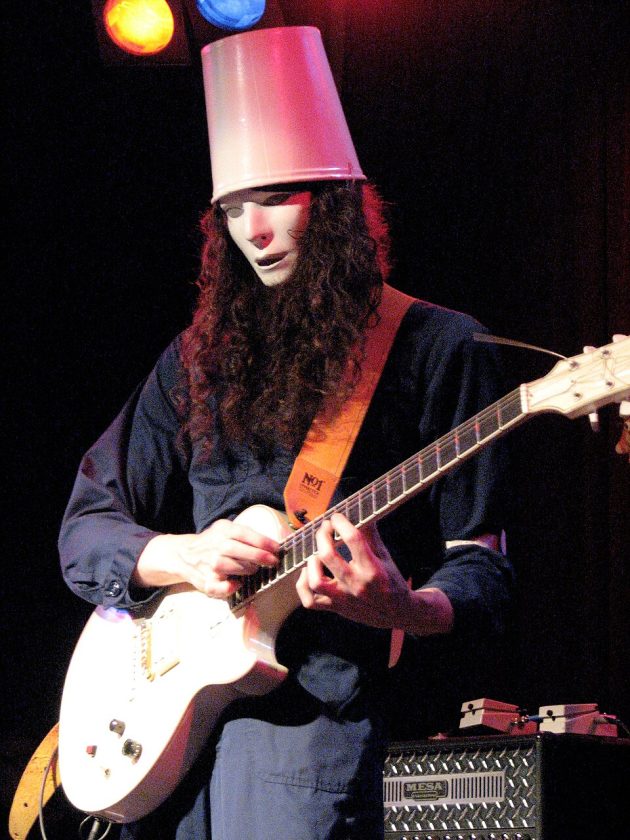
Table of Contents (Click to Expand)
- Buckethead: Early Life and the Birth of a Persona
- First Band: The Deli Creeps and Praxis
- Buckethead and Guns N’ Roses: The Peak Years
- The Solo Years: Buckethead’s Prolific Empire
- Career Challenges: Health and Personal Loss
- The Revival: Return to the Stage
- Buckethead’s Legacy: Recognition and Accolades
- Essential Discography
- Frequently Asked Questions
Buckethead: Early Life and the Birth of a Persona
Brian Patrick Carroll was born on May 13, 1969, in La Verne, California, the youngest of five siblings including Lynn, Lisa, Lori, and John.
His father, Tom Carroll, served as athletic director at Damien High School in La Verne from 1973 until his retirement in 2013.
Growing up near Disneyland in a Southern California suburb, young Carroll was a self-described introvert who spent most of his time alone with books, games, and martial arts movie memorabilia.
He also spent considerable time at Disneyland itself, an influence that would later color much of his conceptual and compositional world.
He picked up the guitar at age 12, learning initially from an elderly neighbor before his family relocated from Huntington Beach to Claremont, California.
In Claremont, his playing accelerated rapidly through lessons at a local music store, where his teachers included Joey Tafolla and a young Paul Gilbert, both of whom pushed his technique into elite territory.
In 1988, he entered a home recording of his original composition “Brazos” into a Guitar Player magazine contest and finished as a runner-up.
The magazine’s editor, Jas Obrecht, was so moved by Carroll’s demo tape that he tracked the family down at a nearby restaurant to personally encourage him to pursue music professionally.
Guitar Player described the then-unknown Carroll as “an astonishingly skilled guitarist” with “post-Paul Gilbert speed and accuracy” and “a psychotronic, demonic edge very far removed from the clichés of classical metal.”
The Buckethead persona was born the same year after Carroll watched Halloween 4: The Return of Michael Myers and immediately purchased a white Michael Myers-style mask.
Later that evening, while eating Kentucky Fried Chicken, he placed the empty bucket on top of his head alongside the mask and walked to a mirror.
He later recalled saying to himself, “Buckethead. That’s Buckethead right there,” and from that moment he committed entirely to maintaining the character in all public appearances.
By 1991, Obrecht and Carroll had become close enough friends that Carroll moved into Obrecht’s basement, deepening his professional connections in the Bay Area music scene.
Browse Buckethead Albums and Merch on Amazon
First Band: The Deli Creeps and Praxis
Before Buckethead became a solo recording force, he developed his craft in a series of bands that operated at the outer edge of rock, metal, and avant-garde music.
His first recorded band was Class-X, a group he left in 1988 after his Guitar Player recognition began opening new doors.
By 1990, he had formed the Deli Creeps, a theatrical hard rock band that became his primary live vehicle through the early 1990s.
The Deli Creeps’ 1991 demo tape, titled “Tribal Rites,” showcased the raw, technically fearless playing that would define his early reputation in underground music circles.
In 1991, Buckethead also contributed to avant-garde guitarist Derek Bailey‘s Company free improvisation project alongside free-jazz luminary John Zorn, resulting in a triple album called Company 91.
In 1992, Zorn released Buckethead’s debut solo album, Bucketheadland, on his Japanese Avant record label, introducing the character to an international audience for the first time.
Though available only as a costly import, Bucketheadland received positive critical reviews and brought him to the attention of prolific bassist and producer Bill Laswell.
In 1992, Laswell formed the supergroup Praxis with Buckethead, funk legend Bootsy Collins, keyboardist Bernie Worrell, and drummer Brain.
Praxis’s debut album, Transmutation (Mutatis Mutandis), released that same year, demonstrated Buckethead’s ability to thrive in a funk-metal context that few conventional rock guitarists could have navigated.
In 1993, he auditioned to replace John Frusciante in the Red Hot Chili Peppers, a position that ultimately went to Arik Marshall and later Dave Navarro.
By the mid-1990s, he appeared on film soundtracks for Johnny Mnemonic and the Mortal Kombat series, broadening his reach well beyond the underground music world.
In 1999, he released Monsters and Robots, a groundbreaking collaboration with Les Claypool of Primus, which became his best-selling album to that point and generated his first-ever music video.
Buckethead and Guns N’ Roses: The Peak Years
No chapter in Buckethead’s story drew more mainstream attention than his four-year tenure as lead guitarist for Guns N’ Roses, one of the most commercially powerful and culturally significant rock bands in history.
Guns N’ Roses had built its legend in the late 1980s and early 1990s with a catalog of era-defining recordings, including the hard-charging opener Welcome to the Jungle, the explosive anthem Paradise City, and the guitar masterpiece Sweet Child O’ Mine.
By the late 1990s, extensive lineup changes had reshaped the band entirely, and frontman Axl Rose was assembling a new roster to complete the long-delayed Chinese Democracy album.
Buckethead officially joined in March 2000, stepping into a role previously held by guitar icon Slash, whose departure had left a void many believed could never be filled.
The rock world watched with intense curiosity, uncertain how an artist defined by a KFC bucket and a horror film mask would fit inside the Guns N’ Roses brand.
Those doubts dissolved quickly during live performances in 2001 and 2002, where Buckethead delivered technically breathtaking renditions of classics that the audience knew by heart.
He performed show-stopping versions of beloved GN’R tracks including the driving rocker Mr. Brownstone, the orchestral power ballad November Rain, and the laid-back masterpiece Patience, impressing even the most skeptical Slash loyalists.
He also brought ferocity to fan favorites like Nightrain, the politically charged Civil War, and the iconic cover Knockin’ on Heaven’s Door with a precision that silenced most remaining critics.
The band performed high-profile shows across two legs of what would eventually be called the Chinese Democracy Tour, including a landmark appearance at Rock in Rio 3 and a memorable slot at MTV’s Video Music Awards.
In the studio, Buckethead’s contributions to the Chinese Democracy album were substantial and far-reaching, appearing on all but two of the final album’s 14 tracks.
He received writing credits on three songs: “Shackler’s Revenge,” “Scraped,” and “Sorry,” with “Shackler’s Revenge” later appearing in the video game Rock Band 2.
His guitar solo on “There Was a Time” drew immediate critical admiration upon the album’s release, with Guitar World and Total Guitar readers both citing it among the finest guitar solos of the 21st century.
The album itself contained eleven separate guitar solos credited to Buckethead, a body of work that represented some of the most focused and technically accomplished playing of his career.
His relationship with the band became increasingly erratic through late 2003 and early 2004, with Rose describing him as having “left” and “rejoined” the band multiple times without notifying anyone.
In March 2004, Buckethead departed Guns N’ Roses permanently, with his manager citing the band’s inability to complete the album or sustain a consistent tour schedule as the central reasons for the break.
Chinese Democracy was ultimately released in November 2008, more than four years after his departure, and immediately generated discussion about Buckethead’s guitar contributions as among the album’s highlights.
Despite the tensions that defined his exit, his tenure with GN’R remains a celebrated and much-discussed chapter in both his personal history and in the band’s long, complicated story.
The Solo Years: Buckethead’s Prolific Empire
Even during his time with Guns N’ Roses, Buckethead had continued releasing solo material at a pace that defied industry convention, and after his departure he returned full focus to building one of the most remarkable solo catalogs in recording history.
In 2005, he released Enter the Chicken through Serj Tankian‘s Serjical Strike label, an album that introduced key fan favorites including “Nottingham Lace” and “Three Fingers,” the latter appearing on the soundtrack to Saw II.
In 2006, his composition “Jordan” was featured as an unlockable bonus track in the massively popular video game Guitar Hero II, introducing his music to an entirely new generation of listeners who had never heard of Bucketheadland or Praxis.
That same year, Crime Slunk Scene introduced “Soothsayer,” written as a tribute to his Aunt Suzie, which has since become one of the most emotionally celebrated instrumental guitar pieces of the past quarter century.
In February 2010, Gibson released a Buckethead Signature Les Paul guitar in his honor, placing him alongside the most prestigious names in electric guitar history.
In 2011, he launched what would become his defining project: the Pikes series, available through his official website at Bucketheadpikes.com.
Each Pike is a mini-album approximately 30 minutes long, numbered sequentially like a comic book issue, and covering an extraordinary range of styles from face-melting heavy metal to delicate acoustic fingerpicking to sprawling ambient soundscapes.
By October 2024, the series had reached 662 Pike albums, including nearly 300 live recordings, making it the largest sustained solo output by any guitarist in rock history.
In 2014, he released 60 albums averaging one new release every six days, and in 2015 he pushed that output further, releasing 118 albums at a rate of roughly one every three days.
Additionally, his alter ego Death Cube K, a photographic negative version of the Buckethead persona described as a dark apparition from his nightmares, has released seven separate studio albums of its own.
In 2015, Buckethead launched the Silver Shamrock Series, releasing one dark ambient album per day throughout October and culminating in a 31-album Halloween collection that was later released on a pumpkin-themed USB drive.
Fans can follow updates on his releases and appearances through his official Facebook page and on Instagram.
Career Challenges: Health and Personal Loss
Despite his extraordinary creative output, Buckethead has navigated serious personal and health challenges that shaped his trajectory in profound ways.
In 1998, he released Colma, a deeply personal acoustic album dedicated entirely to his mother, who was battling colon cancer at the time.
The album is widely regarded as some of the most emotionally unguarded work he has ever committed to record.
In 2010, a back injury forced him off the road and into a prolonged recovery, with his final live performance before a four-year hiatus taking place on December 31, 2012.
During a rare out-of-character interview in October 2017, Brian Carroll revealed that he had been diagnosed with a potentially life-threatening condition called cardiac arrhythmia.
He underwent a cardiac ablation procedure and uses ongoing medication to manage the condition, which he has described as a source of significant personal fear and uncertainty.
His father, Tom Carroll, passed away in September 2014 at age 84 after a long career at Damien High School.
His mother, Nancy York Carroll, also passed away during this same period, a loss he addressed directly through the music, releasing dedicated Pike albums in memory of both parents.
In contrast to many rock figures who have struggled privately, Buckethead processed his grief almost entirely through his music, turning personal devastation into a torrent of creative work.
The Revival: Return to the Stage
After four years away from live performance, Buckethead returned to touring in 2016 to an enthusiastic underground fan base that had never stopped growing during his absence.
His return shows demonstrated that his technical abilities had remained fully intact, drawing strong reviews and confirming that the time away had not dulled his edge.
In 2017, he embarked on a fall US tour with a full live band, including longtime collaborator Brain on drums and Dan Monti on bass, a departure from his usual solo stage format.
Also in 2017, he announced the vinyl release of Live from Bucketheadland, his first official live album, giving both longtime fans and new listeners a physical document of his performing power.
Buckethead continued touring the United States through 2018 and 2019, returning to his traditional solo performance format.
Watch him demonstrate his extraordinary technique in this raw and electrifying footage: Buckethead Plays a Gloriously RAW Guitar Solo.
In 2023, he returned to one of the most astonishing release paces of his career, issuing 119 Pike albums across the year.
For fans still closely following the band that first introduced him to wider audiences, the Guns N’ Roses 2026 tour continues a separate chapter of that story without him, though the GN’R legacy he helped shape remains firmly intact.
Classic rock fans who appreciate the world of prolific, constantly evolving band histories may also find the deep member guides for groups like the members of Black Sabbath and the members of Motorhead rewarding companions to the Buckethead story.
Buckethead’s Legacy: Recognition and Accolades
The accolades for Buckethead have accumulated steadily across decades, even without the commercial promotional infrastructure that typically drives mainstream industry recognition.
Guitar World ranked the 1992 release of Bucketheadland the 45th greatest moment in electric guitar history, citing how the album signaled the arrival of a genuinely new kind of virtuosity.
The magazine has also placed him on its lists of the 50 fastest guitarists of all time and the 25 all-time weirdest guitarists, both categories he occupies with complete authority.
His guitar solo on “There Was a Time” from Chinese Democracy has appeared on multiple polls ranking the finest guitar solos of the 21st century, a recognition that arrived more than four years after he had already left the band.
Gibson’s decision to release a signature Les Paul model in his honor in February 2010 placed him in the company of guitar’s most celebrated names, a distinction reserved for only a small group of players in each generation.
His composition “Jordan,” which exists officially only in the Guitar Hero II version, has become one of the most analyzed and celebrated guitar pieces in modern shred culture despite having no conventional studio release.
“Soothsayer,” from Crime Slunk Scene, is routinely cited by guitarists as one of the most emotionally devastating instrumental pieces of the past 25 years, a reputation built entirely on word of mouth and online sharing.
Significantly, Buckethead has built this entire legacy without mainstream award campaigns, industry events, or commercial radio support.
His cult following has grown through live performance, digital distribution, and sheer output: a model of artistic independence that few musicians of any era have matched.
Essential Discography
The following albums represent the essential starting points for anyone approaching Buckethead’s vast catalog for the first time.
Browse Buckethead Albums and Merch on Amazon
- Bucketheadland (1992) — His debut album, released on John Zorn’s Avant label; Guitar World ranked its release the 45th greatest moment in electric guitar history, a milestone that announced a genuinely new kind of playing to the world.
- Colma (1998) — A deeply personal acoustic album dedicated to his mother during her battle with colon cancer; widely regarded as the most emotionally affecting and human record in his entire body of work.
- Monsters and Robots (1999) — A collaborative powerhouse with Les Claypool of Primus that became his best-selling release, featuring the track “The Ballad of Buckethead” and his first-ever music video.
- Enter the Chicken (2005) — Released through Serj Tankian’s label, this album produced “Nottingham Lace” and “Three Fingers,” two of the most celebrated pieces in his catalog, and reached a broader audience than almost any prior solo release.
- Chinese Democracy (2008) — The Guns N’ Roses album where Buckethead’s guitar work appears on 11 of 14 tracks, including his critically praised solo on “There Was a Time,” recorded years before the album’s eventual release.
- Crime Slunk Scene (2006) — The album that contains “Soothsayer,” written in tribute to his Aunt Suzie and now considered one of the most powerful instrumental guitar pieces of the modern era.
- Electric Sea (2012) — A sweeping ambient record that demonstrated the full range of his compositional vision well beyond the high-speed shredding for which he is primarily known.
As an Amazon Associate, I earn a small commission on qualifying purchases made through my links, at no extra cost to you. Thank you in advance for your support.
Browse Guns N’ Roses Albums and Merch on Amazon
Frequently Asked Questions
Who is Buckethead?
Buckethead is the stage name of Brian Patrick Carroll, an American guitarist born on May 13, 1969, in La Verne, California.
He performs wearing a KFC bucket on his head and a plain white mask inspired by the 1988 horror film Halloween 4: The Return of Michael Myers.
He has released over 700 albums across a solo career spanning more than three decades, including more than 660 entries in his ongoing Pikes mini-album series.
Why did Buckethead leave Guns N’ Roses?
Buckethead departed Guns N’ Roses in March 2004 after approximately four years as lead guitarist.
His manager cited the band’s inability to complete a full album or maintain a consistent touring schedule as the primary drivers of the split.
Despite leaving before the album was finished, his guitar work appeared throughout Chinese Democracy when the record was finally released in November 2008, more than four years later.
What is the Buckethead Pikes series?
The Pikes series is a collection of mini-albums, each roughly 30 minutes long, that Buckethead began releasing in 2011 through his own label infrastructure.
Each Pike is numbered sequentially like a comic book issue and covers an astonishing breadth of styles, from heavy metal shredding to ambient electronic textures to solo acoustic performances.
As of October 2024, over 662 Pike albums have been released, making it the largest sustained solo output by any guitarist in rock history.
What guitar does Buckethead play?
Buckethead is most closely associated with the Gibson Les Paul, and in February 2010, Gibson released a dedicated signature model in his honor.
He is also known for using custom guitars, heavy whammy bar technique, and extensive effects chains that include various wah and delay pedals throughout his live and studio work.
What is Buckethead’s real name?
Buckethead’s real name is Brian Patrick Carroll.
He rarely breaks character in public contexts and has maintained the Buckethead persona consistently since first creating it in 1988.
For a full look at his complete catalog and career timeline, the official Buckethead Wikipedia page is the most comprehensive publicly available reference.
Few guitarists in history have combined the technical brilliance, creative ambition, and relentless discipline of Buckethead, and his influence on modern guitar culture continues to deepen with every new Pike he releases into the world.