

Jim Morrison Books: The Complete Reading Guide
If you want to understand Jim Morrison, the jim morrison books that matter most are not just biographies written about him but the poetry and prose he wrote himself, and a remarkable shelf of first-hand accounts from the people who were there.
Morrison died in Paris on July 3, 1971, at age 27, but the written record he left behind, and the books that followed his death, built a literary legacy that outlasted every piece of conventional rock mythology.
Whether you are starting from the beginning or filling in gaps in a collection you have been building for years, this guide covers every essential title.
To understand the full band story behind all of these books, our complete guide to the members of The Doors provides the essential context.
Quick Navigation
Jim Morrison Books: Where to Start
Jim Morrison is one of the most written-about figures in rock history, and the books about him range from essential to exploitative.
The best place to start depends on what you want: if you want the life story, begin with the Hopkins and Sugerman biography.
If you want Morrison on his own terms, go directly to his poetry.
If you want the inside account from someone who played on every record, pick up one of the three Doors memoirs written by his bandmates.
What distinguishes Morrison from almost every other rock star of his era is that he arrived in music from literature, not the other way around.
He studied film at UCLA, read Nietzsche, Rimbaud, and William Blake, and self-published his own poetry chapbooks before The Doors had a record contract.
The books about him are inseparable from the music because he insisted, from the beginning, that he was primarily a poet who happened to perform.
The Doors’ music has been preserved and repackaged extensively over the decades, most recently in the Dolby Atmos Blu-Ray six-album set, which gives new life to the sonic world these books describe.
Browse Jim Morrison Books on Amazon.ca
No One Here Gets Out Alive: The Essential Biography
“No One Here Gets Out Alive” by Jerry Hopkins and Danny Sugerman is where almost every serious Doors fan begins, and for good reason.
Published in 1980 by Warner Books, it spent weeks on the New York Times bestseller list and is widely considered the best-selling rock biography ever written.
It covers Morrison’s childhood in a military family, his film school years at UCLA, the formation of The Doors, six studio albums, and his death in Paris at 27.
Hopkins brought journalistic discipline to the project; Sugerman brought the personal proximity of someone who had worked in The Doors’ office as a teenager and known Morrison in the flesh.
The combination gives the book a quality that very few band biographies achieve: it reads like a novel but is anchored in reported fact.
It has been criticized in some quarters for hagiography, particularly in its treatment of Morrison’s worst behavior, but no other single volume gives you as complete a picture of his life and context.
The book was a significant influence on Oliver Stone’s 1991 film The Doors, which introduced the band to yet another generation.
Its influence on how Morrison is understood culturally, as a rock martyr and serious poet rather than simply a troubled singer, is impossible to overstate.
It remains the essential starting point for anyone new to the jim morrison books canon.
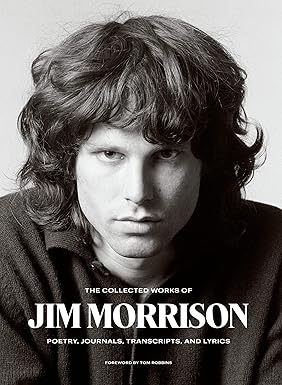
Morrison’s Own Voice: His Poetry and Prose
Morrison’s own writing is the most overlooked part of his legacy and the most rewarding for readers willing to meet him on his own terms.
The Lords and the New Creatures was first published in 1969 (as two separate chapbooks, The Lords and The New Creatures) and combined into a single volume in 1971.
“The Lords” is a collection of dense, aphoristic prose poems about cinema, mass media, and the relationship between spectacle and power.
“The New Creatures” is more lyrical and personal, full of the American Southwest imagery, highway imagery, and death imagery that saturates The Doors’ best records.
It is not casual reading, but it is the clearest window into how Morrison thought.
Wilderness: The Lost Writings of Jim Morrison, published posthumously in 1988, collects poems, journal entries, and prose fragments assembled from the notebooks Morrison left behind.
A second volume, The American Night: The Writings of Jim Morrison, followed in 1990.
Together they represent the most complete picture of his inner life available anywhere.
The poems range from striking to uneven, as you would expect from unedited notebooks, but the moments of genuine power are frequent enough to justify reading both volumes straight through.
Morrison also recorded a spoken word album, An American Prayer, in 1969 and 1970.
The surviving Doors members released it as an album in 1978, setting the recordings to new music they composed specifically to accompany his voice.
It is not a book, but it functions as one: a 57-minute reading of Morrison’s poetry that belongs alongside the written volumes.
For a sense of the musical context these poems lived inside, our breakdown of Light My Fire covers the songwriting dynamics that shaped everything The Doors recorded from 1967 onwards.
Books by The Doors Members
Three of the four Doors wrote memoirs, and all three are worth reading.
Together they provide something the Hopkins/Sugerman biography cannot: the perspective of the people who were in the room for every recording session, every concert, and every crisis.
John Densmore‘s “Riders on the Storm: My Life with Jim Morrison and the Doors” (1990) is the most emotionally direct of the three.
Densmore is candid about both his love for Morrison and his frustration with the destruction Morrison brought on himself and the band.
The title is drawn from one of The Doors’ most enduring tracks, which you can read about in detail in our piece on Riders on the Storm.
Densmore also wrote a second book, “The Doors: Unhinged” (2013), focused on the legal battle he fought against Krieger and Manzarek over the use of the Doors name after Morrison’s death.
Ray Manzarek‘s “Light My Fire: My Life with the Doors” (1998) is the longest and most ebullient of the three member memoirs.
Manzarek writes with obvious joy about the music and with evident grief about Morrison’s decline.
His account of the band’s formation is particularly vivid, and his technical descriptions of how Manzarek built the keyboard bass lines that replaced a traditional bassist are the best available explanation of what made The Doors sound so unusual.
Robby Krieger’s “Set the Night on Fire: Living, Dying, and Playing Guitar with the Doors” (2021) is the most recent and, in many ways, the most balanced.
Krieger had the advantage of hindsight and wrote it with the perspective of someone who had outlived most of the principal figures.
His account of writing “Light My Fire” at Morrison’s request, as a song about nature, and of the creative process across all six albums is essential for anyone who cares about how these records were actually made.
Krieger continues to perform and honor the band’s legacy, as our coverage of his Morrison Hotel Revival in Los Angeles documents.
You can explore the full collection of jim morrison books at the official Morrison estate site at jimmorrison.com/books, which also lists currently available editions of his poetry and prose.
For an introduction to the music discussed throughout all of these books, the band’s complete discography can be browsed on Amazon.
A useful video overview of Morrison’s literary legacy is available on YouTube.
Affiliate Disclosure: As an Amazon Associate, I earn from qualifying purchases. This means that if you click on a link to a classic rock album or piece of gear on this site and make a purchase, I may receive a small commission at no extra cost to you. This helps support classicrockartists.com and allows me to keep providing deep-dive content on the legends of rock. Thank you for your support!
Collector’s Corner: Build Your Jim Morrison Library
If you are building a complete Jim Morrison shelf, the essential five are: No One Here Gets Out Alive, The Lords and the New Creatures, Wilderness, Densmore’s Riders on the Storm, and Krieger’s Set the Night on Fire.
That combination gives you the biography, Morrison’s own voice, and three different insider perspectives on the same band from three different angles.
Everything else on the list builds outward from that core.
Browse Jim Morrison Books on Amazon.ca
Frequently Asked Questions About Jim Morrison Books
What is the best Jim Morrison biography?
“No One Here Gets Out Alive” by Jerry Hopkins and Danny Sugerman (1980) is the most widely read and is generally considered the definitive starting point. For a more critical and nuanced perspective, John Densmore’s “Riders on the Storm” (1990) and Robby Krieger’s “Set the Night on Fire” (2021) provide valuable counterpoints from the people who actually played alongside Morrison every night.
Did Jim Morrison write any books?
Morrison published two poetry chapbooks during his lifetime: The Lords (1969) and The New Creatures (1970), later combined as “The Lords and the New Creatures” (1971). After his death, two volumes of his notebooks were published: “Wilderness: The Lost Writings of Jim Morrison” (1988) and “The American Night” (1990). He also recorded spoken word poetry, released posthumously as the 1978 album “An American Prayer.”
What is Wilderness by Jim Morrison?
“Wilderness: The Lost Writings of Jim Morrison” is a posthumous collection of poems, notebook entries, and prose fragments published in 1988 by Villard Books. It was assembled from the notebooks and personal papers Morrison left behind at his death in 1971. A second volume, “The American Night,” followed in 1990. Together they represent the most complete collection of Morrison’s unpublished writing.
What order should I read Jim Morrison books?
A recommended reading order for newcomers: start with “No One Here Gets Out Alive” for the biographical foundation, then move to “The Lords and the New Creatures” to hear Morrison’s own voice, then pick up one of the three Doors member memoirs depending on whether you want the drummer’s perspective (Densmore), the keyboardist’s (Manzarek), or the guitarist’s (Krieger). The Wilderness volumes work best once you have the biographical context in place.
From his early poetry chapbooks to the posthumous collections that keep appearing decades after his death, the jim morrison books that matter most are the ones that push back against the myth and let you encounter the actual thinking, writing, and music of one of rock’s most complicated figures.