

No One Here Gets Out Alive: The Jim Morrison Biography
“No One Here Gets Out Alive” is the best-selling rock biography ever published, a book that did something almost no biography manages to do: it brought a dead rock star back to life.
First published in 1980, nine years after Jim Morrison’s death in Paris, it turned a fading cult into a full-blown cultural phenomenon and introduced the members of The Doors to an entirely new generation of fans who hadn’t been alive when “Light My Fire” first hit the radio.
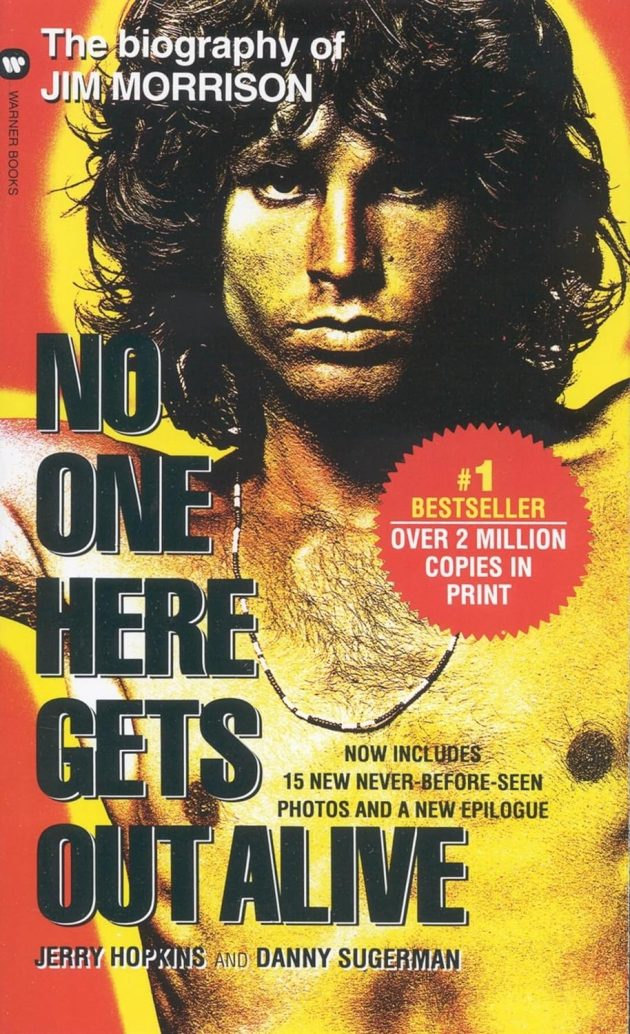
Get No One Here Gets Out Alive on Amazon.ca
Affiliate Disclosure: I am an Amazon affiliate and if you purchase through any amazon links on this site i may earn a small commission at no extra charge to you.
Quick Navigation
What is No One Here Gets Out Alive?
“No One Here Gets Out Alive” is the definitive biography of Jim Morrison, the singer, poet, and frontman of The Doors.
Written by rock journalist Jerry Hopkins and Doors insider Danny Sugerman, the book covers Morrison’s life from his childhood in a U.S. Navy family through his rapid rise with The Doors, his artistic output, his battles with alcohol, and his death at 27 in Paris on July 3, 1971.
It was first published by Warner Books in 1980 and has remained in print continuously for over four decades.
It is widely considered the most commercially successful rock biography of all time.
The Authors: Jerry Hopkins and Danny Sugerman
Jerry Hopkins was a veteran rock journalist who had written extensively for Rolling Stone magazine throughout the 1970s.
He had begun research on a Morrison biography in the years following the singer’s death, interviewing dozens of people who had known him personally and professionally.
Hopkins had previously written an Elvis Presley biography and brought serious journalistic discipline to the project.
Danny Sugerman’s story is remarkable in its own right.
He began working in The Doors’ office as a 12-year-old fan, answering their fan mail, and eventually became their de facto office manager as a teenager.
He knew Morrison personally, spent time with the band throughout their career, and carried that access and intimacy into the book.
After Hopkins had assembled a draft he couldn’t get published, Sugerman came aboard and reshaped the manuscript with personal anecdotes and an insider’s perspective that gave the book its emotional heat.
The combination worked precisely because it fused journalism and lived experience.
Hopkins brought rigor and distance; Sugerman brought proximity and feeling.
The result is a biography that reads more like a novel than a research document, which is both its greatest strength and, occasionally, a source of criticism from those who felt Sugerman’s adoration of Morrison colored some of the portraiture.
How No One Here Gets Out Alive Changed Rock History
By 1980, The Doors were a fading memory for most of the music industry.
Their three post-Morrison albums, Other Voices (1971) and Full Circle (1972) and the live compilation Weird Scenes Inside the Gold Mine, had not restored the band’s commercial standing.
Ray Manzarek, Robby Krieger, and John Densmore had pursued individual projects with limited mainstream visibility.
The publication of “No One Here Gets Out Alive” changed that almost immediately.
The book climbed to the top of the New York Times bestseller list and stayed there for weeks.
It sold millions of copies across multiple editions and triggered a surge in Doors record sales that label Elektra had not seen since Morrison’s death.
Teenagers who had been born after Morrison died were buying The Doors on vinyl because of a paperback book.
That revival set the stage for everything that followed: the 1991 Oliver Stone film “The Doors,” the ongoing commercial success of the band’s catalog, and the enduring cultural image of Jim Morrison as one of rock’s archetypal tragic figures.
The book was the engine of that entire second chapter.
Robby Krieger has acknowledged the book’s importance to the band’s legacy in various interviews over the years, including in the context of his own renewed live work, which you can read about in our coverage of his full Morrison Hotel Revival in Los Angeles.
The book also paved the way for other Doors memoirs, most notably John Densmore’s “Riders on the Storm,” which takes its title from the closing track of the band’s final album with Morrison.
Inside the Book: What You’ll Find
The biography moves chronologically, beginning with Morrison’s childhood as the son of U.S. Navy Admiral George Stephen Morrison.
Jim was born in Melbourne, Florida, in 1943, and the family moved frequently with his father’s postings.
The book establishes early how profoundly Morrison felt alienated from the discipline and authority of his family background and how that tension drove both his artistic ambition and his self-destructive tendencies.
The account of The Doors’ formation at UCLA’s film school, where Morrison met Ray Manzarek in 1965, is one of the most-quoted passages in rock biography.
Manzarek heard Morrison reciting poetry on a Venice Beach rooftop and recognized something extraordinary in the combination of imagery and delivery.
The band that followed that meeting recorded six studio albums in five years and produced some of the most sonically distinctive and lyrically unusual music in rock history.
Hopkins and Sugerman do not spare the reader from Morrison’s deterioration.
The weight gain, the public intoxication, the famous 1969 Miami incident where Morrison was arrested on stage, and the increasing difficulty of recording sessions are all covered with clarity and without sentimentality.
The Paris chapters, covering Morrison’s final months living on the Rue Beautreillis with Pamela Courson, are quiet and melancholy in a way the rest of the book rarely is.
The book also gives substantial space to Morrison’s poetry and film work, arguing consistently that he saw himself primarily as a poet and filmmaker, not as a rock star.
That argument shapes how the whole biography positions him, not as a casualty of rock excess but as a serious artist who happened to find his audience through music.
Whether readers accept that framing is part of what makes the book endlessly debatable fifty years on.
You can watch a video tribute and discussion of the book’s legacy on YouTube and read the full publication history on Wikipedia.
For a complete timeline of The Doors’ music across all six studio albums, the Doors Dolby Atmos Blu-Ray release offers an excellent starting point for understanding what the band actually recorded together.
If you want to start with the music before or alongside the biography, the song that first made Morrison a household name is a good entry point: our deep-dive into Light My Fire covers the songwriting story and legacy in full.
Affiliate Disclosure: As an Amazon Associate, I earn from qualifying purchases. This means that if you click on a link to a classic rock album or piece of gear on this site and make a purchase, I may receive a small commission at no extra cost to you. This helps support classicrockartists.com and allows me to keep providing deep-dive content on the legends of rock. Thank you for your support!
Collector’s Corner: Get No One Here Gets Out Alive
“No One Here Gets Out Alive” has been published in numerous editions since 1980, including standard paperback, hardcover, and updated anniversary printings.
Any edition is worth owning, but if you are buying new, the most recent printings include a preface by Sugerman that adds useful hindsight about the book’s impact and his own complicated relationship with Morrison’s legacy.
It belongs on the shelf of anyone seriously interested in The Doors, in 1960s rock history, or in the literature of creative self-destruction.
Affiliate Disclosure: I am an Amazon affiliate and if you purchase through any amazon links on this site i may earn a small commission at no extra charge to you. This helps support classicrockartists.com and allows me to keep providing deep-dive content on the legends of rock. Thank you for your support!
Get No One Here Gets Out Alive on Amazon.
Frequently Asked Questions About No One Here Gets Out Alive
Who wrote No One Here Gets Out Alive?
“No One Here Gets Out Alive” was written by journalist Jerry Hopkins and Doors insider Danny Sugerman. Hopkins conducted most of the original research and interviews in the 1970s. Sugerman collaborated on the manuscript and brought firsthand experience of the band to the project, having worked in The Doors’ office from a young age.
When was No One Here Gets Out Alive published?
The book was first published in 1980 by Warner Books, nine years after Jim Morrison’s death in Paris on July 3, 1971. It has remained in print continuously since its original publication and has been through multiple revised and anniversary editions.
Is No One Here Gets Out Alive accurate?
The book is generally regarded as the definitive starting point for understanding Morrison’s life, but it has been critiqued over the years for hagiographic tendencies, particularly in Sugerman’s sections, which are colored by his personal admiration for Morrison. Some details have been disputed by other Doors members and associates. It is an essential read, but serious fans typically pair it with John Densmore’s memoir Riders on the Storm and Robby Krieger’s Set the Night on Fire for a more complete and sometimes contrasting picture.
What does the title No One Here Gets Out Alive mean?
The title captures the fatalistic spirit at the heart of Morrison’s personality and worldview. He was preoccupied with mortality from an early age, and the phrase reflects the dark existentialist streak that runs through both his lyrics and his poetry. The title signals from the first page that this is not a conventional rock star success story.
Did No One Here Gets Out Alive become a film?
The book directly influenced Oliver Stone’s 1991 biographical film “The Doors,” in which Val Kilmer played Jim Morrison. While the film was not a direct adaptation, Stone drew heavily on the book’s account of Morrison’s life and character. Danny Sugerman was involved as a consultant. The film renewed mainstream interest in The Doors in much the same way the book had a decade earlier.
More than four decades after it first appeared, “no one here gets out alive” remains the essential entry point for anyone who wants to understand what Jim Morrison was, what The Doors built, and why both still matter.