

Led Zeppelin Kashmir stands as one of the most ambitious and awe-inspiring compositions in the history of rock music, a nine-minute journey through hypnotic riffs and orchestral grandeur.
Released in 1975 on the double album Physical Graffiti, Kashmir was the track that Jimmy Page and Robert Plant both cited as their single greatest achievement together.
The song was inspired by a drive through the Saharan desert in southern Morocco, an experience that left Plant and Page searching for a musical equivalent to the vast, timeless landscape they had witnessed.
Affiliate Disclosure: I am an Amazon affiliate and if you purchase through any Amazon links on this site I may earn a small commission at no extra charge to you. This helps support ClassicRockArtists.com. Thank you for your support!
Quick Navigation
What is the meaning of Led Zeppelin Kashmir?
Despite its title, Kashmir was not inspired by the Himalayan region of Kashmir but rather by a drive Robert Plant and Jimmy Page took through the Sahara Desert in Morocco.
The name Kashmir was chosen because it evoked the same sense of ancient mystery and geographical enormity that Plant experienced while staring out at the endless desert horizon.
Lyrically the song is a spiritual travelogue, with Plant describing a journey through a vast, otherworldly landscape where the traveler feels both lost and profoundly connected to something greater than himself.
The recurring image of “the land of ice and snow” and “the road to the sun” suggests a transcendent journey that exists outside of ordinary time and geography.
The Vibe: Genre, Mood, and Sound of Led Zeppelin Kashmir
Kashmir occupies a genre category essentially its own, blending hard rock power with orchestral sweep, Eastern musical scales, and a hypnotic cyclical structure unlike anything else in rock.
The song feels genuinely ancient and futuristic at the same time, simultaneously primitive in its groove and sophisticated in its arrangement.
- Genre: Hard rock, orchestral rock, world music influences
- Mood: Epic, mysterious, transcendent, hypnotic
- Tempo: Slow, powerful, relentlessly forward-moving
- Key Instruments: Electric guitar, Mellotron, orchestral strings, drums, bass
- If you like this, try: Pink Floyd’s Wish You Were Here, The Who’s Won’t Get Fooled Again, Deep Purple’s Child in Time
Behind the Lyrics
Plant wrote the lyrics in 1973 after the Moroccan road trip, sitting with his images of endless desert and an almost religious sense of awe at the landscape.
The opening lines about traveling to lands of ice and snow are deliberately paradoxical given the song’s desert origin, suggesting a journey that transcends any specific geography.
The lyric “all will be revealed” has a distinctly mystical quality that Plant has attributed to his interest in Eastern spirituality and the writings of Aleister Crowley that he and Page shared at the time.
The repeated chant of “oh let the sun beat down upon my face” carries an almost religious fervor, as if the narrator is surrendering himself to a force larger than himself.
Plant’s vocal performance is among the most commanding of his career, starting with measured restraint and building to ecstatic proclamations over the swelling orchestration.
The imagery of “ships of wonder” and a “road that winds ahead” keeps the journey deliberately abstract, allowing listeners to project their own sense of spiritual quest onto the words.
Despite being nearly nine minutes long, the lyrics never feel padded or repetitive, each verse adding a new dimension to the traveler’s experience.
Recording Story and Production
The basic guitar riff was written by Jimmy Page as early as 1973, but the track took two years to fully develop before being recorded for Physical Graffiti.
Page tuned his guitar to an open DADGAD tuning, which gave the riff its distinctive droning, Middle Eastern quality that conventional Western tuning could not have achieved.
The recording sessions took place at Headley Grange in Hampshire and at Island Studios in London, with engineer Keith Harwood playing a crucial role in capturing the song’s massive sound.
John Bonham’s drumming on Kashmir is a masterpiece of control and power, playing a three-against-four polyrhythmic pattern against Page’s guitar riff that creates the song’s irresistible forward momentum.
John Paul Jones arranged the orchestral string and brass parts that were overdubbed at a later session, creating a wall of sound that transformed the already powerful track into something truly cinematic.
Jones also contributed the Mellotron parts that weave through the verses, adding an ethereal, quasi-Eastern color to the arrangement.
Page played the guitar through Marshall amplifiers at high volume to capture the full weight of the riff, with the natural room acoustics of Headley Grange contributing significantly to the sound.
Producer Jimmy Page oversaw every element of the recording with meticulous care, ensuring that each component of the arrangement served the song’s overarching grandeur.
Chart Performance and Legacy
Kashmir was never released as a single, yet it became one of the most celebrated tracks in rock history, a consistent fan and critical favorite from the moment Physical Graffiti arrived in stores.
Physical Graffiti debuted at number one on the Billboard 200 and the UK Albums Chart in February 1975, becoming the first album ever to debut at number one in the United States.
Rolling Stone ranked Kashmir among the 500 Greatest Songs of All Time and has repeatedly cited it as one of the defining achievements of 1970s rock.
Jimmy Page and Robert Plant performed Kashmir with an Egyptian and Moroccan orchestra at their 1994 No Quarter reunion, an extraordinary live rendering that Plant has called one of the highlights of his entire career.
Puff Daddy sampled Kashmir’s orchestral arrangement for his 1998 tribute to the Notorious B.I.G., bringing the song to a new generation of listeners and demonstrating its cross-genre reach.
The song’s guitar riff is consistently cited by rock guitarists as one of the most influential and studied in the entire canon of rock music.
Led Zeppelin performed Kashmir at their 2007 reunion concert at the O2 Arena in London, where it received one of the longest standing ovations of the night.
Listener’s Note: A Personal Take on Led Zeppelin Kashmir
The first time you hear that guitar riff come in against Bonham’s drums you understand immediately that you are in the presence of something genuinely different from everything else in rock music.
The way the polyrhythm works creates a feeling of being pulled forward by an irresistible current, as if the music itself has its own gravity.
When the strings come in for the first time the emotional impact is almost physical, a sudden expansion of the sonic world that makes you want to turn the volume up rather than down.
Plant’s voice at its peak in this song is extraordinary. There is a genuine sense of transport in his delivery, as if he really did find himself somewhere transcendent while writing these words.
Nine minutes passes in what feels like moments. That is the sign of a truly great piece of music.
Affiliate Disclosure: I am an Amazon affiliate and if you purchase through any Amazon links on this site I may earn a small commission at no extra charge to you. This helps support ClassicRockArtists.com. Thank you for your support!
Collector’s Corner: Own Led Zeppelin Kashmir on Vinyl or CD
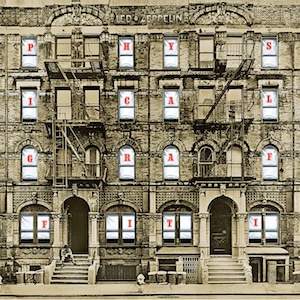
Physical Graffiti’s original 1975 double-LP pressing on Swan Song Records is among the most sought-after pieces of vinyl in classic rock collecting, with its distinctive die-cut sleeve making it immediately recognizable.
Remastered editions overseen by Jimmy Page offer superior audio quality and include detailed liner notes about the recording sessions.
Get Led Zeppelin Physical Graffiti on Vinyl or CD at Amazon
Frequently Asked Questions About Led Zeppelin Kashmir
Is Kashmir actually about Kashmir?
No. Despite the title, Kashmir was inspired by a drive Robert Plant and Jimmy Page took through the Sahara Desert in Morocco, not the Himalayan Kashmir region. The title was chosen for its evocative, exotic sound rather than geographic accuracy.
What guitar tuning does Jimmy Page use on Kashmir?
Jimmy Page tuned his guitar to DADGAD, an open tuning that creates the droning, modal quality of the main riff. This tuning gives the guitar a distinctly Eastern character that standard tuning cannot achieve.
What album is Kashmir on?
Kashmir appears on Led Zeppelin’s Physical Graffiti, a double album released in February 1975 on Swan Song Records. It is widely considered one of the greatest rock albums ever made.
You Might Also Like
Led Zeppelin Kashmir stands as one of the most ambitious compositions in rock history, a track that transcends its era and continues to inspire musicians and listeners across generations. Read about Kashmir on Wikipedia.
Continue your classic rock journey: Led Zeppelin Stairway to Heaven (1971) and Pink Floyd Wish You Were Here (1975).