

Joan Jett picked up a guitar as a teenager and decided, with complete certainty, that she was going to make rock and roll her life, whether the music industry wanted her or not.
Quick Navigation
Joan Jett Before the Blackhearts: A Rebel From the Start
Joan Jett was born Joan Marie Larkin on September 22, 1958, in Wynnewood, Pennsylvania, and spent her earliest years growing quietly restless in the American suburbs.
Her family moved to Rockville, Maryland in 1967, and then relocated again to West Covina, California in 1974, and that second move cracked something permanently open.
California gave her access to a guitar teacher, a record store, and a local music scene feeling the first tremors of punk rock rising from the clubs of Los Angeles.
She dropped the surname Larkin and became Joan Jett during that California chapter, choosing a name that felt like it belonged on a marquee from the first day she used it.
She found the world of rock and roll completely compelling, listened obsessively to the Rolling Stones, the New York Dolls, and the garage acts that valued attitude over studio polish.
She started playing guitar with a focus that signaled she was not treating this as a pastime, and the people around her recognized quickly that her commitment was different in kind from the usual teenage enthusiasm.
Joan Jett was hunting for a sound and a scene, and at 15 she was already certain she had found both.
The Runaways: Where Joan Jett Learned to Lead
At 16, Joan Jett co-founded The Runaways with drummer Sandy West in 1975, and the concept was genuinely radical: an all-female teenage rock band playing hard, raw music in a genre controlled almost entirely by men.
Manager Kim Fowley shaped the band’s provocative image and helped them land a record deal, but Joan Jett was the musical engine from the beginning, writing songs and pushing the sound toward the hard rock she wanted to make.
The classic lineup included Lita Ford on lead guitar, Jackie Fox on bass, Cherie Currie on vocals, and Jett on rhythm guitar, and the friction between their individual talents produced some of the most urgent rock recordings of the decade.
The Runaways released five albums between 1976 and 1979, finding a level of recognition in Japan that American radio simply refused to offer, and they were treated in Tokyo with the kind of stadium-scale adulation that the industry back home was withholding.
During a UK tour in 1976, Joan Jett first heard the original “I Love Rock ‘n Roll” by Arrows on a British television program, and the song lodged itself so deep in her memory that she spent the next six years waiting for the right moment to record it.
The Runaways also gave Joan Jett something no music school could teach: the experience of writing real songs under real pressure, performing for real crowds, and understanding exactly what kind of rock and roll she was built to make.
By 1979, the band had run its course, but everything Joan Jett became afterward was built on what The Runaways had put in place.
The Runaways Break Up and Joan Jett Stands Alone
The Runaways dissolved in 1979, leaving Joan Jett without a band, without a label, and without a clear path forward in an industry that had already decided she was a niche proposition.
She relocated to Long Beach, New York, and connected with producer and manager Kenny Laguna, who would become the most important collaborator of her entire career.
The two began recording demos immediately, with Laguna recognizing something in Joan Jett’s voice and guitar playing that the rest of the industry seemed committed to overlooking.
Twenty-three major record labels rejected the resulting album, some of them without even listening to the full demo, and every rejection closed a door on what they assumed was a dead-end career.
Joan Jett responded to that wall of rejection the same way she responded to every obstacle: by deciding it was completely irrelevant to what she was going to do next.
She and Laguna took the album and began pressing it independently, selling copies out of car trunks and at the merchandise tables of venues that were willing to let her play.
The refusal to accept the industry’s verdict was not stubbornness for its own sake: it was a clear-eyed reading of the situation by someone who understood that the music was good and that the problem was entirely on the other side of the desk.
Blackheart Records: Joan Jett’s DIY Revolution
Joan Jett and Kenny Laguna founded Blackheart Records in 1980, creating an independent label after the major system made its position unmistakably clear.
They pressed the debut album themselves, distributed it through unconventional channels, and operated with none of the infrastructure and all of the determination of something that had every logical reason to fail.
Blackheart Records eventually grew into one of the most enduring independent labels in rock, releasing music by artists including Metal Church and Big Daddy Kane and surviving every shift in the industry that came after it.
The label is still operating today, still independently owned by Joan Jett, and still releasing music on her terms, which is a quietly staggering achievement in an industry that has swallowed hundreds of independent operations whole.
The DIY ethos that Blackheart represented in 1980 was not a marketing angle or a calculated counterculture move: it was survival, built out of necessity by someone who had run out of other options.
That it became a philosophy for generations of musicians who followed, a template for how to build a career when the system refuses to provide one, is one of Joan Jett’s most lasting contributions to rock and roll beyond the recordings themselves.
Blackheart Records turned rejection into infrastructure, and the label is still standing because Joan Jett never gave anyone else the authority to decide when it was done.
Bad Reputation: The Album That Started Everything
The self-titled debut album, later reissued and known universally as Bad Reputation, arrived in 1980 and announced a sound that was blunt, immediate, and completely confident in what it was trying to do.
The title track became one of the defining songs of her career, a first-person declaration of indifference to outside opinion delivered with a guitar tone that made the sentiment feel physically true.
The production by Kenny Laguna and Ritchie Cordell kept everything stripped down and direct, with nothing between the listener and the energy of the performance.
The record built its fanbase the slow way, one converted listener at a time, passed between people who recognized what they were hearing and wanted everyone around them to hear it too.
“Bad Reputation” became the theme for NBC Sunday Night Football from 2006 to 2015, reaching an American audience of tens of millions every week, and it was the entrance music UFC fighter Ronda Rousey used throughout her career.
A song recorded as an act of defiance became a cultural shorthand for fearlessness that traveled across sports, film, and television without losing any of its original charge.
The 2018 documentary Bad Reputation took her full story to a new generation and received a theatrical release that introduced Joan Jett’s history to fans too young to have lived through the original Runaways era.
Joan Jett and I Love Rock n Roll: Seven Weeks at Number One
Joan Jett and the Blackhearts released “I Love Rock ‘n Roll” in late 1981, and it climbed to the top of the Billboard Hot 100 in early 1982, where it remained for seven consecutive weeks.
That is not a chart run that happens by accident: it happens when a song finds the exact frequency the culture is tuned to and refuses to let go, and “I Love Rock ‘n Roll” connected with everything that audiences who had been waiting for an uncomplicated rock anthem were missing from the radio.
The I Love Rock ‘n Roll album followed the single to number 2 on the Billboard 200, the highest chart position of her recording career and the commercial confirmation that the sound she had been building since 1975 was exactly right.
The song had been originally recorded by British band Arrows in 1975, and Joan Jett had heard it during the Runaways UK tour the following year, recognizing it immediately as a song she was eventually going to make her own.
The Recording Academy inducted “I Love Rock ‘n Roll” into the Grammy Hall of Fame in 2016, and Rolling Stone has included it among the greatest songs ever recorded, placing it at number 56 on their all-time chart.
While Rick Springfield and other rock acts dominated the early MTV era, Joan Jett held the top spot on the singles chart longer than almost any rock performer at that point in pop history.
The song made her a mainstream star, but it was a mainstream success built entirely on her terms, with her own label, her own production team, and a recording that sounded nothing like what the industry that rejected her would have asked her to make.
Crimson and Clover and the Power of the Cover
“Crimson and Clover,” originally recorded by Tommy James and the Shondells in 1968, gave Joan Jett her second top-ten single in 1982 and revealed something important about how her musical mind worked.
She had a gift for finding songs that contained more energy than their original recordings had ever released, and her versions consistently felt like discoveries rather than retreads of familiar material.
The guitar on her recording, distorted and tremolo-drenched, turned a psychedelic pop song into something that belonged completely to the early 1980s rock landscape she was helping to define.
Her approach to cover material was never reverential: it was possessive, and listeners heard songs they already knew as if for the first time with every arrangement choice pointing toward intensity rather than nostalgia.
She was doing something similar to what Pat Benatar was doing on the same radio dial at the same moment, carving out female-fronted hard rock territory that had not previously existed in the mainstream of American commercial radio.
Both artists were proving that a woman with a guitar and a fully developed point of view could compete at the top of the chart without diluting the music into something more acceptable to industry gatekeepers.
Joan Jett’s cover choices became a signature element of her catalog, with each selection reflecting the same instinct that drove her to record “I Love Rock ‘n Roll” in the first place: knowing exactly which song needed to be louder.
The Band Behind the Name: The Blackhearts
Joan Jett and the Blackhearts have operated since 1979 with one consistent anchor: Joan Jett herself, with every other lineup position shifting around her across the decades without disrupting the essential character of the band.
The group has included dozens of musicians over the years, but the core experience of seeing them live has always revolved around Jett’s guitar playing, her complete command of a stage, and the white Gibson Melody Maker she has played since 1977.
She purchased that Melody Maker from singer Eric Carmen, and it became one of the most recognizable instruments in rock history, appearing on virtually every album cover and concert photograph from her career.
The Blackhearts have shared stages with acts as varied as Billy Idol and Bruce Springsteen, performed at every major rock festival on the circuit, and maintained a touring schedule that has rarely gone quiet for more than a year at a stretch.
Rolling Stone placed Joan Jett on their list of greatest guitarists in both 2003 and 2023, which is a consistency of recognition across a twenty-year span that very few performers in any genre can claim.
Her playing style is not built on technical complexity: it is built on precision, feel, and the kind of economy that makes every note land exactly where it needs to land in order to make the song work at maximum force.
The band has always been a vehicle for the music rather than a personality contest, and that clarity of purpose is part of why Joan Jett and the Blackhearts have outlasted most of the acts that shared the charts with them in 1982.
Light of Day, Acting, and the Broader Vision
In 1987, Joan Jett starred alongside Michael J. Fox in the film Light of Day, directed by Paul Schrader, playing a musician caught between family obligation and the call of the road.
Roger Ebert praised her performance, noting a natural screen presence that suggested she could have pursued acting as a primary career had she chosen to redirect her energy in that direction.
She appeared in the 2000 Broadway production of The Rocky Horror Show in the role of Columbia, and later provided a voice performance for the animated series Steven Universe, demonstrating a range that extended well beyond the stage.
When The Runaways biopic was released in 2010, with Kristen Stewart portraying Joan Jett and Dakota Fanning as Cherie Currie, Jett served as executive producer and worked to ensure the story was told with the accuracy it deserved.
These projects were not distractions from music: they were natural extensions of a creative identity that was never confined to a single format and that approached storytelling with the same directness as the guitar playing.
Her film and television work also expanded her audience beyond the rock fanbase, reaching viewers who may have encountered Joan Jett’s name and presence long before they discovered the records.
I Hate Myself for Loving You and the Late 1980s
“I Hate Myself for Loving You,” released in 1988 from the platinum album Up Your Alley, peaked at number 8 on the Billboard Hot 100 and earned Joan Jett her first Grammy nomination for Best Rock Performance.
The album proved that she could sustain a mainstream rock presence across an entire decade of dramatic changes in the industry, from the early MTV era through the arena rock peak and into the commercial landscape of the late 1980s.
The song was later adapted as the melody for the NBC Sunday Night Football opening theme, giving her music a weekly audience of tens of millions of American viewers from 2006 to 2015.
Millions of people heard Joan Jett’s composition every Sunday night for nearly a decade without necessarily tracing the melody back to her name, which is a quiet form of cultural saturation that very few artists ever achieve.
The late 1980s also saw her producing records for other artists, including work with punk pioneers The Germs and a production collaboration with Bikini Kill on the New Radio +2 EP in 1994, connecting her to the riot grrrl movement that cited her as a foundational influence.
That connection to younger punk and alternative artists was not a calculated attempt to remain relevant: it was a natural result of Joan Jett having been doing something the riot grrrl generation recognized as theirs long before they had words for it.
Joan Jett and Activism: USO Tours and Animal Rights
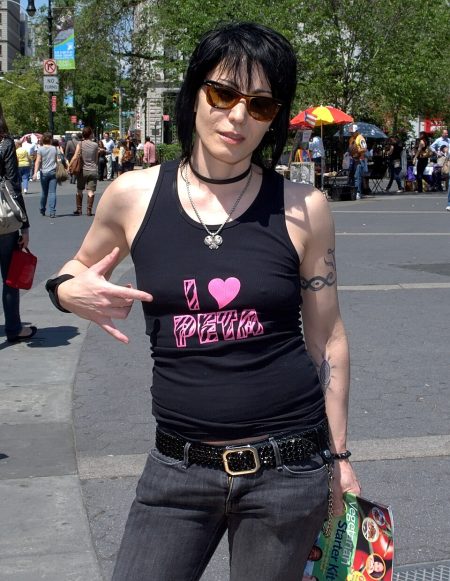
Joan Jett has been a PETA supporter and practicing vegetarian since the late 1980s, and her advocacy for animal rights has been consistent, public, and entirely integrated into her public identity across four decades of rock stardom.
She was the first artist to sign an open letter in Billboard magazine calling for legislative action on gun violence in June 2016, a decision that cost her nothing with her fanbase and that made her position on the issue impossible to misread.
She has toured with the USO for more than twenty years, performing for active military personnel and veterans at bases and military academies across the country, a commitment that stands alongside her music as a long-term practice rather than a one-time gesture.
After the 1993 murder of Gits vocalist Mia Zapata in Seattle, Joan Jett worked closely with the surviving band members to record an album under the name Evil Stig, with all proceeds directed toward the investigation that eventually led to the killer’s capture and conviction in 2003.
These causes are not separate chapters from the music career: they are continuous with the values that drove Joan Jett to record “Bad Reputation” in the first place and that keep her on the road when most artists of her era have long since settled into a reduced schedule.
The through-line from the sixteen-year-old who co-founded The Runaways to the activist who signs open letters in trade publications is the same refusal to be passive in the face of something that needs to change.
The Rock and Roll Hall of Fame: A Legacy Confirmed
Joan Jett and the Blackhearts were inducted into the Rock and Roll Hall of Fame in 2015, a recognition that arrived decades after it was apparent to anyone paying attention that she belonged there.
Her induction speech and performance that night were entirely characteristic: direct, energetic, grateful without any trace of sentiment, and followed immediately by a full-band set that reminded the room why the honor existed.
The previous year, in April 2014, she had joined surviving members of Nirvana on stage at the Rock Hall ceremony to perform “Smells Like Teen Spirit”, one of several women invited to honor the band alongside Kim Gordon, Lorde, and St. Vincent.
That performance demonstrated the regard in which the generation after her held Joan Jett, musicians who had grown up understanding that the path through a closed door was to build your own door, exactly as she had done with Blackheart Records in 1980.
She received the Golden God Award from Metal Hammer magazine in 2014, becoming the first woman to receive the honor, and the Long Island Music Hall of Fame added her in 2006.
Rolling Stone’s inclusion of Joan Jett on their list of the greatest guitarists in both 2003 and 2023 is a confirmation separated by twenty years, which is not the kind of recognition that fades with changing tastes: it is the kind that hardens into historical fact.
Joan Jett Today: Touring, New Music, and the Road Ahead
Joan Jett released Unvarnished in 2013, her first studio album of new material in nearly a decade, followed by Changeup in 2022, her first acoustic album, and the six-song Mindsets EP in 2023.
The official Joan Jett website remains the primary hub for news, releases, and announcements from a career that shows no indication of pulling back into a legacy-act mode.
In 2024, Virgin Atlantic named an Airbus A330-900 “Joan Jet,” embedding the pun in the aircraft’s official identity, which is the kind of cultural recognition that goes well beyond music industry charts or award ceremonies.
She stays connected to her audience through Instagram, where she shares music, causes, and the kind of direct communication that fits a performer who has always preferred straight lines to managed distances.
The Joan Jett 2026 tour continues a road presence that has been essentially unbroken since 1975, with current tour dates and venues available on her official site for fans who want to see what five decades of live performance looks like from the front row.
Joan Jett did not wait for the music industry to decide she was worth hearing: she made that decision herself at fifteen, built everything she needed when the system refused to provide it, and has never stopped playing since.
Listen: Joan Jett and the Blackhearts
You Might Also Like
Affiliate Disclosure: This article contains affiliate links. If you purchase through these links, we may earn a small commission at no additional cost to you. Thank you for supporting Classic Rock Artists.
Shop Joan Jett Albums and Merch: Browse Joan Jett albums and merchandise on Amazon and add some rock and roll to your collection today.