

Fleetwood Mac Rhiannon (1975): The Song That Made Stevie Nicks a Legend
Fleetwood Mac Rhiannon is one of the most bewitching songs in the entire rock canon, a track that turned a unknown new member into the undisputed star of one of the world’s biggest bands.
Written by Stevie Nicks in ten minutes on a piano, inspired by the name of a fictional character in a novel she bought at an airport, the song would go on to define an era and give Nicks an identity she still carries today.
You are about to get the full story: how it was written, how it almost fell apart in the studio, what Welsh mythology actually has to do with it, and why Mick Fleetwood compared Nicks’ live performances of it to an exorcism.
The classic Fleetwood Mac lineup was barely six weeks old when they recorded it at Sound City in Van Nuys, California, and yet the result sounded like a band at the absolute peak of their powers.
Fleetwood Mac Rhiannon remains the defining statement of Stevie Nicks as a songwriter and performer, a song that operates on a frequency most rock songs never reach.
Quick Navigation
- What is the meaning of Rhiannon by Fleetwood Mac?
- The Vibe: Genre, Mood, and Search Intent
- Behind the Lyrics: The Story of Rhiannon
- Technical Corner: The Gear Behind Rhiannon
- Legacy and Charts: Why Rhiannon Still Matters
- Listener’s Note: A Personal Take on Rhiannon
- Collector’s Corner: Own Rhiannon on Vinyl or CD
- Frequently Asked Questions About Rhiannon
- You Might Also Like
What is the meaning of Rhiannon by Fleetwood Mac?
Rhiannon by Fleetwood Mac is a song about a free-spirited, untameable woman drawn from Welsh mythology. Stevie Nicks wrote it in 1974 after reading the novel Triad by Mary Leader, which featured a character named Rhiannon. The lyrics portray a woman who lives on her own terms, ruled by the wind, and impossible to hold, a figure of power and mystery.
The Vibe: Genre, Mood, and Search Intent
Rhiannon sits at the crossroads of soft rock, folk rock, and something a little harder to name: a kind of Celtic mysticism wrapped in a California FM radio bow.
The groove is deceptively simple: a shuffling, mid-tempo pulse under Nicks’ voice, which rises from conversational to something close to a primal shout by the final moments.
- Genre: Soft Rock / Folk Rock / Classic Rock
- Mood: Mysterious, atmospheric, and building toward something electric
- Tempo: Mid-tempo groove with dramatic live escalation
- Best For: Late-night drives, rainy afternoons, deep classic rock playlists
- Similar To: “Gold Dust Woman” by Fleetwood Mac, “Edge of Seventeen” by Stevie Nicks
- Fans of Fleetwood Mac also search: “Rhiannon meaning,” “Stevie Nicks Welsh witch,” “best Fleetwood Mac songs 1975”
Behind the Lyrics: The Story of Rhiannon
Stevie Nicks bought the novel Triad by Mary Bartlet Leader in an airport, on a whim, just before a long flight.
The book features a character named Rhiannon, and Nicks was so taken by the name that she felt compelled to write a song about it.
She composed the song on the piano in 1974, reportedly in about ten minutes, recording a rough demo onto a cassette tape. All of this happened before she had even joined Fleetwood Mac.
As Nicks later recalled about presenting it to Lindsey Buckingham and engineer Richard Dashut: “Don’t you think that Rhiannon is a beautiful name? Three months later, we joined the band and I played it on the piano in my little simple way of playing. They loved it.”
Here is the twist: Nicks did not know anything about the actual Welsh goddess Rhiannon when she wrote the song.
Rhiannon is a figure from the Mabinogion, the collection of medieval Welsh myths, a goddess associated with horses, the moon, and the otherworld, whose name translates roughly to “Divine Queen.”
It was only after writing the song that a fan sent Nicks the Evangeline Walton adaptations of the Mabinogion, and she was astonished to discover that her lyrics matched the mythological Rhiannon almost perfectly.
The lines about a woman “taken by the wind,” who rules her life “like a fine skylark,” who offers the promise of heaven and can never quite be won: they mapped onto ancient Welsh legend in a way that felt less like coincidence and more like channeling.
Nicks bought the film rights to Walton’s Mabinogion novels and has spent decades working on a Rhiannon multimedia project, which as of 2020 she has described as a planned television miniseries, with ten unreleased songs written specifically for it.
On stage, she introduced the song for years as “a song about an old Welsh witch,” letting that description do the atmospheric heavy lifting before the first chord even landed.
Watch the official music video: Fleetwood Mac: Rhiannon (Official Music Video) [HD].
Technical Corner: The Gear Behind Rhiannon
Rhiannon was recorded at Sound City Studios in Van Nuys, California, in January 1975, during sessions that ran roughly ten days for the full album.
The studio’s legendary Neve console, widely credited by Lindsey Buckingham for delivering the drum sound that defined the record, gave the rhythm section a weight and warmth that FM radio broadcasted perfectly.
Producer Keith Olsen noted that while most songs on the album were wrapped in five takes or fewer, Rhiannon was the stubborn exception: it took over a day just to get the basic track.
“The first pass was kind of magical but had too many mistakes,” Olsen explained. “The second pass was pretty good, but didn’t have the magic, and from there it went downhill.”
What Olsen eventually did was physically splice 14 to 15 cuts of two-inch analog tape together, looping certain sections from different takes to construct the final track.
The technique left what he called “mini scars” in some of the cymbal crashes, audible if you know where to listen on a quality pressing.
Stevie Nicks’ vocals were processed through a Lexicon Delta T Delay unit, which added that subtle shimmer and doubling effect that makes her voice feel slightly larger than life on the recording.
Christine McVie’s keyboard part on the studio version is understated, sitting back in the mix, while live she played a Fender Rhodes, which she noted was “so bell-like” that it suited the song’s character perfectly.
The single mix was created separately on January 19, 1976, at Wally Heider Studios by engineer Ken Caillat, who pulled the bass guitar further up in the mix and accentuated the midranges compared to Olsen’s deeper, bottom-heavy album version.
Lindsey Buckingham’s guitar work on the track is notably restrained, precise fills in the spaces, no showboating, which gives Nicks’ voice room to dominate completely.
Mick Fleetwood’s drumming locks in with John McVie’s bass on a groove that feels almost hypnotic in its consistency, a rhythmic foundation that allowed the whole band to lean into the song’s building emotional intensity.
Legacy and Charts: Why Rhiannon Still Matters
Released as a single on February 4, 1976, about seven months after the album arrived in stores, Fleetwood Mac Rhiannon reached No. 11 on the US Billboard Hot 100 in June 1976, making it the band’s second US Top 40 hit.
In Canada, it performed even stronger, peaking at No. 4.
When re-released in the United Kingdom in February 1978, it climbed to No. 46 on the UK Singles Chart, proving the song’s appeal crossed borders as the band’s fame grew with the release of Rumours.
Rolling Stone placed Rhiannon at No. 488 on their 500 Greatest Songs of All Time list, and separately ranked it No. 6 on their list of the 50 greatest Fleetwood Mac songs.
The parent album, Fleetwood Mac (1975), eventually hit No. 1 on the US Billboard 200 chart on September 4, 1976, a full 58 weeks after entering the chart, and has been certified five times platinum by the RIAA.
As for the song’s cultural footprint: Hole sampled “Rhiannon (Will You Ever Win)” on “Starbelly” from their 1991 album Pretty on the Inside. Waylon Jennings covered it on his 1985 album Turn the Page. And Stevie Nicks herself performed it on the third season of American Horror Story: Coven in 2014, playing a fictional version of herself as a “white witch,” a role that brought the song to an entirely new generation of fans.
It has been a permanent fixture in the Fleetwood Mac live setlist from 1975 onward, with only one significant absence: the 1994-1995 tour, when Nicks had left the band and her replacement, Bekka Bramlett, chose not to perform it out of respect for the song’s identity.
Listener’s Note: A Personal Take on Rhiannon
When I first heard this on vinyl, the 1975 pressing, needle drop in the quiet room, what struck me wasn’t Nicks’ voice, though that arrives and immediately commands the room.
It was John McVie’s bass line: that thumping, almost ritualistic pulse underneath everything, steady and deliberate, like a heartbeat that belongs to the song rather than the band playing it.
By the time Nicks reaches the final chorus, where the layered harmonies pile up and her voice starts to climb past where it had any business going, you understand exactly why Mick Fleetwood once said that her live performance of this song felt like watching an exorcism.
There is nothing else in the Fleetwood Mac catalog that sounds quite like the last ninety seconds of Rhiannon at full volume, and very little in all of rock that matches it for sheer atmospheric intensity built from such clean, minimal ingredients.
Affiliate Disclosure: I am an Amazon affiliate and if you purchase through any amazon links on this site i may earn a small commission at no extra charge to you. This helps support classicrockartists.com and allows me to keep providing deep-dive content on the legends of rock. Thank you for your support!
Collector’s Corner: Own Rhiannon on Vinyl or CD
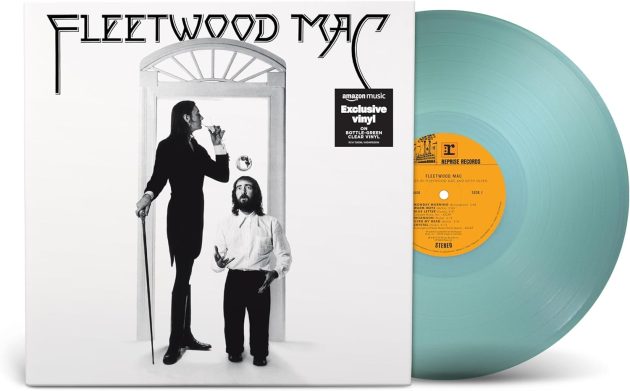
The remastered 2004 Rhino/Warner edition of Fleetwood Mac includes the original album mix plus the single remix of Rhiannon, and it sounds exceptional on a good system.
Original 1975 Reprise pressings are increasingly collectible and worth hunting for if you want the warmth of the analog master as Olsen intended it.
Get Fleetwood Mac (1975) on Vinyl or CD at Amazon.ca
Browse the full Fleetwood Mac Albums Discography at Amazon.ca.
Frequently Asked Questions About Rhiannon
Who wrote Rhiannon?
Rhiannon was written solely by Stevie Nicks in 1974, approximately three months before she and Lindsey Buckingham joined Fleetwood Mac. She composed it on piano, recorded a cassette demo, and the band recorded it for their 1975 self-titled album. Nicks has said the song took roughly ten minutes to write.
What does Rhiannon mean?
Rhiannon is about a free and untameable woman, drawn consciously from the character in Mary Leader’s novel Triad and unconsciously from the Welsh goddess of the same name. The lyrics describe a woman taken by the wind, impossible to hold, who offers the promise of something transcendent but can never quite be won. Nicks had no knowledge of the Welsh mythology when she wrote it. She only discovered the connection after the song was already recorded.
What album is Rhiannon from?
Rhiannon appears on Fleetwood Mac, the band’s tenth studio album, released July 11, 1975 on Reprise Records. The album was the first to feature Stevie Nicks and Lindsey Buckingham as full members. It was released as a single in February 1976 under the title “Rhiannon (Will You Ever Win).”
Did Rhiannon chart?
Yes. Rhiannon peaked at No. 11 on the US Billboard Hot 100 in June 1976 and reached No. 4 in Canada. Upon re-release in the UK in 1978, it charted at No. 46. Rolling Stone ranked it No. 488 on their 500 Greatest Songs of All Time list and No. 6 on their list of the 50 greatest Fleetwood Mac songs.
You Might Also Like
Another Stevie Nicks-written classic from Rumours, sharing Rhiannon’s hypnotic groove and the band’s signature blend of mystery and heartbreak.
The one Rumours track credited to all five members, featuring the same brooding mid-tempo intensity that makes Rhiannon so compelling live.
Nicks’ love letter to the person she was before fame arrived, thematically linked to Rhiannon in its celebration of the free-spirited, wind-blown woman she has always written about.
Complete Credits: Rhiannon
Written by: Stevie Nicks
Lead Vocals: Stevie Nicks
Backing Vocals: Lindsey Buckingham, Christine McVie
Guitar: Lindsey Buckingham
Bass: John McVie
Drums: Mick Fleetwood
Keyboards: Christine McVie
Producer: Keith Olsen
Studio: Sound City Studios, Van Nuys, California
Recorded: January 1975
Album: Fleetwood Mac
Label: Reprise Records
Single Released: February 4, 1976
Length: 4:11 (album version)
Sources
Last updated: March 2026