

Judas Priest Victim of Changes is one of the most powerful vocal showcases in heavy metal history, a thundering eight-minute epic that features Rob Halford at his most extraordinary, ranging from whispered intimacy to banshee screams of terrifying power.
Get Judas Priest Victim of Changes on Vinyl or CD at Amazon
Affiliate Disclosure: I am an Amazon affiliate and if you purchase through any amazon links on this site i may earn a small commission at no extra charge to you. This helps support classicrockartists.com and allows me to keep providing deep-dive content on the legends of rock. Thank you for your support!
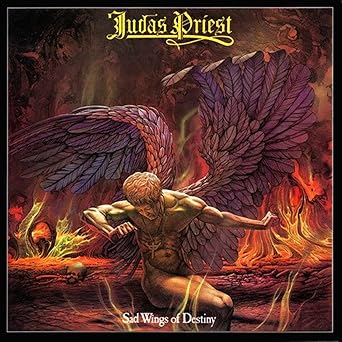
Released in 1976 on the album Sad Wings of Destiny, Victim of Changes is assembled from two separate songs by different band members that were merged into a single piece during the recording sessions, the combination producing something more dramatic than either original could have been.
The song is widely considered Judas Priest’s masterpiece and one of the defining recordings of the heavy metal genre, demonstrating that hard rock could aspire to the compositional ambition of classical music while retaining the power and visceral impact that made it heavy metal.
Quick Navigation
What is the meaning of Judas Priest Victim of Changes?
Victim of Changes tells the story of a man destroyed by a woman and by the broader transformations of a world that has left him behind, a narrative of loss, dissolution, and ultimately a kind of defiant acceptance of his fate.
The title refers to someone who has been undone not by a single dramatic event but by the slow accumulation of changes in his life, his relationships, and himself that have left him unrecognizable to the person he once was.
The song’s lyrical content draws on the British blues tradition of songs about romantic devastation, but elevates it through the scope of its musical ambition into something approaching tragedy in the classical sense.
Rob Halford’s vocal performance gives the character a physicality and emotional immediacy that makes the abstract narrative feel genuinely urgent and personal.
The Vibe: Genre, Mood, and Sound of Judas Priest Victim of Changes
Victim of Changes is a song that evolves through multiple distinct sections, each contributing to an emotional arc that builds from brooding introspection to explosive, cathartic release.
The song demonstrates that Judas Priest were capable of genuine compositional sophistication, structuring an eight-minute piece with the confidence of musicians who understood the value of patience and dynamic contrast.
- Genre: Heavy metal, hard rock, blues rock
- Mood: Dark, emotionally vast, ultimately triumphant in its devastation
- Tempo: Varied, building from slow blues to driving metal climax
- Key Instruments: Dual electric guitars, bass, drums, Halford’s extraordinary vocal range
- If you like this, try: Judas Priest’s Hell Bent for Leather, Black Sabbath’s War Pigs, Led Zeppelin’s Stairway to Heaven
Behind the Lyrics
The song opens with a slow, blues-influenced section in which the narrator describes his emotional devastation with a restraint that makes the eventual release of the climactic sections all the more powerful.
The whisky and women imagery places the song in the long tradition of blues laments, connecting Judas Priest to the musical roots from which heavy metal grew.
Halford’s vocal in the opening sections demonstrates a control and expressiveness that was unusual for the era, his ability to communicate vulnerability as convincingly as aggression setting him apart from most heavy rock singers of the period.
The song’s transition from the controlled opening to the explosive middle section is one of the great moments of dynamic escalation in heavy metal, the music suddenly releasing all the tension that had been building in the earlier passages.
K.K. Downing and Glenn Tipton’s dual guitar work in the climactic sections is a masterclass of complementary playing, their parts weaving around each other in a way that creates a combined texture far greater than either guitar alone.
The final section of the song, where Halford’s screaming reaches its most extreme register, is one of the defining moments of heavy metal vocal performance, demonstrating a physical commitment to the music that few singers have equaled.
Recording Story and Production
Victim of Changes was recorded at Morgan Studios in London in 1975, produced by Jeffrey Calvert and Max West for the Sad Wings of Destiny album.
The song was created by merging two separate compositions, one called Victim of Changes written by guitarist K.K. Downing and vocalist Al Atkins, and another called Whisky Woman, into a single extended piece.
The decision to combine the two songs was made during pre-production when the band and producer recognized that the musical and thematic similarities made them natural companions.
Rob Halford’s vocal was the last element recorded, with his extraordinary range and commitment elevating the already impressive musical framework into something genuinely exceptional.
Glenn Tipton’s guitar work, including several of the song’s most memorable riffs and melodic figures, established him as one of the most technically accomplished guitarists in British heavy metal.
Ian Hill’s bass playing provides the low-end anchor that allows the dual guitars and vocal to operate in the upper registers without losing the song’s physical weight and impact.
Chart Performance and Legacy
Victim of Changes was not released as a single and the Sad Wings of Destiny album had limited commercial success on its initial release, but the song’s reputation has grown continuously in the decades since.
Judas Priest was inducted into the Rock and Roll Hall of Fame in 2022, with Victim of Changes consistently cited in their induction materials as the song that best demonstrated their artistic ambitions.
Rob Halford’s vocal performance on Victim of Changes is regularly cited by metal singers as one of the most influential recordings in the genre, demonstrating the range, power, and expressiveness that became the standard for heavy metal vocalists.
The song has been performed at virtually every Judas Priest concert since its release and is consistently cited by band members and fans as their most important recording.
Metal Hammer and other specialist publications regularly rank Victim of Changes among the greatest heavy metal songs ever recorded, its scope and ambition setting it apart from most of the genre’s output.
Listener’s Note: A Personal Take on Judas Priest Victim of Changes
When Rob Halford’s voice finally opens up in the climactic section of this song, the effect is genuinely shocking even if you have heard it a hundred times. There is simply nothing else like it in rock music.
The song’s patience in its opening sections is what makes the eventual release so powerful. This is music that understands the value of withholding before delivering.
Downing and Tipton playing together is one of the great guitar partnerships in metal history, their complementary styles creating a combined sound that is recognizably Judas Priest and nothing else.
Eight minutes that feel simultaneously too long and not long enough. That paradox is the mark of a truly great piece of music.
Affiliate Disclosure: I am an Amazon affiliate and if you purchase through any Amazon links on this site I may earn a small commission at no extra charge to you. This helps support ClassicRockArtists.com. Thank you for your support!
Collector’s Corner: Own Judas Priest Victim of Changes on Vinyl or CD
Sad Wings of Destiny on Gull Records is one of the most sought-after albums in heavy metal collecting, with original UK pressings commanding significant premiums in excellent condition.
Remastered editions have been issued that significantly improve the audio quality over the somewhat limited original production, making the music more accessible without compromising its essential character.
Get Judas Priest Sad Wings of Destiny on Vinyl or CD at Amazon
Frequently Asked Questions About Judas Priest Victim of Changes
How was Victim of Changes created?
Victim of Changes was created by merging two separate songs. One was called Victim of Changes, written by K.K. Downing and original vocalist Al Atkins, and the other was called Whisky Woman. The two pieces were combined into a single extended composition during the recording sessions for Sad Wings of Destiny.
Why is Rob Halford’s vocal on Victim of Changes so celebrated?
Rob Halford’s performance on Victim of Changes is celebrated for its extraordinary range, from controlled bluesy lower register singing to screams of almost superhuman power, and for the emotional commitment that makes both extremes feel genuinely expressive rather than merely technical. It is widely considered one of the greatest vocal performances in metal history.
What album is Victim of Changes on?
Victim of Changes appears on Judas Priest’s second studio album Sad Wings of Destiny, released in March 1976 on Gull Records. The album is considered the foundation of Judas Priest’s legacy and one of the most important heavy metal albums ever recorded.
You Might Also Like
The enduring power of Judas Priest Victim of Changes is Rob Halford’s demonstration that the human voice can be an instrument of both devastating vulnerability and terrifying power, sometimes within the same song, and that heavy metal at its greatest is capable of emotional and artistic ambitions equal to any genre.