

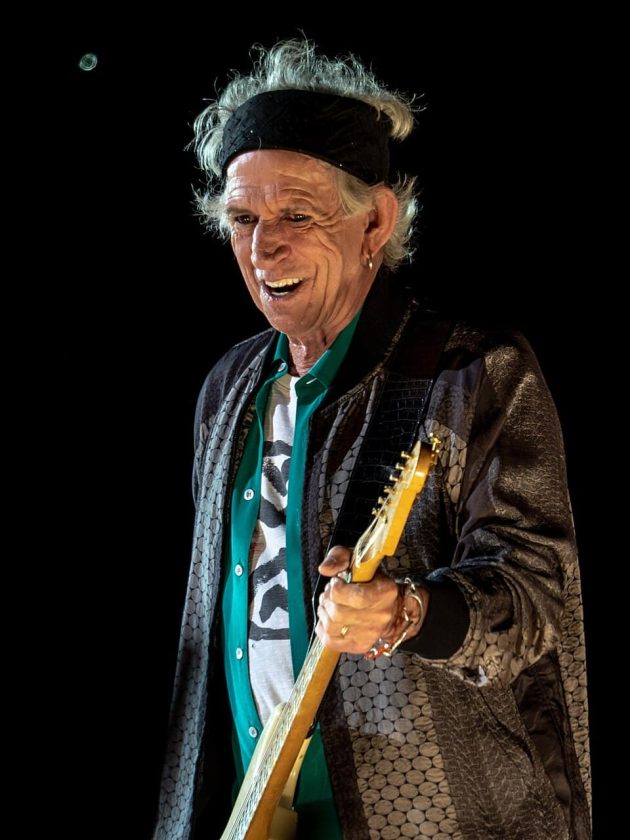
Keith Richards is one of the most influential guitarists, songwriters, and rock personalities of the twentieth century, a founding member of The Rolling Stones, and the architect of some of the most enduring music in history.
For more than six decades, his open-tuned riffs, instinctive rhythm playing, and co-written compositions have served as a cornerstone of rock music worldwide.
Born in working-class postwar England, Richards absorbed American blues records with a devotion that never left him and channeled that raw energy into everything he recorded.
His songwriting partnership with Mick Jagger stands as one of the most celebrated and commercially successful collaborations in the history of popular music.
He survived addiction, arrests, near-fatal accidents, and years of internal band conflict to remain one of rock’s most vital and respected figures.
This definitive biography covers every chapter of Keith Richards’ life and career, from his Dartford roots to the release of the Rolling Stones’ most recent studio album.
☰ Table of Contents
Early Life: From Dartford to Rock Royalty
Keith Richards was born on December 18, 1943, in Dartford, Kent, England, the only child of Herbert William “Bert” Richards, a factory foreman, and Doris Dupree Richards, a homemaker with a deep love of popular music.
The single most formative musical influence of his childhood was his maternal grandfather, Augustus “Gus” Dupree, a semi-professional entertainer who played guitar, violin, and saxophone.
Gus gave the young Richards his first guitar and taught him his earliest chords, igniting an obsession that would never fade.
As a boy, Richards attended Wentworth Primary School in Dartford, where he first crossed paths with a classmate named Michael Philip Jagger, though the two lost touch when they moved to different secondary schools.
He later attended Dartford Technical School before earning a place at Sidcup Art College, where he balanced formal art studies with a growing commitment to the guitar.
By his mid-teens, Richards was spending every available hour listening to imported American blues and R&B records, particularly the music of Chuck Berry, Muddy Waters, Robert Johnson, and Jimmy Reed.
In October 1961, a chance encounter at Dartford Railway Station altered the trajectory of his life.
Richards spotted his old classmate Jagger on the platform, carrying a stack of rare American blues imports under his arm, and the two reconnected immediately over their shared passion for the music.
That meeting set in motion one of the most consequential songwriting partnerships in the history of rock.
The Making of The Rolling Stones
Soon after reconnecting, Richards and Jagger began playing music together in London as part of a loose circle of blues enthusiasts that had formed around guitarist Brian Jones.
Jones had placed an advertisement in Jazz News in May 1962 seeking musicians interested in performing authentic American blues, and the response attracted the core of what would become The Rolling Stones.
The founding lineup included Jones, Richards, Jagger, and pianist Ian Stewart, with drummer Charlie Watts and bassist Bill Wyman joining shortly afterward to complete the core group.
The band made their first public appearance at the Marquee Club in London on July 12, 1962, delivering a raw set of blues covers to a small but enthusiastic crowd.
Their career shifted decisively when manager Andrew Loog Oldham took control of the group in 1963 and recognized that Jagger and Richards needed to write their own songs.
Oldham famously locked the two of them in a kitchen together with the directive to produce a song before they could leave, and the Jagger-Richards songwriting partnership was effectively born from that moment of productive pressure.
The band’s debut single, a Chuck Berry cover titled Come On, was released in June 1963 and reached the top twenty in the UK.
Their debut self-titled album, The Rolling Stones, arrived in April 1964 and went to number one in the UK, immediately establishing the group as the definitive British blues act of the era.
You can explore in-depth profiles of all the band members in the dedicated section at ClassicRockArtists.com.
Throughout the 1960s, Richards and Jagger sharpened their writing to a fine edge, moving beyond blues covers into original compositions with a darker and more urgent character.
By 1966, their evolution had produced some of the decade’s most striking singles, including the hypnotic and unsettling Paint It Black, a track that pushed their sound into adventurous new territory.
Keith Richards and the Golden Age of Rock
The decade stretching from 1968 to 1978 represents the creative apex of Keith Richards’ work with the Rolling Stones, a period that produced the most celebrated recordings of their entire career.
Richards drove the band’s sound during these years with an intuitive, blues-rooted approach to rhythm guitar that prioritized feel and forward momentum above technical precision.
He developed his now-legendary open G guitar tuning during this era, removing the lowest string from the instrument entirely to create a five-string configuration that unlocked a wholly new range of chord voicings and riff patterns.
This seemingly simple adjustment produced some of the most immediately recognizable guitar figures in the history of popular music.
The Riffs That Built a Generation
The Stones’ 1968 album Beggars Banquet announced a decisive return to their blues roots and introduced a darker, more politically charged chapter in their songwriting.
It opened with Sympathy for the Devil, a conga-driven, samba-inflected track that placed the band at the heart of critical acclaim and widespread cultural controversy in equal measure.
That same year, the standalone single Jumpin’ Jack Flash arrived as one of the great comeback statements in rock history, driven by a Richards guitar riff of pure, sustained power.
Significantly, the run of iconic 1960s hits culminated with the 1969 masterpiece Let It Bleed, an album that opened with the apocalyptic urgency of Gimme Shelter.
Gimme Shelter remains one of the most emotionally devastating pieces in the Stones’ entire catalog, built on a descending Richards guitar figure that creates an atmosphere of barely restrained dread.
The 1969 single Honky Tonk Women captured a different dimension of Richards’ writing: a loose-limbed country rock swagger underpinned by a cowbell groove that became iconic within days of its release.
Behind the scenes, 1969 also brought a devastating personal loss when Brian Jones, long estranged from the group he had founded, was found dead in his swimming pool on July 3, 1969, having been asked to leave the band weeks earlier.
Guitarist Mick Taylor stepped in as Jones’s replacement and brought a melodic lead guitar voice that complemented Richards’ rhythm-centered approach with remarkable elegance.
The Richards and Taylor pairing helped generate the finest consecutive run of studio albums in the band’s history, beginning with the 1971 landmark Sticky Fingers.
Released on their own Rolling Stones Records label, Sticky Fingers showcased Richards at his most commanding as both a rhythm player and a co-author of emotionally complex songs.
The album opened with Brown Sugar, one of the most electrifying album openers in rock history, driven by a Richards riff of barely controlled aggression in open G.
Furthermore, the album included Wild Horses, a country-tinged ballad that demonstrated the full emotional range of the Jagger-Richards partnership and remains one of their most beloved recordings.
The 1970s brought the Stones, and Richards in particular, to the absolute peak of their powers as recording artists.
Exile on Main St. and the Soul of Rock
The 1972 double album Exile on Main St. is widely regarded as the greatest recording of the Rolling Stones’ career and one of the most important rock albums ever committed to tape.
Recorded largely in the basement of Richards’ rented villa in Villefranche-sur-Mer in the south of France, it was born from deliberate creative chaos, with musicians flowing in and out of the sessions at all hours of the day and night.
Richards was the central creative engine of the recording process, often staying up through the night to lay down tracks and hold the loosely organized sessions together by sheer force of musical instinct.
The cast of contributors included saxophonist Bobby Keys and brass player Jim Price, whose contributions added depth and warmth to the album’s sprawling, layered sound.
The result was an album that felt genuinely lived-in, a collection of blues, country, gospel, soul, and rock recorded with the lights low and the tapes always rolling.
Among its most enduring moments was Tumbling Dice, a masterclass in Richards-style rhythm guitar built on an open G riff that locks into the groove and refuses to let go.
The album’s murky production, sprawling ambition, and raw emotional honesty made it a watershed moment not only for the Stones but for rock music as an art form.
The 1973 follow-up, Goats Head Soup, offered a more polished and varied collection highlighted by the ballad Angie, which became a worldwide number one single and revealed a tenderness in the Jagger-Richards partnership that many had not anticipated.
Mick Taylor departed in late 1974, and guitarist Ronnie Wood joined in 1975, bringing a more instinctive and collaborative playing style that meshed naturally with Richards’ rhythm-centric approach.
The later years of the decade produced further milestones, including the 1978 album Some Girls, which absorbed the energy of both punk and disco into the Stones’ sound without diluting their essential identity.
The album’s lead single, Miss You, drew on the rhythms of disco to create one of the Stones’ most infectious and commercially successful recordings of the entire decade.
In contrast to their early blues purism, the iconic tracks of the 1970s that Richards helped craft revealed the full scope of his songwriting range and became pillars of classic rock radio for generations to follow.
Keith Richards: Battles, Arrests, and Survival
Keith Richards has never lived a conventional life, and the years from the late 1960s through the early 1980s brought a series of personal and legal crises that tested his resilience at every turn.
His long struggle with heroin and other substances became a defining and destructive force in his mid-career years, drawing intense media attention and repeated encounters with law enforcement across multiple countries.
He faced drug-related charges in the United Kingdom, the United States, and Canada throughout the 1960s and 1970s, accumulating a public reputation for excess that became inseparable from his image as rock’s ultimate survivor.
The most serious legal crisis arrived in February 1977, when Canadian authorities raided his hotel suite in Toronto and charged him with possession of heroin for the purpose of trafficking, an offense that carried the potential for life imprisonment.
The case consumed over a year and ultimately concluded with Richards receiving a suspended sentence and an order to perform two benefit concerts for the Canadian National Institute for the Blind.
The Black and Blue album of 1976 had captured the Stones at a transitional moment, showcasing the band auditioning potential replacements for Mick Taylor while incorporating funk and reggae influences into their evolving sound.
In 1981, the band scored one of their biggest commercial successes with Start Me Up, a track recorded in open G tuning that powered a massive world tour and reaffirmed their enduring commercial strength.
In contrast, the broader 1980s proved the most turbulent decade in the Stones’ internal history, as Mick Jagger’s pursuit of a solo career created a bitter and very public rift between him and Richards.
Richards later described this period in his autobiography, Life, co-written with journalist James Fox and published in 2010, as one of the most frustrating and painful chapters of his professional life.
Further, a near-fatal incident in April 2006 saw Richards hospitalized after falling from a tree in Fiji, requiring emergency brain surgery and raising serious concerns about his long-term health.
In each instance, however, he recovered, regrouped, and returned to making music with a resilience that has become as central to his legend as the riffs themselves.
The Solo Years and the X-Pensive Winos
While Jagger pursued solo projects through the mid-1980s, Richards responded by forming his own group, the X-Pensive Winos, a collective that allowed him to make music entirely on his own terms.
The debut solo album, Talk Is Cheap, released in October 1988, featured drummer Steve Jordan, who became one of Richards’ closest and most trusted musical collaborators.
Talk Is Cheap received strong critical praise for its rawness and directness, demonstrating that Richards had a compelling artistic identity that stood firmly on its own merits outside the Rolling Stones.
The experience of making the album appeared to clear the air between him and Jagger, and by 1989 the two had reconciled sufficiently to reunite the Stones and launch the Steel Wheels tour, one of the most successful concert tours in rock history at that point.
A second solo album, Main Offender, followed in 1992, cementing his reputation as a credible solo artist while staying true to the blues-rock foundation that defined his approach to music.
Throughout the 1990s, the reconciled Rolling Stones recorded and toured with renewed energy, reclaiming their status as one of the most formidable live acts in the world.
Keith Richards in the Modern Era
The Voodoo Lounge album in 1994 showed the Stones still capable of producing vital new music, earning a Grammy Award for Best Rock Album, with Love Is Strong among its most celebrated singles.
The band’s 2005 release A Bigger Bang became one of their most commercially successful albums, supported by the highest-grossing concert tour in history at the time of its conclusion.
Following the death of Charlie Watts in August 2021, the Stones faced their most profound lineup challenge, losing the drummer who had anchored nearly every recording and tour since their formation.
Steve Jordan, Richards’ longtime collaborator, stepped in as the band’s drummer for studio sessions and touring, bringing a warmth of musical familiarity to an emotionally charged transition.
Hackney Diamonds, released in October 2023, became the band’s first album of entirely new studio material since A Bigger Bang and arrived with a creative energy that impressed critics and longtime fans alike.
Produced by Andrew Watt, the album demonstrated that Richards could still write and record with the same focused directness that had defined his best work across six decades.
The album’s lead single, Angry, topped classic rock charts and served as a reminder that Richards could still deliver the kind of riff-driven rock that had made him a legend.
Bassist Darryl Jones, the Stones’ touring bassist since 1993 following Bill Wyman’s retirement, continues to anchor the live lineup with the precision and musicality he has brought to every performance over more than three decades with the band.
The band’s live legacy has also been preserved on the big screen, as detailed in the coverage of the Rolling Stones IMAX Concert Film, which returned to cinemas and brought their extraordinary live presence to a new generation of audiences.
The iconic hits of the 1980s that Richards helped shape, alongside the landmark recordings of the 1990s, remain essential fixtures of classic rock radio and streaming playlists worldwide.
A third solo album, Crosseyed Heart, arrived in 2015 and further extended his body of work beyond the Stones, drawing from the same reservoir of blues and country influences that has fueled his music since childhood.
Legacy, Awards, and Lasting Influence
The Rolling Stones were inducted into the Rock and Roll Hall of Fame in 1989, with Keith Richards recognized as a defining architect of the band’s sound and an irreplaceable figure in the history of guitar-driven rock.
Rolling Stone magazine ranked Richards among the top five greatest guitarists of all time on their comprehensive list of the 100 Greatest Guitarists, a placement that reflects his profound and lasting influence on the instrument.
His open G tuning and rhythm guitar philosophy have been studied, imitated, and adapted by generations of players across rock, blues, country, and alternative music since the late 1960s.
The Rolling Stones received the Grammy Lifetime Achievement Award in 1986, recognizing a body of work that had already reshaped popular music and showed no sign of stopping.
Richards connects directly with fans worldwide through his official YouTube channel and his Facebook page, where decades of music continue to reach new listeners every day.
His influence stretches well beyond the Stones, with punk, garage rock, indie, and Americana artists all citing his rhythm guitar work as a primary reference point for their own playing.
His co-authored autobiography, Life, published in 2010, became an immediate bestseller and is widely regarded as one of the most compelling and candid rock memoirs ever written.
Keith Richards: Essential Discography
The following list covers the most important Rolling Stones studio albums and Keith Richards’ key solo releases, representing over six decades of recorded work.
For in-depth coverage of these records, visit the album reviews section at ClassicRockArtists.com.
The debut album has even been honored with a special vinyl pressing for National Vinyl Record Day, underscoring its lasting status as a landmark of British blues rock.
- The Rolling Stones (1964) — Their UK debut, a forceful declaration built from American blues and R&B that shot to number one in Britain and announced a new force in rock and roll.
- Beggars Banquet (1968) — A defining blues revival that produced Sympathy for the Devil, Street Fighting Man, and helped establish the Stones as rock’s most dangerous creative force.
- Let It Bleed (1969) — A dark, sprawling masterpiece that opened with Gimme Shelter and closed with a full gospel choir, spanning the full emotional range of rock and roll.
- Sticky Fingers (1971) — Released on their own label, this album contains Brown Sugar, Wild Horses, and some of Richards’ finest rhythm guitar performances on record.
- Exile on Main St. (1972) — Widely considered their greatest achievement, a double album recorded in the south of France that captured rock music at its most gloriously chaotic and deeply human.
- Goats Head Soup (1973) — A more polished follow-up that yielded the worldwide ballad hit Angie and showed the Jagger-Richards partnership at its most tender and varied.
- Some Girls (1978) — A commercially triumphant and critically admired response to the punk and disco eras, featuring Miss You and remaining one of their most consistent studio albums.
- Hackney Diamonds (2023) — Their most recent studio album, a vital and energetic collection that proved the Stones still had something essential to say more than sixty years after forming.
- Talk Is Cheap (1988) — Richards’ debut solo album, recorded with the X-Pensive Winos, a raw and compelling statement of personal artistic identity entirely separate from the Stones.
- Main Offender (1992) — A worthy solo follow-up, equally direct and uncompromising in its blues-rock roots and spirit. View the complete discography on Wikipedia.
- Crosseyed Heart (2015) — His third and most recent solo album, a heartfelt and characteristically loose collection that revisits the blues and country sounds he fell in love with as a teenager in Dartford.
Amazon Affiliate Disclosure: As an Amazon affiliate, I make a small commission on any purchases made through the link below at no extra cost to you. I thank you in advance.
Browse Rolling Stones Albums and Merch on Amazon
Frequently Asked Questions
Who is Keith Richards?
Keith Richards is a British guitarist, songwriter, and co-founder of The Rolling Stones, born on December 18, 1943, in Dartford, Kent, England.
He has co-written the vast majority of the Stones’ catalog alongside Mick Jagger over more than sixty years and is widely regarded as one of the defining rhythm guitarists in the history of rock and roll.
What is Keith Richards’ signature guitar technique?
Richards is best known for his use of open G tuning, in which the lowest string is removed from the guitar entirely, leaving a five-string instrument tuned to a G major chord.
This approach enables powerful chord shapes and riffs with minimal movement across the neck, producing the loose and deeply rhythmic feel that defines so much of the Stones’ best music.
What are Keith Richards’ most famous guitar riffs?
His most celebrated riffs include the opening figure of Jumpin’ Jack Flash, the raw surge of Brown Sugar, the kinetic drive of Start Me Up, and the swinging groove of Tumbling Dice.
Each is rooted in open G tuning and demonstrates his exceptional gift for creating simple, irresistible patterns that lock in with a rhythm section and carry a song forward with tremendous force.
How many solo albums has Keith Richards released?
Richards has released three solo studio albums: Talk Is Cheap in 1988, Main Offender in 1992, and Crosseyed Heart in 2015, all recorded with variations of his X-Pensive Winos band.
Is Keith Richards still active?
Yes, Richards remains active, continuing to record and perform with The Rolling Stones, who released Hackney Diamonds in 2023 and have supported it with significant touring commitments.
For the latest updates on tours, releases, and news, visit the news section at ClassicRockArtists.com.
After more than sixty years at the very center of rock and roll, Keith Richards remains one of the most irreplaceable and enduring figures in the music that has defined generations of listeners worldwide.