

Richie Furay albums document the foundational evolution of country rock, spanning his pivotal roles in Buffalo Springfield, Poco, and the Souther-Hillman-Furay Band. His extensive discography includes 1960s folk-rock landmarks, 1970s supergroup successes, and a multi-decade solo career transitioning from secular hits to influential Christian music, cementing his legacy as a Rock and Roll Hall of Fame luminary.
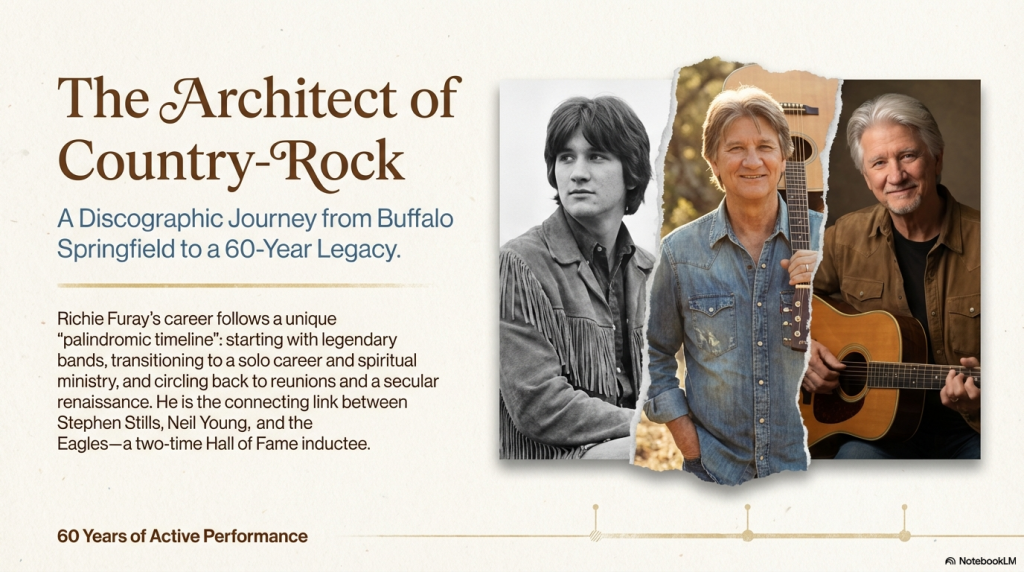
The Palindromic Journey: An Overview of Richie Furay’s Musical Evolution
The career of Richie Furay is often described by music historians as a “palindromic timeline.” This unique trajectory saw the Ohio-born musician begin at a high-profile peak in the mid-1960s, move through a deeply personal middle phase of spiritual and pastoral commitment, and eventually return to the very origins that defined his youth. To understand the depth of Richie Furay albums, one must first look back to the Greenwich Village folk scene of 1964.
Born in Dayton and raised in Yellow Springs, Ohio, Furay’s musical roots were planted early. As an eight-year-old with a Gibson ES-295, he memorized the labels of jukebox records at his father’s drugstore. After a brief stint at Otterbein College, Furay followed his ambitions to New York City. There, he formed a folk trio called the Monks and eventually befriended a young Stephen Stills. The two became the core of the Au Go Go Singers, a nine-member vocal ensemble that served as the house band for the legendary Cafe Au Go Go. While the group’s lone 1964 album failed to capture the public’s imagination, the bond between Stills and Furay became the catalyst for everything that followed.
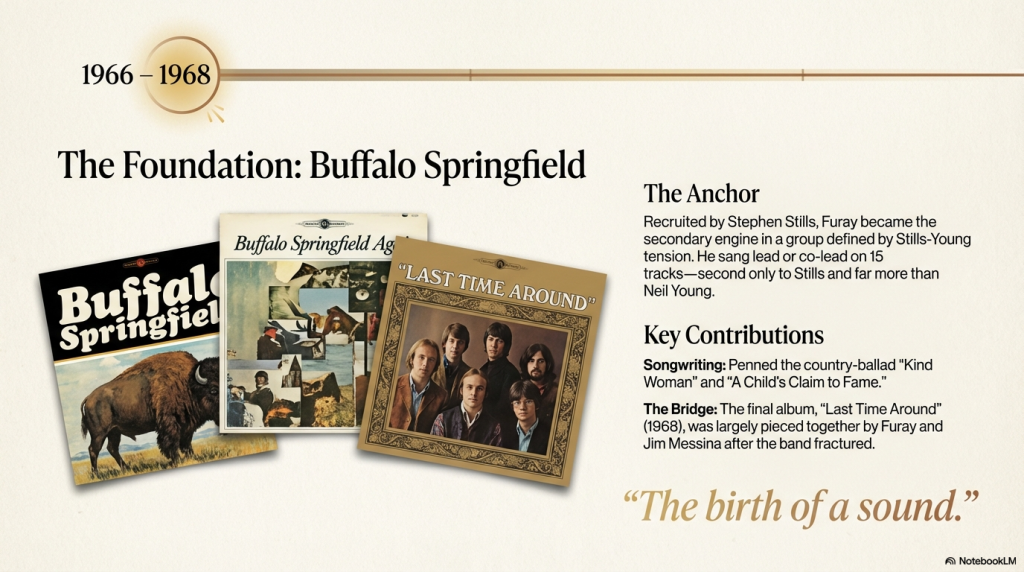
Following a short period working at a Pratt & Whitney plant in Connecticut, Furay was lured to Los Angeles by Stills. The history of American rock changed on April 6, 1966, when Furay and Stills, stuck in traffic on Sunset Boulevard, spotted a 1953 Pontiac hearse driven by Neil Young. This chance encounter led to the formation of Buffalo Springfield. In this short-lived but toweringly influential group, Furay served as the melodic center, his high-tenor voice providing the accessible counterpoint to Stills’ bluesy grit and Young’s experimental folk.
As Buffalo Springfield fractured under the weight of its own genius, Furay, alongside collaborator Jim Messina, refused to let the vision die. Together they founded Poco, the band that would arguably perfect the country-rock blend. Furay led Poco through its first six albums, mentoring future stars like Randy Meisner and Timothy B. Schmit (both of whom would later define the Eagles’ sound). Frustrated by the lack of commercial parity with his former bandmates, Furay joined the “supergroup train” in 1973 with the Souther-Hillman-Furay (SHF) Band, a venture managed by David Geffen that sought to replicate the magic of Crosby, Stills, Nash & Young.
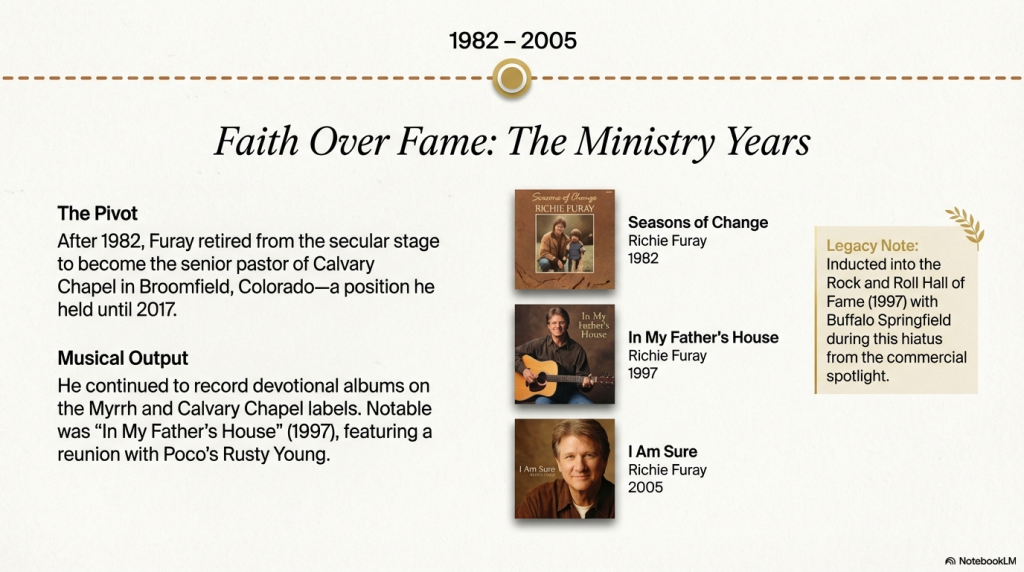
It was during the SHF era that Furay’s life took its most significant turn. Influenced by pedal steel guitarist Al Perkins, Furay underwent a profound conversion to Christianity. This shift eventually led him to step away from the mainstream industry in the early 1980s to serve as the senior pastor of Calvary Chapel in Broomfield, Colorado.
However, the “palindromic” nature of his career ensured he wasn’t gone for long. He reunited with the original Poco lineup for 1989’s Legacy and later rejoined Stills and Young for Buffalo Springfield reunion shows in 2011. Today, his discography stands as a complete circle, a journey that began with the dreamers of Laurel Canyon and returned to those same roots with a lifetime of wisdom and faith.
Affiliate Disclosure:
As an Amazon Associate, I earn from qualifying purchases. This means I may receive a small commission if you purchase through links on this site, at no additional cost to you. I only recommend products relevant to classic rock fans and content featured on ClassicRockArtists.com.
The Complete Richie Furay Discography: A Chronological Masterlist
The following masterlist captures every significant era of Furay’s recording history, from his folk origins to his most recent studio offerings.
The Early Years & Buffalo Springfield (1964–1968)
- The Au Go Go Singers (1964): Furay’s debut recording featuring a nine-member folk ensemble and the start of his partnership with Stephen Stills.
- Buffalo Springfield (1966): The self-titled debut that introduced the world to “Nowadays Clancy Can’t Even Sing,” with Furay on lead vocals.
- Buffalo Springfield Again (1967): A sprawling masterpiece where Furay’s songwriting began to rival his more famous bandmates.
- Last Time Around (1968): The final, posthumous collection of Springfield recordings, featuring the definitive Furay ballad “Kind Woman.”
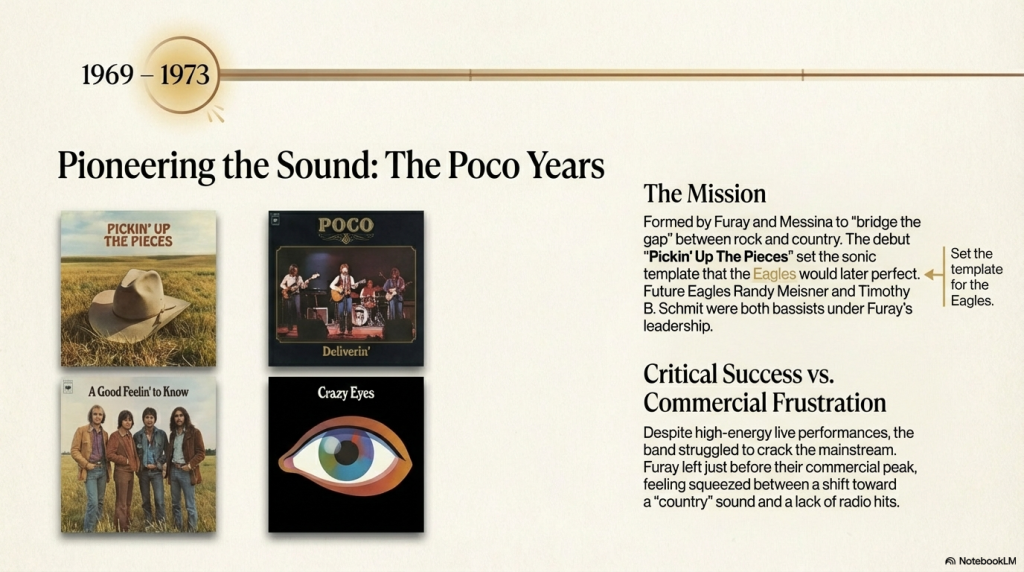
The Poco Era (1969–1973)
- Pickin’ Up the Pieces (1969): The foundational country-rock manifesto recorded by the original five members of Poco.
- Poco (1970): The sophomore effort that saw the band tightening their harmonies and instrumental interplay.
- Deliverin’ (Live) (1971): A high-energy live document capturing Furay’s “powerhouse” stage presence at his peak.
- From the Inside (1971): A polished studio effort produced by Steve Cropper, leaning into a more soulful country sound.
- A Good Feelin’ to Know (1972): An album driven by Furay’s desire for a rock-and-roll breakout hit.
- Crazy Eyes (1973): Furay’s final studio album with the original Poco era, featuring an epic title track dedicated to Gram Parsons.
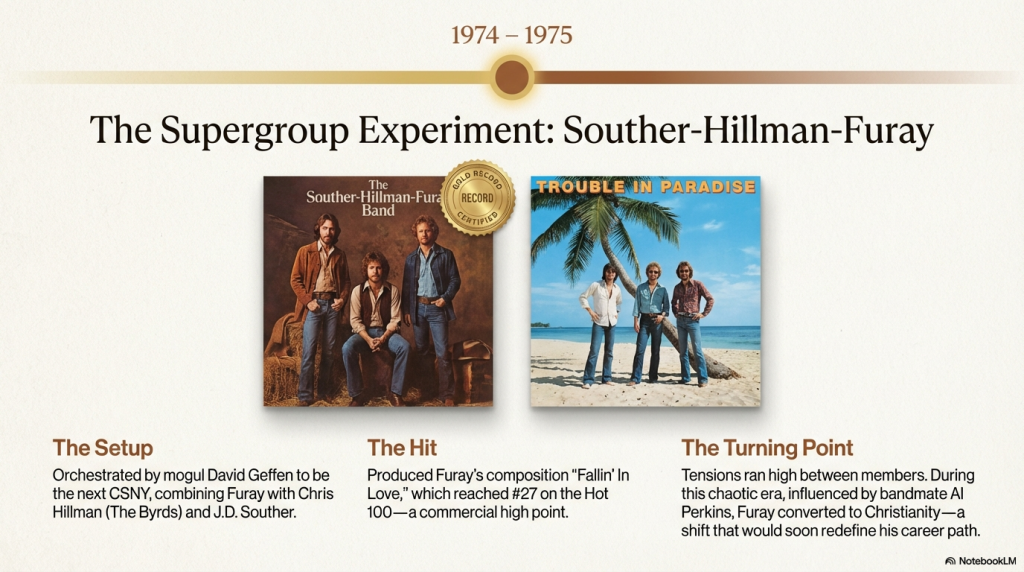
The Supergroup Era: Souther-Hillman-Furay Band (1974–1975)
- The Souther-Hillman-Furay Band (1974): A gold-certified debut featuring the hit “Fallin’ In Love” and a polished California sound.
- Trouble in Paradise (1975): The band’s second and final effort, recorded amidst the internal friction that led to their dissolution.
The Solo & Christian Music Era (1976–2022)
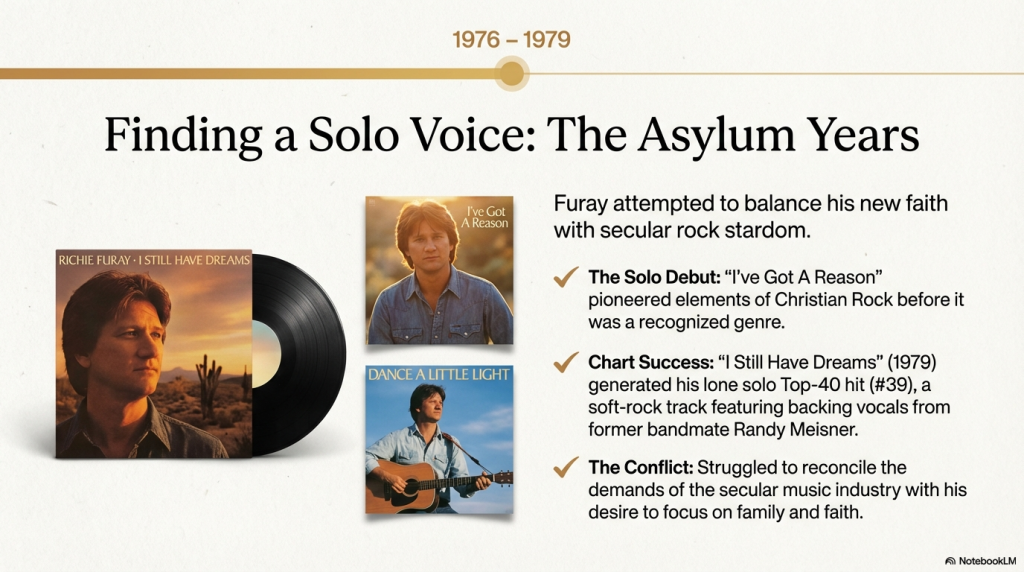
- I’ve Got a Reason (1976): Furay’s solo debut, blending his country-rock roots with his newfound Christian faith.
- Dance a Little Light (1978): A secular-leaning solo effort featuring a cover of “This Magic Moment.”
- I Still Have Dreams (1979): Furay’s most successful solo outing, containing his lone Top 40 hit of the same name.
- Seasons of Change (1982): Released on the Christian label Myrrh, this marked his transition into full-time ministry.
- In My Father’s House (1997): A return to the studio after a long hiatus, featuring guest spots from old friends like Rusty Young.
- I Am Sure (2005): A faith-based project featuring contributions from all his former Poco bandmates.
- The Heartbeat of Love (2006): A return to secular recording that showcased Furay’s enduring vocal strength.
- Hand in Hand (2015): A highly acclaimed “return to form” that reflected on his legacy in the L.A. music scene.
- In the Country (2022): A collection of covers honoring the country music legends who inspired his career.
Reunions & Live Retrospectives (1980–2021)
- Poco: The Songs of Richie Furay (1980): An Epic Records compilation highlighting his best compositions from his years leading Poco.
- Legacy (1989): The gold-certified reunion of the original Poco quintet, producing the hit “Call It Love.”
- ALIVE (2007): A double live album recorded in Colorado, covering 29 songs from his entire career.
- DeLIVErin’ Again (Return to the Troubadour: 50th Anniversary) (2021): A celebratory live recording of the 1971 Deliverin’ album performed in its entirety.
Richie Furay Albums: The Structured Discography Table
| Album | Year | Band/Solo | Notable Songs |
| Buffalo Springfield Again | 1967 | Buffalo Springfield | “A Child’s Claim to Fame”, “Sad Memory”, “Bluebird” |
| Last Time Around | 1968 | Buffalo Springfield | “Kind Woman”, “On The Way Home”, “The Hour of Not Quite Rain” |
| Pickin’ Up the Pieces | 1969 | Poco | “Pickin’ Up the Pieces”, “First Love”, “Grand Junction” |
| A Good Feelin’ to Know | 1972 | Poco | “A Good Feelin’ to Know”, “I Can See Everything”, “And Settlin’ Down” |
| The Souther-Hillman-Furay Band | 1974 | SHF Band | “Fallin’ In Love”, “Believe Me”, “Heavenly Fire” |
| I Still Have Dreams | 1979 | Solo | “I Still Have Dreams”, “Island Love”, “Satisfied” |
| Legacy | 1989 | Poco | “Call It Love”, “Nothin’ To Hide”, “When It All Began” |
| Hand in Hand | 2015 | Solo | “We Were the Dreamers”, “Someday”, “Wind of Change” |
| In the Country | 2022 | Solo | “Somebody Like You”, “Lonesome Town”, “Take Me Home, Country Roads” |
Top 5 Richie Furay Albums Ranked
Based on historical weight, technical innovation, and critical acclaim, these five albums represent the definitive peaks of Richie Furay’s recording career.
1. Buffalo Springfield Again (1967)
This album is widely regarded as one of the greatest records of the 1960s and the moment where Furay emerged as a songwriter of the first rank. While Stephen Stills and Neil Young were often recording in isolation or exploring avant-garde folk, Furay’s contributions provided the melodic glue that kept the band’s identity intact. His track “A Child’s Claim to Fame” is historically significant as a direct precursor to country-rock, featuring the legendary James Burton on dobro.
The album was recorded during a period of extreme volatility, including a high-profile drug bust at the home of Stills’ girlfriend where Furay and Eric Clapton were arrested. Furay’s testimony actually helped spare Clapton from deportation. Despite this chaos, Furay’s vocal performance on tracks like “Sad Memory” proved he was the group’s emotional heartbeat. His growth on this record set the stage for the country-rock movement, proving that country instrumentation could survive within a sophisticated rock framework.
2. Pickin’ Up the Pieces (1969)
The debut album from Poco remains the quintessential country-rock manifesto. After the dissolution of Buffalo Springfield, Furay and Jim Messina sought to create a joyful, seamless blend of Nashville instrumentation and California rock energy. Furay wrote or co-wrote almost every track on the record, using the songs as a way to process the “two years of madness” he experienced in his previous band. It was a bold step forward that established him as a leader rather than a “third wheel.”
Historically, Pickin’ Up the Pieces served as a training ground for the genre’s future superstars. The original lineup featured Randy Meisner on bass, and though he left before the album’s release, Furay quickly recruited Timothy B. Schmit as his replacement. Both men would eventually join the Eagles, taking the country-rock sound Furay pioneered to multi-platinum heights. This album’s clean, bright production and soaring harmonies became the blueprint for the entire L.A. “mellow gold” scene of the 1970s.
3. The Souther-Hillman-Furay Band (1974)
This self-titled debut was the commercial zenith of Furay’s “supergroup” phase. Managed by David Geffen and produced by Richard Podolor, the project was a calculated attempt to replicate the “supergroup” success of Crosby, Stills, Nash & Young. The record was a major success, earning a gold certification and spawning the hit single “Fallin’ In Love,” which reached #27 on the Billboard Hot 100. It remains one of the most polished examples of the 1970s California Sound.
The technical muscle of the album was bolstered by first-call session legends, including drummer Jim Gordon and pedal steel virtuoso Al Perkins. While the internal chemistry between the “three marquee names” was famously strained—with Furay and J.D. Souther acting as “oil and water”—the musical output was undeniable. Furay’s earnest intensity was balanced by Souther’s worldly cool, resulting in a muscular, radio-ready sound that remains a favorite for collectors of mid-70s rock.
4. A Good Feelin’ to Know (1972)
By 1972, Furay was pushing Poco toward a harder, more rock-oriented sound in an attempt to finally achieve the massive commercial success that eluded the group. The title track, “A Good Feelin’ to Know,” is the definitive showcase of Furay’s infectious high-tenor energy. It is a driving, jubilant rocker that perfectly captures the “powerhouse” stage presence that tour manager Dickie Davis once described as “dancing on his toes from one side of the stage to the other.”
Critics often cite this album as the “one that should have been a smash.” While it failed to crack the Top 40 at the time, its influence has only grown. The album features some of Furay’s most confident singing and songwriting, blending his folk roots with the power required for the arena-rock era. It captures a master at work, still hungry for success but refusing to compromise the tight harmonies and technical precision that defined his brand of country-rock.
5. Hand in Hand (2015)
Praised by American Songwriter as a “return to form,” this 2015 release proved that Furay’s distinctive voice remained untouched by time. Decades after his last major secular solo effort, he returned with a batch of songs that reflected on his journey with grace and passion. The standout track, “We Were the Dreamers,” serves as a poignant retrospective of his early days at the Troubadour, name-checking the friends and the “palindromic” moments that defined his life.
The album features a stellar cast of guests, including Neil Young, Kenny Loggins, and Keb’ Mo’, yet Furay remains the undisputed center of attention. It was lauded for its heart and “innocent enthusiasm,” demonstrating that the “country-rock torch” he helped light in 1966 was still burning bright. For many fans, this album was the emotional closure to a career that spanned nearly 60 years of American musical history.
The Listicle: 4 Surprising Takeaways from Richie’s Recording Career
Takeaway 1: The Prolific Melodic Center of Buffalo Springfield
History often remembers Buffalo Springfield as the launching pad for the “Big Two”—Stephen Stills and Neil Young. However, a technical analysis of their discography reveals that Richie Furay was the band’s most prolific vocal presence. Of the 35 songs released by the band, Furay sang lead or co-lead on 15 tracks. While Stills narrowly edged him out with 16 leads, Furay’s count far outpaced Neil Young’s six. Furay was the accessible, melodic core of the group; he was the voice of their first single, “Nowadays Clancy Can’t Even Sing,” and the “powerhouse” who held the center stage at the Whisky a Go Go.
Takeaway 2: The “Heathen Defense League” vs. Faith
The recording of the Souther-Hillman-Furay Band’s albums was marred by a deep spiritual divide. While working with Al Perkins, Furay accepted Christ—a transformation sparked by a “fish sticker” on Perkins’ guitar and a cassette tape of a sermon by Chuck Smith. This move deeply alienated the cynical J.D. Souther, who, along with Chris Hillman, jokingly formed the “Heathen Defense League” to counter Furay’s evangelical fervor. This friction was exacerbated by Furay’s personal life; his wife Nancy had independently converted to Christianity during a seven-month separation, leading to an eventual reconciliation that Furay credits to his faith.
“I was crying my brains out. I had to pull off the road. I was crying out to God, ‘I want my family back.’ I can still hear that still, small voice: ‘That’s how much I want you to want Me.'” — Richie Furay, reflecting on the spiritual turning point that saved his marriage.
Takeaway 3: The Secular Success of a Pastor
In a twist that highlights Furay’s enduring appeal, he achieved some of his greatest commercial success after he had “retired” from the industry to become a pastor. The 1989 Poco reunion album, Legacy, yielded the hit “Call It Love,” which reached #18 on the charts—higher than almost any original 1970s Poco effort. However, the “Pastor” was a selective collaborator. He successfully lobbied to change the lyrics of “The Nature of Love” (moving the setting from the “back seat of a Chevrolet”), refused to sing on the “too New Age” track “Look Within,” and vocally opposed the Michael Bay-directed music video for “Call It Love” due to its suggestive imagery.
Takeaway 4: The “Palindromic” Career Circle
Richie Furay’s career is a perfect circle, ending where it began. He started in 1964 as a student of the folk-rock frontier, became a mentor and pioneer, and ultimately concluded his major touring phases by reuniting with the exact people who were there at the start. This included the 1989 reunion with the original Poco lineup (the first time those five had recorded together since 1969) and the 2011 Buffalo Springfield reunion with Stills and Young. His final “Farewell” shows in 2021 and 2022 were not just concerts; they were living retrospectives of the lifelong musical bonds formed in the shadow of the Hollywood Hills.
FAQs
1. What was Richie Furay’s highest-charting solo hit? Furay’s most successful solo single was the title track from his 1979 album I Still Have Dreams, which reached #39 on the Billboard Hot 100 and spent three weeks in the Top 40.
2. Which Rock and Roll Hall of Fame band was Richie Furay a founder of? Richie Furay was a founding member of Buffalo Springfield. He was inducted into the Rock and Roll Hall of Fame as a member of this legendary group in 1997.
3. Why did Richie Furay leave the music industry in the 1980s? Furay retired from full-time performing in 1983 to focus on his faith and family, serving as the senior pastor at Calvary Chapel in Broomfield, Colorado, until his retirement in 2017.
4. What is Richie Furay’s most famous song? Furay is best known for writing and singing the lead vocals on “Kind Woman,” a song originally recorded by Buffalo Springfield for Last Time Around. He is also known for his lead vocals on the first Springfield single, “Nowadays Clancy Can’t Even Sing,” which was written by Neil Young.
5. Are there any recent Richie Furay albums? Yes. His most recent studio album is In the Country (2022), featuring covers of classic hits by John Denver, Keith Urban, and Garth Brooks. He also released the live retrospective Return to the Troubadour in 2021.
6. Who were the members of the Souther-Hillman-Furay Band? The supergroup consisted of Richie Furay, J.D. Souther, and Chris Hillman, supported by keyboardist Paul Harris, pedal steel guitarist Al Perkins, and drummer Jim Gordon.
Conclusion: The Enduring Legacy of the Country Rock Forefather
Richie Furay stands as the quintessential architect of country-rock, a figure whose influence is woven into the very fabric of American popular music. From the experimental folk of Buffalo Springfield to the polished country textures of Poco, Furay mapped the frontier that later artists would turn into a multi-platinum empire. His recording career is a testament to the power of the “high-tenor dream”—a voice that could bridge the gap between Nashville and Los Angeles without losing its soul.
Even as he transitioned from a rock star to a minister, his influence never waned. He remains the bridge between the 1960s counterculture and the 1970s singer-songwriter boom. As he poignantly sang on his 2015 retrospective, “We were the dreamers”, leaving us with one final, haunting question: Has the country-rock frontier they mapped out ever truly been fully explored, or are modern artists still just living in the beautiful, melodic shadows of Richie’s “Kind Woman”?
Affiliate Disclosure:
As an Amazon Associate, I earn from qualifying purchases. This means I may receive a small commission if you purchase through links on this site, at no additional cost to you. I only recommend products relevant to classic rock fans and content featured on ClassicRockArtists.com.