
The Doors by The Doors: The Debut Album That Changed Rock in 1967
The Doors by The Doors arrived on January 4, 1967, and redefined what an American rock record could sound like. The debut album from Jim Morrison, Ray Manzarek, Robby Krieger, and John Densmore fused blues, jazz, psychedelia, and raw poetic ambition into eleven tracks unlike anything else released that year. It contained the breakout anthem “Light My Fire”, the chilling closer “The End,” and an artistic confidence that has kept it at the top of every serious list of great rock albums for nearly sixty years.
- Artist: The Doors
- Album: The Doors
- Released: January 4, 1967
- Label: Elektra Records
- Producer: Paul A. Rothchild
- Engineer: Bruce Botnick
- Recorded: August 1966, Sunset Sound Recorders, Hollywood, California
- Mixed: October 1966, Elektra Studios, New York
- Genre: Psychedelic Rock, Blues Rock, Art Rock
- Chart Peak: No. 2, Billboard 200 (September 1967)
- Certification: 4x Platinum (RIAA); 13 million+ copies sold worldwide
★ Own This Classic
The Doors debut album is available on vinyl, CD, and deluxe editions that include the original mono mix and live recordings from the Matrix in San Francisco.
Check the latest prices and formats on Amazon →
Disclosure: As an Amazon Associate, ClassicRockArtists.com earns from qualifying purchases at no extra cost to you.
Album Overview & Release Context
The Doors formed in Los Angeles in 1965 when keyboardist Ray Manzarek ran into a former film school classmate, Jim Morrison, on Venice Beach. Morrison recited the opening lines of a song he had written called “Moonlight Drive,” and Manzarek knew immediately he had found something remarkable. The band took its name from Aldous Huxley’s 1954 book The Doors of Perception, itself drawn from a line by the English poet William Blake.
The band spent the first half of 1966 refining their material as the house band at the Whisky a Go Go on the Sunset Strip. Those residency nights gave the group a live intensity that proved difficult to capture on tape. On August 10, 1966, Elektra Records president Jac Holzman attended the Whisky at the suggestion of singer Arthur Lee of the band Love. He watched two full sets and signed the Doors to Elektra Records on August 18, 1966.
Eleven days later, on August 21, the band was fired from the Whisky after Morrison improvised a profanity-laced retelling of the Greek Oedipus myth during a performance of “The End.” That dismissal turned out to be a minor inconvenience. Recording sessions at Sunset Sound Recorders in Hollywood began almost immediately afterward. Holzman had originally planned to release the album in November 1966, but pushed the date to January 4, 1967 to capitalize on post-holiday consumer spending. That date marked the public arrival of one of rock history’s most important debut records.
Why This Album Matters
The Doors by The Doors arrived during one of popular music’s most fertile years. The debut landed in the same calendar year as Sgt. Pepper’s Lonely Hearts Club Band, Surrealistic Pillow, and Disraeli Gears. Even among that extraordinary company, The Doors stood out as something genuinely different. No other major rock record opened with a bossa-nova-driven single and closed with an eleven-minute Oedipal nightmare.
The album’s greatest achievement was demonstrating that rock could be literary and visceral at the same time. Morrison’s lyrics drew on Friedrich Nietzsche, William Blake, Arthur Rimbaud, and film theory without ever losing their emotional directness. The music behind him was sophisticated enough to carry that ambition but raw enough to feel dangerous. That combination made the record a gateway for millions of listeners who wanted more from rock than three-chord simplicity.
The album also proved what a four-piece band without a dedicated bassist could achieve. Manzarek played bass parts on his left hand using a Fender Rhodes Piano Bass while his right hand handled the organ lines. That approach gave the band a singular sound that no other group could replicate. Read more about the full story of the band in our piece on the members of The Doors.
Recording Sessions & Production
Producer Paul A. Rothchild and engineer Bruce Botnick recorded the basic tracks at Sunset Sound Recorders in Hollywood during August 1966. The sessions used an Ampex 200 three-track tape recorder for the initial takes. Densmore’s drums and Manzarek’s piano bass shared one track, Krieger’s guitar and Manzarek’s organ shared another, and Morrison’s vocals occupied the third track alone. That isolation gave Rothchild and Botnick complete control over the lead vocal in the mix.
Overdubs were added on an Ampex 300 four-track machine with Sel-Sync capability. Session bassist Larry Knechtel was brought in to reinforce the low end on about half the tracks, including “Light My Fire” and “Soul Kitchen.” His presence freed Manzarek to focus his left hand on more dynamic keyboard bass lines. Morrison’s vocals were double-tracked on several songs for additional depth. The entire album was tracked in less than one month.
Rothchild had worked extensively with folk and blues artists at Elektra. He understood how to capture an organic sound without over-producing it. His approach was to document the Doors’ live intensity while adding just enough studio polish to make it commercially viable. Five weeks of mixing followed the recording sessions, with the final master cut in October 1966 in New York at Elektra’s east coast studio. The result was an album that sounded both rehearsed and spontaneous.
A notable production moment involved “The End.” Morrison reportedly performed the entire eleven-minute piece with total commitment, reportedly moving Densmore to tears during the session. According to Krieger, Morrison trashed the studio after the takes were completed. That level of emotional investment is audible in the finished recording, which remains one of the most psychologically intense performances in the rock canon.
Musicians & Personnel
- Jim Morrison – lead vocals
- Ray Manzarek – organ, piano, keyboard bass; backing vocals on “Alabama Song (Whisky Bar)”; marxophone on “Alabama Song (Whisky Bar)”
- Robby Krieger – guitar; bass guitar on “Soul Kitchen” and “Back Door Man”; backing vocals on “Alabama Song (Whisky Bar)”
- John Densmore – drums; backing vocals on “Alabama Song (Whisky Bar)”
- Larry Knechtel – bass guitar on “Soul Kitchen,” “Twentieth Century Fox,” “Light My Fire,” “I Looked at You,” and “Take It as It Comes”
- Paul A. Rothchild – producer; backing vocals on “Alabama Song (Whisky Bar)”
- Bruce Botnick – recording engineer
- Jac Holzman – production supervisor
- William S. Harvey – art direction and design
- Guy Webster – front cover photography
- Joel Brodsky – back cover photography
Personnel details are adapted from the 50th Anniversary edition album liner notes. Knechtel was a seasoned session musician who later appeared on dozens of landmark recordings for other artists. His contributions were discrete but important; the low end he added to “Light My Fire” gives the song a physical push that anchors Manzarek’s swirling organ lines. Manzarek himself noted that the keyboard bass worked brilliantly for live performance but lacked the articulation that studio recordings required.
Track-by-Track Highlights
Side One
- Break On Through (To the Other Side)
- Soul Kitchen
- The Crystal Ship
- Twentieth Century Fox
- Alabama Song (Whisky Bar) (Weill/Brecht)
- Light My Fire
Side Two
Break On Through (To the Other Side) opens the album with John Densmore’s rolling bossa-nova drum pattern, which cuts in before any other instrument. Manzarek’s organ kicks in next, then Krieger’s fuzz guitar. Morrison enters with the album’s first command: “You know the day destroys the night.” The song was released as the debut single in January 1967 and found significant airplay only in Los Angeles at first. It remains one of the most thrilling album openers in rock history.
Soul Kitchen follows with a loose, bluesy groove. Morrison’s lyric is one of his most immediate: a roadside diner and a waitress become stand-ins for something much harder to name. Krieger plays bass on this track rather than Knechtel, giving the song a slightly rougher low end.
The Crystal Ship is the album’s most delicate moment. Morrison wrote it as a farewell to his girlfriend Mary Werbelow before he moved from Florida to Los Angeles. Manzarek’s chords fall in slow, melancholy arcs under Morrison’s hushed vocal. The song demonstrates that the Doors were not simply a hard-edged psych band. They could sustain genuine tenderness when the material called for it.
Twentieth Century Fox is bright and playful by comparison, a portrait of a coolly self-possessed girl who lives by her own rules. It is the album’s most straightforwardly pop moment and one of its most immediately infectious tracks. Alabama Song (Whisky Bar) follows as the record’s most radical left turn. The song was originally written by Kurt Weill and Bertolt Brecht in 1927 for their opera Aufstieg und Fall der Stadt Mahagonny. The Doors transform it into something bizarre and carnivalesque, with Manzarek playing a marxophone to achieve its distinctive scraping texture.
Light My Fire closes Side One in its full album form, running to approximately seven minutes and twenty seconds. Robby Krieger wrote the song’s main structure, inspired by a suggestion from Morrison that each band member try to write a complete song. The track opens with Densmore’s subtle hi-hat pattern before the full band enters. Krieger and Manzarek trade extended improvisational solos in the instrumental break, creating a jazz-influenced interlude that sets the song apart from every other pop track of the era. Read the full story of how “Light My Fire” became The Doors’ signature song.
Back Door Man opens Side Two with the album’s most direct blues statement. Written by Willie Dixon and originally recorded by Howlin’ Wolf, the song gave Morrison an opportunity to inhabit a full-throated blues persona. His growling delivery here is markedly different from the tender voice on “The Crystal Ship.” That range was central to what made him compelling as a front man.
I Looked at You and Take It as It Comes are lean, driving pieces that demonstrate the band’s pop instincts. Both keep their runtime brief and their melodies direct. End of the Night draws its title from a Louis-Ferdinand Celine novel and builds a hypnotic, nocturnal mood with minimal instrumentation.
The End is the album’s undeniable centerpiece despite being its final track. Running to nearly twelve minutes, it begins as a slow, dreamlike meditation before expanding into Morrison’s improvised spoken-word section. In that section, he retells the myth of Oedipus in stark, explicit terms, building to a climax that shocked listeners and critics equally in 1967. Densmore recalled during recording that Morrison became tearful and shouted into the studio: “Does anybody understand me?” The song was preserved in two primary takes. It is the same performance that got the band fired from the Whisky a Go Go after Morrison added that Oedipal passage during a live show. Read the complete history of “The End” and its lasting impact.
Singles & Chart Performance
The Doors released “Break On Through (To the Other Side)” as the debut single on January 1, 1967, just days before the album arrived. The song received strong airplay in Los Angeles but failed to make a significant dent on the national charts. For the first several months of 1967, the Doors remained a predominantly underground phenomenon building momentum through word of mouth and live performances.
Everything changed when Elektra persuaded the band to release an edited version of “Light My Fire” as a single in April 1967. The edited version trimmed the seven-minute album track to under three minutes by removing most of the instrumental break. The single shot to number one on the Billboard Hot 100 in the summer of 1967, becoming the first Elektra Records single ever to top that chart. It sold over one million copies. The success of “Light My Fire” pulled the album to No. 2 on the Billboard 200 in September 1967. The only record that kept it from reaching No. 1 was the Beatles’ Sgt. Pepper’s Lonely Hearts Club Band.
The album has been certified 4x Platinum by the RIAA in the United States. Music Canada has issued the same certification. As of 2015, the album had sold over 13 million copies worldwide, making it the best-selling record in the Doors’ entire catalogue. In the United Kingdom, the album failed to chart on its original release. A 1991 reissue, boosted by Oliver Stone’s biographical film The Doors, reached No. 43 on the UK Albums Chart, and a concurrent re-release of “Light My Fire” reached No. 7 on the UK Singles Chart.
Critical Reception
Contemporary reviews were largely enthusiastic. In Crawdaddy! magazine, founder Paul Williams called the record an “album of magnitude” and described the band as creators of “modern music” that contemporary jazz and classical composers would need to measure up to. Record Mirror described the sound as “wild, rough” and noted its blues foundation. Critic Robert Christgau at Esquire offered a more guarded endorsement, praising Manzarek’s organ and Morrison’s singing while expressing reservations about some of the more experimental material.
The album’s reputation has only grown in the decades since. AllMusic critic Richie Unterberger called it a “tremendous debut album” and “one of the best first-time outings in rock history,” arguing that its melodicism and dynamic tension were never equaled by the group again. Rolling Stone ranked the album at No. 42 on their “500 Greatest Albums of All Time” list in 2003, adjusting that position to No. 86 in the 2020 revision. Two of the album’s songs, “Light My Fire” and “The End,” appeared on Rolling Stone’s “500 Greatest Songs of All Time” list in 2004.
In 2015, the Library of Congress selected The Doors for preservation in the National Recording Registry, recognizing it as culturally, historically, and aesthetically significant. Both the album and “Light My Fire” have been inducted into the Grammy Hall of Fame. The Doors as a band were inducted into the Rock and Roll Hall of Fame in 1993. The album was also ranked No. 9 on Sounds magazine’s all-time list in 1985 and No. 25 by NME writers in 1993.
An often-cited cultural footnote: the Beatles reportedly purchased ten copies of the album, and Paul McCartney later cited the Doors as an influence on the creative direction of Sgt. Pepper’s Lonely Hearts Club Band.
Musical Style & Themes
The Doors does not belong cleanly to any single genre. The album draws from blues, jazz, classical, flamenco, Brechtian cabaret, and the psychedelic rock emerging from Los Angeles and San Francisco in 1966 and 1967. That eclecticism was intentional. All four members came to the band from different musical backgrounds, and the debut album captures that diversity without forcing artificial unity.
Manzarek’s keyboard work is the band’s most distinctive sonic element. He could shift in a single song from a churning, rhythmic groove to rippling, impressionistic runs. His refusal to use a conventional bassist on most tracks created space in the low end that gave the music an unusual openness. Krieger’s guitar style moved between Spanish-influenced fingerpicking, bluesy slide work, and electric rock playing. He rarely played the same kind of phrase twice within a single track. Densmore’s drumming borrowed freely from jazz and bossa nova, giving even the harder tracks a swing and rhythmic intelligence that separated the Doors from most of their contemporaries.
Morrison’s lyrical concerns were distinct from almost every other rock vocalist of the era. Death, desire, freedom, the unconscious, and the thin line between transcendence and destruction recur throughout the album. He drew on the Beat Generation writers he had studied at UCLA Film School, as well as Friedrich Nietzsche’s concept of the Dionysian impulse. The result was a body of lyrics that rewarded close reading while still landing with immediate emotional force during a first listen.
Album Artwork & Packaging
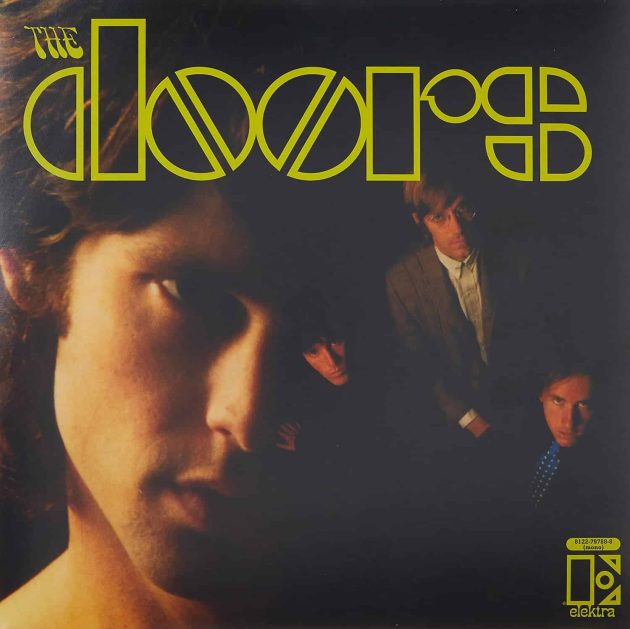
The debut album’s cover photograph was taken by Guy Webster, one of the most sought-after rock photographers working in Los Angeles during the 1960s. Webster shot the band against a dark background with deliberate lighting that draws the eye to Morrison’s face. The image does not position Morrison apart from his bandmates but still allows his presence to dominate the frame. Art direction and design were handled by William S. Harvey, Elektra’s longtime art director and the designer of the label’s logos across two decades. Back cover photography was by Joel Brodsky.
The packaging was clean and direct. The band name and album title were set in the same typeface without additional graphic elements. That simplicity proved to be an effective choice. Decades later, the image is immediately recognizable, and the minimalist design has aged far better than many of the more elaborately designed covers released in the same era.
The album was originally pressed in both mono and stereo formats. The mono LP was withdrawn shortly after release and did not become widely available again until Rhino Records reissued it as a limited 180-gram audiophile pressing in 2009. A 40th Anniversary mix released in 2007 presented a stereo version of “Light My Fire” in speed-corrected form for the first time. A deluxe 50th Anniversary edition in 2017 included the original stereo and mono mixes alongside a compilation of live recordings from the Matrix in San Francisco recorded on March 7, 1967. If you want to experience the album in its best available formats, all major editions are available on Amazon, including vinyl, CD, and the deluxe reissue.
The Doors’ complete studio catalogue is now also available in Dolby Atmos on Blu-ray. Read more about that release in our coverage of the Doors Dolby Atmos six-album Blu-ray set.
Legacy & Influence
The long reach of the Doors’ debut album is difficult to overstate. Its most famous moment outside the world of rock criticism came in 1979, when director Francis Ford Coppola used “The End” to open his Vietnam War film Apocalypse Now. The pairing of Morrison’s vision of psychological disintegration with the helicopter napalm sequence introduced the song to an entirely new generation of listeners. That placement alone ensured the album’s continued discovery across decades.
Oliver Stone’s 1991 biographical film The Doors, starring Val Kilmer as Morrison, produced another wave of renewed public interest. The film drove the album back onto the UK charts and triggered significant re-certification activity in multiple markets. Each subsequent generation of fans has arrived at the debut through a different entry point, whether “Break On Through” on a classic rock radio station, “Light My Fire” on a streaming playlist, or “The End” through Apocalypse Now.
The influence of the album on subsequent artists is broad and well-documented. Bands including Bauhaus, The Cult, Echo and the Bunnymen, Television, and Interpol have all cited the Doors as a foundational reference. The album’s approach to extended instrumental improvisation within a pop framework influenced the psychedelic rock scene that grew rapidly through 1967 and 1968. Its willingness to explore dark lyrical territory without apology helped open the door for everything from gothic rock to art rock in the decades that followed.
The Dolby Atmos and spatial audio remixes released in recent years have confirmed that the album holds up completely in contemporary listening formats. Bruce Botnick’s original recordings contained sufficient sonic depth to support full surround mixes that reveal new details in the performances without losing the raw character that makes them compelling. The Doors are one of the few bands from their era whose debut record sounds as vital in a modern context as it did in 1967. Explore the full story of the band, from Morrison’s early years to Densmore, Krieger, and Manzarek’s later careers, in our comprehensive feature on the members of The Doors.
Conclusion
The Doors by The Doors is not simply a historic artifact. It is a living record that continues to attract new listeners who respond to its combination of poetic ambition, musical originality, and emotional urgency. Few debut albums in the history of rock music arrived so fully formed. The band developed the material across hundreds of live performances, and that preparation gave the album a concentration and authority that studio-born records rarely achieve.
From the opening bars of “Break On Through” to the final fading notes of “The End,” the record is consistent in its vision and relentless in its execution. It introduced Manzarek’s keyboard-bass approach, Krieger’s eclectic guitar language, Densmore’s jazz-inflected drumming, and Morrison’s shamanistic stage persona to the world simultaneously. None of those elements had existed in that combination before January 4, 1967. As a complete statement of artistic identity, the doors by the doors remains one of the most confident debut records any rock band has ever made, and its influence on the music that followed has never diminished.
★ Add It to Your Collection
The Doors debut is available in multiple formats including the 50th Anniversary deluxe edition with bonus live recordings. Browse the full Doors discography and vinyl options on Amazon.
Browse The Doors discography and formats on Amazon →
Disclosure: As an Amazon Associate, ClassicRockArtists.com earns from qualifying purchases at no extra cost to you.