
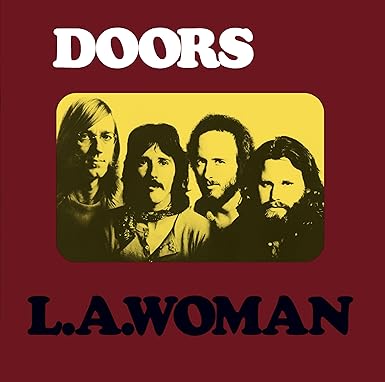
The Doors LA Woman Album: Jim Morrison’s Definitive Farewell to Rock
The Doors LA Woman album stands as one of the most remarkable final statements in rock history. Released on April 19, 1971, by Elektra Records, it was the sixth studio album by the band and the last to feature Jim Morrison during his lifetime. Raw, blues-soaked, and recorded in just nine days at the band’s own rehearsal space, it captured something that five previous albums had only glimpsed: The Doors at their most elemental and alive.
- Artist: The Doors
- Album: L.A. Woman
- Released: April 19, 1971
- Label: Elektra Records
- Producers: The Doors, Bruce Botnick
- Recorded: The Doors’ Workshop, Santa Monica Boulevard, Los Angeles, December 1970 – January 1971
- Genre: Blues Rock, Psychedelic Rock
- Length: 47:43
- Chart Peak: #9 Billboard 200, #28 UK Albums Chart
- Certification: 3x Platinum (RIAA)
Disclosure: ClassicRockArtists.com participates in the Amazon Associates Program. If you purchase through our links, we may earn a small commission at no extra cost to you.
Own a piece of rock history. The Doors LA Woman album is available on vinyl, CD, and deluxe remastered editions. It remains one of the most collectible albums in the classic rock catalog.
Album Overview and Release Context
By late 1970, The Doors were a band under pressure. Jim Morrison faced a criminal conviction stemming from his infamous 1969 Miami concert incident, and his health was visibly deteriorating. The band had released five studio albums since 1967, and their commercial momentum had leveled out after the heights of their debut and Strange Days. There was no guarantee another record was coming.
Morrison himself was determined to go out on his own terms. His artistic vision for this album was simple: make a straight blues record. No orchestration. No big studio production. Just a band in a room, playing loud and honest. The result was the Doors L.A. Woman album, a record that fulfilled that vision entirely.
The album was also the final contractual obligation to Elektra Records. The band had quietly agreed that Morrison would take an extended leave to Paris following its completion. It was meant to be a pause. It became a permanent ending.
Why The Doors LA Woman Album Still Matters
Fifty-plus years after its release, LA Woman continues to attract new listeners at a remarkable rate. The title track alone has amassed over 177 million streams on Spotify. The album delivers what so many classic rock records promise but rarely achieve: a complete, cohesive artistic statement with almost no filler.
It matters because it captures an artist at a crossroads. Morrison sounds nothing like the polished, theatrical Lizard King of the early albums. He sounds weathered, honest, and surprisingly joyful on songs like “The Changeling” and “LA Woman.” That contrast between the mythic figure people expected and the human being actually singing is what makes this album irreplaceable.
It also matters because of its sonic influence. The album’s loose, rehearsal-room feel predicted the direction rock would move in through the mid-1970s. Stripped-down blues-rock, minimal production, and emotional authenticity were all here in 1971. Read about the complete story of The Doors members to understand how much each individual contributed to that sound.
Recording Sessions and Production
The sessions that produced LA Woman nearly never happened at all. The band’s longtime producer Paul A. Rothchild, who had guided every previous Doors record, walked out of an early listening session after calling the material “cocktail lounge music.” Two of the songs he dismissed were “Love Her Madly” and “Riders on the Storm,” both of which became major hits.
Rather than bring in a replacement producer, the band turned to their trusted sound engineer Bruce Botnick, elevating him to co-producer. They also made a key location change. Instead of booking a commercial studio, they set up recording equipment in their own rehearsal space on Santa Monica Boulevard in Los Angeles. The informal environment transformed the sessions immediately.
“He was punctual, professional, all those boring things,” Botnick recalled of Morrison during the sessions. “Some sessions even began in the afternoon! The Doors were making the record Jim wanted, rather than what was expected.” Sessions ran from December 1970 through January 1971. Mixing began in February 1971, and Morrison left for Paris in mid-March, before the album was even finished.
The entire album was recorded in approximately nine days. Most of Morrison’s vocals were captured live as the other musicians played. The result had an energy and spontaneity that the more polished sessions for albums like The Soft Parade had never approached. The notable exception was “Hyacinth House,” which was recorded on a four-track tape machine, giving it a slightly different sonic texture from the rest of the album.
Musicians and Personnel
The core lineup was the same four musicians who had been together since 1965. Jim Morrison sang lead vocals. Ray Manzarek handled keyboards, including Wurlitzer piano and Fender Rhodes. Robby Krieger played lead guitar. John Densmore played drums, including brushes on “Cars Hiss by My Window” and tambourine on two tracks.
Two session players joined for the album. Bassist Jerry Scheff, who was Elvis Presley’s regular bass player at the time, played on every track. His presence was transformative. The Doors had famously avoided using a bass player for years, with Manzarek covering low-end frequencies on keyboard. Scheff gave the album a physical weight and groove that none of their previous records had possessed.
Rhythm guitarist Marc Benno contributed to four tracks: “Been Down So Long,” “Cars Hiss by My Window,” the title song “LA Woman,” and the cover of John Lee Hooker‘s “Crawling King Snake.” Benno had never heard of The Doors before being booked for the sessions. He and Morrison became fast friends during the recording, spending time together between takes.
Bruce Botnick handled production and engineering. He also played a creative role in the final mix, most notably adding the rain and thunder sound effects that transformed “Riders on the Storm” into the atmospheric masterpiece it became.
Track-by-Track Highlights
The Doors LA Woman contains ten tracks. The full track listing is as follows:
- Side One: “The Changeling,” “Love Her Madly,” “Been Down So Long,” “Cars Hiss by My Window,” “L.A. Woman”
- Side Two: “L’America,” “Hyacinth House,” “Crawling King Snake,” “The WASP (Texas Radio and the Big Beat),” “Riders on the Storm”
“The Changeling” opens the album at full velocity. Morrison delivers one of his most physically energetic performances, and the band matches him with a funky, driving groove. The song is Morrison at his most self-aware, inhabiting and shedding personas with each verse.
“Love Her Madly” was the lead single, written by Krieger. It became the band’s final Top 20 hit, reaching number 11 on the Billboard Hot 100. The song has a deceptively breezy feel, underpinned by Scheff’s fluid bass and one of Manzarek’s most melodic keyboard performances.
“Been Down So Long” and “Cars Hiss by My Window” are the album’s deepest blues dives. Morrison discovered a new vocal register for these tracks, a rougher, more guttural approach influenced by traditional blues singers. “Cars Hiss by My Window” is especially striking, ending with Morrison mimicking a harmonica with his voice in a moment of raw, spontaneous brilliance.
“LA Woman” is the centerpiece of the record and one of the greatest songs in the Doors catalog. Running nearly eight minutes, it builds from a funky verse groove into an explosive jam, anchored by Krieger’s most dynamic guitar solos on any Doors record. The lyrics personify Los Angeles as a seductive and consuming city. The repeated chant of “Mr. Mojo Risin'” is an anagram of Jim Morrison’s own name. Read the full story of the “LA Woman” song in our dedicated article. Morrison told the Doors’ office that after he “split for Africa,” he would use the name Mr. Mojo Risin’ to contact them. He instead moved to Paris.
“L’America” was originally intended for director Michelangelo Antonioni‘s 1970 film Zabriskie Point, but was rejected. Manzarek recalled playing it for Antonioni in the studio. “It was so loud, it pinned him up against the wall,” Manzarek said. “When it was over, he thanked us and fled.” The song had actually been recorded earlier during the Morrison Hotel sessions, making it the only track on the album with pre-existing recorded components.
“Hyacinth House” is the album’s most delicate and personal song. Music by Manzarek frames Morrison’s lyric, which many have read as a meditation on endings and relationships. The song features Manzarek quoting Chopin, and Morrison’s vocals carry a vulnerability absent from most Doors recordings. Lines like “I need a brand new friend, the end” take on painful weight given what came next.
“Crawling King Snake” is a cover of a traditional blues song associated with John Lee Hooker. The Doors had performed it live for years, and it fits naturally alongside the album’s blues-heavy material. The band tears through it with locomotive force.
“The WASP (Texas Radio and the Big Beat)” began life as a Morrison poem published in the Doors’ first souvenir tour book in 1968. He had recited it in concert many times. Its inclusion here represents the album’s spoken-word dimension, with Morrison delivering it over tight, hypnotic playing from the band.
“Riders on the Storm” closes the album and is the final song the original four Doors recorded together. The suggestion that it was “cocktail music” seems almost incomprehensible now. Manzarek’s Rhodes piano creates an electric, aquatic atmosphere. Botnick’s added rain and thunder turn the mix into a cinematic experience. Morrison’s vocal is controlled, intimate, and deeply affecting. It was the last Doors single released while Morrison was still alive.
Singles and Chart Performance
“Love Her Madly” was released in March 1971, preceding the album by several weeks. It reached number 11 on the Billboard Hot 100, giving the band their last Top 20 single with Morrison.
“Riders on the Storm” followed as a single in June 1971, after the album had been released. It reached number 14 on the Billboard Hot 100 and also charted in the UK. It was the last Doors single released during Morrison’s lifetime. He died on July 3, 1971, just weeks after it entered the charts.
The album itself peaked at number nine on the Billboard 200 and remained on the charts for 36 weeks. In the UK, it reached number 28 on the Albums Chart, spending four weeks on that chart. L.A. Woman was certified 2x Platinum by the RIAA in June 1987, and upgraded to 3x Platinum in December 2021, reflecting its sustained commercial life across multiple decades.
Critical Reception
Contemporary reviews of L.A. Woman were largely positive. Critics responded to the album’s directness after the more elaborate orchestral production of earlier records like The Soft Parade. The stripped-down approach was seen as both a course correction and a genuine artistic renewal.
Critic David Quantick of BBC Music praised the band for their “stripped-down yet full sound” and for the “confidence born of having been a functioning unit for several years.” Richie Unterberger has also ranked the record among the Doors’ finest work, citing Morrison’s enthusiastic vocal performances throughout. Far Out Magazine awarded it a perfect score, calling it one of the band’s most significant achievements alongside their debut.
Mojo magazine also awarded it a perfect score in their retrospective assessment. Album of the Year aggregates the record at an 88 critic score based on professional reviews. Rolling Stone ranked it number 362 on their 2003 list of the 500 Greatest Albums of All Time, revised to number 364 in 2012. Both Ultimate Classic Rock and Stereogum named it the band’s second-best album. Ultimate Classic Rock also included it in their “Top 100 ’70s Rock Albums” list.
The Independent ranked it the twelfth best album of 1971. That year produced remarkable competition, and placing in the top twelve reflects just how strong L.A. Woman is as a standalone record. Across the decades, its reputation has only grown as the blues-rock template it established became more widely appreciated.
Musical Style and Themes
L.A. Woman is the most blues-oriented album in the Doors catalog. The shift was intentional. Morrison had long identified with classic American blues, and the stripped-down recording environment gave the band permission to lean into that influence more directly than any previous record had allowed. The presence of Scheff’s bass guitar for the first time on a full Doors album was the sonic foundation that made it all possible.
The album also carries a strong sense of place. Los Angeles runs through it as both subject and atmosphere. Lyrics reference the city’s freeways, its nocturnal life, and its consuming nature. Morrison drew on John Rechy’s 1963 novel City of Night for the title track’s depiction of Los Angeles as seductive yet draining. The city is not celebrated. It is examined.
Lyrically, Morrison was in a reflective mood throughout the sessions. Several songs read as farewells, whether to the city, to relationships, or to a version of himself. “Hyacinth House” is the most explicit in this respect. “Riders on the Storm” frames mortality with a calm that is more chilling than any of his theatrical earlier work. The album’s closing image of rain, thunder, and a fading vocal is one of the most quietly devastating endings in classic rock.
From a production standpoint, the record sits at the opposite end of the spectrum from The Soft Parade. No string sections. No horn arrangements. No excessive overdubbing. The informality of the rehearsal-space setting is audible, and it is an asset. The Doors sound like they are playing for themselves, and the listener benefits from that.
Album Artwork and Packaging
The original 1971 Elektra Records pressing of LA Woman had one of the most distinctive physical designs of any album released that year. Jac Holzman, the chief executive officer of Elektra Records, commissioned designer Bill Harvey to create a special collector’s cover. Holzman later explained his reasoning: “I wasn’t sure there would be another album ever, so I had Bill Harvey create a collector’s cover.”
The result was a burgundy-colored, curved-corner cardboard cutout sleeve that framed a clear embossed cellophane insert, glued in from behind. The band members’ faces were printed directly on the clear film, creating a layered visual effect unlike anything else in the rock marketplace at the time. Photography for the album was credited to Wendell Hamick.
The cover photograph shows the four band members, and Manzarek later commented on what he saw in Morrison’s image: “In that photo, you can see the impending demise of Jim Morrison. He was sitting down because he was drunk. A psychic would have known that guy is on the way out. There was a great weight on him. He wasn’t the youthful poet I met on the beach at Venice.” The album has since been reissued in numerous formats, including standard CD, 180-gram vinyl, and deluxe expanded editions, many of which preserve the original artwork.
Legacy and Influence
The Doors LA Woman album has become the reference point most listeners return to when describing what made the band essential. Its legacy operates on several levels simultaneously. It is both a career-closing statement and a creative rebirth. It is both a blues album and a rock record. And it is, unmistakably, the sound of a great band finding a last surge of inspiration under extraordinary pressure.
Morrison left for Paris in mid-March 1971, before mixing was complete, and died there on July 3, 1971, at the age of 27. The album had been out for fewer than three months when he passed. Three remaining members continued as a trio, releasing Other Voices later in 1971 and Full Circle in 1972. Work on Other Voices had actually begun before Morrison’s death, with some material developed during the L.A. Woman sessions. The band officially disbanded in 1973.
The album’s influence on subsequent rock is substantial. Its combination of blues fundamentals with rock energy and poetic lyricism became a template for artists across the 1970s and beyond. The recording approach, a band in their own space making the record they wanted to make, foreshadowed the DIY ethos that would define much of independent rock in later decades.
Robby Krieger summarized LA Woman’s place in the catalog clearly during a 2012 interview: “I’m glad that LA Woman was our last album. It really captured what we were all about. The first record did too but LA Woman is more loose, it’s live. It sounds almost like a rehearsal. It’s pure Doors.”
For those who want to explore the full human story behind the music, Jerry Hopkins and Danny Sugerman’s biography No One Here Gets Out Alive remains essential reading. And for the full journey from the band’s debut to this final chapter, the Morrison Hotel album review shows exactly how L.A. Woman built on the blues resurgence the band started with “Roadhouse Blues.”
Conclusion
Few albums in rock history carry the weight of a perfect last act. The Doors LA Woman album does exactly that. It is a record made without a producer, without a commercial facility, and without any of the trappings of a major studio production. It is the sound of four musicians and two session players committed entirely to the music in front of them. The fact that it became a Top 10 album with two charted singles is almost beside the point. The deeper achievement is artistic.
Jim Morrison walked out of that rehearsal space in January 1971, went to Paris four months later, and never returned. The music he left behind is among the most emotionally honest of his career. “Riders on the Storm” fades out in rain and piano, and the album ends. Decades later, the Doors L.A. Woman album remains exactly what Robby Krieger called it: pure Doors.
Explore more Doors history and music on our complete Doors members guide. You can also listen to this essential album in stunning Dolby Atmos via the six-studio-album Blu-ray immersive release.
Add L.A. Woman to Your Collection
Available on vinyl, CD, and deluxe remastered formats. The 50th Anniversary reissue is especially highly regarded for its sound quality.
Find LA Woman on Amazon | Browse The Doors Full Discography on Amazon