
The Strange Days The Doors album is the band’s second studio record, released on September 25, 1967, by Elektra Records.
It arrived just eight months after their explosive self-titled debut and pushed the band’s sound into darker, more experimental territory.
Produced at Sunset Sound in Hollywood, the Strange Days The Doors album represented a leap forward in both ambition and studio craft.
Despite reaching No. 3 on the Billboard 200 and earning a platinum RIAA certification, it was overshadowed commercially by its own predecessor.
What it lacked in sales momentum, it more than made up for in artistic ambition, and both Jim Morrison and producer Paul Rothchild later called it the greatest thing the Doors ever recorded.
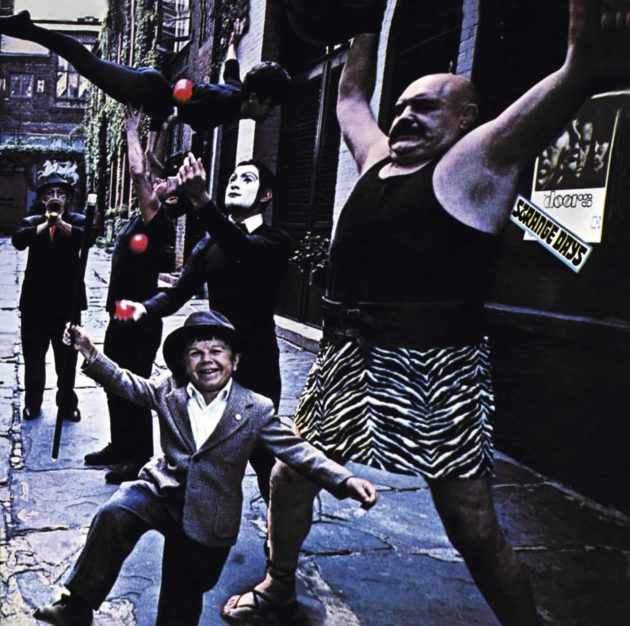
Table of Contents
- Strange Days The Doors Album: Overview and Release Context
- Recording at Sunset Sound: From Four Tracks to Eight
- The Complete Musicians and Personnel Behind Strange Days The Doors Album
- The Making of an Iconic Album Cover
- Strange Days The Doors Album: Complete Track-by-Track Analysis
- Singles and Chart Performance
- Critical Reception: Then and Now
- Musical Style, Themes, and Sonic Experimentation
- Legacy and Influence: Why Strange Days The Doors Album Matters
- Final Thoughts on Strange Days
Own the Definitive Doors Masterpiece
Strange Days is the album even The Doors themselves considered their finest work, and hearing it on vinyl or CD reveals layers that streaming simply cannot match.
Buy on AmazonStrange Days The Doors Album: Overview and Release Context
The Doors entered 1967 as one of the most talked-about new bands in America.
Their self-titled debut had been released in January 1967 and was still climbing the charts when the band returned to the studio.
In fact, The Doors debut album spent an extraordinary 122 weeks on the Billboard charts, peaking at No. 2 and remaining in the top ten for over ten months.
That remarkable run created an unusual commercial problem for the follow-up.
Strange Days was released on September 25, 1967, while the debut was still a top-ten fixture.
Rather than competing with a fresh landscape, Strange Days competed with its own band’s history.
The album reached No. 3 on the Billboard 200 during a 63-week chart stay.
It eventually earned a platinum certification from the RIAA, though it remains the lowest-charting Doors studio album from the Morrison era.
In the UK, the band had yet to break commercially, and Strange Days became one of only two Doors studio albums to miss the UK charts entirely.
Despite all of this, the record’s reputation has grown steadily in the decades since its release.
Rolling Stone listed it at No. 409 on its 2012 list of the 500 Greatest Albums of All Time.
The same magazine included it on their 2007 list of “The 40 Essential Albums of 1967.” Ultimate Classic Rock placed it at No. 20 on their list of the Top 25 Psychedelic Rock Albums.
Q magazine ranked it 35th on their own equivalent list.
Morrison himself gave the record perhaps its most meaningful endorsement in a 1970 interview with Downbeat Magazine, saying the album “tells a story” and expressing confidence that it would eventually receive the recognition it deserved.
A Second Album Built From the Same Well
Several of the songs on the Strange Days The Doors album were written during the same creative period that produced the debut.
The band had amassed a deep catalogue of material between 1965 and 1966, and not everything made the first cut. “Moonlight Drive,” for example, was one of the very first songs Jim Morrison ever brought to Ray Manzarek.
Morrison and Manzarek had famously met on a Venice Beach in the summer of 1965, and “Moonlight Drive” was among the first songs Morrison sang to him on the spot.
Two separate versions of the track were attempted during the sessions for the debut album, and both were set aside.
The version that appears on Strange Days represents a completely fresh approach developed after the band had grown more confident in the studio.
Similarly, “My Eyes Have Seen You” had been demoed at Trans World Pacific Studios in 1965, before guitarist Robby Krieger had even joined the group.
Songs also recorded during the Strange Days sessions but ultimately left off the album include “Summer’s Almost Gone” and “We Could Be So Good Together,” both of which later appeared on the 1968 follow-up Waiting for the Sun.
Recording at Sunset Sound: From Four Tracks to Eight
The Strange Days The Doors album was recorded in sessions spread across six months, from February to August 1967, at Sunset Sound Recorders in Hollywood.
This was the same studio used for their debut, but the technical upgrade for this second record changed everything.
The debut had been recorded on a four-track machine, which offered limited room for experimentation.
For Strange Days, producer Paul A.
Rothchild and engineer Bruce Botnick had access to a cutting-edge eight-track recording system.
Ray Manzarek later explained the significance of this shift in The Doors Anthology, saying the debut essentially documented how the band sounded live, but the second album was “a studio album” where they could use all the elements of the first record and have four additional tracks for overdubs.
He specifically credited the extra tracks with allowing unusual guitar and keyboard parts and overdubbed solos on songs like “Strange Days,” “You’re Lost Little Girl,” and “When the Music’s Over.” Botnick later said the band arrived for the Strange Days sessions determined to pursue “new techniques of recording, no holds barred.” The sessions were conducted around the band’s touring schedule, which gave the recording an unhurried, experimental quality.
Rothchild later described Strange Days as the best album the Doors ever made, telling journalists: “We were confident it was going to be bigger than anything the Beatles had done.
But there was no single.
The record died on us.” He was, of course, talking about commercial performance.
The artistic achievement was undeniable from day one.
The Influence of Sgt. Pepper and Miles Davis
The creative atmosphere of 1967 played a direct role in shaping the sound of Strange Days.
In a 2010 interview with Modern Drummer, John Densmore confirmed that Botnick had obtained an advance copy of the Beatles’ Sgt.
Pepper’s Lonely Hearts Club Band before its official release.
The band listened to it together and, in Densmore’s words, went “Oh my God!” That reaction directly fed the sessions for Strange Days.
Densmore also cited older Miles Davis recordings as a consistent inspiration for the band’s musical development.
The combination of cutting-edge pop production and jazz-rooted improvisation is audible throughout the album.
The keyboard part for “When the Music’s Over,” for example, was directly inspired by Herbie Hancock’s jazz composition “Watermelon Man.”
Musique Concrete and Sonic Experimentation
The band and their production team explored musique concrete techniques during the sessions.
This approach, which involves manipulating recorded sounds as raw compositional material, gave several tracks their distinctly unsettling quality.
On “Unhappy Girl,” Manzarek played his keyboard introduction backwards.
He later explained that he read the sheet music from the lower right corner across to the left, then jumped to the next line up, reading everything backwards and bottom to top.
The correct overdubs were then layered over this reversed performance.
For “Horse Latitudes,” Botnick took white noise from a tape recorder and varied its speed by hand-winding the tape reel, producing a sound resembling wind.
Further varispeed manipulation was then applied to create different timbres and effects.
The result is one of the most genuinely unnerving short pieces of studio audio from the entire rock era.
The Strange Days The Doors album also features one of the earliest uses of the Moog synthesizer in rock music history.
Synth programmer Paul Beaver helped configure the instrument, and Jim Morrison himself played it on the record.
Manzarek also added marimba to several tracks, and his harpsichord performance on “Love Me Two Times” gave that song an unexpectedly baroque elegance.
The Complete Musicians and Personnel Behind Strange Days The Doors Album
The core Doors lineup that recorded the Strange Days The Doors album was the same four-piece unit that had made the debut.
However, the wider creative team expanded significantly compared to the first sessions, reflecting the band’s growing ambition and label investment.
Below is the complete personnel breakdown for the album.
The Doors
Jim Morrison handled lead vocals, percussion, and played the Moog synthesizer on the record.
Morrison’s vocal performances across Strange Days are arguably his most varied on any Doors album.
He moves between sultry baritone crooning, full-throated rock vocals, spoken word poetry, and frenzied shrieking, sometimes within the same song.
Ray Manzarek played Vox Continental organ, Fender Rhodes piano, piano bass, harpsichord, backwards piano, marimba, and sang backing vocals.
Because the Doors famously had no dedicated bass player in their live setup, Manzarek covered bass lines with his left hand on the Fender Rhodes keyboard bass while his right hand handled organ parts.
Robby Krieger contributed all guitar parts on the album, including his signature bottleneck slide work on “Moonlight Drive.” Krieger’s role as a songwriter was also substantial on this album.
His compositions “Love Me Two Times” and “You’re Lost Little Girl” sit alongside Morrison’s material with no loss of quality.
John Densmore played drums throughout the album, delivering some of the most dynamic and sensitive performances of his career.
His jazz-rooted drumming on “When the Music’s Over” in particular demonstrated a level of control and invention that stands up against anything from the rock era.
You can read the full story of all four members of The Doors on this site.
Session Musician: Doug Lubahn
Session bassist Doug Lubahn contributed bass guitar to most of the album’s tracks.
He is absent from “Unhappy Girl,” “Horse Latitudes,” and “When the Music’s Over,” where Manzarek covered the low end with his keyboard bass setup.
Lubahn had previously worked with the Doors and would continue his association with the band on subsequent albums.
His contribution to Strange Days brought a warmer, rounder bottom end to the studio recordings than Manzarek’s synthesized bass could always achieve.
Production Team
Paul A.
Rothchild served as producer and is one of the most important figures in the album’s creation.
Rothchild had previously worked extensively in the folk scene before becoming Elektra Records’ primary rock producer.
His attention to sonic detail and willingness to encourage experimentation made him the ideal architect for this record.
Bruce Botnick engineered the sessions and was a direct creative contributor, particularly on the experimental pieces like “Horse Latitudes.” Botnick wrote the liner notes for the 2007 Rhino Records 40th Anniversary Edition of the album.
The sessions were conducted under Jac Holzman’s production supervision as label head of Elektra.
William S.
Harvey handled the cover concept and art direction.
The Making of an Iconic Album Cover
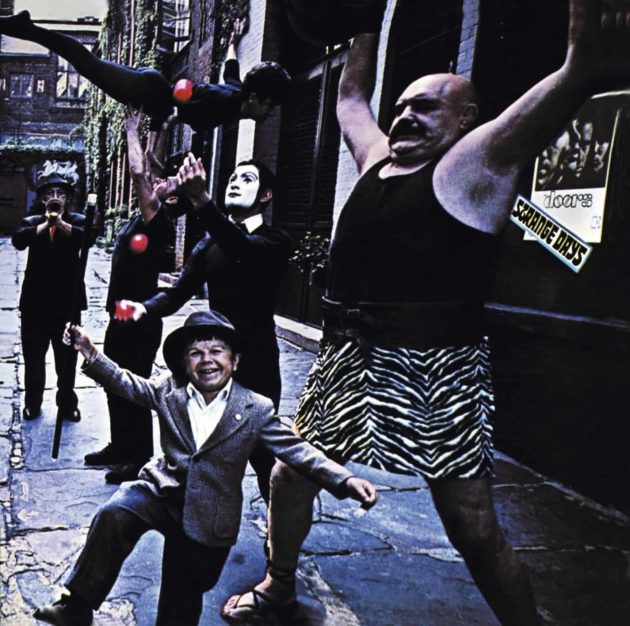
The cover of the Strange Days The Doors album is one of the most discussed and distinctive album sleeves in rock history.
Photographed by Joel Brodsky, it depicts a group of street performers in a Manhattan alley and features no photographs of the band members at all.
This was an almost unheard-of choice for a major rock act at the time, and the reason for it was simple: Jim Morrison refused to pose.
Morrison had grown uncomfortable with his role as a rock pin-up and did not want to place his image at the center of the album’s visual identity.
Brodsky responded to this constraint by drawing inspiration from Federico Fellini’s 1954 circus film La Strada.
The concept called for a group of street performers to populate the image in a way that matched the carnival-meets-nightmare quality of the music.
The shoot took place at Sniffen Court, a narrow residential alley off East 36th Street between Lexington and Third Avenue in Manhattan.
The courtyard dates to the 19th century and features a row of former carriage houses, giving the image its distinctive gothic, cobbled-lane atmosphere.
A Cast of Unexpected Performers
Finding authentic circus performers proved difficult, as most travelling shows were out on summer tour when the shoot was scheduled.
Two brothers, Lester and Stanley Janus, were hired through an acting agency to appear as dwarfs; Lester appears on the front cover and Stanley appears on the back, which is the other half of the same wide photograph.
The acrobats in the image were the only genuine performers in the group.
The juggler was Brodsky’s own assistant.
The strongman was the doorman at the Friars Club in New York, a contact of Brodsky’s.
Most remarkably, the trumpet player was a passing cab driver whom Brodsky grabbed on the spot, paying him five dollars to stand in the frame with a trumpet.
The cab driver later called Brodsky asking where he could pursue a modeling career.
Despite Morrison’s refusal to appear, the band’s image was not entirely absent from the cover.
A poster showing the group can be seen in the background of both the front and back covers, the same photograph that had appeared on the back sleeve of the debut album.
Because the cover carried no visible artist name or album title on its face, most record stores placed identification stickers across the front to help customers find it.
The concept remains one of the most ingenious acts of album art problem-solving in the history of rock.
Add Strange Days to Your Collection
Available on vinyl, CD, and in the acclaimed 40th Anniversary Edition featuring expanded liner notes and remastered audio.
Buy on AmazonStrange Days The Doors Album: Complete Track-by-Track Analysis
The Strange Days The Doors album runs for 34 minutes and 49 seconds across ten tracks split evenly across two vinyl sides.
Every track is credited to The Doors as a group, a reflection of the band’s collaborative writing process and their collective ownership of the material.
The album’s total runtime is deceptive given that the closing epic “When the Music’s Over” accounts for more than eleven minutes of it.
Side A is the more experimental half, while Side B opens with the album’s most commercially accessible track before descending again into the deeper end of the band’s creative range.
Side A
1.
Strange Days (3:05) The title track opens with Manzarek’s circular keyboard figure and Densmore’s deceptively simple, rolling drum pattern before Morrison enters with the album’s central statement.
The lyrics sketch a portrait of dislocation and cultural upheaval that reads as both personal and political.
Manzarek’s overdubbed keyboard solo, made possible by the eight-track setup, gives the song a layered depth entirely absent from the debut.
The combination of sinister pop melody and Morrison’s detached vocal delivery set the tone for everything that follows.
2.
You’re Lost Little Girl (3:01) Written primarily by Krieger, this is one of the album’s most underrated tracks.
It carries a haunted, lullaby quality and features one of Krieger’s most restrained and expressive guitar performances.
Morrison’s vocal approach here is deliberately tender, which makes the song’s underlying sense of danger all the more effective.
Manzarek’s overdubbed keyboard work was specifically cited by him as a highlight of what the eight-track system made possible.
3.
Love Me Two Times (3:23) Krieger wrote this song about a soldier spending his last night with a girlfriend before shipping out to war.
Manzarek’s decision to play the final studio recording on harpsichord rather than organ gives it an unexpectedly classical, almost baroque texture.
Manzarek described the harpsichord as “a most elegant instrument that one does not normally associate with rock and roll.” The track was edited to 2 minutes and 37 seconds for its single release and reached No. 25 on the US charts.
It was banned in New Haven, Connecticut, for being considered too controversial for radio airplay.
You can read the full story and meaning of Love Me Two Times in our dedicated article.
4.
Unhappy Girl (2:00) The album’s shortest track outside “Horse Latitudes” is also one of its most technically interesting.
Manzarek recorded his keyboard introduction backwards, as described in his own account of reading the sheet music from right to left, bottom to top.
The resulting sound was then used as the foundation for the correct forward overdubs.
The track benefits from Doug Lubahn’s bass, which anchors the disorienting production choices.
5.
Horse Latitudes (1:30) This brief spoken-word piece is the album’s most confrontational moment and one of the most challenging recordings the Doors ever released.
Morrison recited a poem he claimed to have written during high school, describing the fate of horses thrown overboard from Spanish galleons becalmed in the Horse Latitudes of the Atlantic.
Manzarek later expressed quiet skepticism that Morrison had written the poem as a teenager, saying the words were “too mature.” Botnick created the track’s violent sonic backdrop by manually winding and unwinding a tape of white noise, producing wind-like sounds, which were then subjected to additional varispeed processing.
The four band members each played instruments in unconventional ways to contribute to the controlled chaos.
6.
Moonlight Drive (3:00) This was among the first songs Jim Morrison ever wrote for the Doors and the first song he sang for Manzarek on Venice Beach in 1965.
Two versions were recorded and discarded during the debut sessions.
The version that appears on Strange Days is the definitive take, featuring Krieger’s bottleneck guitar playing in a slightly off-kilter blues style that creates a persistently uneasy, dream-state feeling.
Manzarek’s marimba parts give the track a tropical, almost cinematic quality that contrasts with the ominous lyrical content.
Side B
7.
People Are Strange (2:10) The album’s first single and its most immediately accessible track was written in early 1967 following a late-night walk up Laurel Canyon.
Densmore and Krieger, then roommates, noticed that Morrison had arrived at their apartment in a visible state of low spirits.
At Densmore’s suggestion, the three of them took a walk along Laurel Canyon.
Morrison reportedly returned from the walk in an elevated mood, carrying the early lyrics of “People Are Strange.” The song peaked at No. 12 on the US charts, making it the second-biggest charting single of the band’s career at that point.
Its cabaret-tinged European quality and unusually concise structure made it instantly recognizable on radio.
A famous later connection came via the 1987 film The Lost Boys, which used the song prominently and introduced it to an entirely new generation of listeners.
Read our complete piece on People Are Strange for the full story behind the song.
8.
My Eyes Have Seen You (2:22) One of the earliest songs in the Doors’ catalogue, “My Eyes Have Seen You” was demoed at Trans World Pacific Studios in 1965, before Krieger had even joined the group.
In its final album form, the track is a straight-ahead rock piece driven by Morrison’s most energetic vocal performance on the record.
The song’s dynamic, lurching rhythm gives Densmore plenty of room to demonstrate his jazz background within a pop-rock framework.
9.
I Can’t See Your Face in My Mind (3:18) This is perhaps the most underappreciated track on the album and one that rewards careful listening.
It carries a delicate, floating quality entirely unlike anything else on the record.
Manzarek’s keyboard work is almost impressionistic, and Morrison sings with a restraint that emphasizes the song’s theme of emotional disconnection.
The track demonstrates that the Doors were capable of something approaching chamber pop when the material called for it.
10.
When the Music’s Over (11:00) The album’s closing epic is one of the great long-form rock recordings of the 1960s and a worthy companion to “The End” from the debut.
Densmore has noted that the song was part of the band’s live setlist before the debut album was even released.
The decision to hold it back for the second record was likely made to avoid overwhelming a single album with two full-scale epics.
The keyboard part was inspired by Herbie Hancock’s jazz composition “Watermelon Man.” Krieger contributes a double-tracked guitar solo that Manzarek described as among the guitarist’s finest work with the Doors.
Morrison’s vocal performance builds from a near whisper to something bordering on ecstatic possession.
The song’s ecological urgency in its “What have they done to the earth?” section reads as remarkably prescient from a 1967 vantage point.
Our dedicated feature on When the Music’s Over explores the track’s full history and meaning.
Singles and Chart Performance
The Strange Days The Doors album produced two charting singles in the United States, and both made the top 30 on the Billboard Hot 100.
People Are Strange (September 1967)
Released in September 1967 as the album’s lead single, “People Are Strange” reached No. 12 on the US Billboard Hot 100.
This was a significant achievement considering that Light My Fire was still charting when it was released.
The band was essentially competing with their own previous success. “People Are Strange” b-sided with “Moonlight Drive” on its original 45 release.
In the UK, the Doors still lacked widespread radio exposure, and neither single charted.
The song’s cultural profile expanded dramatically after its use in Joel Schumacher’s 1987 vampire film The Lost Boys, introducing it to a younger audience that had been born after the band’s peak years.
Love Me Two Times (November 1967)
The second single from the album reached No. 25 on the US charts.
Released in November 1967 with “Moonlight Drive” as its B-side, the single’s edited album track ran at 2 minutes and 37 seconds.
The song was banned from radio in New Haven, Connecticut, on the grounds that it was too controversial.
Given that its lyrical content was considerably tamer than many contemporaneous rock songs, this ban is more a reflection of its period than any genuine objection to its content.
Producer Paul Rothchild later said that the absence of a truly dominant crossover single was one of the main reasons Strange Days underperformed commercially despite its artistic strength.
Neither “People Are Strange” at No. 12 nor “Love Me Two Times” at No. 25 had the explosive commercial impact of Light My Fire, which had reached No. 1 in the summer of 1967.
Album Chart Performance and Certification
Strange Days entered the US Billboard 200 in November 1967 and peaked at No. 3.
It spent 63 weeks on the chart in total.
The album was certified platinum by the RIAA, representing sales of one million units in the United States alone.
In the context of the 1967 market, this was a strong commercial result by any standard other than comparison to the band’s own debut.
Fans of the band who wish to explore the full six-album Doors catalogue in immersive audio can also check out the Doors Dolby Atmos Blu-Ray release, which includes remastered versions of all six studio albums.
Critical Reception: Then and Now
The critical history of the Strange Days The Doors album is one of gradual elevation.
Early reviews were respectful but failed to establish the album as definitively superior to the debut.
The retrospective consensus has proven far more enthusiastic.
Contemporary Reviews (1967-1968)
Music critic Robert Christgau, writing in Esquire in 1968, described the album as “muscular but misshapen” while simultaneously acknowledging that the Doors had come “from nowhere to reign as America’s heaviest group.” This ambivalence was typical of early critical responses.
The album was broadly praised but was rarely placed above the debut in critics’ estimations, largely because the debut had arrived first and carried the shock of discovery.
Producer Rothchild remained frustrated by this for years.
He was categorical in his belief that Strange Days was the superior record and described the band’s confidence during its creation as absolute.
Retrospective Reassessment
By the time of the album’s 40th anniversary in 2007, the critical consensus had shifted substantially.
Sal Cinquemani of Slant Magazine wrote that while The Doors had more frequent and obvious peaks as an album, the Strange Days follow-up was “a more ambitious, unified work” with fewer filler tracks.
Cinquemani called it “a document of a sometimes beautiful, sometimes scared, and often twisted era of fear and idealism.” Rolling Stone’s 2007 retrospective special described Strange Days as exemplifying how “pop this famously psychedelic year was.” Music journalist Stephen Davis declared it the best Doors album outright and called it “one of the great artifacts of the rock movement.” Author David V.
Moskowitz concluded that it was arguably the album “the band itself most appreciated musically and creatively.” AllMusic awarded the album five stars.
PopMatters gave it 9 out of 10.
The German edition of Classic Rock magazine awarded it a perfect score of 10 out of 10.
Musical Style, Themes, and Sonic Experimentation
The Strange Days The Doors album sits at the intersection of several musical approaches without fully belonging to any one of them.
Critics have variously described it as acid rock, psychedelic pop, psychedelic rock, and post-psychedelic pop.
Music writer Barney Hoskyns settled on “post-psychedelic pop” as his preferred designation, acknowledging that the album sits just slightly outside the mainstream of the Summer of Love sonic palette.
The record is simultaneously more experimental than most psychedelic pop of its era and more melodically accessible than the avant-garde rock contemporaries it sometimes resembles.
Morrison’s Poetry and the Spoken Word Tradition
Jim Morrison occupied a unique position among rock lyricists in 1967.
He had studied film at UCLA and was deeply influenced by Rimbaud, Baudelaire, William Blake, and the Beat poets.
Strange Days reflects this literary ambition more directly than the debut album. “Horse Latitudes” is the most explicit example: a piece of standalone poetry given a recorded context rather than a conventional song.
The album’s thematic concerns are broadly existential, circling around themes of alienation, desire, paranoia, and transcendence.
The title track’s opening lyric sets the tone immediately, establishing a world where familiar social structures have quietly become strange.
Morrison was developing what he called the “Dionysian” model of rock performance, in which the singer acts as a shaman or possessed vessel rather than a conventional entertainer.
Strange Days is the album where this artistic vision is most consistently realized across all ten tracks.
The Instrumental Palette
The expansion of the band’s instrumental toolkit on this album was significant and intentional.
While the debut relied primarily on Manzarek’s organ, Krieger’s guitar, and Densmore’s jazz-inflected drumming, Strange Days adds marimba, harpsichord, the Moog synthesizer, and a range of studio-processed sounds to the band’s standard lineup.
This was not decoration.
Each unusual instrument choice was made in service of a specific emotional or dramatic effect within the songs.
The harpsichord on “Love Me Two Times” evokes a kind of doomed elegance appropriate to the song’s wartime separation narrative.
The marimba on “Moonlight Drive” creates a dreamy, nocturnal quality that matches the song’s lyrical imagery.
The Moog synthesizer on the title track introduces a then-futuristic texture that remains striking nearly six decades later.
The Doors’ place in the history of classic rock album making owes a great deal to this willingness to experiment without losing sight of the song.
Legacy and Influence: Why Strange Days The Doors Album Matters
The legacy of the Strange Days The Doors album is best understood in two parts: its standing among the Doors’ own output, and its broader place in the history of rock music.
Its Place Within the Doors Discography
The Doors recorded six studio albums with Jim Morrison before his death in Paris on July 3, 1971.
Of those six, the Strange Days The Doors album is the one most frequently cited by critics and by the surviving band members themselves as the truest artistic statement.
Rothchild’s endorsement was categorical and came early.
Morrison’s own endorsement, given in that 1970 Downbeat Magazine interview, was equally clear.
Manzarek’s comments on the album over the decades consistently framed it as the record where the band’s ambitions were most fully realized.
It is also the only Doors studio album from the Morrison era in which the band appears not to face any serious commercial limitations in the studio.
The debut had been made on a shoestring four-track budget.
The later albums faced various forms of external pressure, including Morrison’s escalating personal difficulties and tensions with Rothchild.
Strange Days sits in a window of creative freedom that the band never quite recaptured.
The Light My Fire era that preceded it and the L.A.
Woman era that followed it both have their champions, but Strange Days represents the peak of the band’s studio ambition.
Influence on Subsequent Rock and Alternative Music
The album’s influence on subsequent rock music is difficult to quantify precisely because it operates on so many levels simultaneously.
Its use of studio technology as an instrument anticipated the approach taken by many progressive rock bands in the early 1970s.
Its integration of literary spoken word with rock music helped create a template that artists from Patti Smith to Nick Cave and Tom Waits would explore in subsequent decades.
Its willingness to place an 11-minute epic at the close of a mainstream rock album helped establish the legitimacy of extended compositions in the rock format.
The Doors were not the first band to record long-form tracks, but the quality of “When the Music’s Over” demonstrated that such ambition could be sustained on a commercial record without losing the audience.
The gothic atmosphere of several Strange Days tracks has been cited as a reference point by artists in the post-punk and alternative movements of the late 1970s and 1980s, and the album retains a distinctive cult following among listeners who came to it from that direction.
The 40th Anniversary and Continued Relevance
Rhino Records released a 40th Anniversary Edition of the Strange Days The Doors album in 2007, featuring remastered audio and expanded liner notes written by Bruce Botnick and author Barney Hoskyns.
The release prompted a wave of critical reassessment and introduced the album to a new generation of listeners who had grown up after the band’s peak cultural moment.
The Doors’ catalogue has continued to reach new audiences through film placements, streaming platforms, and vinyl reissues.
The band had sold over 4.1 million albums and 7.75 million singles in the US alone by the end of 1971, and their global sales have continued to accumulate over the five decades since Morrison’s death.
The immersive Doors Dolby Atmos Blu-Ray reissue of all six studio albums brought Strange Days to life in a spatial audio format that allows listeners to hear the intricate studio layering with unprecedented clarity.
For any serious listener interested in the broader landscape of 1960s and 1970s classic rock, Strange Days is essential listening.
Final Thoughts on Strange Days
The Strange Days The Doors album arrived at one of the most crowded and competitive moments in rock history.
It was released in the same year as Sgt.
Pepper, Are You Experienced, and Jefferson Airplane’s Surrealistic Pillow.
Despite this extraordinary competition, it held its own and has outlasted most of the records that outsold it at the time.
The album’s relative commercial underperformance was the result of specific market circumstances, chiefly the extraordinary long-running success of the debut, rather than any failure of quality.
Every member of the band, every person involved in its production, and a growing number of music historians have reached the same conclusion: this is the album where the Doors were most fully and freely themselves.
The spoken word experiments, the Moog synthesizer, the backwards piano, the Fellini-inspired cover, the 11-minute closing epic, the harpsichord on a rock song, the story of a cab driver paid five dollars to hold a trumpet in a Manhattan alley, these are not the details of a band playing it safe.
They are the details of a band absolutely confident in its vision.
If you have only one Doors album in your collection and it is not the Strange Days The Doors album, this is the one to remedy that with first.