
The The Doors Waiting for the Sun Album stands as one of the most dramatic stories in classic rock history: a record that became the band’s only chart-topping LP despite sessions plagued by creative drought, a frontman in freefall, and a 17-minute suite that never made the final cut.
Released on July 3, 1968, on Elektra Records, Waiting for the Sun shot to number one on the Billboard 200 and held that position for four consecutive weeks.
It gave The Doors their second number one single with “Hello, I Love You” and introduced the world to the darker, more complex depths of Jim Morrison’s poetry.
Yet behind the commercial triumph lay a story of struggle, reinvention, and one of rock’s most closely guarded controversies.
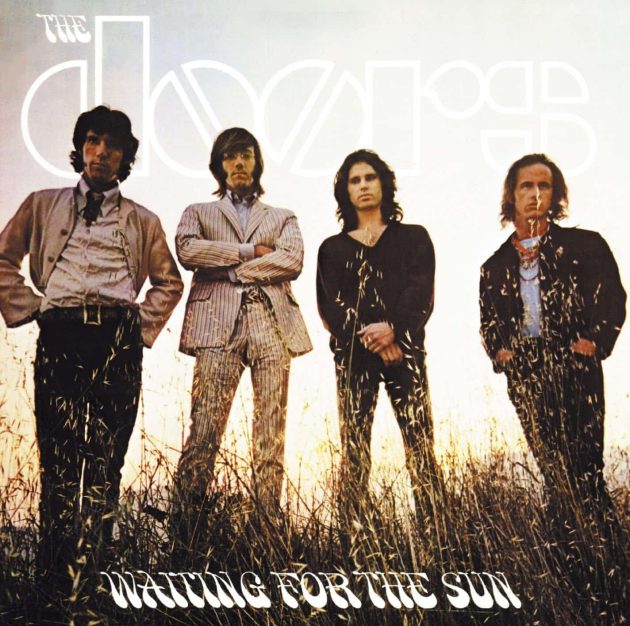
Table of Contents
- 1. Waiting for the Sun: The Doors Album Overview and Release Context
- 2. Recording Sessions: When “Waiting for Jim” Nearly Derailed Everything
- 3. Musicians and Personnel: Who Made the Album
- 4. The Celebration of the Lizard: The Suite That Never Was
- 5. Waiting for the Sun Track-by-Track: A Complete Guide
- 6. Singles and Chart Performance: How the Album Conquered the Charts
- 7. Critical Reception: Praise, Controversy, and the “Kinks Ripoff” Debate
- 8. The Waiting for the Sun Album: Musical Style and Themes
- 9. Album Artwork and Packaging: The Gatefold That Told the Full Story
- 10. Legacy and Influence: Why the Waiting for the Sun Album Still Matters
- Final Thoughts
Own The Doors’ Only Number One Album
Experience Waiting for the Sun on vinyl or CD and hear why over 7 million copies have been sold worldwide since 1968.
Buy on AmazonWaiting for the Sun: The Doors Album Overview and Release Context
Waiting for the Sun is the third studio album by The Doors, released by Elektra Records on July 3, 1968, catalog number EKS-74024.
The album arrived at a pivotal and precarious moment in the band’s career.
Their 1967 debut, The Doors, had charted at number two on the Billboard 200 and launched the massive hit “Light My Fire.”
Their second record, Strange Days, followed just months later in October 1967 and peaked at number three.
Two acclaimed albums released within a single year is an extraordinary feat by any standard.
However, it created an unexpected problem: the band had effectively exhausted their stockpile of pre-written material.
Morrison had arrived in Hollywood in 1965 with a notebook full of lyrics and ideas built up over years of study and solitary writing.
By 1968, that wellspring had largely run dry.
The task of writing an entire album of fresh material, under commercial pressure and tight deadlines, proved enormously challenging for the group.
The result was a record shaped as much by necessity as by inspiration, and its complex creation story makes it one of the most fascinating albums of the psychedelic rock era.
A Band at the Peak of Its Fame
By early 1968, The Doors were one of the biggest rock acts in America.
Jim Morrison had become a tabloid fixture, a rock sex symbol, and a source of constant controversy in equal measure.
The band was filling increasingly larger venues and commanding fees of upwards of $35,000 per night, a sum equivalent to well over $300,000 in today’s money.
Fame, however, was beginning to corrode Morrison from the inside.
Producer Paul A. Rothchild later recalled that the singer was growing tired of the rock star image he had helped create.
Morrison believed himself to be a poet and a thinker first, and a rock performer only incidentally.
The gap between how he saw himself and how the public perceived him was widening fast.
His response to that tension was increasingly self-destructive, and alcohol became his primary coping mechanism throughout the making of this record.
Recording Sessions: When “Waiting for Jim” Nearly Derailed Everything
Recording for the album began in late 1967, initially at Sunset Sound Studios in Los Angeles, where early versions of “The Unknown Soldier” and “Spanish Caravan” were attempted.
The sessions then moved to TTG Studios in Hollywood, California, where the majority of the album was recorded between February and May 1968.
Producer Paul Rothchild would later famously refer to the album as “Waiting for Jim” rather than “Waiting for the Sun.”
Morrison frequently arrived late to sessions, and on some occasions failed to appear at all.
Rothchild noted candidly that the record lacked “the ease that the other records had.”
When Morrison did arrive, his increasing alcoholism made recording difficult and unpredictable.
Drummer John Densmore walked out of at least one session in frustration over Morrison’s behavior.
Even musician Alice Cooper, who was present at the TTG sessions, later recalled being worried about Morrison’s physical condition during this period.
The “Third Album Syndrome” Problem
Densmore described the creative impasse facing the band as the “third album syndrome.”
Having burned through Morrison’s original songbook on the first two records, the group was forced to improvise and write new material in real time inside the studio.
Cultural critic and writer Joan Didion documented this atmosphere in her landmark 1979 book The White Album.
Didion attended a recording session on Sunset Boulevard in spring 1968 and found a band waiting for a lead singer who would not commit to being present.
At one point, keyboardist Ray Manzarek looked up from his keyboard and asked simply, “Do you think Morrison’s going to come back?”
Nobody answered.
When Morrison did eventually appear, he sat on a couch, closed his eyes, and contributed almost nothing for over an hour.
This was the charged, uncertain atmosphere in which Waiting for the Sun was made.
Studio Perfectionism and an Astonishing Take Count
Producer Rothchild’s growing perfectionism added further delays to an already troubled process.
His insistence on repeated takes became a source of tension within the group.
Every song on the album required a minimum of 20 takes to reach Rothchild’s standards.
“The Unknown Soldier,” recorded in two separate parts, required a staggering 130 takes in total, making it one of the most laborious recordings in Doors history.
During the recording of “Five to One,” Morrison arrived at the studio so heavily intoxicated that studio assistants had to physically support him in order for him to complete his vocal parts.
Despite all of this, the final mixes came together with engineer Bruce Botnick at the controls.
Rough stereo mixes were completed by April 18, 1968, with recording continuing into May.
Final mastering was handled by Bernie Grundman in June 1968.
The album was also the final Doors release on which a complete original mono mix was produced and released in the United States.
Musicians and Personnel: Who Made the Album
The core lineup of The Doors is, as always, the beating heart of the album.
Jim Morrison handled lead vocals throughout, delivering performances that range from fragile tenderness on “Love Street” to barely controlled rage on “Five to One.”
Ray Manzarek played keyboards and provided much of the album’s harmonic foundation, functioning simultaneously as rhythm and melody in the absence of a full-time bassist.
Robby Krieger contributed guitar across the record, showcasing remarkable range from the delicate flamenco passages of “Spanish Caravan” to the insistent fuzz work on “Hello, I Love You.”
John Densmore played drums and provided the rhythmic backbone that allowed Morrison, Manzarek, and Krieger to explore freely above him.
Session Musicians: The Bass Question Resolved
Like their previous albums, Waiting for the Sun relied on session musicians to cover bass duties.
The Doors famously had no permanent bassist, with Manzarek’s left hand on a keyboard bass covering low-end duties in live settings.
Douglas Lubahn served as the primary session bassist, appearing on several tracks throughout the album.
Kerry Magness played bass specifically on “Five to One,” the album’s closing track.
On “Spanish Caravan,” jazz bassist Leroy Vinegar played acoustic bass, while Lubahn contributed electric bass on the same track, creating a layered low-end approach.
The Production Team
Paul A. Rothchild served as producer for the third consecutive Doors album.
His relationship with the band was complex by this point, increasingly strained by Morrison’s behavior but still driven by a genuine belief in the group’s artistic potential.
It was Rothchild who identified “Hello, I Love You” as a potential number one single, rescuing it from Morrison’s embarrassment about the song.
Bruce Botnick handled engineering duties and would later play a key role in the album’s anniversary remasters, using the Plangent Process technology for the 2018 50th anniversary edition.
Jac Holzman, founder and head of Elektra Records, served as production supervisor across the project.
The Celebration of the Lizard: The Suite That Never Was
The most significant missing piece from Waiting for the Sun is not a song, but an entire theatrical epic.
Jim Morrison had conceived an ambitious piece called “Celebration of the Lizard,” a sprawling, 17-minute suite of interconnected poetry and music that he intended to occupy all of side two of the album.
The piece was an extension of Morrison’s “Lizard King” mythology, a world of desert landscapes, ancient archetypes, and primal ritual.
The band attempted to record it during the album sessions, but the results consistently failed to translate the vision from stage to studio.
Live performances of the suite had a raw, ritualistic power that simply did not survive the recording process.
Producer Rothchild ultimately declared the studio version unfit for release.
Only a single four-minute fragment, “Not to Touch the Earth,” survived and was included on the album as a standalone track.
The full poem lyrics were printed inside the album’s gatefold sleeve, giving listeners a glimpse of the epic that might have been.
Fans have long mourned this omission, pointing to live recordings of the complete piece as proof of its devastating power.
Its exclusion forced the band to write or excavate additional songs at short notice, fundamentally shaping the album’s final character.
A full live recording of “Celebration of the Lizard” was eventually released on The Doors’ Absolutely Live album in 1970.
The 40th anniversary expanded edition of Waiting for the Sun also included a studio recording of the piece as a bonus track, labeled “An Experiment/Work in Progress.”
Waiting for the Sun Track-by-Track: A Complete Guide
The album contains 11 tracks across two sides, spanning a musical range broader than any previous Doors record.
From baroque pop balladry to anti-war protest, flamenco-infused guitar work to a cappella tribal chanting, the album resists simple categorisation.
Side A
1. Hello, I Love You (2:22)
The album’s opening track is also its most commercially successful and its most controversial.
Morrison originally wrote the song in 1965, inspired by a young woman he watched walking along Venice Beach.
It was one of six songs the pre-Doors lineup, then known as Rick and the Ravens, recorded at World Pacific Jazz Studios in an attempt to secure a record deal with Aura Records.
The band had repeatedly rejected the song as too pop and too simplistic for their identity.
Rothchild, searching for material after “Celebration of the Lizard” fell through, asked the band if they had any songs they considered “not worthy of their dignity.”
When Densmore mentioned the title, Morrison reportedly cringed.
Rothchild listened to Morrison sing it and immediately declared it a potential number one record.
The producer’s studio wizardry transformed the simple song, most notably by stacking ten separate recordings of Krieger’s guitar riff at different tape speeds to create the song’s distinctive, layered sonic texture.
The song topped the Billboard Hot 100 on August 3, 1968, proving Rothchild’s instinct entirely correct.
It remains one of the most hotly debated recordings in the band’s catalog, beloved by casual fans and dismissed by some hardcore devotees as unrepresentative of the band’s true character.
2. Love Street (3:06)
A gentle, hazy baroque-pop ballad, “Love Street” was written by Morrison for his long-term girlfriend Pamela Courson.
The song is named after Rothdell Trail, the modest street in Laurel Canyon’s Hollywood Hills where the couple lived together.
Morrison and Courson would sit on the balcony of their home and watch the neighbourhood’s eccentric inhabitants come and go below.
The lyric “There’s this store where the creatures meet” refers to the Laurel Canyon Country Store, a beloved local landmark just visible from their building.
Manzarek’s piano and Krieger’s guitar interplay throughout the track is elegant and restrained, allowing Morrison’s melody to breathe.
True to form, even in a song of romantic contentment, Morrison added a note of hesitancy: “I guess I like it fine, so far,” a line that speaks volumes about his uneasy relationship with happiness.
3. Not to Touch the Earth (3:54)
The only surviving fragment of the “Celebration of the Lizard” suite, “Not to Touch the Earth” is the album’s most unsettling and experimental track.
Its dense imagery, shifting tempos, and ominous chord progressions marked a direction that would later be identified as proto-progressive rock.
The track introduces the Lizard King mythology that Morrison was developing during this period, with imagery of dead presidents, outlaws, and a mansion on the hill.
Manzarek’s keyboard lines are particularly striking here, adding dissonance and tension that gives the track a genuinely disturbing edge.
4. Summer’s Almost Gone (3:20)
A melancholic waltz of a song, “Summer’s Almost Gone” carries a sense of impending loss.
Like “Hello, I Love You,” it had been demoed as far back as 1965 before Krieger joined the band.
Morrison’s vocal performance is measured and aching, describing the fading of warmth, light, and good times with the quiet dread of someone who has already made peace with the ending.
5. Wintertime Love (1:52)
At under two minutes, “Wintertime Love” is the shortest track on the album and one of the most delicate in the Doors catalog.
A waltz in three-quarter time, the song stands in contrast to both the pop sheen of “Hello, I Love You” and the brooding weight of “Not to Touch the Earth.”
Morrison’s vocal sounds vulnerable here, an unusual register for a singer more often associated with bravado and confrontation.
6. The Unknown Soldier (3:10)
The first single released from the album, “The Unknown Soldier” is one of the most ambitious protest recordings of the Vietnam era.
Its anti-war message is delivered not through sloganeering but through a kind of sonic theatre: a military drum cadence, a mock rifle volley, the collapse and apparent death of the singer, followed by a euphoric musical resurrection.
Morrison’s inspiration came partly from a visit to Arlington Cemetery’s Tomb of the Unknown Soldier before a Washington DC concert the previous year.
The band created a remarkable promotional film for the song, shot at the derelict ruins of Pacific Ocean Park pier in Santa Monica, in which Morrison underwent a staged mock execution complete with simulated gunfire and a dramatic collapse.
The song required 130 takes to complete and was pieced together in sections like a short film rather than a conventional recording.
It was released as a single in March 1968, backed with “We Could Be So Good Together,” and peaked at number 39 on the Billboard Hot 100.
Side B
7. Spanish Caravan (2:58)
The opening track of side two is Robby Krieger’s finest moment on the album and one of the most technically impressive pieces in the Doors catalog.
The song opens with Krieger performing a passage inspired by the classical guitar works of Francisco Tárrega, evoking Spanish and Romani folk traditions before the full band crashes in.
The contrast between the delicate acoustic flamenco introduction and the driving electric rock section that follows is startling and deeply effective.
Leroy Vinegar’s acoustic bass on this track adds a warm, woody texture that distinguishes it sonically from the rest of the album.
Some critics have identified “Spanish Caravan” as one of the earliest examples of progressive rock in the album format.
8. My Wild Love (2:50)
“My Wild Love” is the most unconventional track on the album and the most divisive.
It features no conventional instruments whatsoever, relying entirely on vocals, hand claps, and foot stomps in an a cappella arrangement.
Morrison and the band built the track into a communal work song, with everyone in the studio joining in on the chanting and percussion.
The result is part tribal ritual, part gospel chant, and entirely unlike anything else in the rock music of 1968.
Krieger has openly described it as his least favourite Doors recording.
When a fan once told Krieger it was his favourite Doors song, the guitarist reportedly responded: “Oh shit, man, I hate that song.”
The track’s strangeness, however, is arguably part of what makes the album as a whole so interesting.
9. We Could Be So Good Together (2:20)
One of the album’s more optimistic moments, “We Could Be So Good Together” was actually recorded during the sessions for Strange Days in 1967 and had appeared on an early track listing for that album before being held back.
A Slant Magazine review described the song as representing “categorically pre-fame Morrison,” pointing to the line “The time you wait subtracts from joy” as a kind of innocent idealism the singer had long since left behind by the time the album came out.
The song was released as the B-side to “The Unknown Soldier.”
10. Yes, the River Knows (2:35)
Written by Krieger, “Yes, the River Knows” is one of the album’s most quietly beautiful tracks.
In the liner notes to the 1997 Doors box set, Manzarek singled out the piano and guitar interplay on this track as “absolutely beautiful.”
The song has a contemplative, almost meditative quality that provides breathing room between the raw intensity of “My Wild Love” and the album-closing power of “Five to One.”
11. Five to One (4:22)
“Five to One” closes the album with a performance that feels like a last stand.
The song came together from a spontaneous studio jam, with Morrison chanting his lyrics over Densmore’s relentless 4/4 beat while Krieger and Manzarek improvised around him.
Morrison was by all accounts heavily intoxicated during the recording of the track, requiring physical assistance to remain upright in the vocal booth.
Yet the performance crackles with an almost reckless energy.
The song’s opening line, “Five to one, baby, one in five, no one here gets out alive,” was later adopted as a kind of epitaph for Morrison himself, who died three years after the album’s release.
The primitive drum pattern, heavy guitar riff, and pre-punk ferocity of Morrison’s delivery led some critics to identify the track as a blueprint for the raw energy that would define bands like The Stooges in the early 1970s.
Singles and Chart Performance: How the Album Conquered the Charts
Two singles were extracted from the album, and their contrasting chart results tell a fascinating story about the band’s commercial reach.
“The Unknown Soldier” / “We Could Be So Good Together” (March 1968)
The first single reached number 39 on the Billboard Hot 100 after 11 weeks on the chart.
Its anti-war content, combined with the deliberately provocative promotional film, limited its mainstream radio appeal despite strong critical interest.
“Hello, I Love You” / “Love Street” (June 1968)
The second single told an entirely different story.
Released in June 1968, ahead of the album, “Hello, I Love You” reached number one on the Billboard Hot 100 on August 3, 1968, where it stayed for two weeks.
It also topped the charts in Canada.
In the United Kingdom, the single peaked at number 15, giving the band their first significant UK chart presence.
Album Chart Performance
Driven by “Hello, I Love You,” Waiting for the Sun became The Doors’ first and only number one album in the United States.
It held the top position on the Billboard 200 for four consecutive weeks.
In the United Kingdom, the album peaked at number 16, marking the band’s debut in the UK album charts.
In France, the album reached number one.
As of 2015, the album had sold over 7 million copies worldwide since its original 1968 release.
It was certified platinum by the RIAA in November 2001, more than three decades after its release, reflecting the enduring appeal of the Doors catalog among successive generations of rock fans.
Critical Reception: Praise, Controversy, and the “Kinks Ripoff” Debate
Contemporary critical reaction to Waiting for the Sun was decidedly mixed, a sharp contrast to the almost universal acclaim that had greeted the band’s first two records.
Jim Miller of Rolling Stone expressed disappointment, writing that after a year and a half of Morrison’s theatrical gestures, listeners might have hoped for greater musical growth.
Miller acknowledged the album was not “really terrible” but found it lacking in excitement.
The Rolling Stone Album Guide was even more pointed, dismissing “Hello, I Love You” in terms that many fans found excessive and unfair.
Not all voices were negative, however.
Pete Johnson of The Philadelphia Inquirer argued that Waiting for the Sun contained fewer self-indulgent moments than any previous Doors album.
The New Musical Express praised “The Unknown Soldier” as the standout on side one and described all five tracks on side two as gems, singling out “My Wild Love” and “Five to One.”
The Hello, I Love You Controversy: The Kinks Connection
No aspect of the album generated more sustained controversy than the similarity between “Hello, I Love You” and The Kinks’ 1964 hit “All Day and All of the Night.”
Both songs share a driving guitar riff and comparable rhythmic structure.
In the liner notes to the Doors box set, Krieger denied the allegations and stated that the song’s feel was drawn from Cream’s “Sunshine of Your Love,” not the Kinks.
Densmore confirmed that Krieger had specifically asked him to imitate Ginger Baker’s drumming from the Cream track during the recording session.
However, in 1981, Manzarek made a candid admission to Musician magazine, saying: “Yes, it is a lot like it, isn’t it? Sorry, Ray,” acknowledging the resemblance to Ray Davies’ composition.
UK courts ultimately ruled in favor of Davies, and a settlement was reached under which a portion of the single’s UK royalties were paid to him.
The Kinks did not file a formal lawsuit in the United States, and the song’s US earnings remained unaffected.
In a 2012 interview with Mojo magazine, Ray Davies recalled being informed of the similarity by his publisher while on tour, and saying he would rather the Doors simply own up than face a lawsuit.
The controversy has never fully settled, and debates about the song’s origins continue among music historians and fans to this day.
Retrospective Reassessment
Over the decades, critical opinion on Waiting for the Sun has shifted considerably.
Retrospective assessments have been notably kinder than the original reviews.
Music writer Richie Unterberger concluded that “time’s been fairly kind to the record, which is quite enjoyable and diverse, just not as powerful a full-length statement as the group’s best albums.”
Stereogum ranked it the third-best Doors album overall, behind L.A. Woman and the debut, describing it as the band at their “strangest, most exploratory, and most stylistically expansive.”
The site concluded that the album showed the Doors working at their highest level, at least occasionally.
The consensus that has emerged over time is nuanced: the album is not the Doors at their most powerful, but it is the Doors at their most varied and, in some respects, their most adventurous.
The Waiting for the Sun Album: Musical Style and Themes
If the first two Doors albums were defined by intensity and darkness, Waiting for the Sun introduced something new: contrast.
The album moves deliberately between extremes, placing the warm romanticism of “Love Street” beside the ominous menace of “Not to Touch the Earth,” and the pop brightness of “Hello, I Love You” beside the tribal aggression of “Five to One.”
This tension between lightness and dark is the album’s defining characteristic.
As one critic described it, dappled sunlight enters the Doors’ dungeon of despair through a basement window on Waiting for the Sun.
The imagery is apt: the record feels like a collection of moods rather than a unified statement.
Morrison’s Lyrical Evolution
Lyrically, the album captures Morrison at a crossroads between the youthful idealism of his 1965 notebook and the darker, more self-destructive consciousness he was developing by 1968.
Songs like “We Could Be So Good Together” carry a lightness that critics noted felt almost out of character by 1968 standards.
By contrast, “Five to One” and “Not to Touch the Earth” represent Morrison at his most prophetic and unsettling.
The album also shows the increasing importance of his bandmates as songwriters.
Krieger wrote “Yes, the River Knows,” demonstrating the melodic craft that made him one of the era’s most underrated guitarists.
Several tracks, including “Five to One” and “Not to Touch the Earth,” emerged from collective improvisation rather than individual composition.
Manzarek’s Keyboard Architecture
Ray Manzarek’s keyboard playing on Waiting for the Sun deserves particular attention.
He functions simultaneously as harmonic foundation, melodic lead, and rhythmic driver across the album’s varied styles.
On “Love Street,” his piano creates a hazy, impressionistic backdrop that perfectly suits Morrison’s nostalgic lyric.
On “Not to Touch the Earth,” his keyboard lines are jagged and deliberately dissonant, building an atmosphere of genuine unease.
On “Hello, I Love You,” his organ riff is the song’s propulsive core, as recognisable as anything on the record.
The range he demonstrates across 11 tracks confirms his position as one of the most distinctive keyboard players in rock history.
Album Artwork and Packaging: The Gatefold That Told the Full Story
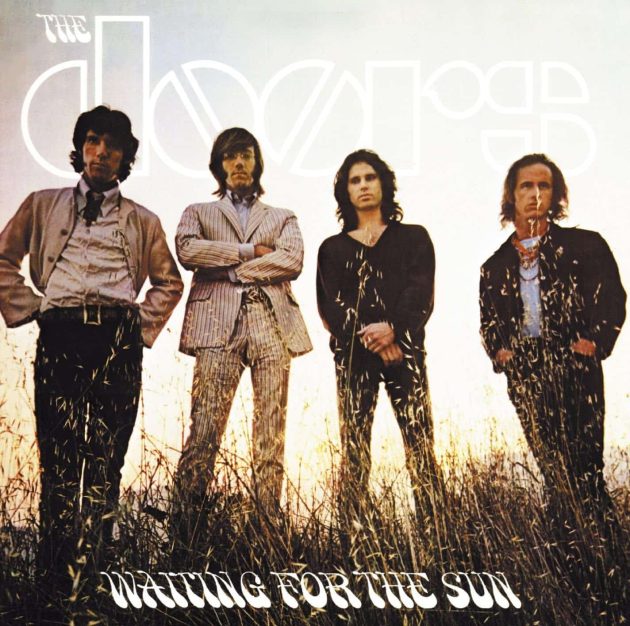
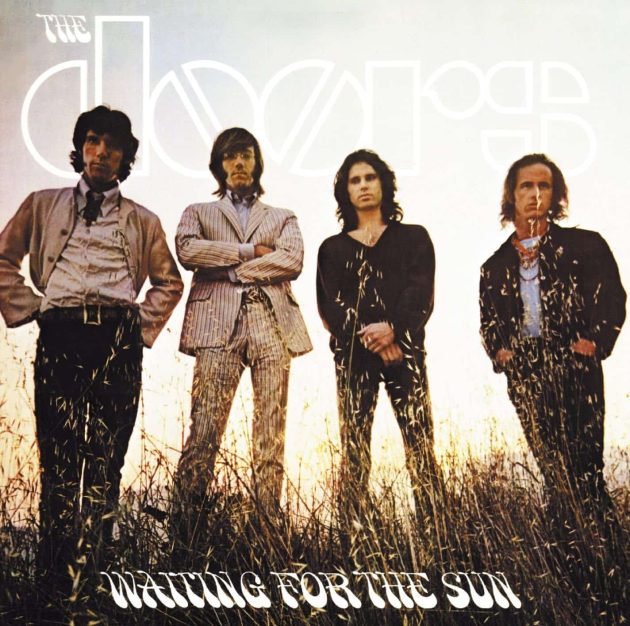
The front cover photograph of Waiting for the Sun was taken by Paul Farrara, one of Morrison’s close friends and an occasional filmmaker who had collaborated with the singer on experimental projects.
The cover was shot in Laurel Canyon, the sun-drenched Los Angeles neighbourhood that was home to many of the era’s most significant musicians.
The image presents the four Doors in a pastoral outdoor setting, a deliberate visual contrast to the urban intensity and darkness that characterised much of their music.
The back cover photograph was taken by Guy Webster, the celebrated rock photographer whose portraits defined the visual identity of numerous 1960s acts.
Art direction and design were handled by William S. Harvey, who gave the package a clean, open feel appropriate to the album’s more varied and melodic content.
The Gatefold and the Lost Epic
The album’s gatefold sleeve served a purpose beyond aesthetics.
Since “Celebration of the Lizard” could not be included as a recorded piece, Morrison insisted on printing the full text of the poem inside the gatefold.
The complete lyrics of “Celebration of the Lizard” were therefore preserved in the original physical release, giving vinyl buyers access to Morrison’s unfiltered poetry even if the music that was meant to accompany it never made the final cut.
The first pressing, released on Elektra’s distinctive tan label, also featured the catalog number EKS-74024.
Some early copies came with a promotional sticker on the cover reading “Includes Hello, I Love You,” evidence of Elektra’s confidence in the single.
The record was released in both stereo and mono formats, and Waiting for the Sun remains the last Doors album to receive a complete, original mono mix release in the United States.
Stream or Own Waiting for the Sun Today
Available on vinyl, CD, and as the acclaimed 50th Anniversary deluxe edition remastered by Bruce Botnick.
Buy on AmazonLegacy and Influence: Why the Waiting for the Sun Album Still Matters
More than five decades after its release, the waiting for the sun the doors album retains a unique place in rock history.
It is the definitive example of a band achieving its greatest commercial success at the precise moment its creative process was under the most strain.
That paradox makes it endlessly fascinating to study.
The album confirmed The Doors as a band capable of true stylistic range, moving fluently between pop, psychedelia, protest, classical, and something approaching progressive rock within a single LP.
It also documented, in real time, the beginning of Jim Morrison’s unravelling, making it an essential historical document for anyone seeking to understand what happened to one of rock’s most extraordinary frontmen.
Commercial Legacy and Sales
The album has demonstrated remarkable commercial staying power over more than five decades.
RIAA platinum certification came in November 2001, over 33 years after the original release, reflecting the ongoing appeal of the Doors catalog through reissues, compilations, and streaming.
Total global sales have exceeded 7 million copies as of 2015.
The Doors maintain approximately 11.1 million monthly listeners on Spotify as of 2025, and the album’s title track, “Waiting for the Sun,” has accumulated over 34 million streams on the platform.
For fans interested in exploring the complete six-studio-album Doors catalog in immersive audio, the Doors Dolby Atmos Blu-ray release offers all six original LPs in stunning surround sound.
Influence on Later Artists
“Five to One” has been consistently cited as a precursor to punk and proto-punk rock.
The track’s raw, aggressive simplicity and Morrison’s confrontational vocal approach pointed directly toward the energy that would define bands like The Stooges and, later, the punk movement of the mid-1970s.
“Spanish Caravan” demonstrated that rock musicians could incorporate classical and world music traditions without compromising the energy of the form, a lesson taken on board by the progressive rock acts that followed.
“The Unknown Soldier” stands as one of the era’s most effective anti-war statements, a song that used theatrical staging and sonic narrative rather than simple protest lyrics to make its point.
Its influence can be heard in the conceptual approach to protest music taken by artists across subsequent decades.
Reissues and Anniversary Editions
The album has been revisited several times in expanded and remastered form.
In 1988, Botnick produced the first digital remaster of the record.
In the 1980s, a CD version was also mastered using previously unused portions of vocals and music from the original sessions, adding new material to tracks including “Wintertime Love” and “My Wild Love.”
The 40th anniversary expanded edition included the full studio recording of “Celebration of the Lizard” as well as early alternate takes of “Not to Touch the Earth.”
In 2018, Rhino Records released the definitive 50th anniversary deluxe edition, featuring a 1-LP/2-CD package remastered by Botnick using the Plangent Process.
The first CD and the LP featured remastered versions of all 11 original tracks.
The second CD added 14 previously unreleased tracks, including rough mixes of every album track.
The audio technology encoded the CDs with MQA technology for audiophile-quality playback.
Botnick noted a personal preference for some of the rough mixes, describing them as capturing “all of the elements and additional background vocals and some intangible roughness, all quite attractive and refreshing.”
Its Place in the Doors Discography
Waiting for the Sun occupies a transitional position in the Doors story.
It is more accessible than the experimental edge of Strange Days and less artistically consistent than the debut.
Yet it points forward as clearly as it looks back.
The blueprint for the harder, blues-driven approach of Morrison Hotel is audible in the raw energy of “Five to One.”
The more orchestrated, commercially polished direction of The Soft Parade is foreshadowed by the baroque arrangements that appear throughout the album’s quieter moments.
In this sense, Waiting for the Sun is a hinge point, a record between two distinct phases of the Doors’ career, holding both directions simultaneously in tension.
To explore where the Doors went next, read our complete song guide to Touch Me, the top-five hit that defined their orchestral era, and the story behind Roadhouse Blues, the raw blues return that followed.
For the complete band biography from formation in 1965 through to the post-Morrison era, the ClassicRockArtists.com Doors hub page covers every chapter of the story.
Final Thoughts: The Album That Defined a Crossroads
Waiting for the Sun is not the Doors album most critics would place at the very top of the band’s catalog.
But it may be the most revealing one.
It is the album that shows what the Doors could do when their usual creative reserves had run dry and their most powerful force was actively working against himself.
The fact that it produced their biggest commercial success, their highest-charting single, and their only number one album under those conditions is remarkable.
It speaks to the extraordinary resilience and raw talent of Manzarek, Krieger, and Densmore, who collectively held the sessions together when Morrison could not.
It speaks to Rothchild’s instinct and determination, driving a band through hundreds of takes to find the performances that worked.
And it speaks, despite everything, to Morrison himself, who delivered some of his most enduring vocal performances during the most turbulent period of his life.
The album contains seven million reasons to listen again and, more importantly, a story behind every one of those sales that goes deeper than any hit single can convey.
Whether you are returning to it after years away or discovering it for the first time, the waiting for the sun the doors album rewards patient, attentive listening with more than most records from 1968 ever could.