

Use Your Illusion I: The Definitive Guns N’ Roses Review
Use Your Illusion I is the most ambitious record Guns N’ Roses ever made, and more than three decades later, it still sounds enormous.
Released on September 17, 1991, it arrived on the same day as its companion volume, Use Your Illusion II, and together the two records reshaped what a hard rock band could accomplish in a single release cycle.
The members of Guns N’ Roses who created this record were not playing it safe.
They were making a statement to every rock legend before them: we belong here too.
Quick Navigation
- Use Your Illusion I: The Album That Changed Rock Forever
- The Band, the Lineup, and the Recording Sessions
- Use Your Illusion I: Every Track Reviewed
- November Rain, the Trilogy, and the Videos That Defined an Era
- Chart Performance, Legacy, and the Cover Art
- Guns N’ Roses Discography at a Glance
- Frequently Asked Questions
Use Your Illusion I: The Album That Changed Rock Forever
By 1991, Guns N’ Roses had spent nearly four years riding the unstoppable momentum of Appetite for Destruction.
That 1987 debut had redefined hard rock with raw swagger, street-level fury, and a lineup that felt genuinely dangerous.
The pressure to follow it up was immense.
Rather than deliver a carbon copy, the band spent close to three years in the studio recording enough material for two full albums.
They released both volumes on the same day, a move that had never been attempted at that scale in rock history.
Industry predictions ahead of release compared potential sales to Michael Jackson’s Thriller and Bruce Springsteen’s Born in the U.S.A.
Use Your Illusion I spans 16 tracks and more than 76 minutes of music.
It blends skull-cracking hard rock with orchestral ballads, blues, punk rock, and piano-driven drama.
The album is widely regarded as the heavier of the two Illusion volumes, driven largely by the earthy, Stonesy influence of rhythm guitarist Izzy Stradlin.
For every chart figure, credit, and critical note documented in one place, the Wikipedia entry on Use Your Illusion I is one of the most thorough resources available.
The Band, the Lineup, and the Recording Sessions
Use Your Illusion I is the only Guns N’ Roses studio album to feature the complete Illusions-era lineup.
Axl Rose handled lead vocals, piano, choir, synthesizer, programming, and acoustic guitar across multiple tracks.
Slash delivered lead guitar performances ranging from heavy metal to classical fingerpicking, slide guitar, Dobro, talkbox, and six-string bass.
Izzy Stradlin anchored the rhythm section with the effortlessly cool swagger that had already made G N’ R Lies such a satisfying listen.
Duff McKagan drove the low end throughout with locked-in bass precision.
New drummer Matt Sorum, brought in from The Cult, replaced original drummer Steven Adler, whose severe heroin addiction had ended his time with the band.
Keyboardist Dizzy Reed joined as a full member, debuting a sonic dimension the band had never explored in a studio setting before.
The album was produced by Mike Clink alongside the band.
After completing mixes of 21 tracks with engineer Bob Clearmountain, the band scrapped everything and restarted with engineer Bill Price, best known for his work on the Sex Pistols records.
The result is a production that sounds simultaneously enormous and alive, never sterile or overly polished.
Use Your Illusion I: Every Track Reviewed
The album explodes out of the gate with “Right Next Door to Hell,” a skull-crushing riff rocker that Rose wrote about a real dispute with his neighbor.
“Dust N’ Bones” follows with Stradlin on lead vocals, laid-back and bluesy with a natural ease.
Track 3 is the band’s ferocious cover of Live and Let Die, transforming Paul McCartney’s Bond theme into something far heavier.
Don’t Cry arrives next, a power ballad with genuine emotional weight that opens the band’s celebrated Illusion video trilogy.
“Perfect Crime” is exactly what its title promises: a two-minute, 23-second sprint of pure punk aggression.
“You Ain’t the First,” “Bad Obsession,” and “Back Off Bitch” demonstrate the album’s remarkable stylistic range across acoustic confession, grinding hard rock, and raw punk.
“Double Talkin’ Jive” is Stradlin at his sharpest, with an extended flamenco-style guitar outro from Slash that stops time for a moment.
“November Rain” lands at track 10 and immediately changes the emotional temperature of the entire album.
“The Garden” is a brooding duet with Alice Cooper, whose vocal was reportedly recorded in just six takes over the course of a single hour.
“Garden of Eden” is the punkiest track on the record, filmed in one static shot for its music video.
“Don’t Damn Me,” “Bad Apples,” and “Dead Horse” each hold their own on the album’s back half.
Then comes “Coma.”
At over 10 minutes, it is the longest song Guns N’ Roses have ever recorded.
Rose drew inspiration from the time he accidentally overdosed on pills during an argument and ended up in the hospital.
The voice in the intro playing the doctor belongs to the actual physician who treated him.
Many fans and critics consider “Coma” the band’s single greatest artistic achievement.
November Rain, the Trilogy, and the Videos That Defined an Era
The emotional centerpiece of this album is November Rain.
Axl Rose had been developing this song since 1983.
It runs to 8 minutes and 57 seconds.
Geffen Records initially refused to release it as a single, judging it far too long for commercial radio play.
A shortened version was eventually issued, and the song peaked at number 3 on the Billboard Hot 100 in 1992.
At the time, it was the longest song in history to crack the top 10 of the Hot 100.
That record stood until Taylor Swift’s “All Too Well” surpassed it in 2021.
Guns N’ Roses performed “November Rain” live with Elton John on piano at the 1992 MTV Video Music Awards, one of the most unforgettable televised moments in rock history.
“November Rain” and “Don’t Cry” form two-thirds of the Illusion video trilogy, with Estranged from Use Your Illusion II completing it.
Together, these three videos cost tens of millions to produce and told a connected, emotionally devastating story across multiple chapters.
You can experience the full album from start to finish by watching the Use Your Illusion I full album on YouTube.
It is one of the most rewarding 76-minute listening experiences in the history of rock music.
Chart Performance, Legacy, and the Cover Art
Use Your Illusion I debuted at number 2 on the Billboard 200, selling 685,000 copies in its very first week.
More than 500,000 copies of both Illusion albums were sold in just two hours on release day alone.
The album is certified 7x Platinum by the RIAA, with US sales exceeding 5.5 million copies as of 2010.
It was the first time in history that a band had held the top two positions on the Billboard 200 simultaneously, a feat not accomplished since Jim Croce in 1974.
Both Use Your Illusion records were jointly ranked number 41 on Rolling Stone’s 2010 list of the best albums of the 1990s.
The album received a Grammy Award nomination in 1992.
David Fricke of Rolling Stone gave it 3.5 out of 5 stars, calling it “so physically assaultive, verbally incendiary and at times downright screwy that it’s hard to believe there’s a sister disc out there just like it.”
Entertainment Weekly awarded it a full “A” grade.
In 2022, a 30th anniversary Super Deluxe box set was released, featuring remastered audio from 96kHz/24-bit transfers of the original tapes, 63 unreleased tracks and videos, and a newly recorded version of “November Rain” performed by a real 50-piece orchestra for the very first time.
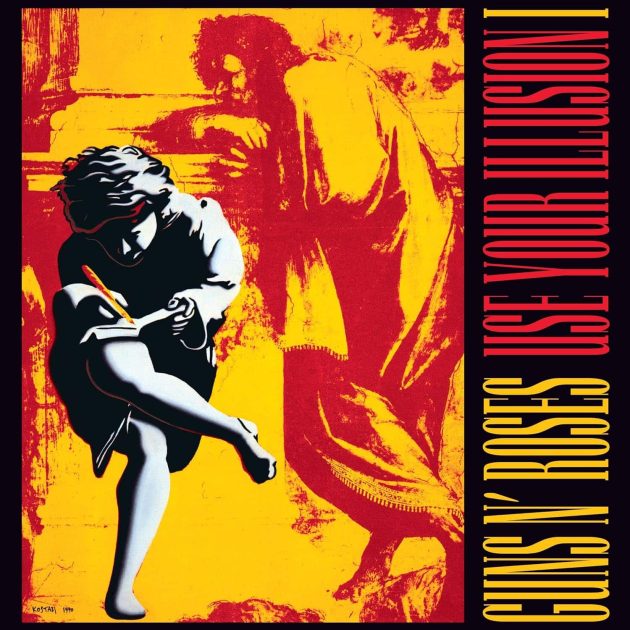
The album’s cover art is a detail from Raphael’s painting “The School of Athens,” colored by Estonian-American artist Mark Kostabi.
The warm yellows and reds of Use Your Illusion I visually distinguish it from the cooler blues and purples of its companion volume.
Both albums carry the liner note “Fuck You, St. Louis,” a reference to the Riverport Riot at the Hollywood Casino Amphitheatre during the July 1991 leg of the Use Your Illusion Tour.
To see how other legendary hard rock acts of the same era built their own legacies, the complete story behind the members of Motley Crue is worth your time.
Affiliate Disclosure: I am an Amazon Associate and earn a small commission from qualifying purchases made through links on this site, at no extra cost to you. This helps keep ClassicRockArtists.com running and the deep dives coming. Thank you for your support.
Browse All Guns N’ Roses Albums and Merch on Amazon
Guns N’ Roses Discography at a Glance
Understanding Use Your Illusion I requires knowing exactly where it sits in the full Guns N’ Roses catalog.
- Live ?!*@ Like a Suicide (EP, 1986)
- Appetite for Destruction (1987)
- G N’ R Lies (1988)
- Use Your Illusion I (1991) — This Album
- Use Your Illusion II (1991)
- The Spaghetti Incident? (1993)
- Chinese Democracy (2008)
Use Your Illusion I sits at the creative peak of what many consider the band’s greatest and most definitive lineup.
If you want to see Guns N’ Roses perform these songs live in 2026, check out the full details on the Guns N’ Roses 2026 tour.
Frequently Asked Questions About Use Your Illusion I
When was Use Your Illusion I released?
Use Your Illusion I was released on September 17, 1991, on Geffen Records, on the exact same day as its companion volume, Use Your Illusion II.
How many tracks are on Use Your Illusion I?
The album contains 16 tracks, running over 76 minutes in total.
What is the longest song on Use Your Illusion I?
“Coma” is the longest track, clocking in at over 10 minutes, and it remains the longest song Guns N’ Roses have ever recorded.
How did Use Your Illusion I chart?
The album debuted at number 2 on the Billboard 200 in September 1991, selling 685,000 copies in its first week, and has since been certified 7x Platinum by the RIAA.
Is Use Your Illusion I better than Use Your Illusion II?
Most critics consider Use Your Illusion I the stronger of the two, with AllMusic calling it a more focused record and the Rolling Stone Album Guide praising it as “the more propulsive” volume, largely due to Izzy Stradlin’s heavier presence throughout.
What is “November Rain” about?
Axl Rose described “November Rain” as a song about not wanting to face the reality of a difficult love, and he had been developing the composition since 1983 before it finally appeared on this album.
Who guests on Use Your Illusion I?
Alice Cooper contributes lead vocals on “The Garden,” and Shannon Hoon of Blind Melon provides backing vocals on several tracks, including “Don’t Cry.”
Is there a remastered edition of Use Your Illusion I?
Yes. In 2022, Guns N’ Roses released a 30th anniversary Super Deluxe box set featuring remastered audio from 96kHz/24-bit transfers of the original tapes, along with 63 unreleased tracks, full live concert footage, and a newly orchestrated version of “November Rain.”
Use Your Illusion I remains one of the most rewarding and relentlessly human rock albums ever committed to tape, and any serious fan of the genre owes it to themselves to spend real time with Use Your Illusion I from track one straight through to “Coma.”