

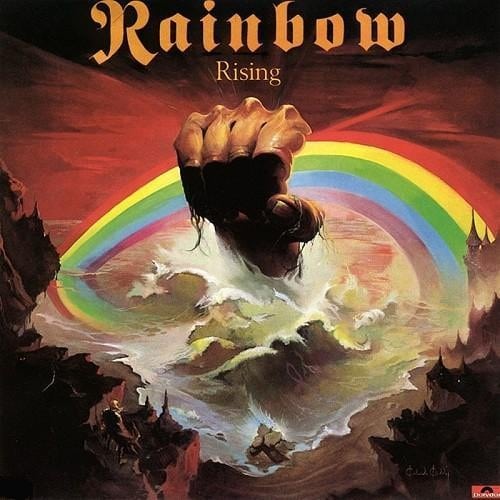
Rainbow Stargazer is the towering centerpiece of Rainbow’s 1976 album Rising, an eight-minute epic that turned a wizard’s obsession with the sky into one of hard rock’s most ambitious recordings.
Ritchie Blackmore and Ronnie James Dio built the song around a cello-inspired riff, a 28-piece orchestra, and Cozy Powell’s thundering drum intro.
Rainbow Stargazer never charted as a single, but critics and musicians still rank it among the greatest heavy metal songs ever recorded.
Here is the full story behind the writing, the recording, and the legacy of Rainbow Stargazer.
This deep dive covers who wrote it, what it means, and why it still matters five decades later.
Affiliate Disclosure: I am an Amazon affiliate and if you purchase through any amazon links on this site i may earn a small commission at no extra charge to you.
📋 Table of Contents [+]
⚡ Key Takeaways
- Rainbow Stargazer appears on Rising, Rainbow’s second studio album, released May 17, 1976.
- Ritchie Blackmore wrote the music and Ronnie James Dio wrote the lyrics, telling the story of a wizard who enslaves a nation to build a tower to the stars.
- A 28-piece section of the Munich Philharmonic Orchestra recorded strings and horns for the track under conductor Rainer Pietsch.
- Rolling Stone ranked Rainbow Stargazer 14th on its 2023 list of the 100 Greatest Heavy Metal Songs.
- Rainbow played the song throughout its 1976 tour and later revived it during Ritchie Blackmore’s Rainbow reunion shows starting in 2016.
What Is the Story Behind Rainbow Stargazer?
Rainbow Stargazer tells the story of an ancient wizard who enslaves a nation to build a tower so he can fly to the stars.
Ritchie Blackmore and Ronnie James Dio built the song as the centerpiece of Rising, Rainbow’s second studio album, released May 17, 1976.
Dio wrote the lyrics from the viewpoint of a slave in ancient Egypt, forced to serve a master obsessed with the sky.
The wizard finally attempts flight from his finished tower and falls to his death.
His freed slaves walk away not knowing where to turn once the only master they ever served is gone.
Rainbow Stargazer runs 8 minutes and 26 seconds in its studio form, making it the longest track on Rising.
Who Wrote Rainbow Stargazer?
Ritchie Blackmore wrote the music for Rainbow Stargazer and Ronnie James Dio wrote the lyrics.
Blackmore built the main riff while learning to play cello, according to Roy Davies’ book Rainbow Rising.
He wanted a riff that sounded like nothing else in hard rock at the time.
Dio matched that ambition with an operatic vocal performance that stretched far past typical rock phrasing.
Blackmore and Dio share the sole songwriting credit even though bassist Jimmy Bain and keyboardist Tony Carey shaped parts of the arrangement during rehearsals.
Where Was Rainbow Stargazer Recorded?
Rainbow recorded Stargazer at Musicland Studios in Munich, West Germany, in February 1976.
Producer Martin Birch oversaw the sessions for the entire Rising album.
The core band tracked the song with Blackmore on guitar, Dio on vocals, Tony Carey on keyboards, Jimmy Bain on bass, and Cozy Powell on drums.
The band flew home to the United States before the orchestral parts were added.
A 28-piece section of the Munich Philharmonic Orchestra recorded strings and horns afterward under conductor Rainer Pietsch, with Fritz Sonnleitner leading as concert master.
Engineers then mixed the orchestra recording together with Carey’s keyboard track to finish Rainbow Stargazer.
What Does the Rainbow Stargazer Story Mean?
Rainbow Stargazer works as a morality tale about blind devotion to a false idol.
Dio explained the wizard, called the Stargazer, becomes obsessed with the sky and forces his people to build him a tower to reach it.
Many listeners read the song as a warning against following messiahs and cult leaders without question.
Others hear it as a message about holding onto hope through years of forced hardship.
The story continues directly into “A Light in the Black,” the next track on Rising, which picks up after the wizard’s fall.
How Did Cozy Powell and the Orchestra Shape Rainbow Stargazer?
Cozy Powell opens Rainbow Stargazer with one of the most recognized drum intros in hard rock.
His thundering fills set the scale for everything the orchestra adds later in the track.
Blackmore’s guitar solo uses a B Phrygian dominant scale, giving Rainbow Stargazer its Middle Eastern and Arabic flavor.
The Munich Philharmonic strings swell underneath the riff instead of sitting quietly in the background.
That combination of drums, guitar, and orchestra gave Rainbow Stargazer a scale few hard rock bands attempted in 1976.
Was Rainbow Stargazer Inspired by Led Zeppelin’s Kashmir?
Rainbow Stargazer took direct inspiration from Led Zeppelin’s “Kashmir,” released the year before on Physical Graffiti in 1975.
Both songs use a desert-themed, orchestral sound built around a hypnotic central riff.
Blackmore wanted his own version of that grand, cinematic scale.
Deep Purple bassist Roger Glover reportedly called the finished track a masterpiece once he heard it.
Rainbow Stargazer answered Kashmir with an orchestra of its own instead of copying the arrangement note for note.
Rainbow Stargazer Personnel and Credits
The table below lists everyone credited on the Rainbow Stargazer recording.
| Role | Name |
|---|---|
| Guitar, songwriter | Ritchie Blackmore |
| Vocals, songwriter | Ronnie James Dio |
| Keyboards | Tony Carey |
| Bass | Jimmy Bain |
| Drums | Cozy Powell |
| Orchestra | Munich Philharmonic Orchestra (28-piece) |
| Conductor | Rainer Pietsch |
| Concert master | Fritz Sonnleitner |
| Producer | Martin Birch |
Why Is Rainbow Stargazer Considered a Metal Landmark?
Rainbow Stargazer is considered a landmark heavy metal recording because of its scale, structure, and vocal performance.
Rolling Stone ranked it 14th on its 2023 list of the “100 Greatest Heavy Metal Songs” and called Dio’s vocal the finest of his recorded career.
AllMusic described the track as a “bombastic, strings-enriched epic.”
A Gibson readers’ poll placed Rainbow Stargazer 17th among the greatest heavy metal songs of all time.
Modern power metal bands still cite Rainbow Stargazer as a direct influence on their own orchestral arrangements.
Did Rainbow Ever Play Stargazer Live?
Rainbow played Stargazer throughout its 1976 European and North American tours in support of Rising.
A live recording from Cologne, Germany, on September 25, 1976, appears on the band’s Live in Germany 1976 album, released in 1990.
Rainbow dropped the song from regular rotation in the years after Dio left the band in 1978.
Blackmore brought Rainbow Stargazer back to the stage during Ritchie Blackmore’s Rainbow reunion shows starting in 2016.
Dio also performed shortened versions of the song during his own solo career.
People Also Ask
What is Rainbow’s Stargazer about?
Rainbow’s Stargazer tells the story of an Egyptian wizard who enslaves his people to build a tower so he can fly to the stars, then falls to his death once he tries.
Ronnie James Dio wrote the lyrics from the viewpoint of one of the wizard’s slaves.
Many fans read it as a warning against blind devotion to false idols.
Who wrote Stargazer by Rainbow?
Ritchie Blackmore wrote the music and Ronnie James Dio wrote the lyrics for Stargazer, released on Rainbow’s 1976 album Rising.
Blackmore built the main riff while learning to play cello.
It remains one of the pair’s most celebrated songwriting collaborations.
How long is Rainbow’s Stargazer?
Rainbow’s Stargazer runs 8 minutes and 26 seconds in its studio version on Rising.
An early rough mix with an extended keyboard intro ran even longer, at over 9 minutes.
It is the longest track on the album.
What album is Stargazer on?
Stargazer appears on Rising, Rainbow’s second studio album, released May 17, 1976 on Polydor and Oyster Records.
It is the fourth track on the original vinyl release, between “Run with the Wolf” and “A Light in the Black.”
Did Rainbow ever play Stargazer live?
Yes, Rainbow performed Stargazer regularly during its 1976 tour behind Rising, including shows captured on the Live in Germany 1976 album.
The band dropped it from rotation for long stretches after Dio left in 1978.
Ritchie Blackmore’s Rainbow revived the song for reunion shows starting in 2016.
Watch Rainbow Stargazer Live
This 1976 performance was filmed during the same West German tour dates that produced the Live in Germany 1976 album.
Rainbow Albums Worth Adding to Your Collection

Rising
1976
The album that opens with Rainbow Stargazer.
Widely considered Rainbow’s creative peak.
🛒 Check Price
Ritchie Blackmore’s Rainbow
1975
The debut album that came one year before Rising.
Shows the lineup Blackmore rebuilt around before recording Stargazer.
🛒 Check Price
Long Live Rock ‘n’ Roll
1978
Dio’s last studio album with Rainbow.
Carries the same mythic songwriting style as Stargazer.
🛒 Check Price
Down to Earth
1979
The album Rainbow made after Dio left the band.
Shows how far the band moved from the Stargazer era.
🛒 Check PriceYou Might Also Like
Man on the Silver Mountain: Rainbow’s Debut Single
The song that introduced the Blackmore-Dio songwriting team a year before they wrote Stargazer.
Rainbow Since You Been Gone: The Cover That Became a Classic
A shorter, more radio-friendly Rainbow hit from the era right after Stargazer’s orchestral ambition.
Long Live Rock & Roll Rainbow: The 1978 Album
Dio’s final Rainbow album, still built on the same mythic themes he explored on Stargazer.
Down to Earth Rainbow Album Review: 1979 Full Guide
The post-Dio Rainbow record that traded Stargazer’s orchestra for a leaner rock sound.
Rainbow Stargazer still stands as proof of how far a hard rock band could push an arrangement in 1976.
For the rest of the album it opens, read the Rainbow Rising review.
For the band’s complete lineup history, visit the Members of Rainbow hub.
Last updated: September 8, 2026
Few songs in the catalog of classic rock artists reach as far as Rainbow Stargazer did with an orchestra, a wizard, and Cozy Powell’s drums.