

Ritchie Blackmore is one of the most technically gifted and stylistically distinctive guitarists in the history of rock music, a player whose influence stretches from the earliest days of heavy metal through to the folk-inflected acoustic music he makes today.
As the co-founder and lead guitarist of Deep Purple, he helped create some of the most recognizable riffs and guitar lines ever committed to tape, on albums that continue to define what hard rock sounds like more than five decades later.
His post-Purple band Rainbow gave him a platform to push his classical and medieval influences even further, producing a string of albums that stand among the finest in 1970s hard rock.
And when he eventually stepped away from rock entirely to pursue the Renaissance folk music of Blackmore’s Night, he proved that his musical vision had always been guided by personal passion rather than commercial expectation.
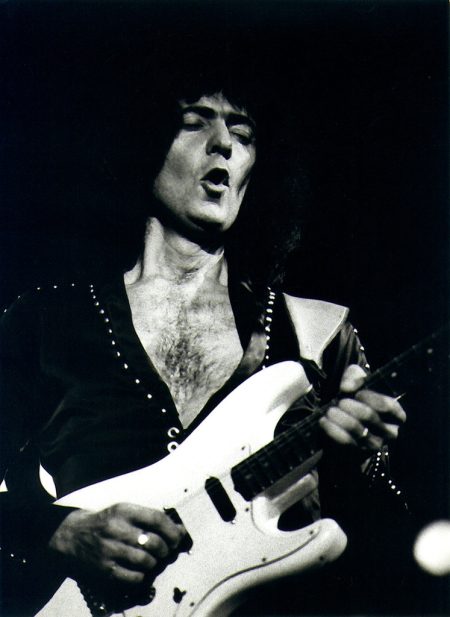
Ritchie Blackmore Quick Facts
| Full Name | Richard Hugh Blackmore |
| Born | April 14, 1945, Weston-super-Mare, Somerset, England |
| Genres | Hard Rock, Heavy Metal, Medieval Folk, Classical Rock |
| Main Bands | Deep Purple, Rainbow, Blackmore’s Night |
| Instrument | Electric and Acoustic Guitar |
| Active Years | 1961 to present |
| Signature Guitar | Fender Stratocaster |
| Hall of Fame | Rock and Roll Hall of Fame (2016, with Deep Purple) |
| Key Albums | Machine Head, Burn, Rainbow Rising, Perfect Strangers |
Ritchie Blackmore’s Early Life and Classical Influences
Growing Up in England
Ritchie Blackmore was born on April 14, 1945, in Weston-super-Mare, Somerset, on the southwest coast of England, though his family soon relocated to Heston in Middlesex, where he spent his formative years.
His father, Lewis Blackmore, was an important early musical influence, encouraging a love of music in the household and providing the young guitarist with his first exposure to a range of genres and sounds.
He took formal guitar lessons as a child, studying under the tutelage of Jim Sullivan, a noted session guitarist who helped ground him in classical technique alongside the popular styles of the day.
The classical training planted seeds that would define his playing for the rest of his career, most visibly in his love of the harmonic minor scale and his tendency to construct guitar solos with a compositional rigor unusual in rock music.
Ritchie Blackmore’s First Steps with the Guitar
By his early teens, Ritchie Blackmore was already demonstrating the obsessive dedication to the instrument that would eventually produce one of rock’s most identifiable guitar voices.
He joined his first professional outfit, Neil Christian and the Crusaders, in the early 1960s, touring extensively across Britain and sharpening his live performance skills in the demanding club circuit of that era.
He also did session work in London during this period, working with producer Joe Meek and appearing on records that gave him valuable studio experience well before Deep Purple was even a concept.
A stint backing Screaming Lord Sutch added further stage miles and introduced him to a broader network of musicians who would prove useful contacts in the years ahead.
By the mid-1960s, he was one of the more experienced young guitarists in London, a reputation that eventually caught the attention of the people who would bring him into the group that became Deep Purple.
Joining Deep Purple and the Birth of Hard Rock
Forming One of Rock’s Greatest Bands
Deep Purple was formed in 1968 by Ritchie Blackmore alongside keyboardist Jon Lord, drummer Ian Paice, bassist Nick Simper, and vocalist Rod Evans, initially as a more pop and psychedelic-oriented act than the hard rock behemoth they would soon become.
The early albums Shades of Deep Purple and “The Book of Taliesyn” showed a band finding its footing, with his guitar work already demonstrating a precision and confidence that set him apart from contemporaries.
The lineup change that brought vocalist Ian Gillan and bassist Roger Glover into the fold in 1969 proved transformative, and the resulting Mark II configuration is the one most listeners think of when they think of Deep Purple.
Deep Purple in Rock (1970) was the album that announced this new, heavier direction to the world, with tracks like “Speed King” and “Child in Time” establishing a template for hard rock guitar that countless bands would subsequently attempt to follow.
“Black Night,” released as a single in 1970, became one of the band’s biggest UK hits and a staple of classic rock radio to this day, built around a riff that is immediately identifiable within a single bar.
The Guitar Sound That Defined an Era
The Fireball album (1971) continued the upward trajectory, with tracks like “Strange Kind of Woman” and the title track demonstrating a rhythmic aggression and melodic sophistication that felt genuinely fresh.
Then came Machine Head in 1972, the album that made Deep Purple a global phenomenon and delivered some of rock’s most enduring compositions.
“Highway Star” opens the album with one of the most blistering guitar solos ever recorded, a piece of playing so precisely constructed that it drew direct comparisons to Bach in the rock press of the day.
“Smoke on the Water” gave the world one of the most famous guitar riffs ever written, a phrase so recognizable that it is arguably the first thing millions of beginner guitarists attempt to learn.
“Space Truckin’” and “Lazy” rounded out an album that holds up as one of hard rock’s definitive statements, a record that still sounds powerful and focused more than fifty years after its release.
The band’s tensions eventually surfaced during the sessions for Who Do We Think We Are (1973), a difficult recording that preceded the departure of both Ian Gillan and Roger Glover.
The rebuilt lineup, with David Coverdale on vocals and Glenn Hughes sharing vocal duties, produced Burn in 1974, an album that remains one of the finest in the entire Deep Purple catalog.
The title track “Burn” contains some of the most ferocious guitar work he ever committed to record, while the David Coverdale showcase “Soldier of Fortune” demonstrated a more restrained and melodic side of his playing.
Stormbringer followed in 1974, a funkier and more R&B-influenced direction that reportedly frustrated him, and Come Taste the Band (1975) was recorded after his departure from the group, with Tommy Bolin replacing him on guitar.
Rainbow: Ritchie Blackmore’s Post-Purple Vision
The Ronnie James Dio Years
After leaving Deep Purple in 1975, Ritchie Blackmore wasted no time in forming a new band, recruiting the members of a California group called Elf and installing their vocalist, Ronnie James Dio, as his frontman.
The self-titled debut album “Ritchie Blackmore’s Rainbow” (1975) showed exactly where his musical priorities lay, leaning into medieval and fantasy imagery paired with hard rock built around his classical guitar leanings.
The follow-up, “Rainbow Rising” (1976), is widely regarded as the creative pinnacle of the entire Rainbow catalog, featuring Dio at the absolute peak of his powers on tracks like “Tarot Woman,” “Stargazer,” and “A Light in the Black.”
“Stargazer” in particular showcases a compositional ambition that few hard rock bands of the era were attempting, its orchestral scope and epic structure drawing a direct line from his classical influences to his rock work.
Dio’s eventual departure opened a revolving door of Rainbow vocalists, but the Dio-era recordings remain the benchmark against which all subsequent Rainbow output is typically measured.
Rainbow’s Later Lineups and Commercial Success
The “Down to Earth” album (1979) introduced vocalist Graham Bonnet and marked a deliberate shift toward more radio-friendly hard rock, producing the hit single “Since You Been Gone” that brought Rainbow its biggest commercial success.
Joe Lynn Turner took over vocal duties in 1980, steering the band further toward the melodic rock mainstream on albums like “Difficult to Cure” (1981) and “Straight Between the Eyes” (1982).
“Difficult to Cure” included a memorable hard rock arrangement of Beethoven’s Ninth Symphony, one of the clearest examples of how consistently classical music informed his approach to writing and arranging guitar-based rock.
Rainbow was eventually dissolved in 1984 when he chose to reunite with the classic Deep Purple Mark II lineup, setting aside the band he had built to return to the group that had first brought him global recognition.
Ritchie Blackmore on Why Practice Makes Perfect (Video)
In this insightful interview, Ritchie Blackmore shares his philosophy on dedication, technical development, and why consistent practice has always been the foundation of his approach to the guitar.
The Perfect Strangers Reunion and Second Era
Ritchie Blackmore Returns for Perfect Strangers
The 1984 reunion of the classic Deep Purple Mark II lineup was one of the most anticipated events in classic rock history, and the resulting album Perfect Strangers delivered on nearly every level.
The title track “Perfect Strangers” sounded like a band picking up exactly where they had left off, with his guitar weaving around Ian Gillan’s vocal in a way that instantly reminded listeners why this particular lineup was so special.
“Knocking at Your Back Door” became another fan favorite, its lengthy guitar showcase section giving him ample room to demonstrate that a decade away from the band had done nothing to diminish his technique or compositional instincts.
The follow-up, The House of Blue Light (1987), maintained a high standard, and the band continued to tour and record through the late 1980s and into the 1990s.
A period with Joe Lynn Turner on vocals produced Slaves and Masters (1990), which divided fan opinion, before Ian Gillan returned to restore the most beloved lineup configuration.
Why Ritchie Blackmore Departed Deep Purple for Good
By 1993, the internal dynamics of Deep Purple had become strained once again, and Ritchie Blackmore made the decision to leave the band for the final time, citing creative differences and a desire to pursue music that reflected his deepening interest in classical and medieval sounds.
Joe Satriani filled in temporarily for touring commitments before Steve Morse was recruited as a permanent replacement, a role Morse held until his own departure decades later.
His exit from Deep Purple in 1993 marked the end of his tenure with a band he had co-founded twenty-five years earlier, and it freed him to follow a musical direction that would surprise many of his longtime fans.
He briefly reformed Rainbow in 1994 and 1995, releasing the album “Stranger in Us All” with Doogie White on vocals, before ultimately stepping away from that project as well.
Blackmore’s Night: Ritchie Blackmore’s Folk Rock Chapter
A Complete Change of Direction
The formation of Blackmore’s Night in 1997 with vocalist and lyricist Candice Night represented one of the most dramatic musical reinventions in classic rock history, a full pivot from Marshall-stack hard rock to acoustic-driven Renaissance and medieval folk music.
Ritchie Blackmore had always cited classical and early music as foundational influences, so for those who had listened closely to his Deep Purple and Rainbow work, the transition made a certain internal sense even if it shocked many who associated him purely with heavy electric guitar.
The band’s debut album “Shadow of the Moon” (1997) established the template that Blackmore’s Night would follow across more than a dozen subsequent releases: acoustic guitar, period instruments, Candice Night’s ethereal vocals, and original songs written in a style evoking the music of 16th and 17th century Europe.
Albums like “Under a Violet Moon” (1999), “Fires at Midnight” (2001), and “Ghost of a Rose” (2003) built a devoted audience worldwide, particularly in Europe and Japan, where interest in the project proved both deep and sustained.
Blackmore’s Night has continued releasing new music and touring through the 2020s, with Ritchie Blackmore and Candice Night, who married in 2008, maintaining a creative partnership that has now outlasted his tenures with both Deep Purple and Rainbow.
Guitar Style, Technique, and Tone
The Classical and Folk Roots of Ritchie Blackmore’s Playing
The most defining characteristic of his playing is the integration of classical music theory and structure into a rock guitar context, a fusion that was genuinely unusual when he first developed it in the late 1960s and early 1970s.
His use of the harmonic minor scale, a scale more commonly associated with classical and Eastern European folk music than with American blues-derived rock, gave his solos a distinctive tension and color that immediately set them apart from the pentatonic-dominated playing of most contemporaries.
His vibrato technique is another signature element, wide and deliberate where many rock guitarists favor faster, narrower variations, giving his sustained notes a vocal quality that draws a clear line of influence to the classical violin playing he admired.
His relationship with the Fender Stratocaster is among the most iconic guitar-instrument pairings in rock history, its bright and cutting tone perfectly complementing the picking attack and precision he brought to his playing throughout the Deep Purple and Rainbow years.
He has also spoken extensively about the importance of dynamics in guitar playing, believing that the contrast between quiet and loud passages gives music its emotional impact, a philosophy clearly audible in the ebb and flow of his best solos and compositions.
Ritchie Blackmore’s Influence on Generations of Guitarists
His influence on subsequent generations of hard rock and heavy metal guitarists is vast and well-documented, with players including Eddie Van Halen, Yngwie Malmsteen, Steve Vai, and Joe Satriani all acknowledging his work as a foundational reference point.
Malmsteen in particular built an entire career around extending the classical-rock synthesis that Ritchie Blackmore pioneered, and the neoclassical metal subgenre that emerged in the 1980s owes its existence almost entirely to the groundwork he laid with Deep Purple and Rainbow.
His influence is not limited to guitarists, either: the compositional ambition and genre-blending adventurousness of his best work helped establish an expectation that rock music could be sophisticated and emotionally complex, not just loud and rhythmically simple.
Ritchie Blackmore’s Legacy and Rock and Roll Hall of Fame
Ritchie Blackmore and his Deep Purple bandmates were inducted into the Rock and Roll Hall of Fame in 2016, a recognition that had been delayed for years despite the band’s enormous influence on the genres that followed in their wake.
He did not attend the induction ceremony, a decision that generated considerable media commentary but was consistent with his longstanding preference for allowing his music to speak for itself rather than engaging with the promotional apparatus surrounding rock’s institutional history.
His catalog with Deep Purple alone would be sufficient to secure his place among rock’s all-time great guitarists, but the Rainbow years add another layer of achievement that further cements his standing.
The fact that he then walked away from electric guitar at the height of his classic rock legacy to pursue medieval folk music is a reminder that his choices have always been driven by personal curiosity rather than commercial logic, which is part of what makes his story so singular in rock history.
As of 2025, Ritchie Blackmore continues to perform and record with Blackmore’s Night, appearing at festivals and concert dates in Europe with the same dedication to acoustic craft that he once brought to the Marshall stacks of Deep Purple.
Ritchie Blackmore Recommended Listening
For anyone looking to understand the full arc of his guitar work, the Rainbow album “Rising” is the essential starting point: a record that captures him at the creative peak of his post-Purple years alongside the incomparable Ronnie James Dio.
Affiliate Disclosure: I am an Amazon affiliate and if you purchase through any amazon links on this site i may earn a small commission at no extra charge to you. This helps support classicrockartists.com and allows me to keep providing deep-dive content on the legends of rock. Thank you for your support!
Frequently Asked Questions About Ritchie Blackmore
Why did Ritchie Blackmore leave Deep Purple?
He left Deep Purple for the first time in 1975 due to creative tensions within the band and a desire to pursue the harder, more classically influenced direction he developed with Rainbow.
His final departure in 1993 was similarly driven by creative differences, ultimately leading him toward the medieval folk music of Blackmore’s Night.
What guitar does Ritchie Blackmore play?
He is most closely associated with the Fender Stratocaster, which he used throughout his Deep Purple and Rainbow years, though his Blackmore’s Night work relies primarily on acoustic instruments including lutes and Renaissance-style guitars.
Did Ritchie Blackmore attend the Deep Purple Rock and Roll Hall of Fame induction?
He did not attend the 2016 Rock and Roll Hall of Fame induction ceremony, a decision he made personally and which was not commented on extensively by the other band members at the time.
What is Blackmore’s Night?
Blackmore’s Night is the Renaissance folk rock band he formed in 1997 with vocalist Candice Night, releasing more than a dozen albums of acoustic-driven medieval and folk-influenced music, a dramatic departure from his hard rock career.
What is Ritchie Blackmore’s most famous guitar solo?
His solo on “Highway Star” from Machine Head is frequently cited as his most celebrated individual performance, a Bach-inspired sequence of arpeggios that remains one of the most technically impressive solos in classic rock.
Is Ritchie Blackmore still performing?
Yes, he continues to perform with Blackmore’s Night as of 2025, primarily at European festivals and venues, maintaining an active touring and recording schedule with Candice Night.
You Might Also Like
Ritchie Blackmore remains one of the most singular figures in rock history: a guitarist who helped invent hard rock, built one of its finest post-Purple catalogs with Rainbow, and then walked away from it all to follow a vision of medieval folk music that proved just as personal and committed as everything that came before.