

When I See You Smile by Bad English reached number one on the US Billboard Hot 100 in October 1989, becoming the biggest chart success for this hard rock supergroup assembled from some of the decade’s most accomplished rock musicians.
Written by hit architect Diane Warren, the song balanced the band’s hard rock credentials with the radio-friendly power ballad format that dominated the late 1980s.
Affiliate Disclosure: As an Amazon Associate I earn from qualifying purchases. This helps support the site at no extra cost to you.
| Song | When I See You Smile |
| Artist | Bad English |
| Album | Bad English (1989) |
| Written by | Diane Warren |
| Produced by | Richie Zito |
| Released | 1989 |
| Genre | Hard Rock, Power Ballad |
| Record Label | Epic Records |
| Chart Peak | #1 US Billboard Hot 100 |
Table of Contents
Background and Meaning
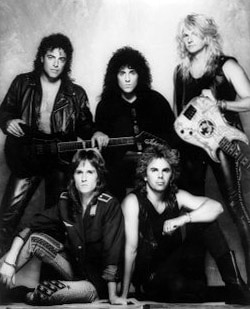
Bad English formed in San Francisco in 1987, bringing together John Waite on vocals, Neal Schon and Jonathan Cain from Journey on guitar and keyboards, Ricky Phillips on bass, and Deen Castronovo on drums.
The band’s lineup gave them a combination of hard rock guitar chops and arena-tested keyboard arrangements that few rock acts of the era could match.
The track was not written within the band but was submitted by Diane Warren, who had already scored major hits for artists ranging from Starship to Aerosmith before this track.
John Waite described the song as a departure from the heavier material on the album, but acknowledged that it connected with audiences in ways the band had not fully anticipated.
The single arrived at the end of a decade in which power ballads had become one of the most commercially reliable formats in rock radio, perfectly timed for maximum impact.
Musical Composition
This song opens with a piano figure before the guitars enter, establishing a more restrained dynamic than the rest of the Bad English debut album.
Jonathan Cain’s keyboard arrangement gives the song its emotional grounding, drawing on the same skills he had used to anchor Journey throughout the 1980s.
Neal Schon delivers a guitar solo that fits the ballad tempo without sacrificing the melodic intensity he brought to Journey hits like “Don’t Stop Believin’.”
John Waite’s vocal performance is measured and expressive, showing the range and control that had made him a recognized frontman since his years with The Babys.
Producer Richie Zito shaped the recording into a polished radio track that retained enough rock weight to sit naturally alongside harder material on album-oriented rock formats.
Chart Success and Impact
This classic rose steadily on the US charts before reaching number one on the Billboard Hot 100, making it one of the biggest hits of the autumn 1989 chart season.
It’s success came at a moment when hard rock ballads were a dominant force on radio, with audiences responding enthusiastically to the combination of guitar-driven arrangements and melodic singing.
The single helped propel the Bad English debut album to platinum status in the United States, justifying the major-label investment in this supergroup lineup.
The song also performed well in Canada and several European markets, extending the band’s commercial reach well beyond their American base.
The chart peak drew considerable attention to the album’s harder tracks as well, introducing listeners to the full range of what Bad English could deliver.
Lasting Legacy
This hit remains a staple of late-1980s power ballad compilations and classic rock radio formats, recognized as one of the defining songs of its genre.
The song’s success gave Diane Warren one more entry in a catalog of chart-topping ballads that has extended across four decades of popular music.
John Waite’s vocal remains the emotional anchor of the recording, demonstrating why he sustained a career as a rock vocalist for more than a decade before Bad English even formed.
The Bad English lineup has never fully reassembled in its original form, which gives the album and its singles additional rarity value among fans who appreciate the supergroup era of late-1980s rock.
For listeners who grew up with late-1980s rock radio, this tune carries a specific period feeling that makes it one of the most reliably recognized singles from that era.
Watch the Official Video
Frequently Asked Questions
FAQ
- Who wrote When I See You Smile?
-
This song was written by Diane Warren, one of the most prolific hit songwriters in pop and rock history, who contributed the track to the band rather than it being written from within Bad English.
- Did it reach number one?
-
Yes it did, it reached number one on the US Billboard Hot 100 in October 1989, becoming Bad English’s biggest commercial success.
- Who were the members of Bad English?
-
Bad English consisted of John Waite on vocals, Neal Schon and Jonathan Cain from Journey on guitar and keyboards, Ricky Phillips on bass, and Deen Castronovo on drums.
- What album is the song from?
-
It is on the self-titled debut album Bad English, released in 1989 on Epic Records.
- Why did Bad English break up?
-
Bad English released two studio albums before disbanding in 1993, with members returning to other projects including Journey, which reunited its core lineup in the years that followed.
You Might Also Like
Built around John Waite’s commanding vocal and Neal Schon’s restrained guitar work, When I See You Smile by Bad English remains one of the most polished and emotionally direct power ballads rock produced in 1989.