

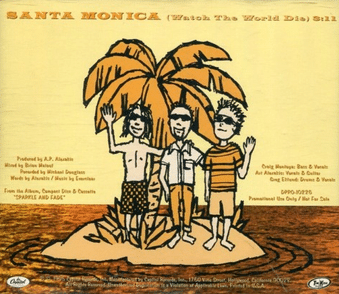
Santa Monica by Everclear reached number one on the US Modern Rock Tracks chart in 1996 and became the breakthrough single from Sparkle and Fade, the Capitol Records debut that established the Portland band as one of the most commercially successful alternative rock acts of the mid-1990s.
Written by vocalist and guitarist Art Alexakis and produced by Thom Panunzio, the song addresses the desire to escape a painful situation by moving to California, using Santa Monica as the destination that represents a clean start that both the singer and the person he’s with can reach together.
Affiliate Disclosure: As an Amazon Associate I earn from qualifying purchases. This helps support the site at no extra cost to you.
| Song | Santa Monica |
| Artist | Everclear |
| Album | Sparkle and Fade (1995) |
| Written by | Art Alexakis |
| Produced by | Thom Panunzio |
| Released | 1995 |
| Genre | Alternative Rock, Post-Grunge |
| Chart Peak | #1 US Modern Rock Tracks, #27 US Billboard Hot 100 |
Table of Contents
Background and History
Everclear formed in Portland, Oregon in 1991, built around vocalist and guitarist Art Alexakis, bassist Craig Montoya, and drummer Greg Eklund.
Alexakis had a difficult early life marked by poverty, substance abuse, and personal loss, and the biographical weight of those experiences ran through the band’s songwriting from the beginning.
The band released an independent album, World of Noise, in 1993 before signing with Capitol Records and recording Sparkle and Fade with producer Thom Panunzio.
Panunzio’s production gave the album a clarity and radio-accessibility that preserved the rawness of Alexakis’s writing while making the recordings competitive in the post-grunge alternative format that dominated rock radio in 1995 and 1996.
Santa Monica emerged as the track most likely to connect with a mainstream audience, combining Alexakis’s direct lyrical approach with a melodic hook strong enough to sustain radio rotation across alternative and mainstream rock formats.
Santa Monica and the Escape Theme
The song addresses the desire to leave behind a damaged situation and start fresh somewhere else, with the California beachside city functioning as a destination that represents possibility rather than a specific place the lyric describes in detail.
Alexakis has drawn on his own experience of poverty and instability throughout his songwriting, and this tune uses that biographical foundation to give the escape fantasy a credibility that a more comfortable writer could not have brought to it.
The lyric’s invitation, the offer to take someone with you rather than escaping alone, gives the song a romantic dimension that made it connect with a broader audience than Alexakis’s more directly confessional writing typically reached.
The California escape narrative placed the song in a tradition of West Coast-oriented rock writing while Everclear’s Portland origins and Alexakis’s working-class biography gave it a tension that the genre’s sunnier examples lacked.
That combination of melodic accessibility and biographical weight gave Santa Monica a quality that distinguished it from the more generalized post-grunge of the period and connected with listeners who found the escape fantasy both appealing and believable.
Santa Monica and the Recording Story
That track opens with a guitar figure that establishes the song’s melodic foundation before Alexakis’s vocal enters with a directness that gives the track its emotional urgency from the first line.
Thom Panunzio’s production keeps the arrangement guitar-forward and energetic, building from the verse into a chorus that opens with enough sonic expansion to justify its radio prominence.
The rhythm section of Montoya and Eklund drives the track with a locked-in momentum that matches the lyric’s sense of forward movement, the urgency of wanting to get out and go somewhere new.
The production approach connected to the same alternative rock landscape that Green Day and Third Eye Blind were navigating simultaneously, placing accessible melodic hooks inside a guitar-driven arrangement that maintained rock credibility.
Alexakis’s vocal delivery on the track is controlled without being polished, preserving the roughness that made his writing feel lived-in rather than crafted for commercial consumption.
The Charts
Santa Monica reached number one on the US Modern Rock Tracks chart and peaked at number twenty-seven on the Billboard Hot 100, a commercial performance that reflected the song’s dominant position on alternative radio while indicating the limits of its crossover into pop formats.
Sparkle and Fade was certified double platinum in the United States and established Everclear as a consistent commercial presence in the alternative rock market through the late 1990s.
The album’s success prompted Capitol Records to invest in the band’s subsequent recording, So Much for the Afterglow (1997), which performed even more strongly and extended the commercial momentum that Santa Monica had initiated.
The song’s chart performance placed Everclear in the same commercial tier as other mid-1990s alternative breakthrough acts, confirming that the Portland band could build a national audience from the regional following they had established through independent releases.
Lasting Legacy
Santa Monica is the Everclear recording most immediately recognized by listeners who encountered the band through mid-1990s alternative radio and the song that most clearly captures Alexakis’s ability to make a personal escape fantasy feel universally applicable.
The song’s combination of melodic accessibility and biographical weight influenced how subsequent alternative rock bands approached the balance between commercial appeal and lyrical authenticity.
Alexakis has continued leading versions of Everclear through lineup changes and extended periods, and this song remains the centerpiece of their live sets as the song most immediately associated with the band’s commercial peak.
Its place in the mid-1990s alternative landscape alongside recordings from Matchbox Twenty and Foo Fighters reflects how completely the post-grunge format had absorbed the melodic directness of Alexakis’s writing by the time the song reached radio.
More than thirty years after its release, Santa Monica endures as the song that proved Everclear could translate the rawness of Alexakis’s experience into a commercial format without losing the quality that made it feel real.
Watch the Official Video
Frequently Asked Questions
FAQ
- Who wrote Santa Monica?
- Art Alexakis wrote the song entirely himself. He drew on his own experience of poverty and instability to give the escape fantasy in the lyric a biographical credibility, and the song’s invitation to take someone else along gave it a romantic dimension that extended its commercial appeal beyond Alexakis’s more directly confessional writing.
- What album is this song from?
- The song appears on Sparkle and Fade, Everclear’s Capitol Records debut album, produced by Thom Panunzio and released in 1995. The album was certified double platinum in the United States and established the band as a consistent commercial presence in alternative rock through the late 1990s.
- Where is Everclear from?
- Everclear formed in Portland, Oregon in 1991. Art Alexakis grew up in poverty in Los Angeles before moving to Portland, and the tension between his difficult West Coast background and the California escape narrative in Santa Monica gives the lyric a complexity that more comfortable writers could not have achieved.
- What chart did Santa Monica reach number one on?
- The song reached number one on the US Modern Rock Tracks chart and peaked at number twenty-seven on the Billboard Hot 100. Its chart performance reflected dominant alternative radio airplay combined with more limited crossover into the mainstream pop formats that would have driven a higher Hot 100 position.
- Is Art Alexakis still performing?
- Alexakis has continued leading Everclear through various lineup changes across the 2000s, 2010s, and 2020s, releasing new albums and touring consistently. He has also been open about managing multiple sclerosis, which he was diagnosed with in 2019, while continuing to perform and record.
You Might Also Like


Written from a life that had given Alexakis good reason to want to leave and go somewhere better, Santa Monica stands as the Everclear recording that turned biographical necessity into one of the most played alternative rock songs of 1996 and the track that proved a Portland band could reach a national audience without softening the edges of what it had to say.