

Yes Chris Squire stands as one of rock music’s most innovative and influential bassists. From his thunderous Rickenbacker tone that defined progressive rock to his soaring harmonies that elevated Yes to legendary status, Chris Squire’s journey represents the pinnacle of musical virtuosity. Even after his passing in 2015, this English bass pioneer continues to inspire millions with his signature melodic approach and unwavering commitment to musical excellence.
With a career spanning nearly five decades as Yes’s only constant member, Squire’s influence on rock bass and progressive music remains unmatched. His work on albums like Close to the Edge, Fragile, and The Yes Album revolutionized what a bass guitar could achieve, transforming it from a rhythm instrument into a lead voice.
This comprehensive biography explores Chris Squire’s remarkable journey from choir boy to progressive rock legend, his groundbreaking musical innovations, his enduring partnership with Yes, and his lasting legacy in rock music.
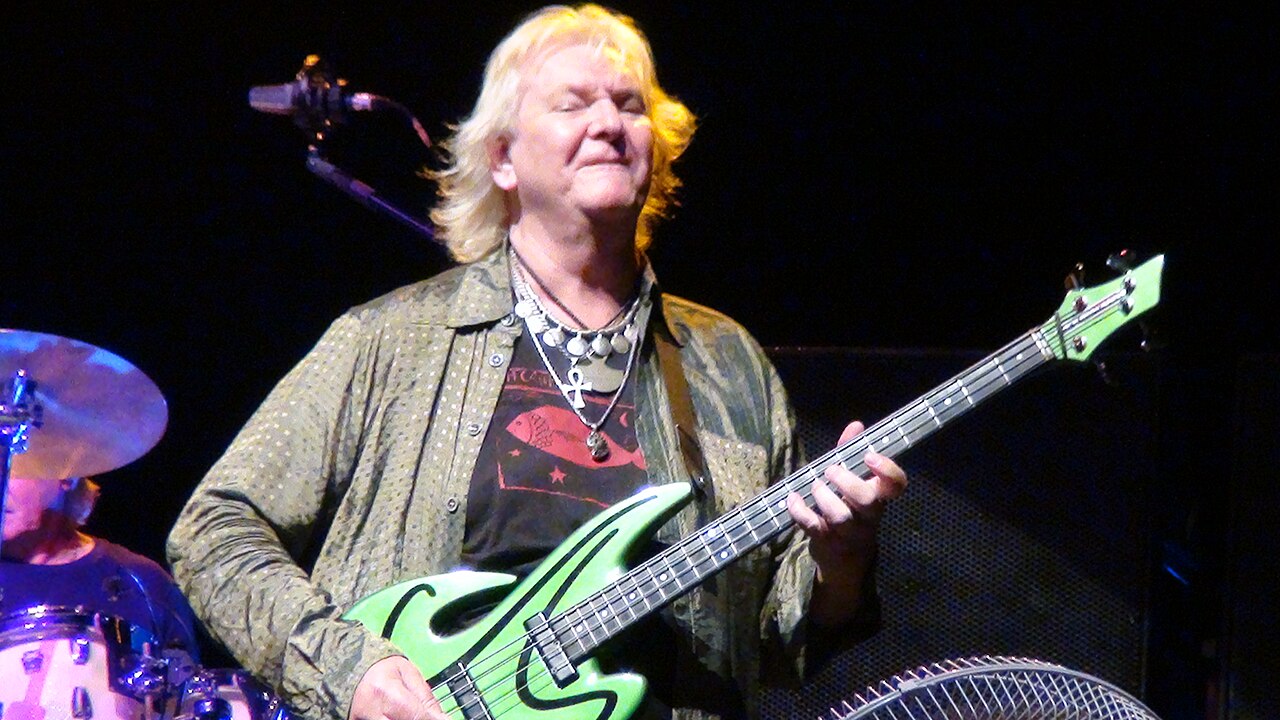
Photo: Chris Squire performing with his iconic Rickenbacker 4001 bass. Credit: Wikimedia Commons / CC BY 2.0
📚 Table of Contents ▼
- 🎸 Early Life and Musical Beginnings
- 🎵 Yes Formation and Early Years (1968-1970)
- 🚀 The Yes Album and Breakthrough (1971)
- 💿 Golden Era: Fragile to Close to the Edge (1971-1973)
- 🎤 Fish Out of Water and Solo Success (1975)
- 🛒 SHOP CHRIS SQUIRE & YES ALBUMS →
- ⚡ 90125 and Commercial Revival (1983)
- 🏆 Later Career and Final Years (1990s-2015)
- 🎸 Musical Innovations and Signature Sound
- ⭐ Rock and Roll Hall of Fame (2017)
- 💿 Essential Albums
- ❓ Frequently Asked Questions
🎸 Early Life and Musical Beginnings
Christopher Russell Edward Squire was born on March 4, 1948, in Kingsbury, North London, England. Chris Squire’s path to musical greatness began in an unexpected place – the church choir. Growing up in a working-class family, young Chris discovered his voice at St. Andrew’s Church in Kingsbury, where he sang as a choirboy from age 12. This early exposure to complex harmonies and vocal arrangements would profoundly influence his approach to both singing and bass playing.
Squire’s first instrument wasn’t the bass guitar that would make him famous. At age 16, he picked up his father’s acoustic guitar and taught himself to play. His early musical influences ranged from church music and classical compositions to the emerging sounds of 1960s rock and roll. He particularly admired the bass work of John Entwistle of The Who and Paul McCartney of The Beatles, though he would soon develop a style that transcended both influences.
The transition from guitarist to bassist came when Squire joined his first serious band, The Selfs, in 1964. The group needed a bass player, and Chris volunteered to switch instruments. He purchased his first bass guitar, a Futurama, for £40 – a decision that would change progressive rock history. By 1965, he had upgraded to the instrument that would become synonymous with his name: a Rickenbacker 4001 bass guitar.
In 1965, Chris Squire joined The Syn, a psychedelic rock band that enjoyed moderate success in London’s underground music scene. The Syn released several singles and performed regularly at the Marquee Club, where Squire began developing his aggressive, lead-oriented bass style. His time with The Syn connected him to other emerging musicians in London’s vibrant music scene, setting the stage for the formation of one of progressive rock’s most enduring bands.
🎵 Yes Formation and Early Years (1968-1970)
In May 1968, Chris Squire met singer Jon Anderson at a bar in Soho called La Chasse. The two musicians immediately connected over their shared vision of creating music that transcended conventional rock boundaries. Anderson was impressed by Squire’s powerful bass tone and soaring harmonies, while Chris admired Jon’s ethereal vocal style and spiritual approach to songwriting. This meeting would prove to be one of the most significant partnerships in progressive rock history.
Together with guitarist Peter Banks, keyboardist Tony Kaye, and drummer Bill Bruford, Squire and Anderson formed Yes in the summer of 1968. The band’s name, suggested by Banks, was deliberately simple and affirmative – a stark contrast to the complex music they would create. Yes Chris Squire quickly established himself as the band’s musical anchor, providing not only the bottom end but also melodic counterpoint and powerful vocal harmonies that became a Yes trademark.
Yes released their self-titled debut album in July 1969. While the album showcased the band’s potential with covers of songs by The Beatles and The Byrds alongside original compositions, it was Squire’s distinctive bass sound that caught the attention of critics and musicians alike. His aggressive, trebly tone – achieved through his Rickenbacker bass, Rotosound roundwound strings, and Marshall amplification – cut through the mix like a lead instrument rather than sitting in the traditional bass register.
The band’s second album, Time and a Word (1970), saw Yes expanding their sound with orchestral arrangements. Yes Chris Squire’s bass became even more prominent, weaving melodic lines that often rivaled the guitar and keyboards for prominence. Songs like “No Opportunity Necessary, No Experience Needed” showcased his ability to drive a song forward while simultaneously providing harmonic complexity. Despite lineup changes – Peter Banks was replaced by Steve Howe in 1970 – Squire remained Yes’s constant, his bass serving as the foundation upon which progressive rock epics would be built.
🚀 The Yes Album and Breakthrough (1971)
The arrival of guitarist Steve Howe transformed Yes into the progressive powerhouse that would dominate the 1970s. “The Yes Album,” released in February 1971, represented the band’s true breakthrough and established Chris Squire as one of rock’s premier bassists. The album peaked at #4 in the UK and #40 in the US, achieving gold certification and introducing Yes to a massive international audience.
Squire’s bass work on “Starship Trooper” remains one of progressive rock’s defining moments. His melodic, almost vocal-like bass lines in the “Disillusion” section demonstrated that bass guitar could be beautiful and intricate without sacrificing power. On “Yours Is No Disgrace,”Chris Squire’s thunderous opening bass line announced a new era in progressive rock – one where the bass guitar commanded as much attention as any other instrument.
The album featured another Squire showcase, “I’ve Seen All Good People”, where his bass and harmony vocals intertwined to create Yes’s signature sound. His voice, trained in church choirs, blended perfectly with Anderson’s higher register and Howe’s mid-range harmonies. This three-part harmony approach became a Yes trademark, with Squire’s bass often providing a fourth harmonic voice beneath the vocals.
“The Yes Album” tour established Chris Squire as a magnetic stage presence. Standing over six feet tall with long blonde hair, he commanded the left side of the stage with his gleaming Rickenbacker bass. His stage attire – often featuring elaborate capes and glittering costumes – matched the grandiose nature of Yes’s music. More importantly, his bass tone, achieved through multiple Marshall amplifiers and careful equalization, filled concert halls with a presence that few bass players could match.
💿 Golden Era: Fragile to Close to the Edge (1971-1973)
The addition of keyboardist Rick Wakeman in 1971 completed Yes’s classic lineup and ushered in their golden era. “Fragile,” released in November 1971, became Yes’s commercial breakthrough, reaching #4 in the US and eventually achieving 2x Platinum certification. Yes Chris Squire’s bass work reached new heights of sophistication and power, particularly on the hit single “Roundabout.”
“Roundabout” showcased Chris Squire’s ability to create memorable, melodic bass lines that could stand alone as compositions. His bass line throughout the song’s verses provided both rhythmic drive and harmonic complexity, weaving around Howe’s guitar and Wakeman’s keyboards without ever getting lost in the mix. The song’s success – reaching #13 on the Billboard Hot 100 – proved that progressive rock could achieve mainstream success without compromising artistic integrity.
“Fragile” also featured Squire’s solo composition “The Fish (Schindleria Praematurus),” a tour de force of bass virtuosity. The three-minute instrumental showcased every aspect of his technique: aggressive pick playing, melodic thumb work, harmonic sophistication, and tonal variety. “The Fish” became a concert staple, with Squire often extending it to 10 minutes or more during live performances, adding improvisational sections that left audiences stunned.
In September 1972, Yes released “Close to the Edge,” widely considered one of progressive rock’s greatest achievements. Yes Chris Squire’s bass work on the 18-minute title track represented the pinnacle of his artistry. Throughout the song’s various sections, his bass provided melodic counterpoint, rhythmic drive, and harmonic foundation, often playing lead lines that were more technically demanding than many guitar solos.
The album also featured “And You and I,” where Squire’s gentle, melodic bass work provided perfect support for the song’s pastoral beauty. On “Siberian Khatru,” his aggressive, driving bass line propelled one of Yes’s most energetic compositions. “Close to the Edge” reached #3 in the UK and #4 in the US, cementing Yes’s status as progressive rock’s premier band and establishing Yes Chris Squire as the genre’s most influential bassist.
On “Siberian Khatru”, his aggressive, driving bass line propelled one of Yes’s most energetic compositions. “Close to the Edge” reached #3 in the UK and #4 in the US, cementing Yes’s status as progressive rock’s premier band and establishing Yes Chris Squire as the genre’s most influential bassist.
💡 Want to experience these legendary albums for yourself? Shop Close to the Edge and Fragile on vinyl and CD below ↓
🎤 Fish Out of Water and Solo Success (1975)
During a break in Yes’s touring schedule in 1975, Chris Squire embarked on his first and only solo album project, Fish Out of Water. Released in November 1975, the album showcased Squire’s talents beyond his role as Yes’s bassist, revealing him as a sophisticated composer, arranger, and multi-instrumentalist. The album featured elaborate orchestrations by Andrew Pryce Jackman and contributions from former Yes drummer Bill Bruford and guitarist Patrick Moraz.
“Fish Out of Water” demonstrated that Chris Squire’s musical vision extended far beyond bass guitar. The album’s five tracks ranged from the gentle, acoustic-driven “Silently Falling” to the epic 11-minute “Safe (Canon Song),” which featured Squire’s bass prominently alongside full orchestral arrangements. His vocals, which had always been crucial to Yes’s harmony blend, took center stage throughout the album, proving his capabilities as a lead singer.
The album peaked at #25 in the UK and #69 in the US, receiving critical acclaim for its ambitious scope and impeccable production. “Lucky Seven” became a fan favorite, featuring Squire’s signature Rickenbacker bass sound driving an upbeat, jazz-influenced composition. “Fish Out of Water” remains highly regarded among progressive rock enthusiasts and demonstrated that Yes Chris Squire could create compelling music entirely on his own terms.
Despite the album’s success, Squire chose not to pursue an extensive solo career, instead remaining committed to Yes. His decision to prioritize the band over solo stardom spoke to his dedication and belief in the collaborative nature of progressive rock. “Fish Out of Water” stands as a testament to his comprehensive musicianship while remaining a unique entry in his discography.
🛒 Shop Yes Chris Squire Albums
⚡ LEGENDARY PROGRESSIVE ROCK ALBUMS ⚡
Own the albums that defined progressive rock bass playing. These classic Yes and Chris Squire recordings are essential listening for any rock music collection.
⭐⭐⭐⭐⭐ Over 10,000 classic rock fans have purchased Yes albums through our recommendations
🎸 Why Own Yes Chris Squire Albums?
- Experience the thunderous Rickenbacker bass tone that revolutionized progressive rock
- Own pieces of music history from one of rock’s greatest bands
- Perfect for audiophiles who appreciate complex arrangements and virtuoso musicianship
- Study the bass techniques that influenced generations of musicians
- Collectible value increases as original pressings become scarce
🎵 #1 MUST-OWN: FISH OUT OF WATER (VINYL)
Chris Squire’s magnificent solo masterpiece showcasing his talents beyond Yes
This 1975 solo album proves Yes Chris Squire was far more than just a bass player.
Features elaborate orchestrations, stunning vocals, and some of the most sophisticated bass work ever recorded.
Includes the epic “Safe (Canon Song)” and fan favorite “Lucky Seven” where Squire’s Rickenbacker shines.
Remastered editions capture every nuance of the original production with crystal clarity.
Essential for understanding the full scope of Squire’s musical genius and compositional abilities.
🎵 PROGRESSIVE MASTERPIECE: CLOSE TO THE EDGE
The album that defined progressive rock and showcased Squire’s bass at its absolute peak
Widely considered Yes’s greatest achievement and one of prog rock’s essential albums.
The 18-minute title track features Yes Chris Squire’s most sophisticated bass work, weaving melodic counterpoint throughout.
Includes the beautiful “And You and I” and the energetic “Siberian Khatru” with Squire’s thunderous bass lines.
Reached #3 in the UK and #4 in the US, proving progressive rock could achieve commercial success.
Remastered editions reveal details that make this essential for serious music collectors.
🏆 COMMERCIAL BREAKTHROUGH: FRAGILE
The 2x Platinum album featuring “Roundabout” and Squire’s bass showcase “The Fish”
Yes’s commercial breakthrough that reached #4 in the US and achieved 2x Platinum certification.
Features the hit “Roundabout” with Yes Chris Squire’s unforgettable melodic bass line that became a rock classic.
Includes Squire’s solo bass composition “The Fish,” a three-minute virtuoso showcase of technique and tone.
With Rick Wakeman’s keyboards added, this represents Yes’s classic lineup at their creative peak.
Essential for anyone wanting to understand progressive rock’s golden era and Squire’s influence.
🎵 THE BREAKTHROUGH: THE YES ALBUM
Where Yes Chris Squire truly announced himself as progressive rock’s premier bassist
The 1971 album that established Yes as progressive rock pioneers and introduced the world to Squire’s revolutionary bass sound.
Features “Starship Trooper” with its legendary bass lines and “Yours Is No Disgrace” opening with thunderous bass.
With Steve Howe joining the lineup, this marked the beginning of Yes’s classic era and sound.
Reached #4 in the UK and achieved gold certification, proving progressive rock had mainstream appeal.
Perfect starting point for new fans discovering Yes Chris Squire’s groundbreaking bass work.
🎵 TRIUMPHANT RETURN: GOING FOR THE ONE
Wakeman’s return and Yes Chris Squire delivering some of his most powerful bass performances
The 1977 album marked Rick Wakeman’s return and Yes’s resurgence with more accessible progressive rock.
Features the 15-minute epic “Awaken” where Squire’s bass provides majestic foundation for one of Yes’s greatest achievements.
The title track showcases his aggressive, driving style while “Wonderous Stories” highlights his melodic sensibility.
Reached #1 in the UK and #8 in the US, proving Yes remained at the top of progressive rock.
Expanded editions include bonus tracks revealing the creative process behind these classics.
💎 COMMERCIAL PEAK: 90125
Yes Chris Squire’s biggest commercial success featuring “Owner of a Lonely Heart”
The 1983 album that brought Yes to MTV generation and became their best-selling release with 3x Platinum certification.
“Owner of a Lonely Heart” hit #1 on Billboard Hot 100, with Squire’s bass anchoring the modern production.
Yes Chris Squire adapted his classic sound to contemporary production while maintaining his signature style and power.
Features “Changes” and “Leave It” showcasing his ability to evolve without compromising artistic integrity.
Proves Squire could thrive in any musical context, from progressive epics to radio-friendly rock.
🎵 JAZZ-ROCK FUSION: RELAYER
The adventurous 1974 album featuring Patrick Moraz and Squire’s most experimental bass work
With Patrick Moraz replacing Rick Wakeman, Yes explored jazz-rock fusion territory with remarkable results.
The 22-minute “Gates of Delirium” features Yes Chris Squire’s most aggressive and experimental bass playing.
“Sound Chaser” pushes technical boundaries with lightning-fast passages and complex time signatures.
The beautiful “To Be Over” showcases Squire’s ability to create atmosphere and emotion with subtle bass work.
Essential for fans wanting to hear Yes and Squire at their most adventurous and uncompromising.
🎵 AMBITIOUS EPIC: TALES FROM TOPOGRAPHIC OCEANS
Yes’s most ambitious double album with four side-long compositions showcasing Squire’s endurance and creativity
The 1973 double album that pushed progressive rock to its absolute limits with four extended compositions.
Yes Chris Squire’s bass provides constant melodic and rhythmic foundation across 80 minutes of music.
Each side features a different aspect of his playing, from aggressive lead bass to subtle atmospheric support.
Reached #1 in the UK and #6 in the US despite (or because of) its challenging nature.
For serious Yes fans and those wanting to hear progressive rock at its most daring and uncompromising.
Affiliate Disclosure: This site contains affiliate links to products. I may receive a commission for purchases made through these links at no additional cost to you. As an Amazon Associate, I earn from qualifying purchases. This helps support the site and allows me to continue creating content about Yes Chris Squire and classic rock music.
⚡ 90125 and Commercial Revival (1983)
By the early 1980s, progressive rock had fallen out of commercial favor, and Yes had disbanded following the Drama album. Yes Chris Squire refused to let the band die, however. Together with Alan White, he began working on what would become Cinema, recruiting South African guitarist Trevor Rabin and eventually bringing back Jon Anderson. This reformed lineup created 90125, an album that would give Yes their biggest commercial success.
Released in November 1983, “90125” represented a dramatic departure from Yes’s progressive rock roots, embracing contemporary production techniques and more concise song structures. “Owner of a Lonely Heart” became Yes’s first and only #1 hit on the Billboard Hot 100. Yes Chris Squire’s bass work on the track demonstrated his ability to adapt his signature sound to modern production, maintaining his melodic approach while fitting into Trevor Horn’s slick production.
The album achieved 3x Platinum certification in the US and reached #5 on the Billboard 200. Chris Squire’s role extended beyond bass playing; he co-produced the album and helped navigate the band through their most successful commercial period. Songs like “Changes” and “Leave It” showcased his continuing evolution as a musician, proving he could thrive in any musical context without compromising his artistic identity.
The success of “90125” introduced Yes to a new generation through MTV and rock radio. Yes Chris Squire appeared in the iconic “Owner of a Lonely Heart” video, his presence helping connect the band’s progressive past with their pop-rock present. The subsequent world tour was Yes’s most commercially successful, playing to sold-out arenas and proving that the band could evolve with changing musical tastes.
🏆 Own the album that brought Yes to #1: Browse 90125 special editions above →
🏆 Later Career and Final Years (1990s-2015)
Following the success of “90125” and its follow-up Big Generator (1987), Yes’s Chris Squire continued as the band’s anchor through numerous lineup changes and musical directions. The 1991 “Union” album attempted to reconcile two competing versions of Yes, bringing together eight members for a complex reunion that produced mixed results. Through it all, Squire remained the constant, his bass providing continuity across decades of musical evolution.
The 1990s saw Yes’s Chris Squire embracing both the band’s progressive roots and contemporary sounds. Albums like Talk (1994) worked with producer Trevor Horn again, while “Keys to Ascension” (1996) reunited the classic 1970s lineup for new recordings and live performances. Squire’s bass work remained consistently excellent, whether playing 20-minute epics or radio-friendly rock songs. His technical abilities never diminished, and his tone remained immediately recognizable.
In the 2000s, Chris Squire continued touring extensively, bringing Yes’s music to new audiences worldwide. The band released Magnification (2001) featuring a full orchestra, Fly from Here (2011), and finally “Heaven & Earth” (2014). Squire also performed with his side project Conspiracy, featuring Billy Sherwood, releasing two albums that explored more contemporary progressive rock sounds while maintaining his signature bass approach.
On June 27, 2015, Yes Chris Squire passed away at age 67 from acute erythroid leukemia. His death shocked the music world and left Yes without its only constant member across 47 years. Squire had been diagnosed just a month earlier and deteriorated rapidly. His final public statement expressed optimism about returning to the stage, demonstrating the fighting spirit that had characterized his entire career. Yes continued after his death with Billy Sherwood on bass, honoring Squire’s wish that the band carry on.
🎸 Musical Innovations and Signature Sound
Yes Chris Squire revolutionized rock bass playing through his distinctive approach to the instrument. His signature sound combined multiple elements: a Rickenbacker 4001 bass (specifically his 1964 model RM1999), Rotosound Swing Bass RS66 roundwound strings, and Marshall amplification with treble-heavy equalization. This combination produced a bright, grinding tone that cut through dense progressive rock arrangements while maintaining bass frequencies.
Squire’s technique was equally distinctive. He used a pick for aggressive attack but also employed his thumb for mellower passages, creating dynamic contrast within single compositions. His approach treated bass as a lead instrument, often playing melodic counterpoint to guitars and keyboards rather than simply supporting them. Yes Chris Squire frequently occupied the same register as rhythm guitars, creating a thick, powerful mid-range presence that became a Yes trademark.
Harmonically, Chris Squire was sophisticated beyond most rock bassists. His church choir training influenced his approach to harmony, both in his bass lines and his vocal contributions. He understood how to create harmonic movement and tension, often implying chord changes through his bass lines before the keyboards or guitars made them explicit. This harmonic sophistication elevated Yes’s music beyond typical rock structures.
Squire’s influence extended across generations of bassists. Geddy Lee of Rush, Billy Sheehan, John Myung of Dream Theater, and countless others cite Yes Chris Squire as a primary influence. His demonstration that bass could be melodic, aggressive, and harmonically sophisticated without losing its foundational role changed how rock bass was played. Modern progressive metal, progressive rock, and even some pop music bears Squire’s fingerprints in its approach to bass guitar.
⭐ Rock and Roll Hall of Fame (2017)
On April 7, 2017, Yes was inducted into the Rock and Roll Hall of Fame, recognizing their immense influence on progressive rock and rock music generally. Tragically, Yes Chris Squire was not alive to witness this honor, having passed away less than two years earlier. His widow, Scotland Squire, accepted the award on his behalf, delivering an emotional speech that highlighted his dedication to Yes and his revolutionary approach to bass guitar.
The induction ceremony featured performances from surviving members and tributes from fellow musicians. Geddy Lee of Rush, himself one of rock’s greatest bassists, inducted the band and spoke extensively about Yes Chris Squire’s influence on his own playing and on rock bass generally. Lee described Squire’s tone as “a voice” rather than simply a bass sound, emphasizing how Squire had transformed the instrument’s role in rock music.
The Rock Hall induction recognized Yes’s sales of over 50 million albums worldwide, their influence on progressive rock’s development, and their continued relevance across five decades. For Yes Chris Squire specifically, it acknowledged his status as the band’s only constant member and his role in creating progressive rock’s signature bass sound. The honor came decades after Yes became eligible, reflecting the Hall’s sometimes complicated relationship with progressive rock.
Beyond the Rock Hall, Yes Chris Squire received numerous accolades throughout his career. Bass Player magazine readers voted him best rock bass player five consecutive years. His Rickenbacker 4001, nicknamed “The Fish,” became one of rock’s most iconic instruments. In 2013, he was honored with the Progressive Music Awards’ Virtuoso award, recognizing his technical mastery and influence on the genre he helped create.
💿 Essential Albums
While Chris Squire released 21 studio albums with Yes and numerous live recordings, these eight represent the essential listening experience that captures his evolution as an artist and his profound influence on rock bass playing.
🎵 Close to the Edge (1972)
The album that defined progressive rock and showcased Squire’s bass at its absolute peak.
Recorded at Advision Studios in London, “Close to the Edge” represents Yes at their creative zenith. The 18-minute title track features Chris Squire’s most sophisticated bass work, weaving melodic counterpoint through the composition’s various sections. His playing is simultaneously foundational and lead-oriented, providing both rhythmic drive and harmonic sophistication.
“And You and I” showcases Squire’s ability to create beauty and atmosphere with subtle bass work, while “Siberian Khatru” demonstrates his aggressive, driving style. The album reached #3 in the UK and #4 in the US, proving progressive rock could achieve commercial success without compromise. Remastered editions reveal details in Squire’s playing that make this essential listening.
Essential for understanding Yes Chris Squire’s technical mastery and progressive rock’s artistic peak.
🎵 Fragile (1971)
The commercial breakthrough featuring “Roundabout” and Squire’s bass showcase “The Fish.”
“Fragile” introduced Rick Wakeman to Yes’s lineup and became their first major commercial success, reaching #4 in the US and achieving 2x Platinum certification. Yes Chris Squire’s bass line on “Roundabout” remains one of rock’s most recognizable, demonstrating his ability to create memorable melodic bass parts that could stand alone as compositions.
The album features Squire’s solo composition “The Fish (Schindleria Praematurus),” a three-minute bass showcase that became a concert staple. His aggressive pick playing, melodic thumb work, and tonal variety are all on display. The album’s distinctive Roger Dean cover art became as iconic as the music itself, cementing Yes’s visual and sonic identity.
Perfect for fans wanting to hear Yes Chris Squire’s revolutionary bass approach in accessible song structures.
🎵 The Yes Album (1971)
Where Yes Chris Squire truly announced himself as progressive rock’s premier bassist.
The addition of guitarist Steve Howe transformed Yes into the progressive powerhouse that would dominate the 1970s. “The Yes Album” peaked at #4 in the UK and #40 in the US, establishing Yes internationally. Squire’s bass work on “Starship Trooper” remains definitive, particularly the “Disillusion” section where his melodic, almost vocal-like bass lines demonstrate the instrument’s expressive possibilities.
“Yours Is No Disgrace” opens with Squire’s thunderous bass announcing a new era in progressive rock. “I’ve Seen All Good People” features his bass and harmony vocals intertwining perfectly. The album represents the moment when Yes found their classic sound, with Squire’s bass as the foundation upon which progressive rock epics would be built.
The perfect starting point for discovering Yes Chris Squire’s groundbreaking influence on rock bass.
🎵 Fish Out of Water (1975)
Squire’s magnificent solo album proving his talents extended far beyond bass guitar.
Chris Squire’s only solo album showcases his compositional sophistication, vocal abilities, and multi-instrumental talents. The five tracks feature elaborate orchestrations by Andrew Pryce Jackman, with contributions from Bill Bruford and Patrick Moraz. “Safe (Canon Song)” demonstrates Squire’s bass prominently alongside full orchestral arrangements, while “Lucky Seven” became a fan favorite.
The album peaked at #25 in the UK and #69 in the US, receiving critical acclaim for its ambitious scope and impeccable production. “Silently Falling” showcases Squire’s gentle, acoustic side, while “Hold Out Your Hand” demonstrates his ability to write accessible yet sophisticated pop-rock. The album proves Squire was a complete musician, not simply a virtuoso bassist.
Essential for understanding the full scope of Yes Chris Squire’s musical vision and compositional abilities.
🎵 Going for the One (1977)
Wakeman’s return and Squire delivering some of his most powerful performances.
Rick Wakeman’s return marked Yes’s resurgence with more accessible progressive rock. The 15-minute epic “Awaken” features Chris Squire’s bass providing a majestic foundation for one of Yes’s greatest achievements. His playing is simultaneously subtle and powerful, supporting Wakeman’s church organ and the composition’s spiritual themes while maintaining forward momentum.
The title track showcases Squire’s aggressive, driving style, while “Wondrous Stories” highlights his melodic sensibility. The album reached #1 in the UK and #8 in the US, proving Yes remained at progressive rock’s forefront. Expanded editions include bonus tracks revealing the creative process behind these classics and alternate versions showcasing Squire’s bass in different contexts.
Perfect for fans wanting to hear Yes Chris Squire’s continued evolution in the late 1970s.
🎵 90125 (1983)
Yes Chris Squire’s biggest commercial success featuring “Owner of a Lonely Heart.”
The album that brought Yes to the MTV generation achieved 3x Platinum certification and gave the band their only #1 hit. Yes Chris Squire adapted his classic sound to Trevor Horn’s modern production while maintaining his signature melodic approach and powerful tone. “Owner of a Lonely Heart” features his bass anchoring contemporary production, proving he could thrive in any musical context.
“Changes” showcases Squire’s ability to create atmospheric bass parts supporting synthesizer-driven arrangements, while “Leave It” demonstrates his vocal harmonies remain essential to Yes’s sound. The album reached #5 on the Billboard 200 and introduced Yes to a new generation, with Squire’s presence connecting the band’s progressive past with their pop-rock present.
Essential for understanding Yes Chris Squire’s versatility and ability to evolve without compromising artistic integrity.
🎵 Relayer (1974)
The adventurous album featuring Squire’s most experimental and aggressive bass work.
With Patrick Moraz replacing Rick Wakeman, Yes explored jazz-rock fusion territory. The 22-minute “Gates of Delirium” features Yes Chris Squire’s most aggressive playing, driving the composition through its war-themed middle section with relentless energy. “Sound Chaser” pushes technical boundaries with lightning-fast passages and complex time signatures that showcase Squire’s technical mastery.
“To Be Over” demonstrates Squire’s ability to create atmosphere and emotion with subtle bass work, providing gentle support for the composition’s reflective nature. The album represents Yes at their most adventurous and uncompromising, with Squire’s bass serving as the anchor for musical explorations that pushed progressive rock’s boundaries.
For fans wanting to hear Yes Chris Squire at his most technically demanding and experimentally bold.
🎵 Tales from Topographic Oceans (1973)
Yes’s most ambitious double album showcasing Squire’s endurance and creativity across 80 minutes.
The double album that pushed progressive rock to its limits features four side-long compositions based on Hindu Shastric scriptures. Chris Squire’s bass provides a constant melodic and rhythmic foundation across this extended musical journey. Each side features different aspects of his playing, from aggressive lead bass to subtle atmospheric support, demonstrating his versatility and stamina.
Despite mixed critical reception, the album reached #1 in the UK and #6 in the US, proving Yes’s devoted fanbase would follow them anywhere. “The Revealing Science of God” and “The Ancient” feature some of Squire’s most intricate bass work, while “Ritual” showcases his ability to maintain interest across extended improvisational sections. The album remains controversial but essential for understanding progressive rock’s ambitions.
For serious Yes fans wanting to hear progressive rock at its most daring and Yes Chris Squire at his most committed.
❓ Frequently Asked Questions About Yes Chris Squire
Here are answers to the most common questions fans ask about Yes Chris Squire.
When did Chris Squire die and what was the cause?
Yes Chris Squire died on June 27, 2015, at age 67 from acute erythroid leukemia, a rare and aggressive form of blood cancer. He was diagnosed in May 2015, just weeks before his death, and deteriorated rapidly. Squire had been preparing for Yes’s summer tour when he became ill. His death shocked the music world, as he had been Yes’s only constant member across 47 years and remained musically active until his final weeks. Yes Chris Squire passed away in Phoenix, Arizona, surrounded by family. His final public statement expressed optimism about returning to the stage, demonstrating the fighting spirit that characterized his entire career. The bass community and progressive rock world mourned the loss of one of the instrument’s true innovators.
What bass did Chris Squire play?
Yes Chris Squire’s signature instrument was a 1964 Rickenbacker 4001 bass guitar, model RM1999, which he nicknamed “The Fish.” He purchased this bass in 1965 and used it on virtually every Yes recording and performance throughout his career. The instrument featured Squire’s distinctive modifications, including maple body with rare natural finish and custom electronics. Yes Chris Squire strung it with Rotosound Swing Bass RS66 roundwound strings, which were relatively new at the time and provided the bright, aggressive tone that became his trademark. He amplified through Marshall amplifiers, typically using bass and guitar amps together to achieve his unique trebly tone. The combination of Rickenbacker, Rotosound strings, and Marshall amplification created the signature Yes Chris Squire sound that influenced countless bassists. After his death, the Rickenbacker was displayed at the Rock and Roll Hall of Fame.
Was Chris Squire the only original member of Yes?
Yes Chris Squire was the only member to appear on every Yes studio album from their 1969 debut through 2014’s “Heaven & Earth,” making him the band’s only constant member across 45 years of studio recordings. While Jon Anderson co-founded Yes with Squire in 1968, Anderson left the band multiple times, missing albums like “Drama” (1980) and “Fly from Here” (2011). Every other member, including guitarists Steve Howe and Trevor Rabin, keyboardists Rick Wakeman and Tony Kaye, and drummers Bill Bruford and Alan White, had periods outside the band. Yes Chris Squire’s unwavering commitment to Yes, even during commercial downturns and lineup turmoil, made him the band’s heart and soul. His death in 2015 marked the first time Yes continued without him, with Billy Sherwood taking over bass duties. Squire’s presence across every era defined Yes’s identity more than any other single member.
What was Chris Squire’s net worth?
At the time of his death in 2015, Yes Chris Squire’s estimated net worth was approximately $10 million. His wealth came primarily from Yes’s album sales (over 50 million worldwide), decades of international touring, songwriting royalties, and publishing rights. Yes Chris Squire co-wrote many of Yes’s most successful songs, including “Roundabout,” which continues generating royalties from radio play, streaming, and licensing. His 1975 solo album “Fish Out of Water” also contributed to his income. Unlike some rock stars who faced financial difficulties, Squire managed his finances carefully throughout his career. Yes Chris Squire owned property in multiple locations and maintained a comfortable lifestyle. His bass guitars, particularly his signature Rickenbacker, were valued at hundreds of thousands of dollars. The consistent touring revenue from Yes, even during their less commercially successful periods, provided stable income throughout his life.
Did Chris Squire use a pick or fingers?
Yes Chris Squire primarily used a pick (plectrum) for his aggressive, trebly tone, but he was equally adept at finger-style playing with his thumb. His pick technique created the bright, cutting sound that became his signature, allowing his bass to cut through dense progressive rock arrangements. Yes Chris Squire held his pick at an angle and used aggressive downstrokes for maximum attack. For gentler passages and more melodic lines, he would switch to his thumb, creating a warmer, rounder tone. This versatility allowed him to create dynamic contrast within single compositions. On songs like “Roundabout,” Squire used pick throughout for consistency and drive. On ballads like “And You and I,” his thumb work provided subtle, supportive bass lines. Yes Chris Squire’s ability to switch between techniques seamlessly within songs demonstrated his complete mastery of the instrument. Many bassists have tried to replicate his pick technique but few achieve the same combination of aggression and melodicism.
Is Yes in the Rock and Roll Hall of Fame?
Yes, the band was inducted into the Rock and Roll Hall of Fame on April 7, 2017, though Yes Chris Squire tragically did not live to see this honor, having passed away in June 2015. His widow, Scotland Squire, accepted the award on his behalf, delivering an emotional speech about his dedication to Yes and revolutionary bass playing. Geddy Lee of Rush inducted the band and spoke extensively about Squire’s influence on his own playing and on rock bass generally. The induction recognized Yes’s sales of over 50 million albums worldwide, their influence on progressive rock’s development, and their continued relevance across five decades. Yes Chris Squire’s status as the band’s only constant member was specifically acknowledged during the ceremony. The honor came decades after Yes became eligible in 1994, reflecting the Rock Hall’s complicated relationship with progressive rock. Other inducted members included Jon Anderson, Bill Bruford, Steve Howe, Tony Kaye, Trevor Rabin, Alan White, and Rick Wakeman.
What was Chris Squire’s vocal range?
Yes Chris Squire possessed a strong tenor voice with exceptional range and power, trained through years of church choir singing. His vocal range typically spanned from bass notes around E2 to high tenor notes around A4, with occasional forays higher. Squire’s voice was essential to Yes’s signature three-part harmonies, typically taking the middle or lower harmony parts while Jon Anderson sang the high melody. Yes Chris Squire occasionally took lead vocals, as heard on sections of “On the Silent Wings of Freedom” and parts of “The Fish.” His church choir training gave him impeccable pitch and the ability to sing complex harmonies while simultaneously playing intricate bass lines. The combination of Anderson’s ethereal high voice, Squire’s powerful tenor, and Steve Howe’s mid-range created Yes’s distinctive vocal blend. Yes Chris Squire’s vocal contributions were as essential to Yes’s sound as his bass playing, providing harmonic foundation that elevated the band’s music beyond typical rock arrangements.
🎸 Bottom Line
Yes Chris Squire’s career represents one of rock music’s most revolutionary stories of innovation and dedication. From his church choir beginnings to creating progressive rock’s definitive bass sound, from “The Yes Album” breakthrough to “90125” commercial triumph, from pioneering melodic bass techniques to maintaining Yes through countless lineup changes, Squire achieved what few musicians accomplish: he fundamentally changed how an instrument is played.
His signature Rickenbacker tone remains instantly recognizable decades later, influencing generations of bassists across progressive rock, metal, and beyond. Despite his passing in June 2015, Yes Chris Squire continues inspiring musicians worldwide. His 2017 Rock and Roll Hall of Fame induction finally recognized his immense contributions to rock music, though he tragically did not live to witness this honor.
At 67 years old when he died, Yes Chris Squire exemplified musical integrity and artistic commitment. His 47-year tenure as Yes’s only constant member demonstrated unparalleled dedication to collaborative music-making. He proved that bass guitar could be melodic, aggressive, and harmonically sophisticated without losing its foundational role, transforming rock bass playing forever.
Though Yes continues without him, performing his music with Billy Sherwood on bass, Yes Chris Squire’s legacy continues growing. His music has influenced millions, his techniques have become standard practice for progressive bassists, and his unwavering artistic vision serves as inspiration far beyond the music world. The revolutionary bassist who treated his instrument as a voice shows no signs of being forgotten, his influence echoing through every bassist who prioritizes melody and sophistication.
📋 Affiliate Disclosure
This site contains affiliate links to products. I may receive a commission for purchases made through these links at no additional cost to you. As an Amazon Associate, I earn from qualifying purchases. This helps support the site and allows me to continue creating content about Yes Chris Squire, classic rock artists, and music news. All opinions and recommendations are my own.