

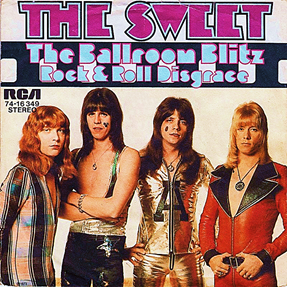
Ballroom Blitz by Sweet is one of the most exhilarating glam rock recordings of the 1970s.
Affiliate Disclosure: I am an Amazon affiliate and if you purchase through any amazon links on this site i may earn a small commission at no extra charge to you.
Released in September 1973 on RCA Records, Ballroom Blitz reached number 2 on the UK Singles Chart and number 5 in the United States.
Written by Nicky Chinn and Mike Chapman and produced by Phil Wainman, it became a defining moment for the band.
Furthermore, the song opens with one of rock’s most famous spoken countdowns before exploding into a full-throttle glam assault.
Indeed, the song remains one of the most energetic singles of its era.
| Song Title | Ballroom Blitz |
|---|---|
| Artist | Sweet |
| Album | Sweet Fanny Adams (1974) |
| Released | September 1973 |
| Genre | Glam Rock, Hard Rock |
| Label | RCA Records |
| Writer | Nicky Chinn, Mike Chapman |
| Producer | Phil Wainman |
| Peak Chart | #2 UK / #5 US |
- What Is the Song About?
- The Vibe: Genre, Mood, and Feel
- Behind the Lyrics
- How It Was Made: The Sound and Production
- Legacy and Charts: Impact and Endurance
- A Listener’s Note
- Watch the Official Video
- Collector’s Corner
- Frequently Asked Questions
What Is the Song About?
Ballroom Blitz describes the chaos of a rock concert crowd turning dangerous.
The singer watches the audience transform from an excited crowd into something threatening.
However, the song is not a dark or anxious recording despite this subject matter.
The energy of the performance treats the chaos as thrilling rather than frightening.
Notably, the lyric captures the physical rush of a concert experience pushed to its limits.
People are moving, pushing, and losing themselves in the noise and heat.
Furthermore, the track channels that chaos into a recording that replicates the feeling rather than simply describing it.
The listener experiences the energy directly rather than at a distance.
As a result, the song works on a purely physical level that bypasses critical analysis entirely.
It is designed to make the body respond before the mind has time to think.
The Vibe: Genre, Mood, and Feel
Ballroom Blitz sits squarely within the glam rock tradition of the early 1970s.
The production has the sheen and compression typical of Chinn and Chapman’s best work.
Moreover, this recording has a hard rock energy that prevents it from feeling merely decorative.
The guitars are genuinely heavy throughout the recording, not just layered for effect.
In particular, the rhythm section drives the track with a relentlessness that matches the lyric’s subject matter.
The mood is aggressive, joyful, and slightly menacing all at once.
There is no ambiguity in the performance.
Similarly, the call-and-response structure of the intro gives the recording a theatrical quality from the first second.
The countdown is itself a performance.
The result is a song that announces itself as an event before the main riff has even arrived.
Behind the Lyrics
Nicky Chinn and Mike Chapman wrote Ballroom Blitz drawing on the chaos of an actual live show.
The writing partnership of Chinnichap was responsible for many of the most successful British singles of the early 1970s.
However, this track stands apart from their other work in its intensity.
Most Chinn-Chapman songs were designed for radio accessibility and melodic appeal.
Furthermore, the lyrics are more visceral and less polished than their typical output.
The chaos of the subject demanded a rougher edge.
In addition, the song gave Sweet the opportunity to push harder than their earlier singles allowed.
The band had been growing frustrated with their bubblegum pop image.
The song provided a bridge between that image and the harder rock sound they wanted to explore.
Consequently, the song represents a turning point in the band’s artistic direction.
How It Was Made: The Sound and Production
Phil Wainman produced Ballroom Blitz at Studio Two in London during the summer of 1973.
Wainman understood the specific sonic requirements of Chinn and Chapman’s writing.
In addition, he captured a production sound that was simultaneously polished and aggressive.
The guitar tones are thick and compressed without losing their edge.
The drums are bright and punchy throughout.
Additionally, the famous spoken intro was recorded with deliberate theatricality.
The countdown builds anticipation precisely because it delays the impact the listener already anticipates.
Meanwhile, the vocal harmonies are layered to create a wall of sound that reinforces the chaos of the lyric.
The production is dense but clear.
Every element has a defined place in the mix and nothing gets lost in the arrangement.
Legacy and Charts: Impact and Endurance
Ballroom Blitz reached number 2 on the UK Singles Chart in 1973 and number 5 in the United States following its American release.
However, the song’s cultural reach extended far beyond its original chart run.
The song has been featured in dozens of films, television shows, and sporting events.
Moreover, the song has been covered and sampled by artists across multiple genres and generations.
In particular, its use in the film Wayne’s World introduced Ballroom Blitz to audiences who had never encountered the original.
The song has remained a reliable fixture of classic rock radio for over fifty years.
Furthermore, live recordings consistently demonstrate the song’s extraordinary physical impact in a concert setting.
As a result, the recording is now recognized as one of the definitive glam rock singles of the era.
Few songs of its type have aged as well.
The energy is entirely intact.
A Listener’s Note
The famous “Are you ready, Steve? Uh-huh. Andy? Yeah. Mick? Okay. Alright fellas, let’s go!” intro is one of rock’s great recorded moments.
The anticipation it builds before the first chord hits is genuinely physical.
Moreover, the Ballroom Blitz guitar riff that follows delivers exactly what the buildup promises.
Nothing about the song is subtle, and that is entirely the point.
Watch the Official Video
Watch Sweet performing Ballroom Blitz in this official video:
Collector’s Corner
Original RCA Records pressings of the Ballroom Blitz single from 1973 are sought after by glam rock collectors.
In particular, UK pressings with the original picture sleeve in strong condition are the most consistently valued.
Similarly, original vinyl pressings of Sweet Fanny Adams reward collectors who want the full album context and Sweet’s harder rock direction’s harder rock direction.
You Might Also Like
Chicago’s combination of Terry Kath’s raw guitar and a precision brass arrangement produced one of the most physically urgent hard rock recordings of the early 1970s, a track that never loses its momentum.
Warren Zevon’s darkly comic supernatural tale combined a memorably simple piano riff with sardonic wit, producing one of the most distinctive and strange recordings in classic rock history.
Cheap Trick’s live recording from Budokan transformed a studio single into a joyful audience-participation event, demonstrating that pop craft and hard rock energy could occupy the same song without compromise.
Frequently Asked Questions
What is Ballroom Blitz about?
Ballroom Blitz describes the chaos of a rock concert crowd turning dangerous and overwhelming. The singer watches the audience transform from an excited group into something threatening and uncontrollable. However, the song treats this chaos as exhilarating rather than frightening. The energy of the performance replicates the physical rush of a concert experience pushed to its limits, making the listener feel the chaos rather than simply read about it.
Who wrote and produced the recording?
The song was written by Nicky Chinn and Mike Chapman, the British songwriting partnership known as Chinnichap, who were responsible for many of the most successful British singles of the early 1970s. The song was produced by Phil Wainman at Studio Two in London during the summer of 1973. Wainman’s production captured a sound that was simultaneously polished and aggressive, reflecting the harder direction Sweet wanted to take.
What inspired the famous intro?
The spoken countdown intro, where the singer checks in with each band member by name before launching the track, was inspired by the theatrical presentation of live rock shows of the era. It was recorded deliberately as a piece of audio drama rather than a simple introduction. The names in the intro correspond to Sweet’s actual band members: Steve Priest, Andy Scott, and Mick Tucker. The countdown builds anticipation precisely because it delays the impact the audience already expects.
How did Ballroom Blitz chart?
Ballroom Blitz reached number 2 on the UK Singles Chart in September 1973, held off the top spot by Donny Osmond. It reached number 5 in the United States following its American release. The song was one of the biggest hits of the glam rock era and helped establish Sweet as one of the leading acts of the British singles chart at its peak moment.
How was the song used in Wayne’s World?
Ballroom Blitz appeared in the 1992 film Wayne’s World in a memorable scene where the characters sing along with the song in their car. The appearance introduced the recording to a new generation of listeners who had not encountered it during its original run. The scene’s energy matched the song’s character perfectly and helped restore the recording to mainstream attention nearly two decades after its original release.
What album is the song from?
The single was released in September 1973 and later appeared on Sweet Fanny Adams, the band’s third studio album, in 1974. Sweet Fanny Adams represented the band’s deliberate move toward a harder rock sound, with Ballroom Blitz as its most commercially successful moment. The album is now recognized as a key document of the glam rock era.
How did the song influence glam rock?
The recording demonstrated that glam rock could carry genuine hard rock power without losing its pop accessibility. Most glam singles of the era were primarily concerned with melody and image. The Ballroom Blitz production combined those qualities with a physical aggression that opened a path between pure pop and hard rock. That combination influenced both the production style and the performance approach of glam rock acts throughout the mid-1970s.
Why does Ballroom Blitz endure as a classic?
Ballroom Blitz endures because pure physical energy in a recording does not expire. The intro still builds anticipation, the guitar riff still hits hard, and the chorus still demands a physical response from the listener. Additionally, the song’s appearance in Wayne’s World gave it a cultural second life that introduced it to audiences too young to have heard it in 1973. The combination of raw energy and pop accessibility has kept it on radio, in films, and at sporting events for over fifty years.
Ballroom Blitz appeals still because it does what only the best rock singles can: it makes the body respond before the mind has time to prepare.