

Closer to the Heart by Rush stands as one of the most beloved songs in the band’s catalog.
Affiliate Disclosure: I am an Amazon affiliate and if you purchase through any amazon links on this site i may earn a small commission at no extra charge to you.
Released in 1977 on Mercury Records, it appeared on the album A Farewell to Kings.
Written by Neil Peart, Alex Lifeson, Geddy Lee, and Peter Talbot, the song was produced by Terry Brown.
Furthermore, at just under three minutes, it is one of Rush’s most concise and accessible recordings.
Indeed, it remains one of the band’s most performed and most recognized songs worldwide.
| Song Title | Closer to the Heart |
|---|---|
| Artist | Rush |
| Album | A Farewell to Kings (1977) |
| Released | 1977 |
| Genre | Progressive Rock, Hard Rock |
| Label | Mercury Records / Anthem Records |
| Writer | Neil Peart, Alex Lifeson, Geddy Lee, Peter Talbot |
| Producer | Terry Brown |
| Peak Chart | #36 UK / #76 US Billboard Hot 100 |
- What Is the Song About?
- The Vibe: Genre, Mood, and Feel
- Behind the Lyrics
- How It Was Made: The Sound and Production
- Legacy and Charts: Impact and Endurance
- A Listener’s Note
- Watch the Official Video
- Collector’s Corner
- Frequently Asked Questions
What Is the Song About?
Closer to the Heart is a call for human beings to take responsibility for building a more just and compassionate world.
The lyric addresses the philosopher, the ploughman, the blacksmith, and the musician.
Each figure is asked to contribute their specific gift to the shared project of bettering human life.
However, the song does not offer a political program.
It is a moral appeal rather than an ideological one.
Notably, the lyric draws on the tradition of visionary English poetry more than on rock convention.
Peter Talbot wrote the original words and Neil Peart refined them into the finished lyric.
As a result, the song carries an unusual literary quality for a hard rock recording of its era.
The directness of the appeal is what gives the song its power.
It asks something of the listener without telling them exactly what that something must be.
The Vibe: Genre, Mood, and Feel
The song sits at the intersection of progressive rock and hard rock.
Rush built their identity around complex arrangements and precise musicianship.
Moreover, this recording demonstrates a different side of the band.
The arrangement is restrained and melodic rather than technically elaborate.
In particular, the acoustic guitar passage gives the song an intimacy unusual in Rush’s catalog.
The mood throughout is earnest and generous.
There is no aggression in the performance.
Similarly, Geddy Lee’s vocal is warm and direct in a way the band’s more complex songs rarely allowed.
The simplicity is deliberate rather than a limitation.
The result is a recording that communicates its message without technical difficulty getting in the way.
Behind the Lyrics
Peter Talbot provided the original lyric concept that Neil Peart then developed into the finished text.
Peart had been reading widely in philosophy and visionary literature throughout his career with Rush.
However, the lyric of this song is unusually simple compared to his other writing.
That simplicity was a conscious choice.
Peart wanted to write something that communicated directly rather than obliquely.
Furthermore, the philosophical content of the lyric reflects his broader interest in humanism and individual responsibility.
The line about forging a new reality captures the song’s central idea.
In addition, the imagery of craftsmen and philosophers working together carries a utopian charge.
The lyric does not pretend change is easy.
Consequently, the appeal it makes feels earned rather than naive.
How It Was Made: The Sound and Production
Terry Brown produced the recording during the sessions for A Farewell to Kings at Rockfield Studio in Wales in 1977.
Brown had worked with Rush throughout their career and understood how to balance their competing impulses.
In addition, the arrangement features an acoustic guitar passage that arrives unexpectedly in the middle of the track.
Alex Lifeson’s acoustic playing gives that section a folk-influenced warmth that contrasts with the electric passages.
Additionally, the rhythm section of Neil Peart and Geddy Lee drives the electric sections with uncommon precision.
The production is clean and direct throughout.
Brown understood that the song required clarity rather than density.
Meanwhile, the brevity of the recording, under three minutes, was unusual for a band known for extended compositions.
That decision to keep the arrangement concise proved commercially wise.
The final mix of the recording captures both the energy and the warmth that the live performances would later amplify.
Legacy and Charts: Impact and Endurance
Closer to the Heart reached number 36 on the UK Singles Chart and number 76 on the US Billboard Hot 100.
However, chart position alone does not capture what the song achieved.
The recording became one of Rush’s signature live moments.
Furthermore, audience sing-alongs turned the song into a communal event at Rush concerts across decades.
In particular, the song demonstrated that Rush could reach listeners who were not devoted fans of progressive rock.
Its accessibility opened a door for casual listeners that the band’s more complex recordings kept closed.
As a result, the song has remained a staple of classic rock radio since its release.
It appears on virtually every Rush greatest hits compilation.
Rolling Stone and other publications consistently cite it among the band’s essential recordings.
The song continues to resonate with listeners who find its moral appeal more relevant than ever.
A Listener’s Note
The acoustic guitar passage that opens the middle section arrives like a breath of fresh air.
It changes the texture of the recording completely without breaking the mood.
Moreover, the transition back to the electric section feels both inevitable and energizing.
The three-minute structure rewards repeated listening without ever feeling too brief.
Watch the Official Video
Watch Rush performing Closer to the Heart in this official video:
Collector’s Corner
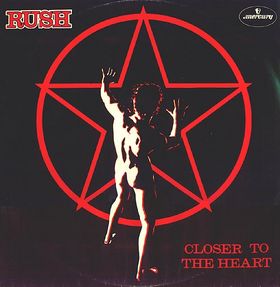
Original Mercury Records pressings of the Closer to the Heart single from 1977 are sought after by progressive rock collectors.
In particular, UK and Canadian pressings with original picture sleeves in strong condition are the most valued.
Similarly, first pressings of A Farewell to Kings reward collectors looking for the original analog sound.
You Might Also Like
Yes combined virtuosic musicianship with genuinely memorable melodies, producing a progressive rock recording that reached a mainstream audience without sacrificing any of its technical ambition.
Jethro Tull’s meditation on homelessness, religion, and moral responsibility combined Ian Anderson’s distinctive flute and vocal with one of rock’s most memorable guitar riffs.
Boston’s debut single combined Tom Scholz’s layered guitar production with a melodic directness that made it one of the most instantly recognizable recordings of the mid-1970s.
Frequently Asked Questions
What is Closer to the Heart about?
Closer to the Heart is a call for individuals to take responsibility for creating a better world. The lyric addresses the philosopher, the ploughman, the blacksmith, and the musician, asking each to contribute their particular gift to the shared project of human improvement. It is a moral appeal rather than a political one, drawing on the tradition of visionary English poetry. The song asks something of the listener without prescribing exactly what that something must be.
Who wrote the song?
The song was written by Neil Peart, Alex Lifeson, Geddy Lee, and Peter Talbot. Talbot provided the original lyric concept and Peart developed it into the finished text. Peart had been reading widely in philosophy and visionary literature throughout his career and brought that sensibility to the writing. The collaboration with Talbot gave the lyric an unusual simplicity and directness compared to Peart’s other compositions.
Who produced the recording?
The recording was produced by Terry Brown, who worked with Rush throughout their most celebrated period. Brown recorded the song at Rockfield Studio in Wales during the sessions for A Farewell to Kings in 1977. His production emphasized clarity and warmth, understanding that the song required a different approach from Rush’s more technically ambitious recordings.
How did the song chart?
The song reached number 36 on the UK Singles Chart and number 76 on the US Billboard Hot 100. Those chart positions understate its cultural impact. The recording became one of Rush’s most performed live songs and one of their most recognized recordings among listeners who were not core fans of progressive rock. Its accessibility gave the band a broader audience than their catalog otherwise reached.
Why is the song so short for Rush?
At under three minutes, the song is unusually brief for a band known for extended progressive compositions. The brevity was a deliberate creative choice. The lyric and melody did not require more space, and extending the arrangement artificially would have weakened the impact. The conciseness proved commercially effective and demonstrated that Rush could operate at any scale they chose without sacrificing quality.
What album is the song from?
The song appears on A Farewell to Kings, Rush’s fifth studio album, released on Mercury Records in 1977. The album marked a transition in the band’s sound, moving away from the extended suite format of previous albums toward slightly more concise compositions. A Farewell to Kings is considered one of Rush’s essential recordings and the song was one of its most commercially successful moments.
What makes the acoustic guitar passage distinctive?
Alex Lifeson’s acoustic guitar passage in the middle of the recording arrives as a complete change of texture. It interrupts the electric energy of the track with something quieter and more intimate. The folk-influenced warmth of the acoustic section gives the recording a range that the electric passages alone could not provide. That contrast between acoustic intimacy and electric power is central to what makes the arrangement work.
Why does the song endure as a classic?
Closer to the Heart endures because its message does not age. The appeal for individuals to take moral responsibility and work toward a better world is as relevant now as it was in 1977. Furthermore, the recording’s musical quality, the balance between electric energy and acoustic warmth, between progressive ambition and melodic accessibility, gives it a range that continues to reach new listeners fifty years on.
Closer to the Heart is a timeless classic because the world it calls for has not yet arrived, and that gap keeps the appeal alive. You can catch the performance of this tune in 2026 and 2027 in the Massive Rush Fifty Something tour.