

Paradise by the Dashboard Light by Meat Loaf is one of the most theatrically ambitious rock recordings of the late 1970s.
Affiliate Disclosure: I am an Amazon affiliate and if you purchase through any amazon links on this site i may earn a small commission at no extra charge to you.
Released in 1977 on Epic Records as part of Bat Out of Hell, the track runs over eight minutes and tells a complete story across three distinct sections.
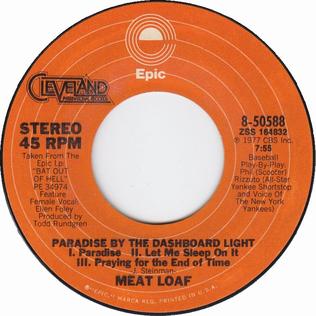
Written by Jim Steinman and produced by Todd Rundgren, the recording features Meat Loaf alongside vocalist Ellen Foley.
Furthermore, baseball broadcaster Phil Rizzuto provides a commentary segment that doubles as one of rock’s most famous extended metaphors.
Indeed, very few recordings before or since have attempted anything quite so elaborately constructed.
| Song Title | Paradise by the Dashboard Light |
|---|---|
| Artist | Meat Loaf featuring Ellen Foley |
| Album | Bat Out of Hell (1977) |
| Released | 1977 |
| Genre | Rock, Glam Rock, Theatrical Rock |
| Label | Epic Records |
| Writer | Jim Steinman |
| Producer | Todd Rundgren |
| Peak Chart | #39 UK (1978) |
- What Is the Song About?
- The Vibe: Genre, Mood, and Feel
- Behind the Lyrics
- How It Was Made: The Sound and Production
- Legacy and Charts: Impact and Endurance
- A Listener’s Note
- Watch the Official Video
- Collector’s Corner
- Frequently Asked Questions
What Is the Song About?
Paradise by the Dashboard Light tells the story of two young people in the back seat of a car on a summer night.
The song moves through three phases.
In the first, the male voice pleads for physical intimacy.
In the second, Phil Rizzuto’s baseball commentary describes a base runner moving toward home plate.
The metaphor is deliberately transparent and darkly comic.
However, the third section changes everything.
The female voice demands a promise of commitment before going further.
The male voice gives the promise under pressure, not conviction.
Notably, the song then jumps forward in time to show the consequences of that promise.
The closing verse reveals a man trapped by a vow he made in desperation, praying every night that his life was over.
The Vibe: Genre, Mood, and Feel
The song sits within the theatrical rock tradition that Jim Steinman developed across his career.
The influences include Phil Spector’s Wall of Sound, Broadway musical drama, and classic rock bombast.
Moreover, the track builds its emotional impact through dynamic contrast rather than through consistent intensity.
The quieter passages make the explosive moments feel genuinely earned.
In particular, the duet structure gives the song a dramatic tension that a solo performance could not achieve.
Meat Loaf and Foley play their roles with complete commitment.
They are not ironic about the material.
Furthermore, the comedy of the baseball commentary works because the surrounding performance takes the love story seriously.
The humor lands harder because the drama around it is real.
The result is a recording that is simultaneously funny and genuinely moving.
Behind the Lyrics
Jim Steinman wrote the material for Bat Out of Hell over several years before finding a recording partner in Meat Loaf.
The concept of using a baseball commentary as a sexual metaphor came from Steinman’s instinct for the absurd.
However, the emotional core of the song is entirely sincere.
Steinman was interested in the reckless promises that young people make under the pressure of desire.
Furthermore, the song explores the regret that follows when desire fades and the promise remains.
The male character in the third section is not villainous.
He is simply someone who said what he needed to say to get what he wanted in the moment.
In addition, the female character is equally complicit in the arrangement.
She extracted the promise knowing it was driven by desperation rather than genuine feeling.
Consequently, the song treats both characters with a complexity unusual in rock music of the era.
How It Was Made: The Sound and Production
Todd Rundgren produced the entire Bat Out of Hell album, including this track, at Bearsville Studios in Woodstock, New York.
Rundgren’s approach was to match Steinman’s theatrical ambitions with an equally theatrical production style.
In addition, the recording features a full band alongside orchestral overdubs that give the track its cinematic scale.
Ellen Foley’s vocal was recorded in full during the sessions, contributing her complete performance to the final mix.
Additionally, Phil Rizzuto recorded his baseball commentary as a separate track that was edited into the song.
Rizzuto initially did not fully understand the context of his commentary.
He is said to have been embarrassed by the final recording once he heard it in context.
Meanwhile, Meat Loaf’s vocal performance required multiple sessions to capture the physical intensity Steinman demanded.
The production process was expensive and protracted.
The final recording runs eight minutes and twenty-eight seconds and does not feel a moment too long.
Legacy and Charts: Impact and Endurance
The song reached number 39 on the UK Singles Chart in 1978.
However, commercial chart performance was not the primary measure of its impact.
Bat Out of Hell as an album became one of the best-selling records in history.
Moreover, the track became the defining centerpiece of the album and of Meat Loaf’s live shows for decades.
In particular, the live version expanded the song further, with the audience participation section becoming a theatrical event in itself.
Jim Steinman’s writing on the song established his reputation as one of rock’s most distinctive composers.
The recording influenced theatrical rock and power ballad traditions throughout the 1980s and beyond.
Furthermore, the song has appeared in films, television dramas, and sporting events, confirming its place in the shared cultural vocabulary of the English-speaking world.
As a result, the recording remains as recognizable and as effective as it was when first released.
Very few rock compositions of any era attempt what the song achieves, and fewer still succeed.
A Listener’s Note
The transition from the baseball commentary into the duet’s final section is one of rock’s great dramatic pivots.
The energy shifts completely without losing momentum.
Moreover, the closing verse lands differently on every listen, depending on where you are in your own life.
The male character’s despair feels comic at twenty and genuinely sad at forty.
Watch the Official Video
Watch Meat Loaf performing Paradise by the Dashboard Light in this official video:
Collector’s Corner
Original Epic Records pressings of Bat Out of Hell from 1977 are consistently sought after by collectors of theatrical and classic rock.
In particular, UK and US first pressings with original inner sleeves in strong condition are the most valued.
Similarly, original 12-inch single pressings of the track carry an extended mix that rewards close listening.
You Might Also Like
Bruce Springsteen’s Wall of Sound production and literary ambition produced a recording of enormous scale that established the heartland rock template and launched his career to the covers of Time and Newsweek.
Warren Zevon’s darkly comic supernatural tale combined sardonic wit with a memorably simple piano riff, producing one of the most distinctive and strange recordings in classic rock history.
Supertramp’s meditation on the education system’s suppression of individuality combined a compelling synthesizer riff with lyrics of unusual philosophical depth for a mainstream rock record.
Frequently Asked Questions
What is Paradise by the Dashboard Light about?
Paradise by the Dashboard Light tells the story of two young people in a car on a summer night. The male character pleads for physical intimacy, the female character demands a promise of commitment, and the male character makes that promise under pressure rather than genuine conviction. The song then jumps forward in time to show a man trapped by a vow he made in desperation, regretting every day of the relationship it created. It is simultaneously a comedy and a tragedy, handled with equal conviction.
Who wrote the song?
The song was written by Jim Steinman, who wrote all the material on Bat Out of Hell. Steinman developed the theatrical rock style over several years before finding a performing partner in Meat Loaf. His writing combines the scale of Broadway musicals with the intensity of hard rock, a combination that was unusual in 1977 and remains rare today. Steinman continued to write for Meat Loaf across several decades of recordings.
Who performs the female vocals?
The female vocals on the recording are performed by Ellen Foley, a rock and pop singer who also appeared on Broadway. Foley’s vocal contribution is equal in dramatic weight to Meat Loaf’s throughout the duet sections. The interplay between Meat Loaf and Foley is central to the song’s effectiveness as a piece of theatrical storytelling. Foley performed on the original studio recording but was not always part of the live show.
Who provides the baseball commentary?
The baseball commentary in the middle section is provided by Phil Rizzuto, the longtime New York Yankees broadcaster. Rizzuto recorded the commentary as a standalone contribution and reportedly did not fully understand the sexual metaphor the commentary was serving. He is said to have been embarrassed when he heard the final recording in context. His commentary runs from the moment a base runner begins his sprint toward home plate.
Who produced the recording?
The recording was produced by Todd Rundgren at Bearsville Studios in Woodstock, New York. Rundgren matched Steinman’s theatrical ambitions with a production style of equal scale, using a full band alongside orchestral overdubs. Rundgren’s production gives the track its cinematic quality, balancing the comedy of the baseball segment against the genuine emotional drama of the duet sections.
What album is the song from?
The song appears on Bat Out of Hell, Meat Loaf’s debut album, released on Epic Records in 1977. Bat Out of Hell is one of the best-selling albums in history, having sold over 40 million copies worldwide. The album was not initially supported by radio or the mainstream music press but built its audience through word of mouth and relentless touring, eventually becoming a cultural phenomenon.
How long is the song?
The studio recording runs eight minutes and twenty-eight seconds. The length is essential to the song’s dramatic structure. The three-part narrative, which moves from the back seat of a car to a baseball diamond to a domestic entrapment, requires time to develop its full emotional arc. A shorter version would lose the comedy, the drama, or the regret that makes the complete recording so effective.
Why does the song endure as a classic?
The song endures because it achieves something genuinely rare: a rock recording that is both completely ridiculous and completely sincere at the same time, and neither quality undermines the other. Jim Steinman’s writing trusts the audience to hold both registers simultaneously. Furthermore, Meat Loaf’s performance commitment is total. He never winks at the camera. The result is a recording that audiences in every decade have found both funny and true.
Paradise by the Dashboard Light still captures our emotions today because very few recordings are brave enough to be both this funny and this sad at the same time.