

The Logical Song by Supertramp is one of the most precisely observed critiques of the way modern society shapes individuals, a recording that takes the collision between childhood freedom and adult conformity and turns it into one of the most melodically satisfying rock songs of the late 1970s, complete with a saxophone solo that arrived in listeners’ ears as if it had always been there.
Affiliate Disclosure: I am an Amazon affiliate and if you purchase through any amazon links on this site i may earn a small commission at no extra charge to you.
Released in March 1979 as the lead single from the album Breakfast in America, The Logical Song reached number 6 on the US Billboard Hot 100 and number 7 in the UK, becoming Supertramp’s highest-charting US single and one of the defining records of the era’s progressive pop movement.
Written by Roger Hodgson and produced by Supertramp and Peter Henderson, the recording won Hodgson the Ivor Novello Award in 1980 for best song both musically and lyrically, a recognition that the writing committee had identified something in the lyric that went beyond craft into genuine insight.
| Song Title | The Logical Song |
|---|---|
| Artist | Supertramp |
| Album | Breakfast in America (1979) |
| Released | March 1979 |
| Genre | Progressive Rock, Pop Rock, Art Rock |
| Label | A&M Records |
| Writer | Roger Hodgson |
| Producer | Supertramp and Peter Henderson |
| Peak Chart | #6 US Billboard Hot 100, #7 UK, #1 Canada |
- What Is the Song About?
- The Vibe: Genre, Mood, and Feel
- Behind the Lyrics
- How It Was Made: The Sound and Production
- Legacy and Charts: Impact and Endurance
- A Listener’s Note
- Watch the Official Video
- Collector’s Corner
- Frequently Asked Questions
What Is the Song About?
The Logical Song is about the loss of childhood wonder and the process by which society systematically replaces it with conformity, presenting the transformation from free-spirited child to responsible, categorized adult as a kind of slow dismantling of the self.
The lyric begins in a state of enchanted innocence, describing a world that is beautiful, wonderful, and magical before tracing the educational process that replaces that enchantment with a set of approved adjectives: responsible, dependable, practical, clinical, intellectual.
The question at the center of the lyric, “Who am I?”, is the question that the educational system never addresses and that the narrator realizes, too late, he has been conditioned not to ask.
The song’s critique is not of knowledge or education itself but of the way institutions use education to produce a particular kind of person, one who is logical and cynical and oh-so-critical rather than one who retains the capacity for wonder that made early childhood rich.
What makes the lyric powerful is its specificity: the narrator is not angry but bewildered, not radicalized but confused, genuinely uncertain about whether the person he has become is someone he would have chosen to become had anyone asked him.
The tension between the beautiful opening vision and the clinical vocabulary of the verses is what gives the recording its emotional force: the song does not tell you how to feel, it simply places the two states of being side by side and asks which one you would choose.
For anyone who has felt the dissonance between who they were as a child and who the world required them to become as an adult, the lyric functions as an exact articulation of a discomfort that is genuinely difficult to put into words.
The song’s final repeated plea — “please tell me who I am” — is not a revolutionary demand but a quiet one, which is exactly why it lands so hard: it is the voice of someone who has played by every rule and still lost the most important thing.
The Vibe: Genre, Mood, and Feel
The Logical Song sits at the intersection of progressive rock and commercial pop in a way that very few recordings managed in 1979, retaining the harmonic sophistication and emotional ambition of prog while delivering it in a form that could reach a mainstream pop audience.
The mood shifts deliberately across its running time: the opening section is dreamlike and warm, the verse builds an increasingly unsettled anxiety, and the chorus bursts into something urgent and almost desperate, a sequence that mirrors the lyric’s emotional journey from innocence to bewilderment.
John Helliwell’s saxophone solo is one of the defining moments in 1970s rock saxophone, arriving in the middle of the recording with a particular quality of controlled fury that gives the listener permission to feel the confusion the lyric has been describing.
Roger Hodgson’s voice on the track carries a quality of genuine distress that is difficult to fake: the delivery is not theatrical but personal, as if the questions being asked are ones the singer has actually asked himself rather than ones he has constructed for effect.
The keyboard work throughout, particularly the synthesizer figures that build under the verses, creates an atmosphere of institutional conformity that supports the lyric without illustrating it too literally, the kind of production decision that distinguishes sophisticated pop from merely competent pop.
The rhythmic propulsion of the recording is deceptive: it moves with enough momentum to feel like an up-tempo track while the harmonic and emotional content is doing something considerably more complex, which is part of why it succeeded on radio without sacrificing any of its substance.
Listeners who discover it for the first time often respond to the melody and the saxophone first, then find on subsequent listens that the lyric is considerably more precise and more troubling than the hook initially suggested.
Behind the Lyrics
The Logical Song was written by Roger Hodgson out of personal experience: he was sent to boarding school at age five, spending the formative years of his childhood in an institutional environment that he later described as the direct inspiration for the song’s central observation about the difference between who you are and who you are taught to be.
The autobiographical origin of the lyric is evident in its emotional precision: Hodgson was not writing a generalized cultural critique but a specific account of a particular kind of bewilderment that boarding school education produces, one in which the self is systematically replaced by an approved version of the self.
The vocabulary of the verses, the litany of approved adjectives that define the “responsible, respectable” adult, was chosen with care: each word is slightly more clinical than the last, building a picture of someone who has been classified and contained without being understood.
Hodgson has described the song as one of the most personal things he ever wrote, which is apparent in the vulnerability of the closing section: the repeated plea for identity is not rhetorical but genuine, the expression of a question that the educational process deliberately left unanswered.
The structure of the lyric mirrors its content: it begins with the expansive, rhapsodic language of childhood wonder and progressively tightens into the restricted vocabulary of approved adulthood, so that the form of the writing enacts what the words describe.
Hodgson’s achievement was to take something intensely personal — his own complicated relationship with the institution that shaped his childhood — and find a way to express it that resonated with millions of people who had very different specific experiences but recognized the same essential feeling.
The Ivor Novello Award for best song both musically and lyrically, presented in 1980, recognized not just the technical quality of the writing but its cultural significance: a song that named something important about post-war Western education had arrived at precisely the moment when that critique was most needed.
How It Was Made: The Sound and Production
The Logical Song was produced by Supertramp alongside engineer and co-producer Peter Henderson, who helped the band achieve the album’s characteristic sound: warm but precise, melodically lush but never cluttered, commercially accessible without sacrificing any of the harmonic sophistication that defined their approach.
The recording was made during the sessions for Breakfast in America at the Village Recorder in Los Angeles in 1978, a studio whose equipment and acoustic properties contributed to the particular clarity that distinguishes the album’s sound from Supertramp’s earlier UK recordings.
The arrangement builds deliberately from the spare, intimate opening through increasingly complex layering: the acoustic guitar and voice that begin the recording are gradually joined by keyboards, bass, drums, and eventually the full ensemble, mirroring the lyric’s journey from individual to institutional.
John Helliwell’s saxophone was given space in the production that many records of the era would have denied it: the solo is not tucked into a corner of the mix but placed front and center, treated as the emotional center of the recording rather than a decorative addition.
Rick Davies’s keyboard work, particularly the synthesizer bass and the chord voicings that support Hodgson’s melody, creates the harmonic richness that distinguishes Supertramp from their pop contemporaries: the chords are more complex than pop convention required, and the listener feels the difference even without being able to name it.
Henderson’s engineering contribution was to capture all of this complexity without allowing it to become muddy: every element of the arrangement is audible in the mix, each instrument occupying its own sonic space in a way that rewards close listening on headphones as much as casual listening on radio.
The production of the track represents the high point of Supertramp’s studio work, the moment where their ambition and their commercial instincts were perfectly aligned, and the result sounds as current today as it did in 1979 because the decisions were musical rather than fashionable.
Legacy and Charts: Impact and Endurance
The Logical Song reached number 6 on the US Billboard Hot 100 and number 7 in the UK in 1979, but its highest chart position was number one in Canada, where it became the country’s biggest-selling single of that year and established Supertramp as one of the decade’s most significant acts in that market.
The song’s success launched Breakfast in America on a trajectory that made it one of the best-selling albums of 1979, eventually reaching number one in the US, UK, Canada, France, and Australia and becoming one of the most commercially successful progressive rock albums ever released.
The Ivor Novello Award for best song both musically and lyrically, presented to Hodgson in 1980, represented the recognition of the British music industry that the recording had achieved something beyond commercial success: it had done something new and done it well.
In the decades since its release, the song has remained a fixture of classic rock radio and has appeared in films, television productions, and advertising consistently, each placement confirming its status as a piece of pop cultural shorthand for a particular kind of educated, reflective dissatisfaction with modern life.
A 2001 techno cover by Scooter, released as “Ramp! (The Logical Song),” reached number one in Norway, Ireland, and Australia, demonstrating that the underlying structure of the song was strong enough to survive radical re-treatment and still connect with new audiences in entirely different musical contexts.
Roger Hodgson has continued performing the song as a solo artist following his departure from Supertramp in 1983, and his live performances confirm that the recording’s emotional power derives primarily from the writing rather than from any particular studio arrangement.
For listeners tracing the history of progressive rock’s transition into the mainstream in the late 1970s, the recording is an essential document: a song that demonstrated that the ambitions of progressive rock and the accessibility of pop radio were not mutually exclusive, and that the most thoughtful music could also be the most popular.
A Listener’s Note
The opening eight bars are one of those moments in pop music where you feel the temperature of the room change: the acoustic guitar figure and Hodgson’s first vocal phrase create an atmosphere of concentrated attention before the first verse has begun.
The experience of hearing the saxophone solo for the first time is genuinely startling even in a recording this familiar: Helliwell’s entrance cuts through the careful architecture of the production with a forcefulness that reframes everything that came before it.
What repeated listening reveals is how precisely the production supports the lyric at every moment: the sonic palette contracts as the vocabulary of the verses tightens, then opens again in the chorus, enacting the emotional journey in purely musical terms.
The song is four minutes and eleven seconds long, and it uses the time to say something specific and true rather than to fill space, which is as good a definition of a well-constructed pop record as any.
Watch the Official Video
Watch Supertramp performing The Logical Song in this official video:
Collector’s Corner
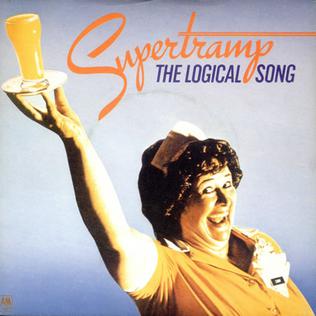
Original pressings of the single on A&M Records appeared in various territories with different sleeve designs, and copies with the original picture sleeves — particularly the UK and US pressings — are sought after by collectors of the era.
Original vinyl copies of Breakfast in America on A&M in strong condition with original inner sleeves are consistently sought after as the album’s status as a progressive pop landmark has grown, and early pressings from the major markets carry the warmth of analog mastering that subsequent CD releases did not always replicate.
You Might Also Like
Pink Floyd’s critique of rigid education and institutional conformity became the most commercially successful single of their career, a song that gave students around the world a three-chord framework for a feeling they recognized immediately.
Yes’s most accessible progressive rock recording demonstrated that complex time signatures and extended instrumental passages could coexist with genuine melodic appeal, establishing the template for the progressive rock mainstream that followed.
Styx’s most ambitious single combined arena rock energy with progressive rock structure, a song about the human need to transcend ordinary existence that became one of the defining recordings of late-1970s radio.
Frequently Asked Questions
What is the song about?
The Logical Song is about the loss of childhood wonder and the process by which education and society replace individual identity with institutional conformity. The lyric traces the journey from free-spirited child to categorized adult, asking who the narrator has become and whether the transformation was one he would have chosen.
Who wrote the song?
The Logical Song was written by Roger Hodgson, inspired by his experience of being sent to boarding school at age five. The autobiographical origin gives the lyric its emotional precision: Hodgson was writing from direct personal experience of institutional education’s effect on individual identity.
How did it chart?
The Logical Song reached number 6 on the US Billboard Hot 100, number 7 in the UK, and number 1 in Canada. It became the lead single from Breakfast in America, which went on to become one of the best-selling albums of 1979 in multiple major markets.
Who produced it?
The Logical Song was produced by Supertramp and Peter Henderson. The production was recorded at the Village Recorder in Los Angeles and is notable for its clarity and balance, allowing the complexity of the arrangement — including John Helliwell’s saxophone solo — to come through without crowding the mix.
What is the saxophone solo?
The saxophone solo is performed by John Helliwell, Supertramp’s multi-instrumentalist, and is one of the most celebrated rock saxophone performances of the 1970s. Placed at the emotional center of the recording, it arrives with a quality of controlled intensity that gives voice to the confusion and frustration the lyric describes.
Did it win any awards?
Roger Hodgson won the Ivor Novello Award for best song both musically and lyrically in 1980 for The Logical Song, one of the most prestigious recognitions in British music. The award acknowledged both the musical sophistication of the composition and the lyrical insight of the writing.
Has the song been covered?
The most notable cover is by the German techno act Scooter, whose 2001 version titled “Ramp! (The Logical Song)” reached number one in Norway, Ireland, and Australia, demonstrating the song’s structural durability across radically different musical treatments. Numerous other artists have recorded versions across multiple genres and decades.
Why does the song endure as a classic?
The Logical Song endures because it names a genuine and widely shared experience — the dissonance between who we were as children and who society required us to become — with a precision and musical sophistication that most pop songs cannot achieve. The combination of Roger Hodgson’s vulnerable vocal, John Helliwell’s saxophone, and a lyric that asks the right questions without providing easy answers creates a recording that sounds as relevant today as it did when it was released.
The Logical Song endures because it asks a question that most popular culture avoids: what happens to the self when it is processed by institutions designed to produce approved versions of people rather than to cultivate the individual qualities that make each person interesting?