

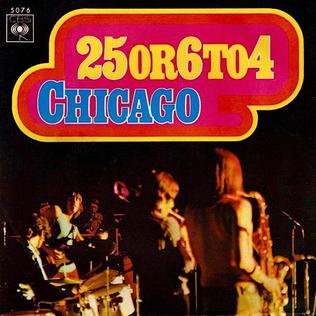
25 or 6 to 4 by Chicago is one of the most explosive hard rock recordings of the early 1970s.
Affiliate Disclosure: I am an Amazon affiliate and if you purchase through any amazon links on this site i may earn a small commission at no extra charge to you.
Released in 1970 on Columbia Records, it reached number 4 on the US Billboard Hot 100 and number 7 in the UK.
Written by Robert Lamm and produced by James William Guercio, the track appeared on Chicago’s second studio album, Chicago II.
Furthermore, the song is built around one of rock’s most recognizable guitar riffs, played by Terry Kath.
Indeed, the track remains a defining showcase for the band’s ability to combine brass arrangements with driving rock power.
| Song Title | 25 or 6 to 4 |
|---|---|
| Artist | Chicago |
| Album | Chicago II (1970) |
| Released | 1970 |
| Genre | Rock, Hard Rock, Jazz Rock |
| Label | Columbia Records |
| Writer | Robert Lamm |
| Producer | James William Guercio |
| Peak Chart | #4 US Billboard Hot 100 / #7 UK |
- What Is the Song About?
- The Vibe: Genre, Mood, and Feel
- Behind the Lyrics
- How It Was Made: The Sound and Production
- Legacy and Charts: Impact and Endurance
- A Listener’s Note
- Watch the Official Video
- Collector’s Corner
- Frequently Asked Questions
What Is the Song About?
25 or 6 to 4 describes the experience of staying up through the night trying to write a song.
The title itself is a time reference.
It means either 25 minutes or 26 minutes before 4 in the morning.
Robert Lamm explained that he was staring at a clock at that hour, struggling with the creative process.
However, the song is not a melancholy recording despite its subject matter.
The energy of the arrangement suggests exhilaration rather than exhaustion.
Notably, the song captures the particular heightened state of late-night creative work.
Everything feels both sharp and slightly unreal at that hour.
As a result, the recording resonates with anyone who has worked past the point where thinking comes easily.
The lyric is specific enough to feel personal but open enough to extend beyond Lamm’s individual experience.
The Vibe: Genre, Mood, and Feel
25 or 6 to 4 sits at the crossroads of hard rock, jazz rock, and brass rock.
Chicago built their identity around combining rock band energy with a full horn section.
Moreover, the recording demonstrates what that combination could achieve at full intensity.
The guitar riff is lean and aggressive.
The horns add momentum without softening the attack.
In particular, the brass lines work against the guitar rather than simply supporting it.
The mood throughout is relentless and tightly coiled.
There is a physical urgency to the recording that sets it apart from most of Chicago’s work.
Similarly, the rhythm section locks in around Kath’s guitar with remarkable precision.
The result is a recording that feels both carefully arranged and genuinely raw.
Behind the Lyrics
Robert Lamm wrote 25 or 6 to 4 during the late-night sessions that defined Chicago’s early recording approach.
The band worked long hours and the creative process often extended well past midnight.
However, the lyric treats that exhaustion as a kind of fuel.
Lamm describes searching for a riff, waiting for inspiration, and watching the light move.
The imagery is spare and vivid.
There are no elaborate metaphors here.
Instead, the writing is concrete and immediate.
Furthermore, the energy of Kath’s guitar fills in what the lyric leaves open.
The performance communicates what description alone could not.
Consequently, the track works as both a lyric and a piece of pure sound simultaneously.
How It Was Made: The Sound and Production
Producer James William Guercio recorded 25 or 6 to 4 during the sessions for Chicago II in 1969 and 1970.
Guercio understood how to balance the band’s two competing strengths.
In addition, he allowed the rock elements to dominate without eliminating the jazz character entirely.
Terry Kath’s guitar tone was deliberately rough and forward in the mix.
The brass parts were arranged to push alongside the guitar rather than simply answering it.
Additionally, the rhythm section of Danny Seraphine on drums and Peter Cetera on bass drove the track with an uncommon physicality.
Guercio favored a dry, tight sound that emphasized attack over ambiance.
The production philosophy matched the lyric’s preoccupation with the raw state of late-night creative energy.
Meanwhile, the horn arrangement by the band gave the recording a precision that harder rock groups of the era could not match.
The final mix captured all of those elements in balance.
Legacy and Charts: Impact and Endurance
25 or 6 to 4 reached number 4 on the US Billboard Hot 100 in 1970.
It also reached number 7 on the UK Singles Chart.
However, chart success only partially describes what the recording achieved.
The song became the definitive showcase for Terry Kath’s guitar playing.
Notably, Jimi Hendrix reportedly said that Kath was a better guitarist than he was.
In particular, the track demonstrated what Kath could do with a sustained riff over a driving arrangement.
The song has remained a staple of classic rock radio for over fifty years.
Furthermore, the song has been covered and referenced by rock bands across multiple generations.
It established the model for how a horn section could function as part of a hard rock arrangement.
As a result, the song influenced the direction of jazz rock well beyond Chicago’s own catalog.
A Listener’s Note
The opening guitar riff of 25 or 6 to 4 is one of the most immediately recognizable moments in early 1970s rock.
It arrives without preamble and establishes the energy of the entire track within two bars.
Moreover, the transition into the horn entrance rewards close listening every time.
The way the brass comes in against Kath’s guitar without softening it is a production decision that still sounds bold today.
Watch the Official Video
Watch Chicago performing 25 or 6 to 4 in this official video:
Collector’s Corner
Original Columbia Records pressings of the 25 or 6 to 4 single from 1970 are valued by classic rock collectors.
In particular, copies with the original Columbia orange label and picture sleeve in strong condition are consistently sought after.
Similarly, original vinyl pressings of Chicago II carry a sonic warmth that later reissues have not fully replicated.
You Might Also Like
Bruce Springsteen’s fourteen-month recording odyssey produced one of rock’s most ambitious Wall of Sound arrangements, a track that put him on the covers of Time and Newsweek and defined the heartland rock template.
Genesis stepped away from progressive complexity toward accessible warmth with this single, demonstrating that a band built on intricate arrangements could also deliver simple emotional directness.
Warren Zevon’s darkly comic tour through London’s supernatural underworld combined a memorably simple piano riff with lyrics of sardonic wit, making it one of the most distinctive recordings of the late 1970s.
Frequently Asked Questions
What is 25 or 6 to 4 about?
25 or 6 to 4 describes the experience of staying up through the night trying to write a song. The title refers to the time, either 25 or 26 minutes before 4 in the morning. Robert Lamm wrote the lyric while staring at a clock late at night, waiting for musical inspiration to arrive. The song captures the heightened, slightly exhausted state of late-night creative work with remarkable accuracy.
What does the title mean?
The title 25 or 6 to 4 is a time reference. It means either 25 minutes or 26 minutes before 4 in the morning, which would be 3:34 or 3:35 am. Robert Lamm explained that the phrase came directly from looking at a clock during a late-night writing session. The ambiguity of “25 or 6” reflects the slightly unreal quality of thinking at that hour.
Who wrote and produced the recording?
The song was written by Robert Lamm and produced by James William Guercio. Guercio worked with Chicago through their most commercially successful period and understood how to balance the band’s rock energy with their jazz and brass influences. His production on 25 or 6 to 4 favored a dry, tight sound that kept Kath’s guitar prominent throughout the recording.
How did 25 or 6 to 4 chart?
25 or 6 to 4 reached number 4 on the US Billboard Hot 100 in 1970, making it one of Chicago’s biggest chart successes of the era. It also reached number 7 on the UK Singles Chart. The chart performance confirmed that hard rock energy and jazz-influenced arrangements could appeal to a mainstream audience simultaneously.
Who plays the guitar on the recording?
The guitar on 25 or 6 to 4 is played by Terry Kath, who is widely regarded as one of the most technically gifted rock guitarists of his generation. His playing on the track combines raw energy with precise control. Jimi Hendrix reportedly praised Kath as one of the best guitarists he had ever heard, with 25 or 6 to 4 cited as evidence of that talent.
What album is the song from?
The track appears on Chicago II, the band’s second studio album, released in 1970 on Columbia Records. Chicago II was a double album that demonstrated the band’s ambition and range, with 25 or 6 to 4 serving as its most direct and commercially successful single. The album cemented Chicago’s position as one of the most ambitious rock acts of the early 1970s.
How did the song influence rock music?
The song demonstrated that a brass section could function as a rock instrument rather than simply as an orchestral addition. Chicago proved that horns could push against a guitar riff with the same aggression the guitar itself provided. Furthermore, the song established a template for how jazz-influenced bands could reach rock audiences without compromising either element of their sound.
Why does the recording endure as a classic?
25 or 6 to 4 endures because its energy has not aged. The guitar riff, the horn arrangement, and the rhythm section all operate at a level of precision that sounds as fresh now as it did in 1970. Additionally, the subject matter of the lyric, creative exhaustion and determination, is one that never goes out of date. Listeners who work late and push through difficulty find something genuinely true in the recording every time they return to it.
25 or 6 to 4 captures the human spirit because of pure musical energy, played with genuine conviction, does not expire.