

Night Moves by Bob Seger is one of the most perfectly realized pieces of American rock nostalgia ever committed to record. A song that transforms the specific physical and emotional landscape of a Detroit teenager’s summer into something universal enough that listeners across generations and geographies have heard their own adolescence in it.
Affiliate Disclosure: I am an Amazon affiliate and if you purchase through any amazon links on this site i may earn a small commission at no extra charge to you.
Released in 1976 from the album of the same name, Night Moves reached number 4 on the US Billboard Hot 100 in early 1977, giving Bob Seger and the Silver Bullet Band their commercial breakthrough and establishing Seger as one of the defining voices of working-class American rock.
Written by Seger and produced by Jack Richardson and Seger himself, the song combines the loose, conversational storytelling of classic rock with the emotional precision of the best country writing, creating something that sounds both effortless and deeply considered.
| Song Title | Night Moves |
|---|---|
| Artist | Bob Seger and the Silver Bullet Band |
| Album | Night Moves (1976) |
| Released | 1976 |
| Genre | Rock, Heartland Rock, Classic Rock |
| Label | Capitol Records |
| Writer | Bob Seger |
| Producer | Jack Richardson and Bob Seger |
| Peak Chart | #4 US Billboard Hot 100 |
- What Is the Song About?
- The Vibe: Genre, Mood, and Feel
- Behind the Lyrics
- How It Was Made: The Sound and Production
- Legacy and Charts: Impact and Endurance
- A Listener’s Note
- Watch the Official Video
- Collector’s Corner
- Frequently Asked Questions
What Is the Song About?
Night Moves is about the summer of youth remembered from middle age, a meditation on first sexual experience and the particular freedom of being young in a small city before responsibility arrived and rearranged everything.
The song follows two teenagers, a boy and a girl “working on our night moves,” finding each other in the summer darkness outside the social structures that define their daylight lives, and the nostalgia Seger brings to the telling is completely free of sentimentality because it is honest about both the beauty and the transience of what he is describing.
What the song does that most nostalgia songs fail to do is maintain the perspective of experience: the singer is not reliving the past but looking at it from a vantage point that includes everything that came after, and the combination of warmth and loss that comes from that position is what gives the song its emotional complexity.
The setting is deeply specific: the drive-in theater, the point on a lake, the flatlands of Michigan outside Detroit, and the specificity is what generates the universality — listeners from entirely different places recognize the emotional truth even if the geography is unfamiliar.
The song’s transition, from the story of two teenagers to the middle-aged man waking in the dark thinking about thunder and wondering “what year is this,” is one of the most effective structural moments in popular songwriting: time collapses, past and present exist simultaneously, and the feeling of loss and beauty mixes in a way that is very difficult to achieve.
The song is ultimately not about sex or summer but about impermanence: the way things that feel permanent when you are seventeen have already changed by the time you are old enough to understand what you had, and the particular ache of knowing that the person you were then is someone you can remember but never again be.
The girl in the song is treated with a specific kind of fondness that avoids both condescension and idealization: she is young and imperfect and real, “working on mysteries without any clues,” and the warmth Seger brings to her memory is the warmth of someone who has genuinely thought about who she was and not just about what she meant to him.
For anyone who has ever looked back on a particular summer and felt the combination of gratitude and grief that Seger describes, Night Moves is the song that names the feeling precisely.
The Vibe: Genre, Mood, and Feel
Night Moves sits in the heartland rock tradition that Seger helped define, a style that values directness and emotional honesty over sophistication, that speaks to working-class experience without condescension, and that finds the universal in the specific details of ordinary American life.
The mood is bittersweet in the most accurate sense: there is genuine warmth in the performance, genuine pleasure in the memory, and genuine sadness in the knowledge that the memory is all that remains, and Seger holds all three feelings simultaneously without letting any of them dominate.
The acoustic guitar that opens the song establishes a tone of quiet intimacy that the full band arrangement, when it arrives, does not disturb: the song moves from spare to full without ever losing the quality of someone telling you something personal.
The tempo is conversational, matching the pace of someone actually remembering rather than performing remembrance, and the band’s performance throughout is restrained in service of the lyric: nobody is showing off, everyone is serving the story.
The vocal performance here is one of Seger’s finest: the voice carries the weight of the years between the events being described and the moment of telling, and the combination of lived-in warmth and controlled emotion gives the performance a quality of genuine experience rather than theatrical simulation.
The genre question is ultimately less interesting than the emotional question, and what Night Moves delivers emotionally is the particular combination of pleasure and loss that characterizes the best writing about memory: you are happy to be reminded and sad that remembering is all you can do.
Listeners who first encounter the song in middle age often find it more affecting than those who discover it in youth, because the song is written from the far side of the experience it describes, and the further you are from those teenage summers, the more precisely the lyric captures your relationship to them.
Behind the Lyrics
Night Moves was written by Seger from personal experience of growing up in Ann Arbor and the working-class suburbs of Detroit in the late 1950s and early 1960s, and the specificity of the lyric reflects the clarity with which he could recall that particular time and place.
The song emerged during a period of creative breakthrough for Seger: having spent the better part of a decade as a regional figure in the Midwest without achieving national recognition, he was developing the material for the Night Moves album with a new sense of what he wanted to say and how he wanted to say it.
The lyric was written quickly, which is often the case with songs that feel most inevitable in retrospect: the emotional content was there, the memories were there, and Seger had enough craft by 1976 to find the form that would hold them without straining.
The structural choice to end the song with the middle-aged narrator waking in the dark was not an afterthought but the key decision that transforms Night Moves from a nostalgia piece into something more complex: without that ending, the song would still be good, but it would not be about time in the way it finally is.
Seger has described the writing as an attempt to capture something that he felt had not been done in rock music before: a song about teenage sexuality that was honest and specific without being either prurient or sanitized, that treated the experience with the seriousness it deserved in retrospect even if it had not seemed serious at the time.
The line about “working on our night moves, trying to make some front page, drive-in news” balances the genuine excitement of adolescent discovery with a gentle self-awareness about how large those experiences felt at the time, and that balance is characteristic of the lyric throughout.
The particular quality of memory that Night Moves captures is the way that experiences which felt complicated when they happened become simpler and more beautiful the further away they are, and the song is honest about the selectivity of nostalgia without abandoning the nostalgia itself.
How It Was Made: The Sound and Production
Night Moves was produced by Jack Richardson and Bob Seger, a collaboration that gave the recording its distinctive combination of intimacy and authority: Richardson’s production experience shaped the sound while Seger’s vision kept it honest.
The recording arrangement was built around the contrast between acoustic and electric elements, with the opening acoustic guitar section establishing the reflective, private quality of the memory before the band enters and gives the story its physical energy.
The Silver Bullet Band’s performance throughout is notable for its discipline: the musicians knew that their job was to support the storytelling rather than to draw attention to themselves, and the restraint they exercised gives the recording its focused emotional power.
The piano work on Night Moves adds harmonic warmth to the middle and later sections of the recording, building the emotional intensity as the narrative progresses without overwhelming the vocal, which remains the center of everything.
Richardson’s production creates a sonic space that feels open and unhurried, matching the quality of genuine reminiscence: nothing in the mix feels rushed or compressed, and the recording breathes in a way that reinforces the emotional content of the lyric.
The decision to let the acoustic opening run without accompaniment for its full duration was crucial: those bars establish the tone and the intimacy that the rest of the recording sustains, and cutting them short would have diminished the emotional investment the listener makes before the story begins.
The result is a recording that sounds both of its era and entirely timeless, which is the reliable indicator of correct production decisions: Night Moves has not dated because its qualities are musical and emotional rather than fashionable.
Legacy and Charts: Impact and Endurance
Night Moves reached number 4 on the US Billboard Hot 100 in February 1977, giving Seger his highest-charting single to that point and launching the Night Moves album to platinum certification and genuine national recognition after years of regional success.
The song’s commercial breakthrough transformed Seger’s career: the Night Moves album became one of the best-selling records of 1977, and its success established the template for the heartland rock movement that shaped American popular music through the late 1970s and early 1980s.
Bruce Springsteen, Tom Petty, and John Mellencamp all owe something to what Seger established with this recording: the idea that working-class American experience, told with honesty and musical skill, could connect with a massive audience that recognized itself in the details.
The song has appeared consistently in films, television productions, and advertising for nearly five decades, each placement confirming its status as shorthand for a particular kind of American nostalgia: warm but honest, specific but universal, happy and sad at the same time.
The recording remains the centerpiece of Seger’s live performances, the moment in every concert where the audience goes from enthusiastic to genuinely moved, which is the most reliable measure of a song’s enduring connection to its listeners beyond its chart life.
The song’s influence on subsequent singer-songwriter work is difficult to overstate: the structural choice to combine specific narrative detail with a reflective, time-collapsed ending became a template for dozens of songs across multiple decades and genres.
For listeners tracing the development of American rock writing from the early 1970s through the heartland movement of the late 1970s and early 1980s, Night Moves is an essential text: the song that demonstrated that rock could carry the emotional weight of genuine adult experience without losing any of its energy or appeal.
A Listener’s Note
The acoustic opening is one of those moments that asks for quiet: the intimacy of the recording rewards attentive listening, and hearing it in the background at high volume misses much of what makes it work.
First-time listeners are often surprised by the structural shift at the end of the song — the sudden jump from teenage summer to middle-aged sleeplessness — and that surprise is part of the experience, the moment where a good song becomes something more.
What repeated listening reveals is the care in every phrase: Seger never reaches for more than the moment requires, and the restraint is more apparent with familiarity, which is the mark of writing that has been genuinely thought through.
The song runs to five minutes and twenty-two seconds, and it earns every one of them.
Watch the Official Video
Watch Bob Seger performing Night Moves in this official video:
Collector’s Corner
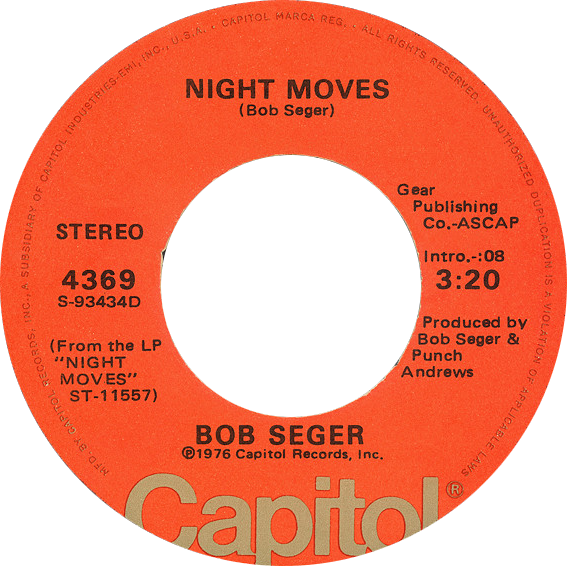
Original pressings of the Night Moves single on Capitol Records are sought after by collectors of 1970s American rock, particularly copies with picture sleeves from the initial release in strong condition.
Original vinyl copies of the Night Moves album on Capitol, in strong condition with original inner sleeves, are consistently sought after as one of the defining heartland rock recordings of its era, and early pressings carry the analog warmth that later digital reissues do not always replicate.
You Might Also Like
Bruce Springsteen’s declaration of escape from small-town suffocation became one of the defining statements of working-class American rock, a song about the need to transcend the limits of where you came from that never stopped sounding urgent.
Jackson Browne’s meditation on the cost of life on the road became one of the most honest examinations of the rock musician’s existence, a song about exhaustion and persistence that connected deeply with anyone who had ever kept going past the point where stopping seemed rational.
Neil Young’s only US number one combined the simplest possible lyric with a harmonica figure that became one of the most recognizable sounds in 1970s rock, a song about searching for authenticity that itself became the defining example of what it was looking for.
Frequently Asked Questions
What is the song about?
Night Moves is about adolescent summer romance remembered from middle age, told from the perspective of a man who wakes in the night thinking about the teenagers he and a girl once were and the particular freedom and intensity of that season of life. The song combines genuine warmth for the past with an honest awareness of its distance, creating a meditation on memory, impermanence, and the specific ache of knowing that your younger self is someone you can remember but never again be.
Who wrote the song?
Night Moves was written entirely by Bob Seger, drawing on his personal experience of growing up in the working-class suburbs of Detroit in the late 1950s and early 1960s. The autobiographical origin gives the lyric its specificity and emotional honesty, with details about Michigan geography and the particular rituals of teenage life in that era and place.
How did it chart?
Night Moves reached number 4 on the US Billboard Hot 100 in February 1977, giving Bob Seger his first major national hit. The Night Moves album went on to achieve platinum certification and established Seger as a major figure in mainstream American rock after more than a decade as a regional favorite in the Midwest.
Who produced the recording?
Night Moves was produced by Jack Richardson and Bob Seger. Richardson brought experienced production instincts while Seger maintained creative control over the material, resulting in a sound that combined professional polish with the emotional directness that defined Seger’s best work.
What makes it different from other nostalgia songs?
Night Moves avoids the two traps that most nostalgia songs fall into: it is neither sentimentally idealized nor self-consciously ironic about the past. Seger maintains the perspective of genuine adult reflection, acknowledging both the beauty of what he is remembering and the fact that it is gone, and the structural choice to end the song in the present tense — the middle-aged narrator waking in the dark — gives the recording a dimension of emotional complexity that most songs about the past never achieve.
Where does the song take place?
The song is set in the working-class suburbs of Detroit, Michigan, drawing on Seger’s own upbringing in and around Ann Arbor. The lyrics reference specific geographical and cultural details of that time and place — drive-in theaters, points on lakes, the flatlands of southern Michigan — that give the song its particularity while allowing listeners from anywhere to recognize the emotional landscape it describes.
What is the significance of the ending?
The ending, where the middle-aged narrator wakes in the night thinking about thunder and wondering what year it is, is the structural choice that elevates Night Moves from a good nostalgia song to something more complex. By collapsing the distance between past and present, Seger makes the listener feel rather than simply observe the passage of time, and the combination of pleasure in the memory and pain in its distance from the present is what gives the song its lasting emotional power.
Why does the song endure as a classic?
Night Moves endures because it captures something that most popular songs avoid: the complex relationship between memory, loss, and gratitude that defines adult life’s relationship to youth. The song’s combination of specific detail and universal feeling, honest sentiment and complete lack of sentimentality, and musical craft in service of genuine emotional content makes it one of the most durable records in the American rock catalog.
Night Moves still matters because it is honest about the one thing that most nostalgia gets wrong: the past was not better than the present, but it was irreplaceable, and that distinction is the source of everything the song makes you feel.