

Heart of Gold by Neil Young arrived in January 1972 as something that sounded simultaneously like it had always existed and like nothing that had been recorded before: a three-minute meditation on the search for authenticity, built on acoustic guitar and harmonica, that became the only US number one single of Young’s career and one of the defining sounds of the early 1970s singer-songwriter movement.
Affiliate Disclosure: I am an Amazon affiliate and if you purchase through any amazon links on this site i may earn a small commission at no extra charge to you.
Released from the album Harvest, Heart of Gold reached number one on the US Billboard Hot 100 and on the Canadian RPM chart, becoming Young’s commercial peak at the precise moment he was beginning to feel uncomfortable with the kind of mainstream success it represented.
Written by Young and produced by Elliot Mazer and Young himself, the recording featured James Taylor and Linda Ronstadt on backing vocals and was cut at Quadrafonic Sound Studios in Nashville on February 6 and 7, 1971 — two days that produced one of the most listened-to recordings of the decade.
| Song Title | Heart of Gold |
|---|---|
| Artist | Neil Young |
| Album | Harvest (1972) |
| Released | February 1972 |
| Genre | Folk Rock, Country Rock, Singer-Songwriter |
| Label | Reprise Records |
| Writer | Neil Young |
| Producer | Elliot Mazer and Neil Young |
| Peak Chart | #1 US Billboard Hot 100, #1 Canada, #10 UK |
- What Is the Song About?
- The Vibe: Genre, Mood, and Feel
- Behind the Lyrics
- How It Was Made: The Sound and Production
- Legacy and Charts: Impact and Endurance
- A Listener’s Note
- Watch the Official Video
- Collector’s Corner
- Frequently Asked Questions
What Is the Song About?
Heart of Gold is about the search for authenticity — the effort to find in oneself and in the world a quality of genuine goodness that is not performed, that survives pressure and remains worth having.
The lyric is deceptively simple: Young describes himself as aging, searching, and determined to keep searching, and the central image functions simultaneously as a personal quality to be cultivated and as a standard for other people and experiences to be measured against.
What makes the writing effective is its refusal to define what the central image actually refers to: the phrase resonates because everyone recognizes it as a quality without being able to specify its content exactly, which means every listener brings their own understanding of what is worth searching for.
The search itself is the subject of the song as much as the destination: Young presents the act of seeking as valuable in itself rather than as a means to an end, which is why the lyric does not resolve into arrival or achievement but continues in the act of looking.
The image of “getting old” is important to the song’s emotional content: Young was only twenty-five when he recorded it, yet the lyric carries a quality of genuine wear that makes the search feel earned rather than theoretical, as if the singer has already given up enough along the way to make the continued searching meaningful.
The backing vocals of James Taylor and Linda Ronstadt, two of the most celebrated voices of the same era, add a dimension of community to what is otherwise a solitary quest: the search being described is individual but the recognition of it is shared, and the harmonies embody that sharing.
For listeners who have spent any portion of their lives looking for something they could not precisely name but could not stop wanting, Heart of Gold names that condition with a precision and economy that very few songs manage.
The song’s continued resonance across generations suggests that the experience it describes — the sense of searching for a quality of being that keeps receding as you approach it — is not specific to any era but is part of the human experience of aspiration.
The Vibe: Genre, Mood, and Feel
Heart of Gold sits in the folk rock and country rock tradition, drawing on the Nashville Sound while remaining distinctly Young’s own: the production has the warmth of country recording without the genre’s conventional subject matter, and the folk tradition’s directness without its political urgency.
The mood is contemplative and quietly urgent: the song does not rush, but the harmonica figure that runs through it carries a quality of restlessness that prevents the contemplation from becoming comfortable.
Young’s voice on the track has a quality of naked honesty that is difficult to replicate: the performance is unguarded in a way that makes the lyric sound like something being spoken rather than sung, which is the quality that has made him one of the most immediately identifiable voices in rock music.
Ben Keith’s pedal steel guitar adds a country warmth that softens the emotional edges of the recording without blunting them, creating an atmosphere that is melancholy without being despairing and searching without being anxious.
The harmonica work, played by Young himself, is one of the most recognizable figures in 1970s rock — four notes that announce the recording before a word is sung and that, once heard, are impossible to forget.
The genre boundaries of the recording are ultimately less interesting than its emotional temperature, which is somewhere between acceptance and longing: the song knows that what it is searching for may not be findable, and it has decided to search anyway.
Listeners who encounter the recording for the first time often report a sense of immediate familiarity, as if they have heard it before even when they have not, which is the characteristic of recordings that express something so universally felt that recognition precedes actual knowledge.
Behind the Lyrics
Heart of Gold was written during a period of personal transition for Young: following back surgery that limited his physical ability and a period of reflection about the direction of his career, he was developing the more acoustic, introspective approach that would characterize Harvest and define his public image for much of the early 1970s.
The Nashville sessions that produced the recording were arranged through Young’s friendship with Linda Ronstadt and James Taylor, who were also recording in the city; their presence in the studio was spontaneous rather than planned, and their backing vocals give the recording a warmth that studio session singers would not have provided.
Young has spoken about the writing of Heart of Gold as coming from a genuine personal searching rather than from a conscious artistic strategy: the lyric reflects a genuine state of mind rather than a constructed position, and that origin is one reason the recording connects so reliably with listeners.
The simplicity of the lyric was not accidental but was the result of stripping away everything that was not essential: Young’s instinct was that the central idea was strong enough to carry the song without elaboration, and the restraint he exercised in the writing is what makes it last.
The phrase “heart of gold” carries multiple simultaneous meanings: a personal quality of generosity and authenticity, an impossible standard that can only be approached rather than reached, and a description of the quality of searching itself — the quality of continuing to look for something true.
Young has described the song as the point at which he found himself most in the middle of the road, which explains both its commercial success and his subsequent creative retreat: the mainstream audience recognized itself in Heart of Gold, and Young recognized that was not where he wanted to be.
The paradox at the center of Young’s career is embodied in the song’s reception: the most direct and accessible thing he ever made became his biggest commercial success, which caused him to deliberately move away from that accessibility, producing some of the most challenging and least commercially successful work of the decade.
How It Was Made: The Sound and Production
The recording was made at Quadrafonic Sound Studios in Nashville on February 6 and 7, 1971, during sessions for Harvest that represented Young’s most deliberate engagement with Nashville’s recording traditions and personnel.
Elliot Mazer co-produced the sessions with Young, bringing the Nashville studio’s technical resources to bear on material that required a particular combination of warmth and intimacy, and his contribution was to create an environment in which Young could perform with the kind of direct, unguarded quality that the recording required.
The arrangement is built around Young’s acoustic guitar and voice, with Ben Keith’s pedal steel and Kenny Buttrey’s drums providing a country-inflected rhythmic and harmonic foundation that supports the vocal without competing with it.
The harmonica, which opens the recording and recurs throughout, was played by Young himself, and its placement in the mix — clear, close, slightly rough-toned — is one of the production’s crucial decisions: a more polished harmonica sound would have removed the quality of personal directness that gives the recording its intimacy.
James Taylor and Linda Ronstadt’s presence in the studio was serendipitous: both were recording in Nashville at the same time, both knew Young, and both were willing to add their voices to the sessions without the kind of formal arrangement that would have turned it into a collaboration rather than a gathering of friends.
The result of their participation is a backing vocal blend that combines Taylor’s warm baritone-adjacent voice with Ronstadt’s pure-toned soprano in a way that gives the chorus a quality of gentle communal affirmation: the search being described is individual, but the backing voices say that others recognize and share it.
The overall production is a master class in restraint: every element earns its place, nothing is added for decoration, and the recording sounds as immediate today as it did in 1972 because every decision was made in service of the song rather than in service of the moment’s production fashions.
Legacy and Charts: Impact and Endurance
Heart of Gold reached number one on the US Billboard Hot 100 in March 1972 and topped the Canadian chart simultaneously, becoming Neil Young’s only chart-topping single in either country and launching Harvest to become one of the best-selling albums of 1972.
The success of Harvest and its lead single established the commercial template for the soft rock and country rock sounds that would dominate much of American radio through the mid-1970s, with Young’s example showing that acoustic simplicity and emotional directness could achieve massive commercial reach.
Young’s famous response to this commercial breakthrough — his deliberate retreat into the “ditch trilogy” of challenging, uncommercial albums that followed — has itself become part of the song’s legacy: The recording is the sound of the last moment before one of rock’s most celebrated careers made a decisive turn away from the mainstream.
The recording has appeared in films, documentaries, and advertising consistently since its release, and its status as a piece of American cultural shorthand for a particular kind of earnest searching has only grown with time.
Young’s 2005 concert film was titled after the recording, and the live performances it documents confirmed that the song’s power derives from the writing rather than from any particular studio arrangement: decades of performance had not diminished the emotional content of the lyric.
The influence of Heart of Gold on subsequent singer-songwriter work is incalculable: its combination of spare acoustic arrangement, personal lyric, and unguarded vocal performance became the template for an entire tradition of introspective pop that continues to produce important work today.
For listeners tracing the development of the singer-songwriter tradition from its folk roots through the commercial mainstream of the early 1970s, the recording is an essential document: the moment the form achieved its widest reach without compromising any of the qualities that made it valuable.
A Listener’s Note
The harmonica figure that opens the recording is one of those sounds that, once heard, is simply part of the listener’s permanent musical landscape: four notes that announce everything the song is going to be before a word is sung.
What repeated listening reveals is how much is contained in the simplicity: the lyric has fewer words than most pop songs and says more than most, and the recording’s restraint makes it more rather than less powerful with familiarity.
The backing vocals of Taylor and Ronstadt repay close attention on headphones: the blend is not polished in the way studio session singing is polished, and the slight roughness of the combination gives it the quality of genuine voices rather than vocal production.
The song runs to three minutes and five seconds, which is exactly as long as it needs to be.
Watch the Official Video
Watch Neil Young performing Heart of Gold in this official video:
Collector’s Corner
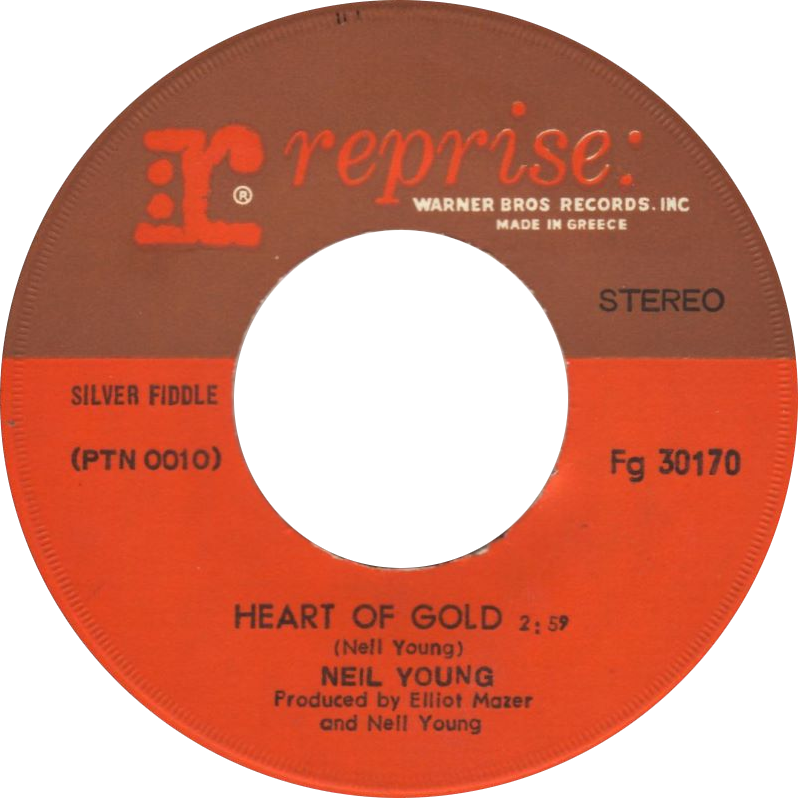
Original pressings of the Heart of Gold single on Reprise Records are sought after by collectors of Neil Young’s catalog and of the early 1970s singer-songwriter era, with first pressings carrying the original sleeve design and Reprise label art.
Original vinyl copies of Harvest on Reprise in strong condition are among the most sought-after records in the folk rock and country rock canon, with early pressings of both the US and UK versions carrying the analog warmth that subsequent reissues have approximated but rarely matched.
You Might Also Like
Bob Seger’s meditation on adolescent memory from the far side of experience became the heartland rock anthem that defined a generation’s relationship to its own nostalgia, a song about the past that only makes full sense when you have enough past to look back on.
Jackson Browne’s debut single established the introspective California singer-songwriter sound that would define a decade of American popular music, a song about emotional exhaustion that connected precisely because its honesty was so uncommon.
Cat Stevens’s farewell song to Patti D’Arbanville became one of the defining recordings of the early 1970s folk rock era, a combination of tenderness and regret that has resonated with every generation of listeners who have had to let go of someone they cared about.
Frequently Asked Questions
What is the song about?
Heart of Gold is about the search for authenticity — the effort to find in oneself and in the world a quality of genuine goodness that does not compromise or perform. The lyric traces the experience of aging and continuing to search for something worth having, with the central image of the heart of gold functioning as both a personal ideal and an impossible but necessary standard.
Who played on the recording?
The recording features Neil Young on lead vocals, acoustic guitar, and harmonica, Ben Keith on pedal steel guitar, Tim Drummond on bass, Kenny Buttrey on drums, and Teddy Irwin on guitar. James Taylor and Linda Ronstadt, who were both recording in Nashville at the time, provided the backing vocals that give the chorus its warm communal quality.
Did the song reach number one?
Heart of Gold reached number one on the US Billboard Hot 100 in March 1972, making it Neil Young’s only US number one single. It also topped the Canadian chart simultaneously and reached number 10 in the UK.
Who produced the recording?
Heart of Gold was produced by Elliot Mazer and Neil Young, recorded at Quadrafonic Sound Studios in Nashville in February 1971. Mazer’s production approach combined Nashville’s recording warmth with the intimacy that Young’s material required, creating a sound that was both polished and direct.
What album is the song from?
Heart of Gold appears on Harvest, Neil Young’s fourth studio album, released in February 1972 on Reprise Records. The album went to number one in the US, UK, Canada, and Australia and is widely considered one of the most important records of the early 1970s singer-songwriter era.
Why did Young move away from this style after its success?
Young has described Heart of Gold and Harvest as the point at which he found himself too close to the middle of the road, a position he was uncomfortable with despite — or because of — the commercial success it brought. He responded by making the “ditch trilogy” of deliberately challenging, uncommercial albums, a creative retreat that has itself become one of rock history’s most celebrated acts of artistic integrity.
What is the harmonica figure at the start of the song?
The harmonica figure that opens Heart of Gold and recurs throughout is played by Neil Young himself and is one of the most recognizable passages in 1970s rock. The four-note phrase establishes the song’s emotional tone immediately, combining a quality of searching and longing with the directness that characterizes the recording as a whole.
Why does the song endure as a classic?
Heart of Gold endures because it describes a state of searching that most people recognize and few songs name precisely: the effort to find and maintain a quality of authenticity and goodness in the face of the compromises that experience requires. Neil Young’s unguarded vocal, the Nashville warmth of the production, the memorable harmonica figure, and the combination of James Taylor and Linda Ronstadt’s voices create a recording that sounds both of its moment and outside of time.
Heart of Gold is honest about the one experience that connects all searching people across all eras: the knowledge that what you are looking for is worth looking for, even if you are not certain you will find it, and the particular quality of character required to keep looking anyway.