

Wild World by Cat Stevens is one of the most emotionally complex breakup songs in the folk rock catalog, a piece of writing that manages to be simultaneously tender and regretful, wishing the best for someone you are losing while acknowledging that the world outside will not be kind.
Affiliate Disclosure: I am an Amazon affiliate and if you purchase through any amazon links on this site i may earn a small commission at no extra charge to you.
Released in September 1970 as a single from the album Tea for the Tillerman, Wild World reached number 8 in the UK and number 11 in the US, establishing the song as one of the defining tracks of the early 1970s singer-songwriter movement.
Written by Stevens about his relationship with actress and model Patti D’Arbanville, and produced by Paul Samwell-Smith, the song has since been covered by artists from Jimmy Cliff to Mr. Big, each version finding something different in a lyric that works equally as romantic farewell, life advice, and social commentary.
It endures because it captures a feeling that is genuinely difficult to articulate: the combination of love, disappointment, and care that characterizes the end of a relationship between two people who still wish each other well even as they separate.
| Song Title | Wild World |
|---|---|
| Artist | Cat Stevens |
| Album | Tea for the Tillerman (1970) |
| Released | September 1970 |
| Genre | Folk Rock, Soft Rock, Singer-Songwriter |
| Label | Island Records (UK), A&M Records (US) |
| Writer | Cat Stevens |
| Producer | Paul Samwell-Smith |
| Peak Chart | #8 UK, #11 US Billboard Hot 100 |
- What Is the Song About?
- The Vibe: Genre, Mood, and Feel
- Behind the Lyrics
- How It Was Made: The Sound and Production
- Legacy and Charts: Impact and Endurance
- A Listener’s Note
- Watch the Official Video
- Collector’s Corner
- Frequently Asked Questions
What Is the Song About?
Wild World is a farewell addressed to a young woman who is leaving a relationship, a combination of warning and benediction from someone who loves her enough to acknowledge that the world outside she is entering will be harder than she expects.
The world of the title is not a metaphor for anything specific but rather a general description of adult experience: the indifference of life outside the shelter of a loving relationship, the way the world treats people who are not yet armored against it.
What makes the song unusual among breakup songs is the absence of bitterness: the person singing is genuinely sad to be losing this person, genuinely concerned for her wellbeing in the world outside, and the warmth of that concern comes through even as the farewell is being given.
The lyric offers advice that is practical rather than sentimental: be careful how you give your heart away, the world will not treat you gently, hold onto the goodness you have.
There is something parental as well as romantic in the song, an older-sibling or mentor quality that goes beyond the relationship between two equals to suggest a genuine concern for someone younger and less experienced navigating a world that can be genuinely difficult.
The tension between the care being expressed and the fact of the ending is what gives the song its emotional complexity: you cannot truly send someone you love into the world with only good wishes, but sometimes that is all you have to give.
The song manages to say goodbye and to love at the same time, which is one of the rarest and most difficult emotional achievements in popular song, and the reason the lyric has resonated with listeners far beyond the specific relationship that inspired it.
For anyone who has had to let go of someone they cared about while knowing the world outside would not be kind to them, This is the song that captures that specific helplessness with complete accuracy.
The Vibe: Genre, Mood, and Feel
Wild World sits in the folk rock tradition that was reaching its peak in the early 1970s, a style characterized by acoustic guitar, intimate production, and lyrics that took the listener’s intelligence seriously.
The mood is bittersweet in the most precise sense of the word: there is genuine warmth in the performance, genuine sadness, and a quality of acceptance that prevents the song from tipping into either sentimentality or anger.
Cat Stevens’s voice here has a particular quality of sincerity that was one of the defining characteristics of his work: it sounds like someone who means exactly what he is saying, without performance or artifice.
The arrangement is relatively spare, built around acoustic guitar with subtle orchestral additions that add emotional depth without overwhelming the intimacy of the performance.
Paul Samwell-Smith’s production keeps the focus on Stevens’s vocal and the guitar, trusting the song to carry the emotional weight without needing elaborate sonic reinforcement.
The tempo is unhurried and conversational, matching the tone of someone speaking directly to another person rather than performing for an audience, which is part of why the song feels so immediate and personal even to listeners who had no part in the relationship that inspired it.
For listeners discovering the song through subsequent covers or through classic radio rotation rather than through the original album, the first encounter is often a moment of recognition: this is a song about something real, expressed without complication.
Behind the Lyrics
Wild World was written by Cat Stevens about his relationship with Patti D’Arbanville, an American actress and model who appeared in several European films in the late 1960s and early 1970s and who was a significant figure in Stevens’s personal life during the period he was writing Tea for the Tillerman.
The lyric reflects the particular emotional state of someone who has invested deeply in another person and is now watching them prepare to leave, finding language for a combination of feelings that resist simple expression.
Stevens wrote the song with the directness that characterized his best work: no elaborate metaphors, no literary devices that might create distance between the lyric and the feeling, just a clear statement of what it means to love someone and know the Wild World they are stepping into.
The advice embedded in the chorus, that a girl cannot just go and “leave” in such a world, carries both possessiveness and genuine care in equal measure, which is what makes it feel honest rather than either controlling or saccharine.
The specific details are few but well chosen: the reference to going back to find what you want leaves the song open to interpretation while giving it enough specificity to feel grounded in real experience rather than general sentiment.
Stevens understood when writing the song that the most durable songs are those that leave space for the listener to bring their own experience: the song is specific enough to feel personal but general enough to be claimed by anyone who has felt the same combination of love and loss.
The lyric has the quality of something written quickly and honestly rather than labored over, which is often the mark of songs that connect most directly with listeners: the feeling came first and the words followed, rather than the other way around.
What the recording captured about the end of a relationship was not the anger or the grief but the anxiety: the worry about what happens to someone you love once they are no longer within the shelter of your care, navigating a world that does not know them the way you do.
How It Was Made: The Sound and Production
Wild World was recorded for Tea for the Tillerman with Paul Samwell-Smith producing, a collaboration that proved essential to the commercial and artistic success of the album that many consider Stevens’s masterpiece.
Samwell-Smith had come from the Yardbirds as a bassist before transitioning into production, and his background as a musician who understood both the technical and emotional dimensions of recording shaped the approach he brought to these sessions.
The recording prioritizes intimacy above everything else: the acoustic guitar is central, Stevens’s voice is clear and close, and every production decision reinforces the sense that the listener is present in the room where the farewell is taking place.
The string arrangement adds emotional weight and warmth to the acoustic foundation without transforming the song into something more elaborate than it needs to be: it enhances the feeling without overwhelming the directness of the performance.
Samwell-Smith’s great achievement was recognizing that the song did not need to be made bigger than it was: its power came from its restraint, its honesty, and its willingness to leave space around the vocal rather than filling every gap with instrumental activity.
That production approach established the template for the rest of Tea for the Tillerman: warm but not lavish, melodically rich but never ornate, trusting the songs to carry their weight without requiring elaborate production reinforcement.
The result is a recording that sounds as immediate today as it did in 1970, which is the reliable test of whether a production decision was correct: time has not made the recording feel dated or of its era because it was made with enough restraint to remain essentially timeless.
The recording represents one of the best examples of producer and artist finding the perfect balance between emotional expression and commercial accessibility, a balance that makes the song available to a wide audience without sacrificing any of the qualities that make it valuable.
Legacy and Charts: Impact and Endurance
Wild World reached number 8 in the UK and number 11 on the US Billboard Hot 100 in late 1970 and early 1971, strong chart performances that reflected the genuine public response to a song whose combination of melodic clarity and emotional honesty cut through the complexity of the early 1970s music landscape.
The song’s legacy was substantially extended by Jimmy Cliff’s reggae cover in 1970, which became a major hit in Jamaica and introduced the song to audiences who might not have encountered the Cat Stevens original.
Mr. Big’s 1992 hard rock cover of Wild World reached number 3 on the US Billboard Hot 100, their highest-charting single and a recording that introduced the Cat Stevens lyric to a generation of rock listeners 22 years after the original recording, demonstrating the song’s remarkable durability across very different musical treatments.
The song has appeared in films, television series, and advertising consistently since its release, each placement confirming its status as a piece of music that communicates its emotional content reliably across very different contexts and audiences.
Cat Stevens’s conversion to Islam in 1977 and his subsequent withdrawal from the music industry gave his pre-conversion catalog an additional poignancy, and Wild World in particular took on a different quality when listeners knew the person who wrote it had chosen to leave the world the song described.
Stevens’s return to music as Yusuf Islam in the 2000s and 2010s gave the song a new life in concert performance, and his willingness to revisit the song demonstrated that even decades later the lyric still resonated with the person who had written it about a specific person in a specific moment.
The legacy extends beyond chart performance and covers to the influence the song had on the development of the singer-songwriter genre: its combination of personal subject matter, melodic accessibility, and lyrical directness became a template that subsequent artists drew on throughout the 1970s and beyond.
For listeners tracing the history of folk rock and the singer-songwriter tradition, It is an essential entry: a song that defined its genre, outlasted its era, and proved that genuine emotional honesty is the most reliable path to lasting popular appeal.
A Listener’s Note
First-time listeners often find themselves caught by the opening guitar figure before the first word is sung: The song announces itself quietly but with complete conviction, establishing a tone that the entire performance maintains.
The arrangement rewards close listening because its restraint is more apparent with familiarity: the closer you listen, the more clearly you hear how much Samwell-Smith left out of the production, and how much stronger the song is for those absences.
What keeps Wild World in regular rotation after more than fifty years is the combination of a melody that is impossible to forget and a lyric that says something true about human experience without reaching for anything more than honesty.
The song is exactly as long as it needs to be, making its case completely and stepping aside without elaboration or repetition.
Watch the Official Video
Watch Cat Stevens performing Wild World in this official video:
Collector’s Corner
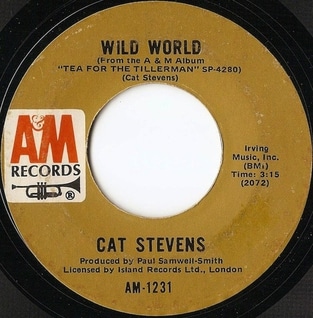
Original pressings of the Wild World single appeared on Island Records in the UK and A&M Records in the United States, and copies of both pressing are collected by fans of Cat Stevens and of the early 1970s singer-songwriter era.
The UK Island pressing with its distinctive label design is particularly sought after by collectors who prioritize the original release context, while the American A&M pressing is valued for its different sleeve design and for the mainstream market it targeted.
Original copies of Tea for the Tillerman on Island and A&M provide the full album context in which the song first appeared, and pressings in strong condition with original inner sleeves are increasingly sought after as the album’s status as a classic has grown.
Collectors also seek out the various cover versions that appeared on single format in different territories, particularly the Jimmy Cliff reggae version and Mr. Big’s 1992 hard rock recording, both of which have their own collector followings.
You Might Also Like
Jackson Browne’s debut single established the template for the introspective California singer-songwriter sound, a song about emotional exhaustion that connected with a generation trying to process the idealism and disillusionment of the late 1960s.
Joni Mitchell’s environmental protest song, written after seeing the paved paradise of Hawaii from her hotel window, became one of the most covered and quoted songs of the singer-songwriter era and a lasting piece of ecological commentary.
Neil Young’s only US number one hit combined the simplest possible lyric with a harmonica figure that became one of the most recognizable sounds in 1970s rock, a song about searching for authenticity that itself became the defining example of the thing it was looking for.
Frequently Asked Questions
What is the song about?
Wild World is a farewell addressed to a young woman leaving a relationship, combining genuine care and concern with the acknowledgment that the world outside is harder and less forgiving than the shelter of being loved. The song offers both warning and benediction, wishing her well while honestly acknowledging that the Wild World she is entering will not treat her gently.
Who wrote the song?
Wild World was written by Cat Stevens about his relationship with actress and model Patti D’Arbanville, during the period he was composing the songs that became Tea for the Tillerman. Stevens wrote the song with the directness that characterized his best work, trusting the lyric to communicate without elaboration.
Who produced the recording?
Wild World was produced by Paul Samwell-Smith, a former member of the Yardbirds who became one of the most sympathetic producers of the early 1970s singer-songwriter scene. Samwell-Smith’s instinct was to serve the song rather than impose a production identity on it, and Wild World benefits from that restraint throughout.
How did it chart?
Wild World reached number 8 in the UK and number 11 on the US Billboard Hot 100 in late 1970 and early 1971. The song also became a major hit in Jamaica through Jimmy Cliff’s reggae cover, and Mr. Big’s 1992 hard rock version reached number 3 on the US Hot 100, demonstrating the remarkable cross-genre appeal of the Wild World framework.
What album is the song from?
Wild World appears on Tea for the Tillerman, Cat Stevens’s fourth studio album, released in November 1970 on Island Records in the UK and A&M Records in the US. The album is widely considered his masterpiece and one of the defining records of the early 1970s singer-songwriter era.
Who was the song written about?
Wild World was written about Patti D’Arbanville, an American actress and model who was in a relationship with Cat Stevens during the period he composed Tea for the Tillerman. D’Arbanville later appeared in numerous films and television productions, and the Wild World lyric reflects Stevens’s genuine feeling for her and his concern for her wellbeing as the relationship ended.
What are the most notable covers?
The most notable covers of Wild World include Jimmy Cliff’s reggae version from 1970, which became a major Jamaican hit, and Mr. Big’s 1992 hard rock recording, which reached number 3 on the US Billboard Hot 100 and became the highest-charting version of the Wild World song in America. Numerous other artists have recorded the song across multiple decades and genres.
Why does the song endure as a classic?
Wild World endures because it captures a genuinely complex emotional experience, the combination of love, loss, and concern that marks the end of a relationship between two people who still care about each other, with a simplicity and honesty that makes it available to any listener who has been in that position. The melody is immediately accessible, the lyric is precise without being limiting, and the Wild World performance sounds as personal today as it did when Cat Stevens first recorded it.
Cat Stevens Wild World endures because it is true to something most people have felt but few have been able to express as cleanly: the particular love that survives the end of a relationship, that sends someone you care about into the world with nothing more than the hope that they will be careful and come through it well.