

Big Yellow Taxi by Joni Mitchell is one of the first and most enduring environmental songs in popular music, a track whose deceptively cheerful melody and pointed lyric introduced the idea of ecological loss to mainstream rock audiences in 1970 and has not lost a single degree of its relevance in the decades since.
Affiliate Disclosure: I am an Amazon affiliate and if you purchase through any amazon links on this site i may earn a small commission at no extra charge to you.
Written and self-produced by Mitchell during her stay at a hotel in Hawaii, Big Yellow Taxi was reportedly inspired by the view from her hotel window: beautiful Diamond Head in the distance, and a vast parking lot directly below.
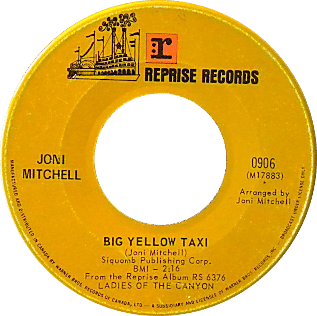
The song appeared on Mitchell’s third album Ladies of the Canyon in 1970 and was released as a single reaching #11 on the UK Singles Chart, introducing her work to a broader audience and demonstrating that serious environmental commentary could be delivered through a form as light and accessible as a pop song.
Big Yellow Taxi has since been covered by more than two hundred artists, from Amy Grant to Counting Crows, and the line “they paved paradise and put up a parking lot” has entered the cultural vocabulary as a shorthand for the destruction of natural beauty in the name of development, a phrase that has outlasted almost every other lyric of its era.
The recording remains one of the most compelling demonstrations of Mitchell’s ability to embed a serious political and ecological argument inside a song that sounds effortless, immediate, and impossible to get out of your head.
| Song Title | Big Yellow Taxi |
| Artist | Joni Mitchell |
| Album | Ladies of the Canyon (1970) |
| Released | 1970 |
| Written By | Joni Mitchell |
| Producer | Joni Mitchell |
| Label | Reprise Records |
| Chart Peak | #11 UK Singles Chart, #67 US Billboard Hot 100 |
What Is the Song About?
Big Yellow Taxi is a song about environmental destruction and the human tendency to recognise the value of what has been lost only after it is gone, delivered through a series of images that move from the general to the personal before landing on the private loss of the final verse.
The lyric progresses through several registers of ecological loss: the paving of paradise for a parking lot, the admission fee to see trees, the use of DDT on the orchard, and finally the departure of a “old man” in a big yellow taxi, combining public environmental commentary with a private romantic loss that gives the song its unexpected emotional weight.
Mitchell herself has said that the juxtaposition of the environmental observations with the personal loss in the final verse was deliberate, drawing a connection between humanity’s habit of destroying natural things and the individual’s habit of not appreciating what they have until it is gone.
The song’s emotional range, from ironic social commentary to genuine personal regret, is what gives Big Yellow Taxi its complexity, lifting it above the standard protest song format and explaining why it has spoken to listeners in so many different contexts for more than fifty years.
The Vibe: Genre, Mood, and Search Intent
The recording opens with Mitchell’s acoustic guitar and her voice in close-miked intimacy before the backing singers add the cheerful vocal harmony that creates the track’s characteristic tension between upbeat sound and sobering content.
The melody is one of Mitchell’s most immediately accessible, with a bouncy, almost playful quality that makes the lyric’s serious message land with greater force precisely because of the contrast.
- Genre: Folk Pop, Singer-Songwriter, Folk Rock
- Mood: Bright yet pointed, Bittersweet, Ironic
- Tempo: Upbeat folk pop (~134 BPM)
- Best For: Folk rock playlists, 1970s singer-songwriter collections, environmental music deep dives
- Similar To: Cat Stevens “Wild World”, Bob Dylan “Blowin’ in the Wind”
- Fans Also Search: Joni Mitchell Ladies of the Canyon, environmental protest songs, folk rock 1970s
Behind the Lyrics: The Song’s Story
Mitchell has described arriving at her hotel in Hawaii and experiencing the shock of seeing Diamond Head and the Pacific Ocean on one side and a vast hotel parking lot on the other, and the song grew directly from that moment of disorientation.
The parking lot that inspired the famous opening image was directly visible from her hotel room, and the collision of natural beauty and human development that it represented struck her as emblematic of a pattern she saw being repeated across North America.
According to the Wikipedia entry on Big Yellow Taxi, the DDT reference in the third verse addressed the contemporary controversy over pesticide use in agriculture, following the publication of Rachel Carson’s Silent Spring in 1962, making the lyric part of an emerging environmental discourse that would grow significantly through the 1970s.
The final verse’s shift from public ecological loss to private romantic loss, with the big yellow taxi taking away the narrator’s “old man,” was a late addition that Mitchell felt gave the song a personal anchor that the purely political verses lacked.
For listeners exploring the singer-songwriter tradition and its relationship to social commentary, the recording belongs alongside Bob Dylan’s protest songs and Pete Seeger‘s folk tradition as one of the recordings that demonstrated how personal voice and political content can reinforce rather than undermine each other.
Technical Corner: Gear and Production
Mitchell self-produced the recording at a time when female self-production in rock and pop was extremely rare, maintaining complete creative control over every aspect of the sound and ensuring that the finished track reflected her specific vision rather than an external producer’s interpretation of it.
The acoustic guitar tuning Mitchell uses throughout the track is one of her open tunings, giving the chord voicings an unusual resonance and allowing her to achieve harmonic complexity with a relatively simple physical approach to the instrument.
The backing vocals, provided by Mitchell herself in close harmony, were a deliberate choice to give the track a folksy, cheerful sound that contrasts with the lyric’s darker implications, and the production decision to place them prominently in the mix is central to the recording’s emotional strategy.
The close-miked intimacy of the recording gives it a direct, personal quality that suits the singer-songwriter format: the listener feels physically present with Mitchell as she delivers the lyric, and this proximity makes the observations in the words feel more personal and less rhetorical than they might in a more produced setting.
The brevity of the arrangement, just over two and a half minutes, is itself a production choice: the song delivers its message efficiently and leaves before it has outstayed its welcome, a discipline that many more elaborate recordings of the era lacked.
Legacy and Charts: Impact and Endurance
Big Yellow Taxi reached #11 on the UK Singles Chart on its original 1970 release and has since become one of the most covered songs in the history of folk and pop, with over two hundred recorded versions demonstrating the breadth of the song’s appeal across different musical contexts and generations.
The line “they paved paradise and put up a parking lot” has entered the cultural vocabulary independently of the song itself, appearing in environmental journalism, political speeches, and everyday conversation as a shorthand for the destruction of natural space in the name of commercial development.
Cover versions by Amy Grant (1995) and Counting Crows featuring Vanessa Carlton (2003) both reached higher chart positions than Mitchell’s original, demonstrating that each generation has found new reasons to connect with the song’s core message.
The track’s environmental message, which felt prescient in 1970, has only grown more relevant with time, and its ability to address issues that are now understood as central to the survival of the natural world through the form of a three-minute pop song remains one of the more remarkable achievements in the history of popular music.
It stands as one of the most enduring recordings of Joni Mitchell’s career and one of the most significant environmental songs ever written, a track whose deceptively cheerful surface conceals a depth of feeling and a sharpness of observation that have kept it relevant across more than five decades.
Listener’s Note: A Personal Take
The tension between the bright, bouncy melody and the pointed lyric is the recording’s central achievement and its most instructive quality: the song demonstrates that the most effective way to communicate an uncomfortable truth is sometimes to package it in something that people will want to listen to.
Mitchell’s vocal is the perfect vehicle for this strategy: warm, direct, and entirely without the hectoring quality that makes many environmental songs difficult to listen to more than once, she delivers even the most pointed observations with the ease of someone sharing an interesting observation rather than delivering a sermon.
The backing vocals give the track a communal quality that is politically significant: the environmental loss the song describes is not a personal problem but a shared one, and the presence of multiple voices acknowledges that fact without making it explicit.
The shift to the personal in the final verse is one of the most effective structural choices in the folk-pop tradition: by grounding the abstract political observations in a concrete personal loss, Mitchell makes the song’s emotional argument far more powerful than it would have been as pure commentary.
It is a recording that sounds simple and is extraordinarily sophisticated, that seems effortless and represents a very high level of craft, and that appears immediate while addressing concerns that have only deepened in significance since the day it was written.
Watch: The Official Music Video
Watch Joni Mitchell performing Big Yellow Taxi in this official video:
Collector’s Corner: Own a Piece of Rock History
Joni Mitchell: Ladies of the Canyon (1970)
Own the landmark album that contains one of the most enduring environmental songs in popular music alongside other Mitchell classics including “The Circle Game” and “Woodstock.”
Original Reprise Records pressings, remastered editions, and vinyl available.
Frequently Asked Questions
What inspired Big Yellow Taxi?
Joni Mitchell was inspired by the view from her hotel window in Hawaii, where she could see both the natural beauty of Diamond Head and a large hotel parking lot directly below. The contrast between the natural landscape and the commercial development struck her as emblematic of a pattern she saw across North America, and she wrote the song immediately from that experience.
What does the title mean?
The big yellow taxi in the final verse is the vehicle that takes away the narrator’s “old man,” shifting the song from public environmental commentary to private personal loss. The title connects the ecological theme with an individual experience of loss, suggesting that the human tendency to destroy natural things and the individual tendency to not appreciate what one has until it is gone are related impulses.
Who has covered Big Yellow Taxi?
Over two hundred artists have recorded versions of the song. Notable covers include Amy Grant’s 1995 version, which reached #6 in the UK, and the Counting Crows version featuring Vanessa Carlton in 2003, which reached #16 on the US Billboard Hot 100. The song’s accessibility and timeless message have made it attractive to artists across many different genres.
What is the DDT reference in the song?
The line about DDT in the orchard refers to the controversy over pesticide use in agriculture that followed Rachel Carson’s 1962 book Silent Spring. Carson’s work documented the environmental damage caused by DDT and other pesticides and helped launch the modern environmental movement. Mitchell’s reference placed the song within an emerging environmental discourse that was becoming mainstream in the early 1970s.
Who produced the recording?
Big Yellow Taxi was self-produced by Joni Mitchell, at a time when female self-production in popular music was extremely rare. Mitchell maintained complete creative control over the recording, including the decision to use her own voice for the backing harmonies and to record the guitar and vocal with close-miked intimacy.
What album is the song from?
Big Yellow Taxi is from Joni Mitchell’s third studio album Ladies of the Canyon, released on Reprise Records in 1970. The album also contains “The Circle Game,” “Woodstock,” and “For Free,” making it one of the most substantial collections of Mitchell’s early period and one of the landmark albums of the singer-songwriter tradition.
Why has the song remained relevant for over fifty years?
Big Yellow Taxi has remained relevant because the environmental concerns it addresses have grown more urgent rather than less so in the decades since its recording. The song’s core observation about the human tendency to destroy natural beauty for commercial development has been confirmed repeatedly by subsequent history, and the phrase “paved paradise and put up a parking lot” has become a cultural shorthand that operates independently of the song itself.
How did the track chart originally?
Joni Mitchell’s original 1970 version reached #11 on the UK Singles Chart and #67 on the US Billboard Hot 100. While the original recording did not achieve major chart success in the United States, subsequent cover versions reached significantly higher chart positions, and the song’s reputation has grown continuously since its original release.
You May Also Like
Cat Stevens: Wild World (1970)
A 1970 singer-songwriter classic from the same year, sharing the same acoustic folk approach, melodic directness, and the same ability to deliver an emotionally pointed message inside a deceptively accessible pop song.
John Lennon: Imagine (1971)
A classic recording from the following year that shares the same strategy of embedding a serious political and social message inside an immediately appealing musical form.
Neil Young: Heart of Gold (1972)
A singer-songwriter classic from the same early 1970s period, sharing the same acoustic folk sensibility, personal directness, and the same ability to achieve a complex emotional effect through a simple, unadorned arrangement.
More than fifty years after its creation, Big Yellow Taxi retains every degree of the melodic charm, lyric precision, and environmental urgency that made it one of the most enduring songs of 1970 and produced a phrase that has become part of the cultural vocabulary of anyone who has ever seen something beautiful replaced by something useful.