

Radar Love by Golden Earring is one of the most instantly recognizable hard rock recordings of the 1970s, a song built around an irresistible premise and a guitar riff that lodges itself in the memory from the first listen.
Affiliate Disclosure: I am an Amazon affiliate and if you purchase through any amazon links on this site i may earn a small commission at no extra charge to you.
Released in August 1973 and drawn from the band’s ninth studio album Moontan, Radar Love became the Dutch band’s first major international hit after nearly a decade of work in their home market.
The single climbed to number 13 on the US Billboard Hot 100, reached number 7 in the United Kingdom, and topped the chart in the Netherlands, where the band had long been established stars.
What separated this track from the hard rock singles of its era was its structural ambition: the album version runs to over six minutes and moves through several musically distinct sections, functioning more like a suite than a conventional song.
More than fifty years after its release, Radar Love is still in constant rotation on classic rock radio and is consistently ranked as the defining driving song in the genre.
| Song Title | Radar Love |
|---|---|
| Artist | Golden Earring |
| Album | Moontan (1973) |
| Released | August 1973 |
| Genre | Hard Rock, Progressive Rock |
| Label | Polydor (UK), Track/MCA (US) |
| Writers | George Kooymans, Barry Hay |
| Producer | Golden Earring |
| Peak Chart | #1 Netherlands, #5 Germany, #7 UK, #13 US Billboard Hot 100 |
- What Is the Song About?
- The Vibe: Genre, Mood, and Feel
- Behind the Lyrics
- How It Was Made: The Sound and Production
- Legacy and Charts: Impact and Endurance
- A Listener’s Note
- Watch the Official Video
- Collector’s Corner
- Frequently Asked Questions
What Is the Song About?
Radar Love centers on a psychic bond between two lovers who are physically separated, a connection that operates like a radio signal, invisible but constant.
The singer is behind the wheel late at night, feeling the pull of that bond grow stronger with every passing mile, sensing that his partner urgently needs him to come home.
He describes receiving ordinary radio broadcasts and news bulletins that belong to the wider world while the only signal that matters to him is operating on a different, unspoken frequency.
The urgency of the feeling builds through the song, pushing him to drive faster regardless of the physical dangers, trading caution for the need to close the distance.
The lyric references Brenda Lee’s “Coming On Strong” as a melody that floats up out of nowhere during the drive, one of those small details that grounds an otherwise abstract premise in the texture of a real night on a real road.
One interpretation of the ending is that the driver causes a fatal accident in his haste, and that the radar love connection survives even beyond that moment.
Whether the ending is read literally or metaphorically, the emotional center of the song holds either way: a connection between two people powerful enough to transcend the limits of ordinary communication.
The concept is simple and the execution is remarkable, which is exactly why the song has stayed in the popular imagination for decades without showing any sign of wearing out.
The Vibe: Genre, Mood, and Feel
Radar Love is a hard rock track constructed entirely around the sensation of forward motion, every element of the arrangement serving that single driving purpose.
The tempo is relentless from the opening notes to the final fadeout, never letting up, never offering a moment of rest that might break the spell of momentum.
The mood sits somewhere between cinematic and urgent, more focused than aggressive, with a quality of inevitable forward progress that gives it a slightly hypnotic effect over its full running time.
Listeners consistently describe a physical response to the song: the instinct to press down harder on a gas pedal, the sense of being carried forward by something larger than the individual instruments.
The brass section that enters during the chorus adds a warmth that lifts the track above straight hard rock, giving it a richer texture than the opening guitar riff alone would suggest.
The extended instrumental passages in the album version work as emotional escalation, building tension without resolving it until the final minutes, which is why the full-length cut is considered by most listeners to be the definitive version of the song.
For a band that had spent a decade working within the Dutch market, the sound here was internationally confident, a recording that did not sound like it came from any one country or scene.
That quality of placeless authority is part of what made the track connect so quickly with listeners in America, the UK, and Germany when the single was released internationally.
Behind the Lyrics
Radar Love was written by guitarist George Kooymans and vocalist Barry Hay, the creative core of Golden Earring throughout the band’s career.
Kooymans has spoken in interviews about how the concept of a telepathic bond between lovers gave the song its emotional center, an idea that was romantic in premise but grounded in the specific imagery of nighttime driving.
The imagery in Radar Love moves through radio transmissions, the passing lights of other cars, the loneliness of long-distance travel, and the almost desperate quality of connection maintained at a remove.
Barry Hay’s vocal performance is crucial to the song’s effect, carrying the right balance of urgency and control, suggesting a man who is fully aware of what he is doing and cannot bring himself to stop.
The reference to Brenda Lee’s song as a “forgotten tune” is a quietly effective lyrical touch, evoking the way music surfaces in the mind during long drives, unbidden and associative.
Kooymans has noted that the intro riff was partly inspired by the work of Carlos Santana, according to bassist Rinus Gerritsen, which helps explain the track’s simultaneously driving and hypnotic quality.
The lyric functions in two modes at once: as a story about a man driving and as a meditation on the experience of distance in a close relationship, the way absence can feel like a physical signal rather than merely an absence.
That double register is what gives the song its staying power, a surface simplicity that opens onto something more complicated the more closely you engage with the words.
How It Was Made: The Sound and Production
Radar Love is structured as a suite, moving through several distinct musical sections over its full album running time of six minutes and twenty-six seconds, though commercial single versions were edited to under four minutes.
The recording was made at Trident Studios in London in 1973, with Golden Earring producing the sessions themselves, a choice that gave the band complete creative control over the arrangements.
Bertus Borgers plays saxophone during the chorus sections, providing the brass texture that gives the track its cinematic sweep and contrasts with the hard rock foundation of the verse passages.
Eelco Gelling contributes slide guitar on the recording, adding a fluid, bluesy element to the track alongside the more aggressive rhythm guitar work from Kooymans.
Rinus Gerritsen’s bassline is widely cited as one of the most effective in rock history, a rolling, insistent figure that drives the song forward even in its quieter moments and gives the track its physical pull.
Cesar Zuiderwijk‘s drumming locks the arrangement together with a force that complements the bassline without overshadowing it, creating the sensation of machinery running at full power.
The production decision to sequence the track as a multi-section suite rather than a standard verse-chorus-verse structure was ambitious for a band releasing their first international single, and it paid off in creating something that demanded full attention rather than mere background listening.
The fact that Golden Earring chose to self-produce rather than bring in an outside producer reflects the confidence the band had developed from years of work in the Dutch market, and that confidence is audible throughout the recording.
Legacy and Charts: Impact and Endurance
Radar Love reached number 13 on the US Billboard Hot 100 when the single was released there in April 1974, representing the band’s first genuine commercial breakthrough in America after years of European success.
The single also reached number 7 in the United Kingdom, number 5 in Germany, number 10 in both Canada and Australia, and number 1 in the Netherlands, demonstrating an international reach that few European rock acts had achieved to that point.
Radar Love has been covered by a wide range of rock and metal artists over the decades, from White Lion’s 1989 version that charted in the US to countless other recordings that treated the song as a benchmark to be measured against.
The track regularly tops listener polls for the greatest driving song in rock history, a designation it has held for decades and shows no sign of relinquishing.
It was chosen as the best radio song by readers of the Washington Post in 2001 and ranked as the number one driving song in both Australia and Canada in separate polls conducted in 2005 and 2006.
The song’s use as the long-running theme for the Australian current affairs programme Four Corners brought it to a new audience in a different context, demonstrating the track’s versatility beyond its original function as a rock single.
Golden Earring continued performing the song as the centerpiece of their live sets for decades, and it became the recording by which the band will always be primarily known outside the Netherlands.
The staying power of the song comes not from nostalgia alone but from the fact that every element of the recording still functions exactly as intended: the groove still pulls, the riff still hooks, and the concept still resonates.
A Listener’s Note
First-time listeners often notice the bassline before anything else, the rolling, insistent figure that establishes the song’s mood within the first few bars and does not let go until the final note.
The album version rewards full attention in a way that the edited single cannot quite match: the extended instrumental passages allow the tension to build to a level that the shorter cut reaches only briefly.
What keeps the song in regular rotation after fifty years is how completely every element serves one emotional purpose, the feeling of being pulled toward something with no ability or desire to slow down.
That quality of total commitment is rare in a rock single and rarer still in a song that has survived as long as this one has without losing any of its original force.
Watch the Official Video
Watch Golden Earring performing the song in this official video:
Collector’s Corner
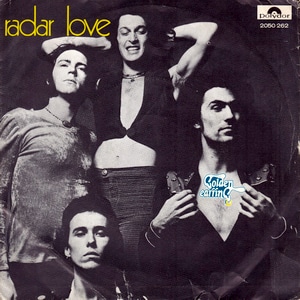
Original pressings of the Radar Love single came out on the Polydor label in the UK and on Track/MCA in the United States, with different B-sides for each territory: “Just Like Vince Taylor” for the UK and US markets, and “The Song Is Over” for some European pressings.
The original Dutch pressing from August 1973 predates the international releases by several months and is the earliest physical format of the song, sought after by collectors of both Golden Earring material and Dutch rock memorabilia.
The full album version on Moontan, running to six minutes and twenty-six seconds, is significantly longer than any of the commercial single edits and is widely considered the definitive listening experience for the track.
Original Moontan pressings on Polydor also carry value for collectors, as the album represents the high point of the band’s international ambitions and is the context in which the song was originally designed to be heard.
You Might Also Like
The Moody Blues create a sweeping orchestral meditation on longing and youth that became one of the most enduring ballads in rock history.
Kansas open their Leftoverture album with a hard-driving progressive rock anthem that has become a staple of classic rock programming for nearly fifty years.
Heart’s debut hit introduced Ann and Nancy Wilson to mainstream audiences with a song built on blues guitar and a vocal performance of remarkable power and range.
Frequently Asked Questions
What is Radar Love about?
Radar Love is about a man driving through the night, guided by a psychic bond with his partner who is waiting for him, a connection so powerful it pushes him to drive faster regardless of the risks involved in reaching her.
Who wrote Radar Love?
Radar Love was written by George Kooymans and Barry Hay of Golden Earring, who developed the concept of a telepathic bond between lovers as the song’s central premise.
What album is the song from?
The song appears on Moontan, the ninth studio album by Golden Earring, released in 1973 on Polydor in the UK and Track/MCA in the United States.
Where was the recording made?
The recording was made at Trident Studios in London in 1973, with Golden Earring producing the sessions themselves and maintaining full creative control over the arrangements.
How did Radar Love perform on the charts?
Radar Love reached number 13 on the US Billboard Hot 100, number 7 in the UK, number 5 in Germany, and number 1 in the Netherlands, becoming the band’s first genuine international hit after nearly ten years in the Dutch market.
Who produced the recording?
Radar Love was self-produced by Golden Earring, a decision that gave the band complete creative control and reflected the confidence they had built through years of work as a live and recording act in the Netherlands.
Why is the song considered the defining driving track in rock?
The relentless tempo, the driving bassline by Rinus Gerritsen, and the forward momentum of every element in the arrangement create a physical sensation of motion that has made the song the top choice in driving song polls in multiple countries for decades.
Has the song been covered by other artists?
Yes, many rock and metal artists have recorded their own versions of the track, among them White Lion, whose 1989 cover reached number 26 on the Billboard Hot 100, cementing Radar Love as one of the most covered tracks in the classic rock catalog.
Radar Love proves that the simplest concept, two people connected across distance by something beyond ordinary explanation, can become one of the most powerful recordings in rock history when the band behind it commits completely to making it real.