

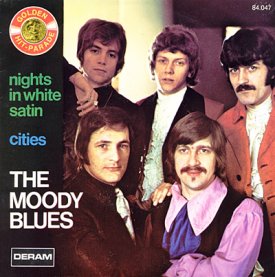
Nights in White Satin by The Moody Blues is one of the most enduring recordings in rock history, a track written by Justin Hayward at the age of nineteen that combined orchestral arrangement, mellotron, and a lyric of remarkable emotional maturity to create something that has outlasted almost every other recording of its era.
Affiliate Disclosure: I am an Amazon affiliate and if you purchase through any amazon links on this site i may earn a small commission at no extra charge to you.
Nights in White Satin appeared on the 1967 album Days of Future Passed, recorded with the London Festival Orchestra and produced by Tony Clarke, and it was the combination of the orchestral arrangement with Hayward’s vocal and Mike Pinder‘s mellotron that gave the recording its distinctive sound.
Originally released in 1967, the single reached only #19 on the UK Singles Chart before being withdrawn, but a reissue in 1972 brought it to #9 in the UK and #2 on the US Billboard Hot 100, demonstrating that the recording had an emotional resonance that transcended the moment of its original release.
The track is bookended by Graeme Edge‘s poem “Late Lament,” read by Mike Pinder, and the combination of the spoken word passages, orchestral strings, and Hayward’s vocal gives the recording a formal completeness that goes well beyond the standard pop single structure.
Nights in White Satin remains one of the most recognisable recordings in the history of psychedelic and symphonic rock, and its sustained presence on classic radio across six decades confirms its status as one of the truly timeless recordings of the late 1960s.
| Song Title | Nights in White Satin |
| Artist | The Moody Blues |
| Album | Days of Future Passed (1967) |
| Released | November 1967 (original), 1972 (reissue) |
| Written By | Justin Hayward |
| Producer | Tony Clarke |
| Label | Deram Records |
| Chart Peak | #2 US Billboard Hot 100 (1972), #9 UK Singles Chart (1972) |
What Is Nights in White Satin About?
The lyric is a young man’s meditation on unrequited love and emotional confusion, written by Hayward when he was nineteen and living in London, separated from a girlfriend and trying to articulate feelings he could not yet fully understand.
The central image of the “nights in white satin” refers to the letters he wrote but never sent, the private communications that express what direct conversation cannot, and the contrast between the physical beauty of the image and the emotional pain it represents is sustained throughout the lyric.
The poem “Late Lament” that brackets the track extends the song’s meditation into a more philosophical register, with Edge’s words addressing mortality and the search for meaning alongside the romantic pain of Hayward’s lyric.
The song’s emotional range, from personal romantic loss to something approaching a broader existential statement, is what gives it the depth that separates it from the love songs of its era and explains why it has continued to resonate with listeners across generations.
The Vibe: Genre, Mood, and Search Intent
The recording opens with Ray Thomas‘s flute and the mellotron string sounds before the full orchestral arrangement enters, and the combination of rock instruments with a full orchestra was genuinely novel at the time of recording.
Hayward’s vocal is delivered with a restraint and solemnity that suits the lyric’s reflective quality: there is no rock excess in his performance, only a sustained attention to the emotional content of each line.
- Genre: Psychedelic Rock, Symphonic Rock, Progressive Rock
- Mood: Melancholy, Reflective, Haunting
- Tempo: Slow ballad (~60 BPM)
- Best For: Classic rock playlists, late-night listening, 1960s rock deep dives
- Similar To: Yes “Close to the Edge”, Pink Floyd “Comfortably Numb”
- Fans Also Search: Justin Hayward vocals, Moody Blues Days of Future Passed, mellotron rock
Behind the Lyrics: Nights in White Satin Story
Hayward wrote the song in 1967 at the age of nineteen, during his first year with The Moody Blues after replacing Denny Laine, and the lyric reflects the emotional inexperience and romantic intensity of someone very young trying to make sense of powerful feelings.
The “nights in white satin” image came to him from the gift of satin sheets from a girlfriend, and the lyric developed from that domestic detail into something considerably more ambitious as he worked on it.
According to the Wikipedia entry on the recording, Hayward has said in interviews that the song was essentially finished on the day he wrote it, that it arrived as a complete thing rather than being assembled piece by piece over multiple writing sessions.
The decision to record Days of Future Passed with the London Festival Orchestra was made by Deram Records as a demonstration of their new Deramic Sound System stereo technology, and the orchestral arrangements by Peter Knight gave Hayward’s song a grandeur that the band alone could not have achieved.
For listeners exploring the intersection of rock and classical music in the late 1960s, this recording belongs alongside the Beatles’ Sgt. Pepper’s Lonely Hearts Club Band and the Velvet Underground’s debut as one of the recordings that expanded what popular music could attempt.
Technical Corner: Gear and Production
Mike Pinder’s mellotron playing is central to the recording’s character: the instrument, which uses pre-recorded tape loops to simulate orchestral sounds, gives the track its distinctive texture and bridges the gap between the rock band and the full orchestra that plays on the album.
The London Festival Orchestra’s arrangement by Peter Knight was recorded separately from the band tracks, a common practice of the era that required careful planning to ensure the two elements would work together in the final mix.
Tony Clarke’s production approach preserved the dynamic range of both the orchestral and rock elements, allowing the quiet moments to be genuinely quiet and the fuller sections to carry the weight they needed without compression destroying the contrast.
John Lodge‘s bass and Graeme Edge’s drumming provide the rhythmic foundation with a gentleness that matches the lyric’s reflective tone: this is not a track that needs aggressive rhythm playing, and the restraint of the rhythm section is one of its most important qualities.
The spoken word passages from Graeme Edge’s “Late Lament,” delivered by Mike Pinder over a minimal orchestral backing, were recorded with a close-miked intimacy that makes them feel like a private communication rather than a theatrical performance.
Legacy and Charts: Impact and Endurance
Nights in White Satin reached #2 on the US Billboard Hot 100 on its 1972 reissue, five years after its original recording, a timeline that itself tells a story about the relationship between commercial success and artistic quality.
The recording’s initial commercial failure in 1967 followed by its eventual worldwide success demonstrated that some recordings need time to find their audience, and that the combination of qualities it offers, emotional depth, melodic beauty, and sonic originality, are not always immediately recognisable as commercial assets.
The track has appeared on more “greatest songs of all time” lists than almost any other Moody Blues recording, and its regular use in film, television, and advertising contexts suggests that its combination of grandeur and intimacy continues to function effectively across many different emotional registers.
Hayward’s later career has kept the song in circulation through decades of live performance, and each new audience that encounters it discovers that a nineteen-year-old’s meditation on romantic confusion can speak to experiences far beyond its original context.
It stands as one of the most enduring recordings of the late 1960s, a track whose combination of youth, ambition, and genuine emotional intelligence has given it a life far longer than its commercial trajectory at the time of release could have predicted.
Listener’s Note: A Personal Take
The opening mellotron and flute passage creates an atmosphere in the first thirty seconds that the rest of the recording has to live up to, and remarkably, everything that follows meets that standard rather than diminishing it.
Hayward’s vocal has a quality of barely contained emotion throughout: you hear a young man struggling to find words adequate to feelings he has not yet fully processed, and the slight imperfection of that struggle is exactly what gives the performance its authenticity.
The orchestral arrangement is one of the most successful examples of rock and classical integration in the history of the genre: it neither overwhelms the song’s intimate character nor feels tacked on, but functions as a natural extension of the emotional content.
The “Late Lament” passages give the track a formal completeness that distinguishes it from the love songs around it: the shift from personal romantic pain to something more philosophical is not jarring but feels like a natural development of the emotional journey.
It is a recording that reveals its qualities differently at different ages: what sounds like romantic melancholy at seventeen becomes something more complex and resonant by forty, and that ability to grow with the listener is one of the rarest qualities a recording can have.
Watch: The Official Music Video
Watch The Moody Blues performing Nights in White Satin in this official video:
Collector’s Corner: Own a Piece of Rock History
The Moody Blues: Days of Future Passed (1967)
Own the landmark album that launched the symphonic rock genre and contains one of the most enduring recordings in rock history.
Original Deram Records pressings, remastered editions, and vinyl available.
Frequently Asked Questions
Who wrote Nights in White Satin?
Nights in White Satin was written by Justin Hayward at the age of nineteen, in 1967, during his first year as a member of The Moody Blues. Hayward has said the song was essentially written in a single session, arriving as a complete thing rather than being assembled over time.
What is the song about?
The lyric is about unrequited love and emotional confusion, written from the perspective of a young man separated from a girlfriend and struggling to articulate his feelings. The central image of the title refers to letters he wrote but never sent, and the poem “Late Lament” that frames the track extends the emotional range into more philosophical territory.
Why did the song succeed on reissue when it failed originally?
The original 1967 release reached only #19 in the UK before being withdrawn. By 1972, the band had built a substantial following through their later albums and extensive touring, and FM radio in the United States had created an audience receptive to longer, more atmospheric rock recordings. The 1972 reissue reached #2 in the US and #9 in the UK.
What is “Late Lament”?
“Late Lament” is a spoken word poem written by drummer Graeme Edge and read by Mike Pinder over a minimal orchestral backing. It brackets the main song, appearing both before and after Hayward’s vocal, and extends the emotional range of the recording from personal romantic loss into more philosophical territory about mortality and the search for meaning.
Who produced the recording?
The recording was produced by Tony Clarke, who worked with The Moody Blues throughout their most successful period. The orchestral arrangements were written by Peter Knight, who scored the London Festival Orchestra parts that appear throughout the album.
What is the mellotron?
The mellotron is a keyboard instrument that uses pre-recorded magnetic tape loops to simulate orchestral sounds, most notably strings, flutes, and choir. Mike Pinder’s mellotron playing is central to the character of the recording, bridging the gap between the rock band and the live orchestra and giving the track its distinctive atmospheric quality.
What album is the song from?
The track appears on The Moody Blues’ second studio album Days of Future Passed, released on Deram Records in November 1967. The album was conceived as a demonstration of Deram’s Deramic Sound System stereo technology and was recorded with the London Festival Orchestra, making it one of the first rock albums to feature a full classical orchestra.
Who are the members of The Moody Blues on the recording?
The recording features Justin Hayward on vocals and guitar, John Lodge on bass and vocals, Mike Pinder on mellotron and vocals, Ray Thomas on flute and vocals, and Graeme Edge on drums and vocals. The five-piece lineup is backed by the London Festival Orchestra throughout the album.
You May Also Like
The Moody Blues: Nights in White Satin (1967)
A pioneering fusion of rock and orchestration, this timeless track mirrors the atmospheric depth and experimental spirit found in “Moonchild,” highlighting how far artists were willing to push the boundaries of sound and emotion.
Yes: Roundabout (1971)
A British progressive rock classic that shares the same orchestral ambition, musical complexity, and commitment to taking rock beyond its pop origins.
John Lennon: Imagine (1971)
A classic recording from the same era that shares the same combination of melodic beauty, emotional directness, and the ability to speak to listeners across generations.
Nearly sixty years after its original recording, Nights in White Satin retains every degree of the emotional depth, orchestral grandeur, and melodic beauty that has made it one of the most enduring recordings in the history of symphonic rock, and a testament to what a nineteen-year-old songwriter can achieve when feeling and craft arrive together at the right moment.