

Day After Day by Badfinger is the most commercially successful single the band ever released and one of the finest pop rock recordings to come out of the Apple Records era.
Affiliate Disclosure: I am an Amazon affiliate and if you purchase through any amazon links on this site i may earn a small commission at no extra charge to you.
Released in November 1971 on Apple Records, Day After Day was written by Pete Ham and produced by George Harrison, who also played slide guitar on the recording alongside Ham.
The single peaked at number 4 on the US Billboard Hot 100 and reached number 10 in the United Kingdom, earning gold accreditation from the RIAA and becoming the only gold single Badfinger would ever receive.
What gave the recording its particular emotional resonance was the combination of Harrison’s quietly exceptional production, Ham’s yearning vocal delivery, and a slide guitar arrangement that elevated the song well beyond the standard pop of its era.
Day After Day endures as the recording that most fully captures what Badfinger could achieve at their best: a song of genuine feeling, economically constructed, with a melodic clarity that has kept it in the hearts of listeners for over fifty years.
| Song Title | Day After Day |
|---|---|
| Artist | Badfinger |
| Album | Straight Up (1971) |
| Released | November 10, 1971 (US), January 14, 1972 (UK) |
| Genre | Pop Rock, Power Pop |
| Label | Apple Records |
| Writer | Pete Ham |
| Producer | George Harrison |
| Peak Chart | #4 US Billboard Hot 100, #10 UK |
- What Is the Song About?
- The Vibe: Genre, Mood, and Feel
- Behind the Lyrics
- How It Was Made: The Sound and Production
- Legacy and Charts: Impact and Endurance
- A Listener’s Note
- Watch the Official Video
- Collector’s Corner
- Frequently Asked Questions
What Is the Song About?
The song is about the ache of longing for someone who is absent, a feeling sustained over time rather than expressed as a single dramatic outburst.
The singer describes waiting and wishing, the weight of ordinary days made heavier by the absence of the person who defines what those days are for.
Pete Ham’s lyric is direct and economical, working with plain language that most listeners can map onto their own experience of missing someone without effort.
The repetition in the title phrase itself acts as a structural and emotional device: each recurrence of the three words signals another day passing, another cycle of waiting, the accumulation of time as absence.
There is no drama in the lyric, no confrontation or resolution, just the patient and slightly painful observation of time moving forward without the desired person in it.
That restraint is part of what makes the song emotionally effective: it does not overstate its case, which means the feeling it describes comes through clearly rather than being diluted by excessive expression.
The universality of the theme has kept the song accessible to new listeners across generations, since the experience of longing for someone at a distance is one that does not become dated or culturally specific.
Pete Ham understood that simplicity in songwriting is not a limitation but a quality, and this song is the clearest demonstration of that understanding in the Badfinger catalog.
The Vibe: Genre, Mood, and Feel
The track sits in the tradition of the melodic pop ballad but carries enough rock weight in its guitar work and arrangement to keep it from sounding lightweight or overly polished.
The mood is wistful rather than despairing, carried forward by Ham’s warm tenor and the shimmer of George Harrison’s slide guitar, which gives the song a quality of gentle ache rather than active grief.
There is a spaciousness in the production that allows the song to breathe, the arrangement never crowding the listener, always leaving room for the emotional content to settle.
The tempo is unhurried, which reinforces the lyrical content: a song about days passing slowly would betray its own subject if it moved too quickly.
The combination of restraint and emotional directness gives the recording a quality of deep sincerity, the sense that every element, vocal, guitar, piano, rhythm section, is serving the same modest but genuine purpose.
George Harrison’s production approach here is closest to his work on his own All Things Must Pass, creating space and warmth around the central performance rather than filling the track with additional elements.
For listeners who came to Badfinger through their connection to the Beatles and Apple Records, this track offered the most direct sense of what the band could achieve on their own terms.
The song proved that Badfinger were not simply a Beatles satellite act but a band with their own emotional register, capable of producing something genuinely moving in their own right.
Behind the Lyrics
Day After Day was written by Pete Ham, Badfinger’s primary songwriter and the creative force behind much of the band’s best work.
Ham wrote with a facility for melody that placed him in the lineage of classic British pop songwriting, capable of constructing hooks that felt both immediate and durable.
The lyric for this track is among his most stripped-down work, relying on the repetition of the title phrase and a small number of direct images to carry the entire emotional weight of the song.
Ham’s songs were frequently compared to early Beatles work for their melodic clarity, and the comparison is most apt here, where the directness of the lyric and the simplicity of the structure recall the best of early-to-mid period Lennon-McCartney.
What separates Ham from a mere imitator is the quality of genuine feeling behind the lyric, the sense that the song was written from personal experience rather than constructed to fit a commercial formula.
Ham’s subsequent tragic death in 1975 gave this song and the rest of his catalog a particular poignancy, but even without that biographical context, the quality of the songwriting stands on its own terms.
The economy with which the lyric operates, saying exactly what it means and nothing more, is a mark of a songwriter who understood that the best songs do not explain themselves but simply present their feeling clearly.
Badfinger’s story is one of the sadder narratives in rock history, but this recording is a reminder of what the band had at their peak: a songwriter of genuine talent and a group capable of doing justice to his material.
How It Was Made: The Sound and Production
Day After Day was produced by George Harrison, who brought the same sonic sensibility to the recording that he had applied to his own solo debut All Things Must Pass the previous year.
The session was recorded on June 3, 1971, and Harrison’s instinct for giving a song the space it needs rather than filling every frequency is evident throughout the final recording.
Harrison plays slide guitar on the track, contributing the sustained, sighing lines that are the most immediately identifiable element of the arrangement, gliding above the rhythm track with a controlled expressiveness that perfectly matches the lyrical tone.
Leon Russell plays piano on the recording, adding a richness to the harmonic texture and providing a warm anchor beneath Harrison’s slide work and Ham’s rhythm guitar.
The rhythm section of Tom Evans on bass and Mike Gibbins on drums provides a steady, unobtrusive foundation that supports the melodic content without drawing attention to itself.
Joey Molland contributes additional guitar work, completing the Badfinger lineup on what became the most important recording of the band’s career.
Harrison’s production choice to let the slide guitar carry most of the sonic interest was the right call, giving the recording a distinctive sound while keeping the focus firmly on Ham’s vocal and the song’s central melody.
The clarity of the production reflects the relatively small number of elements used: this is not a dense or layered recording but a spare one, where each component can be heard distinctly and each has a specific purpose.
Legacy and Charts: Impact and Endurance
Day After Day reached number 4 on the US Billboard Hot 100 in early 1972, becoming Badfinger’s highest-charting single in America and the peak of the band’s commercial success.
The single also reached number 10 in the United Kingdom and earned gold certification from the RIAA, the only gold single the band would ever receive, marking it as the high point of their chart career.
The song’s success in America was significant for Apple Records as well, demonstrating that the label could develop acts beyond the Beatles themselves and that Badfinger’s consistent chart presence was not accidental.
George Harrison’s involvement as producer brought additional critical attention to the recording, and his slide guitar contribution was widely noted in contemporary reviews as the element that elevated the song above its competition.
The track has maintained a presence in classic pop and rock programming for decades, regularly cited in discussions of early-70s songwriting as an example of the melodic tradition at its most refined.
For younger listeners discovering Badfinger through streaming services, this remains the entry point, the recording that most fully represents what the band could do and why the loss of Pete Ham was so significant for rock music.
The song has appeared in film and television soundtracks on multiple occasions, each time introducing it to a new generation of listeners who then work backward through the band’s catalog.
Its durability is a function of its quality: a song built on a genuinely universal emotional experience, executed with care and skill by musicians who understood exactly what it needed.
A Listener’s Note
The slide guitar entrance in the opening bars is one of the most immediately affecting moments in early-1970s pop, a sound that communicates something tender and sad before the first word is sung.
First-time listeners are often struck by how quickly the song establishes its emotional tone, which is a function of how well every element works together from the first notes.
What keeps the recording compelling over repeated listening is the economy of the arrangement: nothing is wasted, nothing is missing, and every element serves the song’s central feeling without excess.
Leon Russell’s piano and Harrison’s slide guitar create a conversation between two melodic voices that the rest of the arrangement frames rather than competes with, and that restraint is what gives Day After Day its particular warmth.
Watch the Official Video
Watch Badfinger performing the song in this official video:
Collector’s Corner
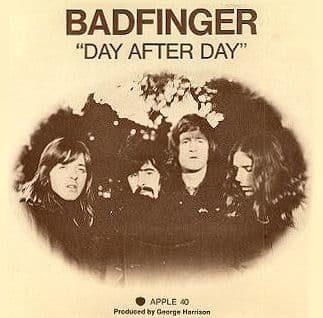
The original single was released on Apple Records as catalog number Apple 40 in the US, with “Money” as the B-side, and as a separate release in the UK with “Sweet Tuesday Morning” on the reverse.
Apple Records pressings from this period are consistently sought after by collectors of both Beatles-related material and early-70s British rock, and clean copies of the original Apple 40 single command genuine interest on the secondary market.
The song also appears on Straight Up, Badfinger’s third studio album, which was partly produced by Todd Rundgren as well as Harrison, and original pressings of that LP are valuable for collectors interested in the full context of this recording.
For streaming listeners, the Apple Records remaster is the recommended version, as it restores the warmth and clarity of the original recording that some earlier digital transfers compressed away.
You Might Also Like
Joni Mitchell channels environmental concern and personal loss into a song that has been covered by more than two hundred artists and put the phrase “paved paradise” into the cultural vocabulary.
Bachman-Turner Overdrive turn an accidental stutter vocal into a number one hit, one of the great lucky accidents in rock recording history and one of the most immediately recognizable songs of the 1970s.
Peter Frampton’s live recording from Frampton Comes Alive captures the talk box effect that made the song a defining moment in mid-70s rock and helped the album become one of the best-selling live records in history.
Frequently Asked Questions
What is Day After Day about?
Day After Day is about longing for someone who is absent, the slow accumulation of ordinary days made heavy by missing a person you want back in your life, expressed through a lyric of quiet restraint and genuine feeling.
Who wrote Day After Day?
Day After Day was written by Pete Ham, the lead vocalist and primary songwriter of Badfinger, who composed it with the plain directness and melodic clarity that characterize his best work.
Who produced the recording?
The recording was produced by George Harrison, who also played slide guitar on the track and brought the same spacious, warm production approach he had used on his own solo albums.
Who else played on the recording?
Leon Russell played piano on the recording, contributing warmth to the arrangement alongside George Harrison’s slide guitar, Pete Ham’s rhythm guitar and vocals, Tom Evans on bass, Mike Gibbins on drums, and Joey Molland on additional guitar.
What album is the song from?
The song appears on Straight Up, Badfinger’s third studio album, released in 1971 on Apple Records and produced partly by George Harrison and partly by Todd Rundgren.
How did Day After Day chart?
Day After Day reached number 4 on the US Billboard Hot 100, number 10 in the UK, and earned gold certification from the RIAA, making it the highest-charting and most commercially successful single of Badfinger’s career.
What label released the single?
The single was released on Apple Records, the label founded by The Beatles in 1968, where Badfinger were one of the most prominent non-Beatles acts and the band most directly identified with the label’s musical aesthetic.
Why does the song continue to resonate with listeners?
The combination of Pete Ham’s direct and honest lyric, George Harrison’s slide guitar, and the unhurried production creates a listening experience that feels genuinely felt rather than constructed, which is why the recording continues to connect with new audiences more than fifty years after its release.
This recording demonstrates what happens when a naturally gifted songwriter meets a producer with perfect sympathy for the material, and the result is a song that still sounds freshly felt more than fifty years after it was made.