
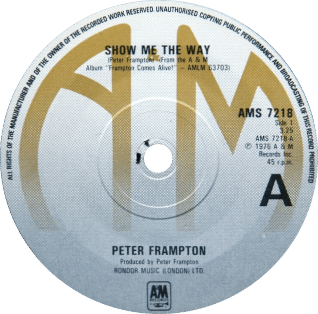
Show Me the Way by Peter Frampton is one of the defining live recordings of the mid-1970s, a track whose talk box guitar effect, soaring vocal, and emotional directness made it one of the most distinctive singles of 1976 and one of the best-known recordings on one of the best-selling live albums in rock history.
Affiliate Disclosure: I am an Amazon affiliate and if you purchase through any amazon links on this site i may earn a small commission at no extra charge to you.
Originally written for Frampton’s 1975 studio album Frampton, Show Me the Way found its commercial success when the live version recorded at Winterland Ballroom in San Francisco in June 1975 appeared on Frampton Comes Alive! in January 1976.
Produced by Frampton himself, the recording captures a performance in which the audience energy is audible throughout, and the call-and-response between Frampton’s talk box guitar and his vocal became the track’s most celebrated and widely imitated moment.
The single reached #6 on the US Billboard Hot 100 and helped drive Frampton Comes Alive! to sales of more than eight million copies in the United States alone, making it one of the best-selling live albums in rock history and confirming Frampton’s status as one of the era’s most compelling live performers.
Show Me the Way remains the recording that most listeners associate with Frampton’s peak period, and its combination of technical innovation, melodic strength, and the warm energy of a live audience has given it an endurance well beyond the era in which it was made.
| Song Title | Show Me the Way |
| Artist | Peter Frampton |
| Album | Frampton Comes Alive! (1976) |
| Released | January 1976 |
| Written By | Peter Frampton |
| Producer | Peter Frampton |
| Label | A&M Records |
| Chart Peak | #6 US Billboard Hot 100 |
What Is Show Me the Way About?
Show Me the Way is a song about longing for guidance and connection, written from the perspective of someone searching for both romantic certainty and a deeper sense of direction in life.
The lyric operates on two levels simultaneously: as a straightforward expression of romantic desire and as a broader spiritual appeal, with the narrator asking to be shown a path through uncertainty and confusion.
Frampton has described the writing process as intuitive and personal, and the song’s directness gives it the quality of an honest appeal rather than a crafted pop construction.
The ambiguity between the romantic and the spiritual readings is part of what gives the track its broad emotional appeal, allowing listeners to hear in it whatever combination of longing and hope suits their own experience.
The Vibe: Genre, Mood, and Search Intent
The recording opens with a clean electric guitar figure before Frampton’s vocal enters with the warmth and directness that characterise his best work, and the crowd’s audible presence gives the performance an immediacy that studio recordings rarely achieve.
The talk box passage that follows the first chorus is the moment that defines the recording’s sonic character: the instrument creates a vocal-like articulation from the guitar signal, and Frampton’s physical performance of the effect is as much theatre as technique.
- Genre: Classic Rock, Soft Rock, Blues Rock
- Mood: Warm, Searching, Emotionally Direct
- Tempo: Mid-tempo rock (~100 BPM)
- Best For: Classic rock playlists, 1970s rock collections, guitar effect enthusiasts
- Similar To: Rod Stewart “Maggie May”, Eagles “Desperado”
- Fans Also Search: Peter Frampton talk box, Frampton Comes Alive album, Winterland Ballroom concerts
Behind the Lyrics: The Song’s Story
Frampton wrote the song during a period of creative productivity that preceded the recording of the Frampton album, and the track was part of a set of songs that he had been developing through live performance before committing them to tape.
The studio version on Frampton (1975) is a competent recording, but it is the live version that gave the song its commercial life, demonstrating how much the track gained from the energy of an engaged audience and from Frampton’s ability to amplify the emotional content of a performance in front of a crowd.
According to the Wikipedia entry on the song, the talk box that Frampton used was a device through which the guitar signal was routed into his mouth via a plastic tube, allowing him to shape the sound using his lips and mouth cavity while the microphone picked up the resulting vocal-like tone.
The Winterland performance captured on Frampton Comes Alive! was recorded across several nights in June 1975, and the decision to release it as a live double album rather than produce a conventional studio follow-up proved to be one of the most commercially astute choices in mid-1970s rock.
For listeners exploring the live rock recordings of the 1970s, this performance belongs alongside Humble Pie‘s Performance: Rockin’ the Fillmore and Thin Lizzy‘s Live and Dangerous as one of the definitive documents of the era’s concert rock.
Technical Corner: Gear and Production
The talk box effect that defines the recording was created using a Heil Talk Box, a device that routes the guitar amplifier’s output through a plastic tube to the performer’s mouth, allowing the shape of the oral cavity to modulate the guitar tone in real time.
Frampton’s guitar of choice for the recording was a Gibson Les Paul Custom, whose warm, sustained tone works particularly well with the talk box by providing a clean, sustain-rich input signal for the effect to shape.
Bob Mayo‘s keyboard work adds texture and harmonic depth to the arrangement without competing with the guitar for sonic space, and Stanley Sheldon‘s bass playing provides a solid rhythmic foundation throughout.
The production decision to use an essentially unprocessed recording of the live performance, with crowd noise preserved and no significant studio overdubs, gives the final release an authenticity that is immediately audible.
Frampton produced the recording himself, maintaining the direct connection between the performances captured at Winterland and the sound that listeners heard on the finished album.
Legacy and Charts: Impact and Endurance
The single reached #6 on the US Billboard Hot 100 in early 1976 and was one of three top-ten US singles from Frampton Comes Alive!, an achievement that reflected the album’s extraordinary commercial reach and the depth of audience engagement with Frampton’s live performances.
The talk box technique that Show Me the Way brought to mainstream attention was subsequently adopted by artists including Joe Walsh, Jon Bon Jovi, and Roger Troutman, making it one of the more influential guitar effects demonstrations in rock history.
The recording has retained its place on classic rock radio across four decades, and its talk box passage remains one of the most recognisable guitar moments in popular music, instantly identifying both the technique and the artist.
The broader legacy of Frampton Comes Alive! as one of the best-selling live albums in rock history has kept the recording in cultural circulation in a way that few contemporary singles have sustained.
It stands as one of the defining recordings of the mid-1970s arena rock era and as the track that most completely captures what made Peter Frampton one of the most compelling live performers of his generation.
Listener’s Note: A Personal Take
The talk box passage is one of those moments in popular music where a technical innovation serves an emotional purpose rather than existing as a demonstration of skill for its own sake: the guitar literally appears to speak, and what it says is entirely in keeping with the lyric’s appeal for connection and understanding.
Frampton’s vocal throughout the recording is warm and committed without being overwrought, and the restraint he shows in the verses makes the more expansive moments in the chorus land with genuine impact.
The crowd’s presence throughout the recording is not a distraction but a participant: their responses shape the energy of the performance in real time, and you can hear Frampton responding to them as much as performing for them.
Bob Mayo’s keyboard fills and Stanley Sheldon’s bass work are models of ensemble playing in a live rock context: always present, always supportive, never overreaching their roles within the arrangement.
It is a recording that demonstrates something important about the difference between studio and live performance: the song itself is good, but the performance on the live album is great, and the difference is entirely in the energy that an audience creates.
Watch: The Official Music Video
Watch Peter Frampton performing the song in this official video:
Collector’s Corner: Own a Piece of Rock History
Peter Frampton: Frampton Comes Alive! (1976)
Own one of the best-selling live albums in rock history, the recording that made Peter Frampton one of the biggest rock stars of the mid-1970s.
Original A&M Records pressings, remastered editions, and vinyl available.
Frequently Asked Questions
What is Show Me the Way about?
Show Me the Way is a song about longing for romantic and spiritual guidance, written from the perspective of someone seeking direction and connection. The lyric works on both a romantic level and as a broader spiritual appeal, which gives it an emotional openness that has contributed to its lasting resonance with listeners.
Who wrote the song?
The song was written solely by Peter Frampton. He developed it as part of the material for his 1975 studio album Frampton, before the live version captured on Frampton Comes Alive! became the commercially successful recording that most listeners know.
What is the talk box effect?
The talk box routes the guitar amplifier’s output signal through a plastic tube to the performer’s mouth. By shaping the oral cavity while the microphone picks up the resulting sound, the performer can make the guitar appear to speak or sing. Frampton used a Heil Talk Box to create the distinctive vocal-guitar passages that define the recording.
Where was the live version recorded?
The live version was recorded at Winterland Ballroom in San Francisco across several nights in June 1975. The Winterland was one of the premier rock concert venues of the era, and the recordings captured there for Frampton Comes Alive! are considered among the best-sounding live rock recordings of the 1970s.
How did the track chart?
The single reached #6 on the US Billboard Hot 100 in early 1976. It was one of three top-ten US singles from Frampton Comes Alive!, which became one of the best-selling live albums in rock history with over eight million copies sold in the United States alone.
Who played on the recording?
The live recording features Peter Frampton on lead guitar, talk box, and vocals, Bob Mayo on keyboards and rhythm guitar, Stanley Sheldon on bass, and John Siomos on drums. Frampton produced the recording himself, choosing to present the performances with minimal studio processing.
Was the song on a studio album first?
Yes. The song first appeared on Frampton’s 1975 studio album Frampton before the live version became the widely known commercial success. The studio version is a solid recording, but it is the live capture on Frampton Comes Alive! that demonstrated how much the track gained from audience energy and live performance dynamics.
What guitar did Frampton use on the recording?
Frampton played a Gibson Les Paul Custom for much of the Frampton Comes Alive! recording sessions. The Les Paul’s warm, sustain-rich tone works well with the talk box effect by providing a clean, long-decay signal for the device to process into vocal-like articulations.
You May Also Like
Rod Stewart: Maggie May (1971)
A British rock classic built on a direct, autobiographical vocal performance and an acoustic folk arrangement, sharing the same commitment to emotional honesty over studio polish.
Joe Walsh: Rocky Mountain Way (1973)
A mid-1970s rock classic from a guitarist who also championed the talk box effect, sharing the same bluesy confidence and the same guitar-as-voice sensibility.
Heart: Magic Man (1976)
A 1976 rock classic from the same year, sharing the same era and the same ability to combine a powerful vocal performance with sophisticated guitar work in a live-energy arrangement.
Nearly fifty years after its release, this recording retains every degree of the live energy, technical originality, and emotional warmth that made it one of the most recognisable singles of 1976 and one of the defining tracks on one of rock history’s best-selling live albums.