

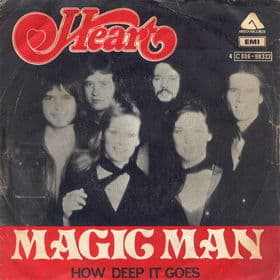
Magic Man by Heart is one of the most powerful debut singles in classic rock, a track whose hard-driving guitar riff, extended arrangement, and the extraordinary vocal performance of Ann Wilson announced Heart as one of the most formidable new rock bands of 1976.
Affiliate Disclosure: I am an Amazon affiliate and if you purchase through any amazon links on this site i may earn a small commission at no extra charge to you.
Written by Ann Wilson and Roger Fisher, the track was recorded at Can Base Studio in Vancouver, Canada, and produced by Mike Flicker for the debut album Dreamboat Annie.
Ann Wilson has described Magic Man as semi-autobiographical, written about her relationship with Mike Fisher, Roger’s older brother, and the lyric’s portrayal of a relationship with a charismatic older man carries the conviction of personal experience.
The single reached #9 on the US Billboard Hot 100 and helped establish Heart as one of the few female-fronted rock bands to achieve sustained mainstream success in an era dominated by male performers, making it one of the more significant rock singles of its decade.
Magic Man remains one of the most played tracks in Heart’s catalogue and a definitive recording of the mid-1970s hard rock era, its combination of blues guitar, Ann Wilson’s four-octave vocal range, and the track’s seven-minute album version standing as one of the more ambitious debut statements in rock history.
| Song Title | Magic Man |
| Artist | Heart |
| Album | Dreamboat Annie (1976) |
| Released | 1975 (Canada), 1976 (US) |
| Written By | Ann Wilson, Roger Fisher |
| Producer | Mike Flicker |
| Label | Mushroom Records (Canada), Portrait Records (US) |
| Chart Peak | #9 US Billboard Hot 100 |
What Is the Song About?
Magic Man is a song about a young woman’s involvement with a charismatic older man who seems to possess an almost supernatural hold over her, written from the perspective of someone who is aware that the relationship may not be what others would approve of but cannot resist it.
The lyric captures a specific kind of romantic powerlessness: the narrator’s mother warns her to “come on home,” but the Magic Man’s hold is stronger than family obligation or practical caution, and the song documents both the attraction and the awareness that the relationship has a cost.
Ann Wilson has confirmed that the Magic Man in the lyric was based on Mike Fisher, the older brother of guitarist Roger Fisher, with whom Ann was in a relationship during the period when the song was written.
The song’s emotional intelligence lies in its refusal to pass judgement on either the narrator or the Magic Man: the relationship is presented in all its complexity, with the narrator’s desire, her awareness of others’ disapproval, and her ultimate inability to leave all given equal weight.
The Vibe: Genre, Mood, and Search Intent
The recording opens with a clean, fingerpicked guitar introduction that gives no indication of the hard rock intensity that follows when the full band enters, a contrast between acoustic intimacy and electric power that became one of Heart’s signature approaches.
Nancy Wilson‘s acoustic guitar work throughout the track provides both textural contrast and rhythmic foundation, while Roger Fisher’s electric guitar delivers the blues-influenced riffs and fills that drive the arrangement forward.
- Genre: Hard Rock, Classic Rock, Blues Rock
- Mood: Powerful, Searching, Emotionally Intense
- Tempo: Mid-tempo hard rock (~112 BPM)
- Best For: Classic rock playlists, 1970s rock collections, female-fronted rock deep dives
- Similar To: Led Zeppelin “Whole Lotta Love”, Fleetwood Mac “The Chain”
- Fans Also Search: Ann Wilson vocals, Heart Dreamboat Annie album, Roger Fisher guitar
Behind the Lyrics: The Song’s Story
Ann and Nancy Wilson had relocated from Seattle to Vancouver, Canada, where they joined the existing Canadian band that would become Heart, and it was during this period that Ann’s relationship with Mike Fisher developed and provided the material for Magic Man.
The song’s long gestation through live performance before recording gave the arrangement its confidence and its sense of dynamic purpose: by the time the band recorded it, they knew exactly how each section should build and where the emotional peaks should fall.
According to the Wikipedia entry on the song, the lyric’s opening line “Cold late night so long ago” refers to a specific memory of Ann’s first encounter with Mike Fisher, and the autobiographical specificity of details throughout the lyric gives it a grounded emotional quality that more generic love songs cannot match.
Mike Flicker’s production approach was to capture the band’s live energy while giving the recording enough sonic refinement to work on radio, a balance that the finished track achieves with considerable skill across both its edited single and seven-minute album versions.
For listeners exploring the harder edge of mid-1970s rock, Magic Man belongs alongside Bad Company‘s debut recordings and Aerosmith‘s early work as one of the recordings that defined what blues-influenced hard rock could sound like when built around a vocalist of genuine power.
Technical Corner: Gear and Production
Roger Fisher’s guitar work on Magic Man draws directly from the blues rock tradition established by Jimmy Page and Eric Clapton, with riff-driven rhythm playing and melodic lead fills that serve the song’s emotional content rather than existing as technical showpieces.
Ann Wilson’s vocal performance required a microphone and signal chain capable of handling her extreme dynamic range, from the intimate conversational passages in the verses to the full-power delivery of the chorus, without distortion or loss of detail at either extreme.
Nancy Wilson’s acoustic guitar contributions are a crucial part of the arrangement’s character: her fingerpicking style, influenced by folk and classical technique, provides a textural contrast to Roger’s electric work that gives the track its acoustic-electric tension.
Mike Flicker’s production at Can Base Studio in Vancouver was technically accomplished for a band recording their debut, with a clean, detailed mix that gives each instrument its own space while maintaining the live ensemble feel that the performances required.
Steve Fossen‘s bass playing and Michael Derosier‘s drumming provide the rhythmic foundation with a solidity that gives Ann Wilson’s vocal performance the platform it needs.
Legacy and Charts: Impact and Endurance
The single reached #9 on the US Billboard Hot 100 in 1976, a landmark achievement for a female-fronted rock band in an era when such acts faced significant barriers to mainstream rock radio acceptance.
The track’s success helped open radio doors for Heart that had been largely closed to women-led hard rock bands, and the band’s subsequent career demonstrated that the audience for female-fronted rock was larger and more durable than the industry had assumed.
Ann Wilson’s vocal performance on the recording has been widely cited by critics and fellow musicians as one of the great debuts in rock, demonstrating a range and power that put her among the foremost rock vocalists of any era.
The song has remained a fixture on classic rock radio across five decades, and its combination of blues guitar, acoustic texture, and Ann Wilson’s extraordinary voice continues to sound as vital as it did on first release.
Magic Man stands as one of the defining recordings of 1976 and one of the most important debut singles in classic rock history, a track that announced a new kind of rock band and delivered fully on that announcement.
Listener’s Note: A Personal Take
The contrast between the acoustic opening and the moment when the full band enters is one of the most effective dynamic shifts in 1970s rock: the listener is lulled into an intimate folk-influenced mood before the electric guitar and rhythm section arrive with a force that makes the transition feel genuinely exciting rather than predictable.
Ann Wilson’s vocal is the centrepiece around which everything else is arranged, and the performance is one of those rare recordings where the singer’s ability to inhabit the lyric’s emotional content is completely convincing from the first note to the last.
Roger Fisher’s guitar solo mid-track is a model of blues-rock economy: every phrase contributes to the song’s emotional arc, and the restraint he shows in not overplaying makes the moments of intensity, when they come, land with appropriate force.
Nancy Wilson’s acoustic guitar work, particularly in the introduction and in the quieter passages between the hard rock sections, demonstrates an acoustic sensibility that gives Heart a dimension that most of their contemporaries lacked.
It is a record that sounds like a debut in the best possible sense: everything is committed, everything is fresh, and the band plays with the conviction of people who have been waiting for this moment and are determined to make the most of it.
Watch: The Official Music Video
Watch Heart performing Magic Man in this official video:
Collector’s Corner: Own a Piece of Rock History
Heart: Dreamboat Annie (1976)
Own the landmark debut album that introduced one of rock’s most powerful voices and launched one of the most enduring careers in classic rock.
Original Mushroom Records pressings, remastered editions, and vinyl available.
Frequently Asked Questions
Who is the Magic Man in the song?
The Magic Man in the lyric is based on Mike Fisher, the older brother of Heart guitarist Roger Fisher, with whom Ann Wilson was in a relationship when the song was written. Ann Wilson has confirmed the autobiographical basis of the lyric in several interviews.
Who wrote Magic Man?
Magic Man was written by Ann Wilson and Roger Fisher. The autobiographical lyric came from Ann Wilson’s personal experience, while Fisher contributed to the musical arrangement including the guitar work that drives the track.
What is the song about?
Magic Man is about a young woman’s relationship with a charismatic older man who has a powerful hold over her, despite warnings from her family. The lyric captures both the attraction and the awareness that the relationship has consequences, without passing judgement on either the narrator or the man she cannot leave.
How did the track chart?
The single reached #9 on the US Billboard Hot 100 in 1976. This was a significant achievement for a female-fronted hard rock band, as mainstream rock radio at the time gave very limited airtime to women-led acts in the genre, and the track’s success helped open doors for Heart’s subsequent career.
Who produced Magic Man?
The recording was produced by Mike Flicker at Can Base Studio in Vancouver, Canada. Flicker worked with Heart throughout the Dreamboat Annie sessions and his production approach balanced the band’s live rock energy with the sonic clarity needed for radio play.
What is significant about Ann Wilson’s vocal performance?
Ann Wilson’s vocal on Magic Man is widely regarded as one of the great debut rock performances, demonstrating a range and power comparable to the foremost rock vocalists of any era. The performance covers an enormous dynamic range, from intimate conversational verses to full-power chorus delivery, all with complete control and emotional commitment.
Is there a longer version of the song?
Yes. The album version of Magic Man on Dreamboat Annie runs approximately seven minutes and includes extended instrumental passages not present in the edited single version. The longer version is generally preferred by fans for its more complete development of the arrangement and for giving Roger Fisher’s guitar playing more room to develop.
What album is Magic Man from?
Magic Man is from Heart’s debut album Dreamboat Annie, released on Mushroom Records in Canada in 1975 and in the United States in 1976. The album reached #7 on the US Billboard 200 and established Heart as one of the most significant new rock acts of the mid-1970s.
You May Also Like
Peter Frampton: Show Me the Way (1976)
A 1976 rock classic from the same year, sharing the same era and the same commitment to a powerful vocal performance at the centre of a carefully crafted rock arrangement.
Free: All Right Now (1970)
A British hard rock landmark built around raw vocal power and blues-influenced guitar, sharing the same commitment to authenticity and emotional directness over studio polish.
Bad Company: Feel Like Makin’ Love (1975)
A mid-1970s hard rock classic from the same era, sharing the same blues-rock guitar approach and the same ability to combine raw power with melodic sophistication.
Nearly fifty years after its release, Magic Man retains every degree of the raw power, blues-rock authority, and vocal brilliance that made it one of the most commanding debut singles of 1976 and one of the recordings that most clearly demonstrated what Ann Wilson could achieve as a rock vocalist.