

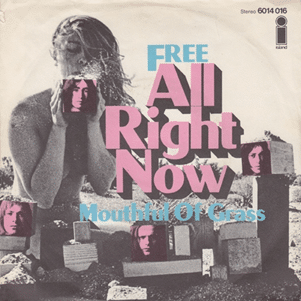
All Right Now by Free is one of the most enduring hard rock singles of 1970, a track whose guitar riff, blues-rooted swagger, and direct lyric have kept it on classic rock playlists for more than fifty years.
Affiliate Disclosure: I am an Amazon affiliate and if you purchase through any amazon links on this site i may earn a small commission at no extra charge to you.
Written by vocalist Paul Rodgers and bassist Andy Fraser in approximately ten minutes at Durham Students’ Union after a poorly received gig, the song appeared on the band’s third studio album Fire and Water, recorded at Trident and Island Studios in London in early 1970.
All Right Now reached #2 on the UK Singles Chart and #4 on the US Billboard Hot 100, becoming the band’s breakthrough international hit and one of the defining recordings of the era’s British hard rock movement.
Guitarist Paul Kossoff‘s pentatonic riff has been cited by countless guitarists as one of the great riff performances in rock history, and the recording’s self-produced directness gave it a presence that studio-polished contemporaries could not match.
The track has appeared in films, television programmes, and advertising campaigns across six decades, and its endurance on radio confirms a staying power that only a handful of 1970s singles have managed to sustain.
| Song Title | All Right Now |
| Artist | Free |
| Album | Fire and Water (1970) |
| Released | 15 May 1970 |
| Written By | Paul Rodgers, Andy Fraser |
| Producer | Free |
| Label | Island Records |
| Chart Peak | #2 UK Singles Chart, #4 US Billboard Hot 100 |
What Is the Song About?
All Right Now is a song about desire and the directness of attraction, its lyric written from the perspective of a man who spots a woman at a gig and pursues her with a confidence that is half-comic and entirely committed.
Rodgers has explained that the lyric was inspired by a real encounter: he saw an attractive woman at the Durham Students’ Union gig, tried to chat her up, and was firmly rejected.
Fraser helped shape the lyric into a narrative with a clear arc, and the result is a song that is simultaneously a story, a boast, and a self-deprecating joke at the narrator’s expense.
The frankness of the lyric was unusual for 1970, and the combination of its directness with Kossoff’s guitar riff gave the recording a kind of compressed sexuality that was new in British rock at the time.
The Vibe: Genre, Mood, and Search Intent
All Right Now opens with one of the most immediately identifiable guitar figures in rock history: Kossoff’s riff is pentatonic, economical, and completely self-assured, announcing the song’s character in two bars.
The production, handled by the band themselves, captures a rawness and live energy that distinguishes the recording from the more polished contemporary British releases.
- Genre: Hard Rock, Blues Rock, Classic Rock
- Mood: Confident, Driving, Celebratory
- Tempo: Mid-tempo rock (~122 BPM)
- Best For: Hard rock playlists, 1970 rock collections, classic rock driving mixes
- Similar To: Led Zeppelin “Whole Lotta Love”, Rolling Stones “Honky Tonk Women”
- Fans Also Search: Free discography, Paul Rodgers, Paul Kossoff guitar, Fire and Water album
Behind the Lyrics: The Song’s Story
Free had been struggling on the live circuit in early 1970, and the band needed a song with more immediate impact to close their sets effectively.
According to drummer Simon Kirke, the composition could not have taken more than ten minutes, with Rodgers and Fraser developing the verse, chorus, and bridge structure in rapid succession backstage at Durham.
According to the Wikipedia entry on All Right Now, the song was written specifically to give the set a stronger finale, and its immediate effect on audiences at subsequent gigs confirmed it had achieved exactly that purpose.
The song was recorded during the sessions for Fire and Water, produced by the band themselves with engineer Robin Black at Trident Studios, and the self-production gave the recording a directness and authority that a conventional producer might have smoothed away.
For listeners exploring the harder end of 1970 British rock, this track stands alongside Led Zeppelin’s work and the Rolling Stones’ late-1960s recordings as one of the defining performances of the era.
Technical Corner: Gear and Production
Kossoff played through a Gibson Les Paul into a Marshall amplifier, and the combination of his natural vibrato and the warm overdrive of the Marshall stack created the distinctive tone that defines the recording’s guitar character.
Fraser’s bass playing is a masterclass in supportive but inventive accompaniment: he locks in with Kirke’s drumming to create a rhythmic platform that is simultaneously stable and propulsive.
The band’s decision to produce themselves was both a practical and an artistic one: they were young, confident in their sound, and the sessions at Trident and Island Studios gave them the technical environment to capture the live energy they had developed on tour.
The recording’s relatively sparse arrangement was a deliberate aesthetic choice: there are no keyboards, no overdubs beyond the guitar solo, and the four-piece band sound gives the track a clarity that amplifies its impact.
Rodgers’ vocal performance is one of the great British rock vocal deliveries of the era: his voice at twenty years old had a maturity and grain that belied his age, and the casual authority of his delivery matches the lyric’s confidence exactly.
Legacy and Charts: Impact and Endurance
All Right Now reached #2 on the UK Singles Chart in June 1970 and #4 on the US Billboard Hot 100 later that year, establishing Free as a major international act almost overnight.
The Fire and Water album reached #2 on the UK Albums Chart and #17 on the US Billboard 200, demonstrating that the band’s appeal extended well beyond the single.
The track’s placement in numerous films and television programmes across the following decades kept it in active cultural circulation long after the band’s dissolution in 1973, and its regular use in advertising confirmed its status as a sound universally associated with rock confidence and energy.
VH1’s multiple lists of the greatest classic rock songs have consistently included the track among the most important recordings of the early 1970s, acknowledging the combination of Kossoff’s riff, Rodgers’ vocal, and Fraser’s lyric as a near-perfect alignment of talent.
It stands as one of the great recordings of 1970 and one of the most enduring singles of the decade that followed.
Listener’s Note: A Personal Take
There is a particular quality to the guitar riff that makes it impossible to hear without immediately understanding what kind of band Free were: confident, economical, and completely committed to the idea that rock and roll does not need ornamentation to communicate power.
Rodgers’ vocal is the perfect complement to the guitar: there is no distance between the singer and the material, no irony, no performance of cool, just a completely inhabited delivery that makes the lyric’s directness entirely convincing.
The recording’s self-produced rawness is one of its greatest strengths: it sounds like four musicians who know exactly what they want and have the technical command to get it without anyone telling them to do it differently.
Kossoff’s guitar playing throughout the recording, and particularly in the solo, is a reminder of what was lost when he died in 1976 at twenty-five: a player of extraordinary natural gift who gave this track a guitar performance that has not dated by a single second.
It is a record that demands volume and rewards attention, and anyone who has heard it loud in the right context will understand immediately why it has been on rock radio for more than fifty years without losing any of its momentum or force.
Watch: The Official Music Video
Watch Free performing the song in this official video:
Collector’s Corner: Own a Piece of Rock History
Free: Fire and Water (1970)
Own the breakthrough album that contains one of rock history’s most celebrated guitar riffs.
Original Island Records pressings, remastered editions, and vinyl available.
Frequently Asked Questions
Who wrote All Right Now?
All Right Now was written by Paul Rodgers and Andy Fraser in approximately ten minutes backstage at Durham Students’ Union in early 1970, after the band had played a poorly received gig and needed a stronger set-closer.
What is All Right Now about?
The song is about desire and the directness of attraction, written from the perspective of a man who spots an attractive woman at a gig and pursues her, only to be initially rebuffed. The lyric was inspired by a real encounter that Paul Rodgers had at the Durham gig where it was written.
How did All Right Now chart?
The single reached #2 on the UK Singles Chart in June 1970 and #4 on the US Billboard Hot 100, making it Free’s highest-charting recording in both countries and establishing them as a major international act.
How long did it take to write All Right Now?
According to drummer Simon Kirke, the song could not have taken more than ten minutes to write. Paul Rodgers and Andy Fraser developed the verse, chorus, and bridge backstage at Durham Students’ Union immediately after a gig that had gone poorly.
Who played the guitar riff on All Right Now?
Paul Kossoff played the guitar riff, using a Gibson Les Paul through a Marshall amplifier. Kossoff’s natural vibrato and his instinctive understanding of pentatonic blues phrasing gave the riff a character that has made it one of the most recognisable in rock history.
Was the recording self-produced?
Yes. Free produced the recording themselves at Trident and Island Studios in London, with engineer Robin Black. The decision to self-produce gave the track a rawness and directness that a conventional producer might have polished away.
What happened to Paul Kossoff after this recording?
Paul Kossoff continued with Free through their break-up in 1973 and then formed Back Street Crawler. He struggled with health problems related to drug use throughout the early 1970s and died on March 19, 1976, aged twenty-five, from heart failure during a flight from Los Angeles to New York.
Which album is the song from?
The song is from Free’s third studio album, Fire and Water, released on Island Records on 26 June 1970. The album reached #2 on the UK Albums Chart and #17 on the US Billboard 200.
You May Also Like
Mountain: Mississippi Queen (1970)
A fellow 1970 hard rock landmark built on one of the era’s great guitar riffs, sharing the same blues-rooted power and the same year of release.
Foghat: Slow Ride (1975)
A mid-1970s American hard rock track that shares the same economy of means and the same absolute confidence in the power of guitar, rhythm, and a committed vocal.
Deep Purple: Smoke on the Water (1972)
A British hard rock landmark from two years later that shares the same commitment to guitar power and the same enduring status on classic rock radio.
More than fifty years on, this recording retains every degree of the confidence and force that made it a worldwide hit in 1970, and it sounds as direct and powerful today as it did the first time anyone heard it.