

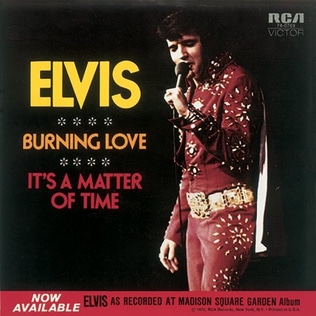
Burning Love by Elvis Presley is the last great pop chart performance of his career, a 1972 recording that reached #2 on the US Billboard Hot 100 and demonstrated that Presley’s voice and stage instincts remained fully intact even as his health began to deteriorate.
Affiliate Disclosure: I am an Amazon affiliate and if you purchase through any amazon links on this site i may earn a small commission at no extra charge to you.
Written by Dennis Linde and produced by Felton Jarvis, the recording was made on March 28, 1972 at RCA Studio C in Hollywood, with overdubs added on April 27, 1972 at RCA Studio B in Nashville.
Burning Love reached #2 on the US Billboard Hot 100 in September 1972, making it Elvis’s fortieth and final top ten hit on the chart, and it also reached #7 on the UK Singles Chart, demonstrating his continued international commercial appeal.
The recording featured the TCB Band with guitarist James Burton, pianist Glen D. Hardin, bassist Jerry Scheff, drummer Ronnie Tutt, and backing vocals by J.D. Sumner and the Stamps, one of the great studio ensembles of early 1970s popular music.
Despite Elvis’s initial reluctance to record the song, the resulting performance contained an unscripted vocal improvisation — the “hunka hunka” phrase — that became one of the most recognisable moments in his entire catalogue.
| Song Title | Burning Love |
| Artist | Elvis Presley |
| Album | Burning Love and Hits from His Movies, Vol. 2 (1972) |
| Released | 1 August 1972 |
| Written By | Dennis Linde |
| Producer | Felton Jarvis |
| Label | RCA Victor |
| Chart Peak | #2 US Billboard Hot 100, #7 UK Singles Chart |
What Is the Song About?
Burning Love is a song about the physical intensity of desire, its lyric deploying an extended metaphor of heat and fire to describe a kind of attraction that is beyond rational control.
Dennis Linde wrote the song with a directness that was typical of his approach to songwriting: the imagery is unambiguous, the emotion is immediate, and the lyric makes no attempt to intellectualise what it is describing.
Elvis had originally been reluctant to record the song, feeling it was not well suited to the romantic ballad style that had characterised his most successful recordings of the late 1960s.
His friends and colleagues persuaded him to attempt it, and the resulting session produced a performance that was more energised and committed than much of his early 1970s output, largely because of the unscripted “hunka hunka” ad-lib that he added spontaneously during the recording.
The Vibe: Genre, Mood, and Search Intent
Burning Love opens with a guitar figure that immediately establishes the song’s character: urgent, driving, and unambiguous in its energy.
The production by Felton Jarvis captures the TCB Band at their tightest, with James Burton’s guitar work providing a rhythmic and melodic foundation that Elvis’s vocal navigates with the ease of a performer who has been working with these musicians for years.
- Genre: Rock, Pop Rock, Classic Rock
- Mood: Urgent, Passionate, Driving
- Tempo: Fast (~174 BPM)
- Best For: 1970s rock playlists, Elvis collections, classic rock radio
- Similar To: T. Rex “Bang a Gong (Get It On)”, Rod Stewart “Maggie May”
- Fans Also Search: Elvis Presley discography, TCB Band, Dennis Linde songwriter
Behind the Lyrics: The Song’s Story
Dennis Linde had originally recorded a version of Burning Love himself, and Elvis’s manager Colonel Tom Parker had recommended it to Felton Jarvis as a potential vehicle for Presley’s next single.
Elvis’s reluctance was genuine: he had been most comfortable with the gospel-influenced ballads and romantic material that had characterised his late-1960s recordings, and the direct rock energy of the song was a departure from his recent preferred style.
According to the Wikipedia entry on Burning Love, Elvis’s friend Jerry Schilling recalled that Presley did not hate the song but was simply not in the mood for it, and that it was the encouragement of colleagues that pushed him to commit to the recording.
The session at RCA Studio C on March 28, 1972 produced a performance in six takes, and the “hunka hunka” improvisation in the final take was retained because it was clearly the vocal moment that defined the recording’s character.
For listeners exploring the more energised end of Elvis’s 1970s output, this track stands apart from the Las Vegas ballad style that dominated much of his work in the period as a reminder of what he could do when pushed toward harder material.
Technical Corner: Gear and Production
Felton Jarvis had been working with Elvis since 1966, and his production approach was built around capturing the singer’s best vocal performance rather than imposing a predetermined sonic concept on the recording.
James Burton’s guitar work on the track is characteristically efficient and inventive: his rhythm playing provides the song’s energetic pulse, and his instinctive understanding of what Presley’s vocal required made him one of the most valuable members of the TCB Band.
The overdubs added at RCA Studio B in Nashville on April 27, 1972 allowed Jarvis to refine the track’s sonic character, building on the live session energy of the Hollywood recording while adding the textural elements that gave the finished single its commercial polish.
Glen D. Hardin’s piano playing and Ronnie Tutt’s drumming create a rhythmic foundation that is exactly right for the material: tight, fast, and entirely in service of the vocal rather than competing with it.
The J.D. Sumner and Stamps backing vocals give the track a gospel-tinged energy that connects it to Elvis’s deeper musical roots, reminding listeners that even in a more secular hard rock context, that gospel grounding remained fundamental to his sound.
Legacy and Charts: Impact and Endurance
Burning Love reached #2 on the US Billboard Hot 100 in September 1972, held off the top position by Michael Jackson’s “Ben,” and became Elvis’s fortieth and final top ten hit on the chart.
The UK chart performance of #7 confirmed that his commercial appeal remained strong internationally, and the recording’s energy and commitment distinguished it from the more formulaic material that had dominated his early 1970s output.
The track’s continued presence on classic rock and oldies radio has made it one of the most recognisable Elvis recordings of the decade, regularly cited alongside “Suspicious Minds” as one of the defining singles of his later career.
Its use in the 1972 concert film Elvis on Tour gave the song a visual context that amplified its impact, and subsequent live recordings have confirmed that it remained one of the highlights of his concert performances in the final years of his life.
It stands as both a great pop single and a recording that demonstrates the full scope of what Elvis could achieve when presented with the right material and the right production environment.
Listener’s Note: A Personal Take
There is something both exhilarating and melancholy about this recording: hearing the full force of that voice applied to the right material in 1972, knowing what came after, makes the performance feel like a demonstration of resources that were only briefly and partially deployed in the years that remained.
The “hunka hunka” improvisation is one of those moments in popular music where an unscripted instinct produces something so right that it becomes definitional: it is impossible to imagine the recording without it.
Felton Jarvis’s production is among his best work for Elvis: tight, fast, and completely focused on delivering the vocal rather than surrounding it with unnecessary ornamentation.
James Burton’s guitar playing throughout is a reminder of why he was the ideal guitarist for this particular singer: his approach is economical, inventive, and always in service of the vocal rather than competing with it.
It is a record that makes you wish Elvis had pushed more consistently toward this kind of energised material in the early 1970s, and that makes the handful of recordings where he did stand out all the more clearly for their rarity.
Watch: The Official Music Video
Watch Elvis Presley perform the song in this official video:
Collector’s Corner: Own a Piece of Rock History
Elvis Presley: Burning Love and Hits from His Movies, Vol. 2 (1972)
Own the album that contains Elvis’s last great pop chart performance.
Original RCA Victor pressings, remastered editions, and compilation appearances available.
Frequently Asked Questions
Who wrote Burning Love?
Burning Love was written by Dennis Linde, an American singer-songwriter who recorded his own version of the song before it was presented to Elvis Presley. Linde later wrote “Goodbye Earl” for the Dixie Chicks, but this remains his most celebrated composition.
What is the song about?
The song is about the physical intensity of desire, using an extended metaphor of heat and fire to describe a kind of attraction that is overwhelming and beyond rational control. The lyric is direct and unambiguous, written with the economy typical of Dennis Linde’s best work.
How did Burning Love chart?
Burning Love reached #2 on the US Billboard Hot 100 in September 1972, making it Elvis’s fortieth and final top ten hit on the chart. It also reached #7 on the UK Singles Chart and #1 on the US Cash Box chart.
Why was Elvis reluctant to record Burning Love?
Elvis felt that the song’s direct rock energy was not well suited to the romantic ballad style that had characterised his most successful recent recordings. His friend Jerry Schilling later recalled that Elvis did not dislike the song but simply was not in the mood for it during the sessions, and that colleagues encouraged him to proceed.
Was Burning Love Elvis’s last major hit?
Yes. Burning Love was Elvis Presley’s fortieth and final top ten hit on the US Billboard Hot 100. While he continued to release singles and record albums until his death in August 1977, none of them matched the commercial impact of this recording on the mainstream pop chart.
What is the “hunka hunka” phrase in the song?
The phrase “burning love, I’m just a hunk, a hunk of burning love” was an improvisation added by Elvis during the recording session. It was not in Dennis Linde’s original version of the song, and it became one of the most recognisable vocal moments in Presley’s entire catalogue.
Who are the TCB Band that played on Burning Love?
The TCB Band was Elvis’s regular touring and recording ensemble from 1969. On this recording the key members were James Burton (guitar), Glen D. Hardin (piano), Jerry Scheff (bass), and Ronnie Tutt (drums), with backing vocals from J.D. Sumner and the Stamps.
Where was Burning Love recorded?
The basic track was recorded on March 28, 1972 at RCA Studio C in Hollywood, California. Overdubs were added on April 27, 1972 at RCA Studio B in Nashville, Tennessee. The recording was produced by Felton Jarvis.
You May Also Like
T. Rex: Bang a Gong (Get It On) (1971)
A 1971 glam rock landmark from the same era, sharing the same driving energy and the same confidence in the power of a great vocal performance over a propulsive rock backing.
Rod Stewart: Maggie May (1971)
A 1971 rock classic from the same year that shares the same raw vocal commitment and the same ability to communicate genuine emotion through an apparently simple rock arrangement.
Gary Wright: Dream Weaver (1975)
A 1975 pop rock classic from the same era that shares the same polished production approach and the same commitment to a strong, distinctive vocal performance at the centre of the arrangement.
More than fifty years after its release, this recording stands as proof that Elvis Presley at his best was a vocalist and performer of the very highest order, and that when the right material and the right studio environment came together, the results were irreplaceable.