

Rocky Mountain Way by Joe Walsh is the recording that established him as a major solo voice in rock, a blues-rock statement built around layered guitars and the innovative use of a talk box effect that had never been heard so prominently in a rock context.
Affiliate Disclosure: I am an Amazon affiliate and if you purchase through any amazon links on this site i may earn a small commission at no extra charge to you.
Released in 1973 from his second solo album The Smoker You Drink, The Player You Get, Rocky Mountain Way peaked at number 23 on the US Billboard Hot 100 while achieving far greater cultural impact through album-oriented rock radio.
The song was co-written by all four members of Walsh’s band Barnstorm and produced by Walsh alongside Bill Szymczyk, who had previously worked with the Eagles and became one of the defining producers of the AOR era.
The talk box guitar passages that Walsh developed for this recording gave the track an immediately distinctive sound that no one had used as a primary feature in a rock song before, and that sound became one of the most recognizable in 1970s rock.
Rocky Mountain Way became a cornerstone of classic rock programming and is still widely cited as the recording that most fully demonstrates Walsh’s creative identity as a solo artist before his years with the Eagles.
| Song Title | Rocky Mountain Way |
|---|---|
| Artist | Joe Walsh |
| Album | The Smoker You Drink, The Player You Get (1973) |
| Released | 1973 |
| Genre | Blues Rock |
| Label | ABC-Dunhill |
| Writers | Joe Walsh, Joe Vitale, Kenny Passarelli, Rocke Grace |
| Producer | Joe Walsh, Bill Szymczyk |
| Peak Chart | #23 US Billboard Hot 100 |
- What Is the Song About?
- The Vibe: Genre, Mood, and Feel
- Behind the Lyrics
- How It Was Made: The Sound and Production
- Legacy and Charts: Impact and Endurance
- A Listener’s Note
- Watch the Official Video
- Collector’s Corner
- Frequently Asked Questions
What Is the Song About?
Rocky Mountain Way is about Walsh’s deliberate decision to leave the James Gang at the height of their commercial run and start over in Colorado, trading one kind of career for another.
He had relocated to the mountains after walking away from the band, a choice that felt risky from the outside but that Walsh has consistently described as the right decision for both his music and his state of mind.
The lyric frames the Colorado lifestyle as superior to what had come before, not in terms of commercial success but in terms of creative freedom and the quality of the music he was making.
There is a specific anecdote behind the words: Walsh has described looking up from mowing his lawn in Colorado, seeing snow on the Rocky Mountains in summer, and feeling the entire idea of the song arrive at once.
The simplest summary of the lyric is that a man chose his path, found it better than the one he left, and is saying so without apology or qualification.
That directness and confidence carry through into the music, which has the sound of someone who does not need external validation for the choices he has made.
The Colorado setting functions as more than a backdrop: it represents a specific quality of life that Walsh was actively choosing over the demands and compromises of being in a commercially successful band.
For listeners who know that Walsh eventually joined the Eagles, the song takes on an additional dimension: a statement of artistic independence made just before he chose to collaborate within one of the biggest commercial enterprises in rock history.
The Vibe: Genre, Mood, and Feel
The track is a blues-rock recording with a swagger that makes it feel considerably more substantial than its three-and-a-half minute single runtime would suggest.
The mood is self-assured rather than aggressive, a recording that knows precisely what it is and does not need to prove anything to the listener.
The talk box guitar tone gives the track a quality that is simultaneously futuristic and rooted in blues tradition, a combination that should not work as well as it does but creates something entirely original.
Walsh’s guitar playing throughout the track has the quality of absolute authority, the product of a musician who has been working toward this specific sound for years and has finally found the right context for it.
The rhythm section, featuring Joe Vitale on drums and Kenny Passarelli on bass, provides a locked-in foundation that allows Walsh’s guitar work to operate above it without anything shifting underneath.
Listeners respond to the confidence of the performance, the sense that every element has been placed where it belongs and that there is nothing to add or subtract from the arrangement.
The production gives the track a physical presence, a quality of air and space around the instruments that makes it feel like a live performance captured rather than a studio construction.
For a song that was the statement of a musician stepping out on his own, it sounds remarkably complete, more like the work of a fully formed artist than someone still finding his identity outside a previous band.
Behind the Lyrics
The song was written by all four members of Barnstorm: Walsh, Joe Vitale, Kenny Passarelli, and Rocke Grace, though Walsh has described the lyrical concept coming to him personally during the lawn-mowing moment in Colorado.
Walsh has varied his account of where the recording was made, sometimes citing the moment of inspiration at his Colorado home and sometimes describing the development of the track at Caribou Ranch Recording Studio during the album sessions.
The key lyrical statement, that the Colorado way of life is better than what he had before, is direct enough to need no interpretation, but it rewards attention: “had” rather than “left” or “abandoned” suggests possession rather than obligation, a life he owned but chose not to keep.
The verses surrounding that central line describe the specifics of mountain living, the sense of space and clarity that Walsh found there, without sentimentalizing the experience.
What makes the lyric effective is that it does not try to convince anyone of anything: it simply states what Walsh found and invites listeners to take the observation at face value, without making any broader argument about how other people should live.
The connection between the lyrical content and the musical confidence of the performance is complete: a man who has found the right place to be sounds exactly like what this recording sounds like.
The writing credit shared among all four band members reflects the collaborative nature of Barnstorm as a working group, though the personal dimension of the lyric suggests that the emotional center of the song was always Walsh’s own.
The song also functions as a document of a specific moment in rock history: the post-band solo album as artistic declaration, a tradition that Walsh entered with more clarity of purpose than most of his contemporaries.
How It Was Made: The Sound and Production
Rocky Mountain Way was produced by Walsh and Bill Szymczyk, with sessions at Criteria Studio and Caribou Ranch Recording Studio in Colorado contributing to the final recording.
Szymczyk has described the process in Jake Brown’s book Behind the Boards II: Walsh started with a blues-shuffle instrumental, stripped it back to drums alone at Caribou, and then rebuilt the arrangement from the ground up, adding layers until the track had the density and focus he was looking for.
Walsh layered approximately six to seven guitar tracks on the recording, playing through a small amplifier with a single Shure SM57 microphone aimed at it, building the thick guitar sound through accumulated performances rather than studio processing.
Szymczyk has noted that the thick, heavy guitar sound came entirely from Walsh’s playing and technique rather than from any studio trickery, a point that speaks to the level of craft Walsh had developed by this stage in his career.
The talk box effect was produced using a device manufactured by audio engineer Bob Heil, allowing Walsh to route guitar tone through a tube into his mouth and shape the sound with his vocal tract, creating the vocal-like quality that defines the solo passages.
This technique had existed before Walsh used it, but bringing it to the foreground of a major rock recording was his innovation, and the sound became one of the most distinctive in 1970s guitar rock as a result.
The album version runs to five minutes and seventeen seconds, giving room for the talk box solo passage to develop fully; the single edit at three minutes and thirty-nine seconds captures the essential elements while cutting the extended outro.
The production reflects Szymczyk’s philosophy of capturing performance rather than constructing it in post-production, an approach that gives the recording the live energy that makes it feel physically present rather than merely sonically interesting.
Legacy and Charts: Impact and Endurance
Rocky Mountain Way reached number 23 on the US Billboard Hot 100 in 1973, a modest chart position that significantly understated its actual cultural impact within the album-oriented rock format.
The song became a staple of AOR radio programming and has remained in regular rotation on classic rock stations for decades, outlasting many singles from the same period that charted much higher but did not sustain long-term interest.
Walsh joined the Eagles in 1975, bringing the guitar sensibility he had developed in Barnstorm to one of the best-selling rock acts in history, but he continued performing this track as part of both his solo sets and Eagles concerts.
The talk box effect on the recording influenced a generation of rock guitarists, establishing the device as a legitimate creative tool in rock rather than a novelty, and the sound Walsh developed here can be heard in subsequent recordings by Peter Frampton, Aerosmith, and others.
The song’s use as the title track of Walsh’s 1985 compilation album confirmed its status as the recording by which his pre-Eagles work is most commonly known and assessed.
For listeners discovering Walsh through the Eagles catalog, this recording serves as the most direct introduction to the artist he was before joining that band, and the confidence audible throughout helps explain why Glenn Frey and Don Henley wanted him in the group.
The track has also appeared in television and film contexts over the years, each time reintroducing it to a generation of listeners who may not have encountered it through radio.
Its durability on classic rock radio is a function of its quality: a recording that sounds completely achieved from the first listen and continues to reward repeat plays with details that did not register initially.
A Listener’s Note
The talk box passage is the moment most listeners point to as the defining element of the recording, the sound that makes the song immediately identifiable within the first few seconds of hearing it.
Walsh’s guitar work elsewhere in Rocky Mountain Way is equally impressive but less immediately striking, the mark of a musician who can subordinate his more conventional technique to serve the overall character of the recording.
What keeps the song in regular rotation is the combination of technical innovation and personal conviction, a track that is as much about a life decision as it is about a guitar sound.
The two qualities reinforce each other: the confidence in the Rocky Mountain Way performance matches the confidence of a man who has decided where he belongs and is no longer interested in pretending otherwise.
Watch the Official Video
Watch Joe Walsh performing the song in this official audio video:
Collector’s Corner
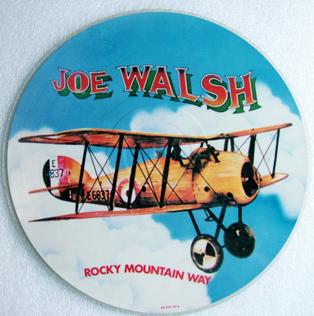
Original pressings of the single were released on the ABC-Dunhill label in 1973, with “(Day Dream) Prayer” as the B-side, and are collectible as part of the documented history of both Walsh’s solo career and the ABC-Dunhill catalog from this period.
The album version from The Smoker You Drink, The Player You Get runs to five minutes and seventeen seconds, significantly longer than the single edit, and is the version most classic rock listeners know from radio play and album-oriented programming.
Original pressings of the album on ABC-Dunhill carry interest for collectors of both Walsh’s catalog and early-70s AOR rock, as the record marks a specific transitional moment in American rock before the commercial consolidation of the mid-to-late-1970s.
Listeners who know Walsh primarily through the Eagles are often surprised by how fully realized his solo voice was on this album, which makes original pressings worth seeking out for the full context they provide.
You Might Also Like
Dire Straits introduce Mark Knopfler’s fingerpicked guitar style and a vivid portrait of a jazz band playing to an empty room, a debut single that announced one of the most distinctive guitar voices of the era.
The Cars fuse new wave cool with power pop hooks in a debut single sung by bassist Benjamin Orr, a track that helped define the sound of late-70s American rock radio.
Rod Stewart’s breakthrough hit tells the story of a young man’s entanglement with an older woman, a song built on acoustic guitar and mandolin that changed his career overnight and produced one of rock’s most enduring opening riffs.
Frequently Asked Questions
What is Rocky Mountain Way about?
Rocky Mountain Way is about Joe Walsh’s decision to leave the James Gang and relocate to Colorado, a choice he frames as an improvement over his previous life, with the mountains and the music he was making there representing a freer and more honest way of working.
Who wrote Rocky Mountain Way?
Rocky Mountain Way was written by all four members of Walsh’s band Barnstorm: Joe Walsh, Joe Vitale, Kenny Passarelli, and Rocke Grace, with the lyrical concept originating from a personal moment Walsh experienced while living in Colorado.
What is the talk box guitar effect?
The talk box routes guitar tone through a tube connected to the musician’s mouth, allowing the shape of the vocal tract to modify the guitar sound and create a voice-like quality, as heard prominently in the solo passages of this recording where Walsh’s guitar appears to be speaking.
Who produced the recording?
The track was produced by Joe Walsh and Bill Szymczyk, who worked at Criteria Studio and Caribou Ranch Recording Studio, building the arrangement from a stripped-down drum foundation upward and capturing Walsh’s layered guitar work through a relatively simple recording setup.
What album is the song from?
The song appears on The Smoker You Drink, The Player You Get, Joe Walsh’s second solo studio album, released in 1973 on ABC-Dunhill, and is the most commercially successful and widely heard track from that record.
How did Rocky Mountain Way chart?
Rocky Mountain Way reached number 23 on the US Billboard Hot 100 in 1973, a chart position that understated its impact: the song became a cornerstone of album-oriented rock radio and has remained in regular rotation on classic rock stations for over fifty years.
Did Joe Walsh join the Eagles after this album?
Yes, Walsh joined the Eagles in 1975, bringing the guitar sensibility he had developed in his Barnstorm period to one of the most commercially successful rock bands of the decade, and he continued performing this track as part of his live set throughout his Eagles years and beyond.
Why does the song endure on classic rock radio?
The song combines an immediately distinctive guitar sound with a lyric that captures a genuinely felt life decision, and the combination gives the recording a character that does not diminish with familiarity: fifty years of airplay have made it more embedded in the listener’s experience rather than less interesting.
Rocky Mountain Way shows what a musician can accomplish when personal conviction and technical mastery arrive at the same point simultaneously, producing a recording that sounds like someone who has finally figured out exactly who they are.