

Love Hurts by Nazareth is the recording that transformed a song written for the Everly Brothers in 1960 into one of the most powerful rock ballads of the 1970s, a performance so definitive that it is now the version most people mean when they say the title.
Affiliate Disclosure: I am an Amazon affiliate and if you purchase through any amazon links on this site i may earn a small commission at no extra charge to you.
Released as a single in November 1974 and included on the album Hair of the Dog, Love Hurts became the only version of the song to become a hit in the United States, reaching number 8 on the Billboard Hot 100 in early 1976.
The single topped the charts in Norway, Canada, the Netherlands, Belgium, and South Africa, with the Norwegian performance particularly extraordinary: it charted for 61 weeks and spent 14 weeks at number 1, making it the best-selling single of all time in that country.
What Nazareth brought to the song was a reading that amplified its emotional content without drowning it in sentiment, finding the hard rock ballad that was always present in the lyric but had never been fully realized in any earlier recording.
Love Hurts remains one of the defining power ballads of its era and the recording that cemented Nazareth’s international reputation after years of building a following through relentless touring.
| Song Title | Love Hurts |
|---|---|
| Artist | Nazareth |
| Album | Hair of the Dog (1975) |
| Released | November 8, 1974 |
| Genre | Hard Rock, Power Ballad, AOR |
| Label | Mooncrest (UK), A&M (US/Canada) |
| Writer | Boudleaux Bryant |
| Producer | Manny Charlton |
| Peak Chart | #8 US Billboard Hot 100, #1 Norway, #1 Canada |
- What Is the Song About?
- The Vibe: Genre, Mood, and Feel
- Behind the Lyrics
- How It Was Made: The Sound and Production
- Legacy and Charts: Impact and Endurance
- A Listener’s Note
- Watch the Official Video
- Collector’s Corner
- Frequently Asked Questions
What Is the Song About?
Love Hurts is a song about the pain that is inseparable from loving someone, the way emotional vulnerability inevitably leads to being wounded, regardless of intention or effort.
The lyric does not tell a specific story but rather states a universal truth directly: that love is not a source of comfort or safety alone but something that carries an equal capacity for damage.
The central metaphor in the song, love compared to something that burns when it is hot, is simple and physical, grounding the emotional content in a concrete sensation.
Dan McCafferty’s vocal interpretation gives the lyric a rawness that Boudleaux Bryant may not have fully anticipated when he wrote the song for the Everly Brothers, transforming a country-pop reflection into something that sounds wrung from direct personal experience.
The song functions as a confession and an acknowledgment simultaneously, admitting that knowing this does not make you any less likely to seek it or suffer from it.
What Love Hurts captures so effectively is the paradox at the center of romantic feeling: the things that hurt most are the things you cannot stop wanting.
The Nazareth version extends the emotional range of the original recording, making space around the lyric through the arrangement so that the words have room to land with their full weight.
For listeners who have experienced loss or heartbreak, the song functions less like entertainment and more like recognition, which is why it has connected across generations and cultures far removed from Scotland in the 1970s.
The Vibe: Genre, Mood, and Feel
Love Hurts sits at the intersection of hard rock and the power ballad, a genre that Nazareth helped define with this recording even before the term became standard industry vocabulary.
The mood is one of controlled devastation: not theatrical despair but something quieter and more genuine, the sound of someone stating a painful truth without melodrama.
The arrangement builds from a relatively restrained opening into a fuller sound by the end, reflecting the lyric’s movement from observation to something more like resignation.
Dan McCafferty‘s voice is the emotional center of the recording, a raw, slightly roughened instrument that suits the lyrical content perfectly, suggesting someone who has earned what they are saying through actual experience.
The guitar work by Manny Charlton provides warmth and texture without overplaying, a quality of restraint that keeps the focus firmly on the vocal.
The overall effect is immersive, a song that draws the listener in and holds them there, which is why it remained on the Norwegian charts for over a year without showing any sign of the audience tiring of it.
The pacing of the recording is deliberate, never rushing toward resolution but allowing the emotional weight of the lyric to accumulate naturally through the arrangement.
For listeners coming to it for the first time, the most immediate impression is often the quality of McCafferty’s vocal: it sounds lived-in in a way that is impossible to fake.
Behind the Lyrics
Love Hurts was written by Boudleaux Bryant, one of the most prolific and successful songwriters in American popular music, who wrote it originally for the Everly Brothers in 1960.
The Everly Brothers recorded the song but were never able to release it as a single due to a business dispute with their manager and publisher, and it appeared only as an album track on A Date with the Everly Brothers.
Roy Orbison covered the song in 1961 as a B-side, and Gram Parsons recorded it in harmony with Emmylou Harris for his posthumously released album Grievous Angel in 1974.
When Nazareth chose the song, they transformed Bryant’s original country-pop sensibility into something harder and more emotionally raw, bringing the lyric into a rock context where its direct statement of painful truth could resonate with a wider and younger audience.
The specific change Nazareth made to the lyric was to substitute “flame” for “stove” in the central metaphor, a small adjustment that gives the image a more archetypal quality: flames are more immediately associated with both passion and destruction than a kitchen appliance.
McCafferty’s delivery makes the lyric sound personal rather than general, as though the specific words were written for his specific voice and experience, which is part of the reason the recording feels so authentic.
The economy of the lyric is one of its strengths: Love Hurts says everything it needs to say within its three-and-a-half minutes and does not overstay its welcome.
Bryant’s gift was for writing lyrics that were simple enough to be universally understood and genuine enough to be emotionally affecting, and this song is one of the clearest demonstrations of that quality in his catalog.
How It Was Made: The Sound and Production
Love Hurts was produced by Manny Charlton, who was also the band’s guitarist, a dual role that gave him a particular understanding of how to shape the recording around McCafferty’s vocal performance.
Charlton’s production approach was to serve the song rather than impose a style on it, allowing the arrangement to develop from the emotional requirements of the lyric rather than from any predetermined formula.
The recording features Pete Agnew on bass and Darrell Sweet on drums, the rhythm section that underpinned all of Nazareth’s work through their most commercially successful period.
The guitar arrangement is more subdued than on many Nazareth recordings, reflecting the decision to present the song as a ballad rather than as a hard rock track, a choice that proved commercially and artistically correct.
The US single version at three minutes and three seconds is slightly shorter than the standard international version at three minutes and fifty-three seconds, though both capture the essential emotional arc of the performance.
The production does not attempt to conceal the rawness in McCafferty’s voice but rather foregrounds it, treating the imperfections and roughness of his delivery as attributes rather than problems to be corrected.
The result is a recording that sounds less like a polished studio product and more like a document of a genuine performance, which is the quality that has given it its lasting appeal.
Charlton understood that the song’s power came from its emotional directness, and the production serves that directness without decoration or distraction.
Legacy and Charts: Impact and Endurance
Love Hurts reached number 8 on the US Billboard Hot 100 in early 1976, becoming the only version of the song to chart in America and confirming Nazareth’s status as a genuine international act.
The single topped the charts in Norway, Canada, the Netherlands, Belgium, and South Africa, with the Norwegian performance exceptional by any measure: 61 weeks on the chart with 14 weeks at number 1, a record that still stands as the best-selling single in Norwegian chart history.
The UK chart position was more modest, but the song gained traction there through the “Hot Tracks” EP in 1977, reaching number 15 and introducing it to a British audience that would come to know it through classic rock radio.
The recording’s endurance has been remarkable: it appears in films, television programmes, and advertising regularly, each new context introducing it to an audience that had not heard it before.
Nazareth’s version effectively retired all previous interpretations of the song in the popular consciousness, making it their definitive recording and the one by which the band is most commonly remembered outside their Scottish homeland.
The song influenced the development of the power ballad as a genre, demonstrating that hard rock bands could achieve commercial success and emotional resonance by stripping back the aggression of their regular sound.
Many rock acts that came after Nazareth, from bands across the AOR spectrum to the glam metal artists of the 1980s, were influenced by the template this recording established.
The song continues to appear in concert setlists globally, performed by the band for audiences who may have first heard it decades ago and by new listeners encountering it for the first time.
A Listener’s Note
First-time listeners are often struck by how immediately McCafferty’s vocal communicates genuine feeling, a quality that is difficult to describe technically but impossible to miss experientially.
The song rewards repeated listening because the arrangement reveals more with familiarity: the restraint of the guitar work, the careful pacing of the rhythm section, and the way the arrangement builds without ever overreaching.
What keeps the recording in rotation after fifty years is the combination of an honest lyric and a performance that gives it complete conviction, the sense that the band understood exactly what the song was asking of them.
For listeners who have not heard the original Everly Brothers or Roy Orbison versions, encountering this recording first makes it almost impossible to imagine the song in any other form.
Watch the Official Video
Watch Nazareth performing Love Hurts in this official video:
Collector’s Corner
Original pressings of the Love Hurts single appeared on Mooncrest in the UK, on Vertigo for European markets, and on A&M in the United States and Canada, with different B-sides in each territory.
The US pressing with “Hair of the Dog” as the B-side is particularly sought after by collectors, as that combination places two of Nazareth’s most celebrated recordings on a single piece of vinyl.
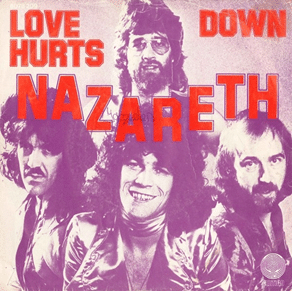
The Netherlands single sleeve, showing a distinctive graphic design, is among the most collectible physical formats of the recording for international Nazareth collectors.
Original pressings of Hair of the Dog on A&M, the album on which Love Hurts appeared, are also valued collector items and provide the full context in which the single was originally released.
You Might Also Like
Heart’s debut hit delivered a vocal performance of remarkable range from Ann Wilson and established the band as one of the most powerful hard rock acts of the mid-1970s.
Kansas open Leftoverture with a progressive rock anthem that has become one of the most enduring hard rock recordings of the decade, built on stacked harmonies and a riff of unusual intelligence.
Peter Frampton’s live recording from Frampton Comes Alive introduced the talk box guitar effect to millions of listeners and became one of the best-selling live albums in rock history.
Frequently Asked Questions
What is Love Hurts about?
Love Hurts is about the pain that is inherent in loving someone, the way emotional openness inevitably leads to vulnerability and damage regardless of how much you want the opposite to be true.
Who wrote Love Hurts?
Love Hurts was written by Boudleaux Bryant, the American songwriter who co-wrote numerous hits for the Everly Brothers and other artists throughout the 1950s and 1960s, and who composed this song for the Everlys in 1960.
Who originally recorded the song?
The Everly Brothers were the first to record the song in July 1960, though they were unable to release it as a single at the time due to a business dispute with their manager, and it appeared only as an album track before Nazareth’s version made it famous worldwide.
Who produced the Nazareth version?
Love Hurts was produced by Manny Charlton, who was also Nazareth’s lead guitarist, a dual role that gave him an intimate understanding of how to shape the recording around Dan McCafferty’s vocal performance.
How did Love Hurts perform on the charts?
Love Hurts reached number 8 on the US Billboard Hot 100 in early 1976, topped the charts in Norway for 14 weeks across a 61-week chart run, and also reached number 1 in Canada, the Netherlands, Belgium, and South Africa.
What album is Love Hurts from?
Love Hurts appears on Hair of the Dog, Nazareth’s sixth studio album, released in 1975 on A&M Records in the United States and on Mooncrest in the United Kingdom.
What change did Nazareth make to the original lyric?
Nazareth changed the line “love is like a stove, it burns you when it’s hot” to “love is like a flame, it burns you when it’s hot,” a small substitution that gives the central metaphor a more archetypal and less domestic quality.
Why does Love Hurts endure as a classic rock staple?
Love Hurts endures because it addresses one of the most universal human experiences with complete emotional honesty, and Dan McCafferty’s vocal performance gives the lyric a credibility that makes it impossible to dismiss as mere sentiment.
Love Hurts demonstrates that the simplest truths about human experience, when given a voice capable of carrying them with complete conviction, can become permanent fixtures in the popular imagination regardless of when or where they were first created.