

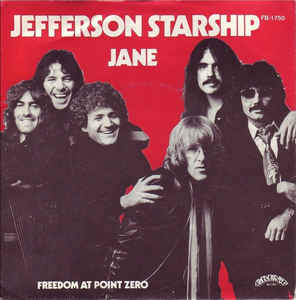
Jane by Jefferson Starship is the song that brought the band back to the mainstream in 1979, a hard rock track with an unmistakable guitar hook and a vocal performance from Mickey Thomas that redefined what Jane could be as a rock entity.
Affiliate Disclosure: I am an Amazon affiliate and if you purchase through any amazon links on this site i may earn a small commission at no extra charge to you.
Released as the lead single from Freedom at Point Zero, Jane reached number 14 on the US Billboard Hot 100, number 21 in the UK, and number 13 in Canada, giving the band their highest chart showing in years and introducing a new lineup to a generation of classic rock listeners.
The song was written by David Freiberg, Jim McPherson, Craig Chaquico, and Paul Kantner, and produced by Ron Nevison, whose hard rock production sensibility shaped this song into something sharper and more direct than much of what Jefferson Starship had released in the years before.
It remains the track most closely associated with this period of the band’s history, the song that plays when anyone asks what Jefferson Starship sounded like when they were at their commercial peak in the late 1970s.
| Song Title | Jane |
|---|---|
| Artist | Jefferson Starship |
| Album | Freedom at Point Zero (1979) |
| Released | 1979 |
| Genre | Hard Rock, AOR, Arena Rock |
| Label | Grunt (RCA) |
| Writers | David Freiberg, Jim McPherson, Craig Chaquico, Paul Kantner |
| Producer | Ron Nevison |
| Peak Chart | #14 US Billboard Hot 100, #21 UK, #13 Canada |
- What Is the Song About?
- The Vibe: Genre, Mood, and Feel
- Behind the Lyrics
- How It Was Made: The Sound and Production
- Legacy and Charts: Impact and Endurance
- A Listener’s Note
- Watch the Official Video
- Collector’s Corner
- Frequently Asked Questions
What Is the Song About?
Jane is a rock song addressed directly to a woman by that name, an appeal to Jane to return or to stay, to not leave the person speaking alone.
The lyric places her at the center of everything: her presence is what makes life bearable, her absence is what makes it hollow, and the song expresses this dependency with the directness that hard rock demands.
There is nothing ambiguous in what the song is asking for: it wants her back, wants her near, wants the feeling that she brought with her to return along with her.
Mickey Thomas’s vocal delivery makes the appeal feel urgent without tipping into desperation, finding the balance between wanting something and sounding strong enough to deserve it.
The song functions as both a name and a concept in the lyric: the specific person and the idea of what she represents, the combination of need and desire that any listener who has wanted someone back can recognize immediately.
The directness of the appeal is part of what has kept the track in rotation: it does not dress up what it wants in metaphor or complication but comes straight at the feeling with full force.
For Jane as a piece of writing, the economy of the lyric is an asset: the song says one thing and says it completely, without detours or qualifications.
Every chorus that calls Jane’s name adds another layer of emphasis, each repetition reinforcing the sense that this is not a casual request but something the person cannot stop feeling.
The Vibe: Genre, Mood, and Feel
This tune sits squarely in the arena rock tradition of the late 1970s, a song built for large spaces and large audiences, with a guitar hook designed to carry over crowd noise and a chorus that invites collective response.
The mood is insistent and energetic, not melancholic in the way a ballad about loss might be, but forward-moving, as though the person singing is determined to get what they are asking for.
Craig Chaquico’s guitar work is the sonic signature of the track, the riff that identifies Jane before the first word is sung and the element that most listeners remember longest after the song is over.
Ron Nevison’s production gives the track a clarity and punch that distinguishes it from the more atmospheric work Jefferson Starship had produced in earlier years, pushing the sound toward hard rock while retaining the melodic quality that makes the chorus so immediately accessible.
The overall feel is confident, the sound of a band that knows what it is doing and a new vocalist who is exactly right for the material, delivering every note with authority.
For listeners encountering this song for the first time through classic rock radio, the immediate impression is the guitar intro: it is one of those riffs that announces itself so completely that you recognize it before you can place it.
The energy of the track does not let up through the performance, maintaining its momentum from the opening notes to the final chorus with the drive that defines the best arena rock of the period.
Behind the Lyrics
Jane was written by four members and associates of the band: David Freiberg, Jim McPherson, Craig Chaquico, and Paul Kantner, a collaborative process that brought together different perspectives on what the song needed to be.
The decision to address the song to a character named Jane gave it a personal immediacy that a more abstract lyric would not have achieved: Jane feels like a real person being spoken to directly, not a generalized romantic ideal.
The lyric benefits from its simplicity, stating its emotional content without trying to be more complicated than the feeling requires.
The repeated use of Jane as both address and refrain throughout the song is what makes it work as an arena rock track: it gives the audience something to hold onto and respond to, a single point of emotional focus that the entire performance builds around.
For Chaquico, who contributed to both the writing and the guitar performance, the track represented an opportunity to demonstrate what the band could do with a harder, more direct approach than their previous work had often shown.
The lyric does not try to explain Jane or place her in a narrative: she exists entirely as the object of the appeal, defined by what the song needs her to be rather than by backstory or detail.
This economy of characterization is not a weakness but a choice: It works as a song because it is entirely about the feeling of wanting someone, and adding more detail would only dilute that focus.
The writing team understood that for this kind of arena rock, the simpler the emotional premise the stronger the performance, and Jane demonstrates that understanding completely.
How It Was Made: The Sound and Production
The song was produced by Ron Nevison, who had worked with acts including Led Zeppelin, The Who, and Heart before bringing his hard rock production approach to Jefferson Starship’s Freedom at Point Zero sessions.
Nevison’s influence is audible throughout the recording: the recording has a directness and punch that reflects his preference for hard rock production values over the more layered and atmospheric approach that had characterized some of Jefferson Starship’s earlier work.
The guitar tone that Chaquico achieves on this tune is one of the defining sounds of the track, a clean, cutting tone that makes the intro riff immediately recognizable and keeps the energy high through every section of the song.
Mickey Thomas joined the band shortly before the Freedom at Point Zero sessions after Grace Slick’s health problems required a change in lineup, and his voice proved immediately suited to the harder, more direct sound that Nevison and the band were building.
Thomas brought a range and power that the song demanded, delivering the chorus with the kind of conviction that arena rock requires: every note needs to land with authority when the room is large enough.
The rhythm section drives the track with the consistent power that effective arena rock depends on, keeping the momentum steady beneath the guitar work and the vocal.
The production is clean without being sterile, retaining enough edge to feel like hard rock while polished enough for mainstream radio, a balance that Nevison achieved consistently throughout his career.
The result is a recording that sounds exactly like what it was intended to be: a rock radio hit with enough substance to hold up under repeated listening, which is why this tune has maintained its place on classic rock playlists for decades.
Legacy and Charts: Impact and Endurance
Jane reached number 14 on the US Billboard Hot 100 in late 1979 and early 1980, number 13 in Canada, and number 21 in the UK, making it Jefferson Starship’s most successful single of the period and one of the enduring classic rock songs of its era.
The success of the single validated the decision to bring Ron Nevison in as producer and to introduce Mickey Thomas as the band’s new lead vocalist, establishing the lineup and sound that would continue into the early 1980s.
The song introduced a generation of listeners to Jefferson Starship who had not followed the band through its earlier incarnations as Jefferson Airplane and through the more experimental mid-1970s material.
The song appeared in the Freedom at Point Zero album context but quickly established itself as the track that represented the band most completely to anyone who discovered them through radio in this period.
The guitar intro for Jane is one of the most recognized openings in late 1970s rock radio, identifiable within the first few notes and capable of generating an immediate response in any audience that grew up with classic rock.
The song has maintained a consistent presence on AOR and classic rock formats since its release, and it continues to appear in documentaries, retrospectives, and playlists covering the era.
Jefferson Starship’s commercial revival that Jane helped establish continued through the early 1980s with further chart success, but the song remains the moment of transition that is most clearly audible in the band’s catalog.
For listeners compiling an understanding of late-1970s AOR and arena rock, Jane is one of the essential entries: a track that captures the sound, the ambition, and the commercial instincts of the period with complete clarity.
A Listener’s Note
First-time listeners are typically struck by the guitar intro before anything else: Chaquico’s riff announces Jane so completely that the vocal almost seems to follow from it rather than lead it.
The song rewards attention to the production details: the way the rhythm section locks in behind the guitar, the way Nevison has placed Thomas’s vocal so that every word lands with maximum impact.
What keeps Jane on classic rock playlists is the combination of a genuinely memorable guitar hook, a vocal performance of real authority, and a lyric that expresses its emotional content without complication.
The song is exactly as long as it needs to be, arriving, making its case for Jane completely, and ending without overstaying its welcome.
Watch the Official Video
Watch Jefferson Starship performing Jane in this official video:
Collector’s Corner
Original pressings of the Jane single on the Grunt label, distributed through RCA, are the primary collector’s item for fans of the recording in its original physical format.
The 7-inch single with its original sleeve is the most sought-after format, particularly copies in strong condition given the age of the pressing and the wear that comes with decades of handling.
Copies of Freedom at Point Zero on the original Grunt pressing provide Jane in its original album context and are valued by collectors who prefer to hear the song as part of the complete record.
International pressings of the Jane single on various national labels are also collected, with UK and European versions carrying their own sleeve designs that differ from the American release.
You Might Also Like
Journey’s defining anthem from Escape became one of the best-selling digital singles of all time and remains a cornerstone of classic rock radio more than four decades after its release.
Heart’s debut hit delivered a vocal performance of remarkable range from Ann Wilson and established the band as one of the most powerful hard rock acts of the mid-1970s.
Boston’s debut single introduced one of the most distinctive guitar sounds in rock history and launched a band that would define the AOR format for years to come.
Frequently Asked Questions
What is Jane by Jefferson Starship about?
Jane is an appeal addressed directly to a woman by that name, asking her to stay or return, expressing the dependency and desire of someone who needs her presence in their life and cannot stop wanting it.
Who wrote Jane?
Jane was written collaboratively by David Freiberg, Jim McPherson, Craig Chaquico, and Paul Kantner, four members and associates of Jefferson Starship who contributed to the song that became the band’s biggest hit of the late 1970s.
Who sang Jane?
Jane was sung by Mickey Thomas, who had joined Jefferson Starship as lead vocalist shortly before the Freedom at Point Zero sessions after Grace Slick’s health required a change in the band’s lineup. Thomas’s powerful range and hard rock delivery suited the song perfectly.
Who produced Jane?
Jane was produced by Ron Nevison, who had previously worked with Led Zeppelin, The Who, and Heart. Nevison brought a hard rock production approach to the Freedom at Point Zero sessions that shaped Jane into the punchy, radio-ready track it became.
How did Jane perform on the charts?
Jane reached number 14 on the US Billboard Hot 100, number 13 in Canada, and number 21 in the UK, making it Jefferson Starship’s highest-charting single of the late 1970s and one of the defining AOR hits of the era.
What album is Jane from?
Jane appears on Freedom at Point Zero, Jefferson Starship’s seventh studio album, released in 1979 on the Grunt label distributed through RCA Records. The album marked a significant shift toward a harder rock sound for the band.
What makes the guitar riff in Jane so memorable?
Craig Chaquico’s intro riff for Jane is memorable because it is both instantly recognizable and completely suited to the emotional character of the song, announcing the track’s energy and intent before a single word is sung. It is one of the defining guitar figures of late-1970s AOR.
Why does Jane endure as a classic rock staple?
Jane endures because it combines a genuinely memorable guitar hook with a vocal performance of real authority and a lyric that expresses its emotional content with complete directness. The song captures the best qualities of late-1970s arena rock in a single, tight performance.
Jane stands as the recording that defined what Jefferson Starship could be when they committed fully to hard rock, a song that captured a band at a moment of transformation and gave that transformation a hook memorable enough to last across generations of classic rock radio.