

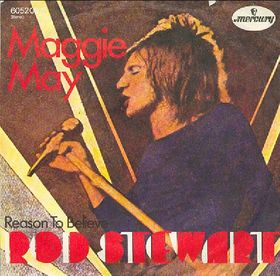
Maggie May by Rod Stewart is one of the great autobiographical rock recordings of the early 1970s, a candid account of a young man’s first sexual experience that reached #1 simultaneously on the UK Singles Chart and the US Billboard Hot 100 in 1971.
Affiliate Disclosure: I am an Amazon affiliate and if you purchase through any amazon links on this site i may earn a small commission at no extra charge to you.
Written by Stewart and guitarist Martin Quittenton, the recording was completed in just two takes and appeared on the album Every Picture Tells a Story, which reached #1 on both sides of the Atlantic simultaneously , a remarkable achievement that confirmed Stewart’s standing as one of the era’s defining rock vocalists.
Maggie May spent five weeks at the top of both charts, and its mandolin coda — played by Ray Jackson of Lindisfarne for a fee of just £15 — became one of the most recognisable instrumental passages in British rock.
The album version begins with a thirty-second acoustic guitar introduction titled “Henry,” also composed by Quittenton, that sets the folk-influenced tone before Stewart’s vocal enters with the directness that characterises the entire performance.
The track has remained a fixture on classic rock radio for more than fifty years, and its combination of autobiographical honesty, melodic strength, and the contrast between Stewart’s raspy vocal and the song’s acoustic folk setting has given it an endurance that few recordings of the era have matched.
| Song Title | Maggie May |
| Artist | Rod Stewart |
| Album | Every Picture Tells a Story (1971) |
| Released | July 1971 |
| Written By | Rod Stewart, Martin Quittenton |
| Producer | Rod Stewart |
| Label | Mercury Records |
| Chart Peak | #1 UK Singles Chart (5 weeks), #1 US Billboard Hot 100 (5 weeks) |
What Is Maggie May About?
Maggie May is a song about a young man’s seduction by an older woman, drawn directly from Stewart’s own experience at the 1961 Beaulieu Jazz Festival when he was sixteen years old.
Stewart described the encounter in several interviews as his first sexual experience, and the song’s power comes from the combination of its candour. Rod Stewart knows he is being used and resents it, and his underlying affection for the woman he cannot quite bring himself to leave.
The name “Maggie May” was borrowed from an old English folk song about a Liverpool prostitute rather than the actual name of the woman Stewart was writing about, and the choice of that name gives the lyric a literary reference that deepens its emotional resonance.
The ambivalence at the song’s heart, desire mixed with resentment, attachment mixed with self-awareness, gives it a psychological complexity that elevates it well above the standard rock narrative of uncomplicated conquest.
The Vibe: Genre, Mood, and Search Intent
Maggie May opens with Quittenton’s thirty-second acoustic guitar introduction before Stewart’s vocal enters with a conversational directness that immediately establishes the song’s character: intimate, unsentimental, and entirely committed to the truth of the experience it describes.
Ray Jackson’s mandolin coda gives the recording its most distinctive instrumental moment, and the contrast between the folk instrument and the rock rhythm section creates the sonic tension that makes the arrangement so immediately recognisable.
- Genre: Folk Rock, Soft Rock, Classic Rock
- Mood: Nostalgic, Ambivalent, Confessional
- Tempo: Mid-tempo folk rock (~108 BPM)
- Best For: Classic rock playlists, 1970s rock collections, singer-songwriter deep dives
- Similar To: Free “All Right Now”, Cat Stevens “Wild World”
- Fans Also Search: Rod Stewart discography, Every Picture Tells a Story album, Ray Jackson mandolin
Behind the Lyrics: The Song’s Story
Stewart and Quittenton had been developing the song for some time before it was recorded, and the acoustic folk structure that Quittenton brought to the arrangement gave Stewart’s lyric the setting it needed: something that sounded both intimate and musically sophisticated.
The decision to use Ray Jackson’s mandolin was not originally planned: Jackson was simply visiting the recording session, and producer Stewart asked him to add the coda that became the song’s most memorable element.
According to the Wikipedia entry on Maggie May, Jackson received only £15 for the session and was not credited by name on the original album sleeve, a fact that has been widely cited as one of the more egregious examples of session musician underpayment in British rock history.
The recording was completed in just two takes, a speed that reflects both the band’s preparedness and the directness of the song itself: there is nothing tentative or over-produced about the final result.
For listeners exploring the autobiographical end of early 1970s British rock, this track belongs alongside John Lennon’s “Working Class Hero” and Cat Stevens’ confessional material as one of the era’s most personally revealing recordings.
Technical Corner: Gear and Production
Rod Stewart’s decision to produce the album himself gave the recording a directness and personal authority that a hired producer might have smoothed away: he knew exactly what the song needed and had the confidence to pursue it without compromise.
Quittenton’s acoustic guitar work — both the “Henry” introduction and the body of the arrangement — provides the folk foundation that distinguishes the track from the electric rock recordings that dominated contemporary radio.
Micky Waller‘s drumming was recorded with Waller’s cymbal crashes overdubbed separately after the initial take, a production choice that gives the rhythm track an unusual character — slightly hesitant in places — that becomes part of the song’s charm rather than a flaw.
Ron Wood’s electric guitar contributions add texture and muscle to the arrangement without dominating it, maintaining the acoustic folk feel that gives the recording its distinctive character.
The recording was made at Morgan Studios in London, and the relatively straightforward production approach — no elaborate overdubs, no orchestral additions — gives the finished track a live quality that suits the autobiographical honesty of the lyric perfectly.
Legacy and Charts: Impact and Endurance
Maggie May reached #1 on the UK Singles Chart in August 1971 and simultaneously #1 on the US Billboard Hot 100 in October 1971, holding both positions for five consecutive weeks — an achievement that confirmed Stewart as one of the most commercially significant rock artists of his generation.
The simultaneous chart-topping on both sides of the Atlantic was notable even in an era when British artists regularly crossed over to US success: the combination of Stewart’s vocal, the song’s folk-rock arrangement, and its autobiographical directness appealed to audiences with very different musical cultures.
The track’s endurance on classic rock radio has been consistent across more than fifty years, and its regular appearance on “greatest rock songs” lists of every era confirms its status as one of the defining recordings of the early 1970s.
Ray Jackson’s mandolin playing, despite the injustice of his original compensation, has become one of the most cited instrumental passages in discussions of folk rock production, and the instrument’s sound is now inseparable from the song’s identity.
It stands as one of the great recordings of 1971 and one of the most enduring pop-rock singles of the entire decade.
Listener’s Note: A Personal Take
The opening guitar introduction sets a mood that the rest of the arrangement consistently delivers on: there is something in the acoustic folk setting that makes the lyric’s confessional quality feel entirely natural rather than calculated.
Stewart’s vocal performance is one of the great rock deliveries of the era: rough-edged, emotionally direct, and completely inhabited, with none of the affectation that sometimes crept into his later recordings.
The mandolin coda is one of those moments in popular music where the right instrumental choice transforms a good recording into an unforgettable one: it gives the song a wistful quality that the lyric alone could not quite achieve.
Quittenton’s guitar work throughout is a masterclass in understated accompaniment: always present, always supportive, never competing with the vocal for the listener’s attention.
It is a record that rewards repeated listening because each time you hear it you notice another small detail — a guitar phrase, a drum fill, a vocal inflection — that demonstrates how much craft went into making something that sounds this effortless and spontaneous.
Watch: The Official Music Video
Watch Rod Stewart performing Maggie May in this official video:
Collector’s Corner: Own a Piece of Rock History
Rod Stewart: Every Picture Tells a Story (1971)
Own the landmark album that reached #1 on both sides of the Atlantic simultaneously.
Original Mercury Records pressings, remastered editions, and vinyl available.
Frequently Asked Questions About Maggie May
Who wrote Maggie May?
Maggie May was written by Rod Stewart and Martin Quittenton. Quittenton provided the acoustic guitar arrangement and the “Henry” introduction, while Stewart wrote the autobiographical lyric based on his own experience at the 1961 Beaulieu Jazz Festival.
What is Maggie May about?
The song is about a young man’s seduction by an older woman, drawn from Stewart’s own first sexual experience at the age of sixteen. The lyric captures the narrator’s ambivalence: he knows he is being used, resents the disruption to his education and plans, but cannot bring himself to leave.
How did Maggie May chart?
The single reached #1 on both the UK Singles Chart and the US Billboard Hot 100, spending five consecutive weeks at the top of each. The simultaneous double chart-topper confirmed Stewart as one of the era’s most commercially significant rock artists.
Who played the mandolin on the recording?
Ray Jackson of Lindisfarne played the mandolin coda. He was visiting the recording session and was asked by Stewart to add the part, which he composed himself. Jackson received only £15 for the session and was not credited by name on the original album sleeve.
Who played on Maggie May?
The key musicians were Rod Stewart (vocals), Martin Quittenton (acoustic guitar), Ron Wood (electric guitar), Micky Waller (drums), and Ray Jackson (mandolin). The album was produced by Rod Stewart himself at Morgan Studios in London.
What is the “Henry” introduction?
The thirty-second acoustic guitar introduction that opens the album version of the recording is titled “Henry” and was also composed by Martin Quittenton. It was released as the B-side of the original single in some markets, which is how the single initially charted — radio DJs flipped it over from the A-side “Reason to Believe.”
How many takes did the recording require?
The recording was completed in just two takes, a speed that reflects both the band’s thorough preparation and the directness of the song’s arrangement. The spontaneous, live-in-the-room quality of the performance is one of its defining characteristics.
What album is Maggie May from?
Maggie May is from Rod Stewart’s third studio album, Every Picture Tells a Story, released on Mercury Records in May 1971. The album reached #1 on both the UK Albums Chart and the US Billboard 200, making Stewart and the album #1 on both sides of the Atlantic simultaneously with both the single and the LP.
You May Also Like
Free: All Right Now (1970)
A British rock landmark from the same era that shares the same raw vocal commitment and the same ability to communicate genuine emotion through a direct, unadorned arrangement.
T. Rex: Bang a Gong (Get It On) (1971)
A 1971 British rock classic from the same year, sharing the same confident vocal performance and the same ability to combine rock energy with a sophisticated musical arrangement.
Gary Wright: Dream Weaver (1975)
A 1975 rock classic that shares the same era and the same commitment to a strong, distinctive vocal at the centre of a carefully crafted arrangement.
More than fifty years after its release, this recording retains every degree of the autobiographical directness and folk-rock warmth that made it a worldwide number one hit in 1971, and it remains one of the most genuinely personal recordings in the history of British rock.