

The Joker by the Steve Miller Band is one of the most disarmingly charming number one singles in American rock history, a song built around a nonsense phrase, a borrowed lyric, and an acoustic guitar figure so relaxed it sounds like it was written in an afternoon, yet it captured something so perfectly easy in its confidence that it went straight to number one on the US Billboard Hot 100 in early 1974.
Affiliate Disclosure: I am an Amazon affiliate and if you purchase through any amazon links on this site i may earn a small commission at no extra charge to you.
Released in October 1973 as the title track from the album of the same name, The Joker was Steve Miller’s first US number one, the commercial breakthrough that confirmed him as a major figure in mainstream rock after years of respected but less commercially successful work out of San Francisco.
Written by Steve Miller with Ahmet Ertegun and Eddie Curtis, and produced by Miller himself, The Joker draws on early rhythm and blues — including lyrical elements borrowed from Hank Ballard and The Medallions — and assembles them into something that sounds entirely of its own moment: loose, confident, and impossible to dislike.
| Song Title | The Joker |
|---|---|
| Artist | Steve Miller Band |
| Album | The Joker (1973) |
| Released | October 1973 |
| Genre | Rock, Blues Rock, Soft Rock |
| Label | Capitol Records |
| Writers | Steve Miller, Ahmet Ertegun, Eddie Curtis |
| Producer | Steve Miller |
| Peak Chart | #1 US Billboard Hot 100, #1 UK (1990 reissue) |
- What Is the Song About?
- The Vibe: Genre, Mood, and Feel
- Behind the Lyrics
- How It Was Made: The Sound and Production
- Legacy and Charts: Impact and Endurance
- A Listener’s Note
- Watch the Official Video
- Collector’s Corner
- Frequently Asked Questions
What Is the Song About?
The Joker is, on the surface, a relaxed declaration of romantic availability and easy living, a song in which the singer introduces himself through a series of affectionate nicknames and makes clear that he has exactly what his beloved needs.
The famous opening line declares the singer to be a smoker, a joker, and a midnight toker, which establishes the character’s vibe instantly: someone who does not take himself too seriously, who enjoys life’s pleasures without apology, and who wants to share that ease with someone he cares about.
The phrase “pompatus of love” — one of the most discussed pieces of apparent nonsense in rock history — originated from Miller mishearing the word “puppetutes” in The Medallions‘ 1954 recording “The Letter,” adapting it into something that sounds like it means something profound while being essentially invented.
What makes the song work as a piece of writing is precisely its refusal to be earnest: it is a love song delivered with a wink, confident enough in its own charm not to need sincerity as a crutch, communicating warmth through ease rather than through declaration.
The lyric also references two earlier Steve Miller Band songs, “Space Cowboy” and “Gangster of Love,” effectively building a mythology around the singer’s character that rewards fans who have been following his work while remaining accessible to anyone who has not.
There is something fundamentally American about the character at the center of the song: self-deprecating but self-assured, laid-back but persistent, the kind of person who can call himself a midnight toker and make it sound like an endorsement rather than a confession.
The song’s emotional content is not complicated, which is entirely the point: sometimes a song about feeling good, about being easy with yourself and the world, is exactly what the moment requires, and this one delivers that feeling with complete authority.
For listeners who encountered it in the California sunshine of 1973 or through the Levi’s commercial that revived it in 1990, the effect is the same: The Joker sounds like a Friday afternoon, and that is not a small achievement.
The Vibe: Genre, Mood, and Feel
The Joker sits comfortably in the California rock tradition of the early 1970s, drawing on blues, country, folk, and soft rock influences to create something that fits neatly into no single category while feeling instantly familiar in all of them.
The mood is relaxed to the point of being almost somnambulant: the guitar groove is unhurried, the vocal is delivered as if Steve Miller is barely trying, and every production decision reinforces the sense that nobody in the studio was in a rush to be anywhere else.
The song’s tempo is set by an acoustic guitar figure that is immediately recognizable from its very first note, one of those musical hooks so simple and effective that it seems almost unfair, a melody that plants itself in the listener’s memory before a word has been sung.
The tone is playful throughout, from the throwaway verse about the pompatus of love to the gentle slide guitar that drifts through the arrangement like smoke, and the playfulness is always in service of the song’s central emotional quality: generous ease.
For listeners who associate rock music with urgency or intensity, the track offers something different: proof that a song can be completely effective without raising its voice, that confidence expressed through relaxation is at least as powerful as confidence expressed through aggression.
The genre question is ultimately less interesting than the mood question, and the mood here is unmistakable: this is music for warm evenings and unhurried drives, music that makes the ordinary feel pleasantly adequate.
Listeners who discover it for the first time often report the same experience: a sense of recognition, as if they have always known this song, which is the quality shared by all the great casual recordings and is much harder to achieve than it looks.
Behind the Lyrics
The Joker was written during a period when Steve Miller was beginning to move away from the blues-influenced psychedelic rock of his San Francisco period toward a more commercially accessible style, and the lyric reflects that transition: it keeps the bluesman’s ease while removing most of the complexity.
The co-writing credits with Ahmet Ertegun and Eddie Curtis reflect the song’s debt to earlier R&B: the phrase “lovey dovey” was borrowed from a 1954 Ike Turner recording, and the overall character of the smooth-talking romantic narrator has its roots in the blues tradition of self-mythologizing.
The “pompatus of love” phrase became one of the most analyzed pieces of apparent nonsense in rock history, the subject of a 1996 film called “The Pompatus of Love” and countless magazine articles, all of which Miller has addressed with characteristic good humor.
Miller borrowed the original word “puppetutes” from The Medallions’ “The Letter,” which he heard as a teenager and misremembered phonetically; the resulting “pompatus” entered the language as a kind of placeholder for romantic intensity that cannot be named more precisely.
The self-referential elements — the mentions of Space Cowboy and Gangster of Love — give the lyric a playful meta-quality, as if the song exists in a shared universe with earlier recordings, and the character at its center is both fictional and autobiographical simultaneously.
What Miller captured in the writing was the specific combination of confidence and vulnerability that makes someone genuinely charming: the willingness to be laughed at a little, to not take the performance of attraction too seriously, while still communicating real warmth.
The lyric is the most successful example of Miller’s tendency to treat songs as affectionate self-portraits, and the reason it connects so broadly is that the portrait is drawn with enough humor and humanity to feel like someone you would actually like to know.
How It Was Made: The Sound and Production
The Joker was recorded at Capitol Studios in Hollywood and produced by Steve Miller, who by 1973 had developed enough confidence in his own instincts to know that the song required restraint above all else: any attempt to make it bigger would have destroyed the quality that made it work.
The central acoustic guitar figure was tracked simply and cleanly, giving the recording its foundation of ease; the slide guitar, electric elements, and backing vocals were all added in service of that core groove rather than as elaborations on it.
Miller’s vocal approach was similarly understated: the delivery is conversational rather than performative, as if he is telling a story to someone sitting across a table rather than projecting to a concert hall, which is entirely appropriate for a lyric about the pleasures of easy company.
The production strips away the more elaborate psychedelic elements of earlier Steve Miller Band work and replaces them with a directness that makes everything on the recording immediately accessible: there are no passages that require patience or attention, just the groove and the voice and the easy momentum of the song.
Capitol Studios, where the recording was made, had been the site of countless classic recordings, and the sound of the finished track carries some of that institutional confidence: it sounds like a record, properly recorded and mixed, without feeling clinical or overworked.
The decision to keep the production sparse was not timidity but confidence: Miller knew that anything added beyond what was necessary would dilute the casual authority of the performance, and the restraint throughout confirms that the instinct was correct.
The result is a recording that rewards both casual listening and close attention, sounding simple on the surface while revealing, on closer inspection, exactly how many small decisions went into making it sound as effortless as it does.
Legacy and Charts: Impact and Endurance
The Joker reached number one on the US Billboard Hot 100 in February 1974, holding the position for one week and providing Steve Miller with his first chart-topping single after more than six years of recording, a commercial breakthrough that reshaped the trajectory of his career.
The song’s US success established the template for the more commercially oriented phase of Miller’s work that followed, including subsequent hits like “Fly Like an Eagle” and “Rock’n Me,” and the album became one of the best-selling records of 1973 in the United States.
The UK story was different and, in some ways, more remarkable: the recording spent seventeen years without ever charting in Britain, then was placed in a Levi’s television commercial in 1990 and promptly went to number one on the UK Singles Chart, displacing Deee-Lite’s “Groove Is in the Heart” in what became one of the more surprising chart stories of that era.
The 1990 UK number one demonstrated the song’s remarkable cross-generational durability: a recording made in 1973 could reach the top of a chart in 1990 because the qualities that made it appealing — the easy groove, the memorable guitar figure, the affectionate character of the lyric — had not aged at all.
In the decades since, the track has become one of the most immediately recognizable recordings in classic rock radio history, its opening guitar figure among the most identified in the American rock canon alongside a handful of other recordings from the same era.
The song has appeared in films, television commercials, and sporting event soundtracks consistently since its initial release, each appearance confirming its status as a piece of American popular music that communicates something reliably recognizable across very different contexts.
Steve Miller has performed the song at every concert he has given since its release, and it remains the moment in his live shows where the audience responds most immediately, which is the most reliable measure of a song’s enduring connection to its listeners.
A Listener’s Note
The opening acoustic guitar figure is one of those moments in rock music where the recording announces everything it is going to be before a single word is sung: you know within four bars exactly how you are going to feel for the next three minutes.
The key to The Joker is the confidence of the delivery, which never tips into arrogance and never drops into self-deprecation: Miller occupies exactly the right emotional register throughout, charming without trying too hard, casual without being indifferent.
What the recording gives repeated listeners is something slightly different from what it gives first-time listeners: familiarity has a way of making the song’s construction more visible, and what initially seems effortless turns out to be the product of very precise choices.
The song is three minutes and fifty-four seconds long and uses every one of them efficiently, arriving exactly where it needs to and ending before it has overstayed its welcome, which is harder than it sounds.
Watch the Official Video
Watch Steve Miller Band performing The Joker in this official video:
Collector’s Corner
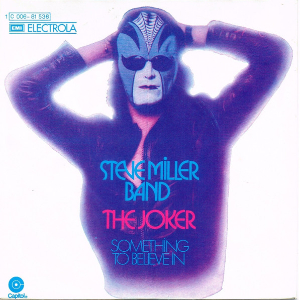
Original pressings of The Joker single on Capitol Records are sought after by collectors of 1970s American rock, particularly the first pressings with the original label art and picture sleeves from different territories.
The 1990 UK reissue is itself a collector’s item in some circles, representing the unusual circumstance of a seventeen-year-old recording reaching number one in a new market, and copies of the UK pressing with its contemporary sleeve design have their own following.
Original copies of the The Joker album on Capitol, particularly early pressings in strong condition with original inner sleeves, are consistently sought after by collectors who want the complete original context of the recording.
You Might Also Like
Boston’s debut single introduced one of the most perfectly constructed guitar sounds in rock history, a song about music itself that became one of the defining records of the American classic rock era.
The Eagles’ most complex and debated recording, a gothic examination of the darker side of the California dream built around one of rock’s most celebrated guitar solos and a lyric that has resisted definitive interpretation for nearly fifty years.
Lynyrd Skynyrd’s defiant answer to Neil Young’s Southern Man became the defining statement of Southern rock pride, a song that has outlasted the controversy it generated and become one of the most beloved regional anthems in American popular music.
Frequently Asked Questions
What is The Joker about?
The Joker is a relaxed, affectionate declaration of romantic availability in which the singer introduces himself through a series of nicknames and makes clear he has what his beloved needs. The song combines genuine warmth with playful self-deprecation, using humor and ease rather than earnest declaration to communicate attraction.
What does “pompatus of love” mean in The Joker?
The phrase “pompatus of love” is a piece of invented nonsense that Steve Miller adapted from mishearing the word “puppetutes” in The Medallions’ 1954 song “The Letter.” It has no specific meaning but functions as a placeholder for romantic intensity that cannot be named more precisely. The phrase became so famous it was the subject of a 1996 film.
Did The Joker reach number one?
The Joker reached number one on the US Billboard Hot 100 in February 1974, giving Steve Miller his first US chart-topper. In 1990, after being featured in a Levi’s advertisement, the reissued recording also reached number one in the United Kingdom, making it a number one hit in two different decades.
Who wrote The Joker?
The Joker was written by Steve Miller, Ahmet Ertegun, and Eddie Curtis. The writing credits reflect the song’s debt to earlier R&B and blues recordings, including lyrical elements borrowed from Hank Ballard and The Medallions.
What album is The Joker from?
The Joker is the title track of Steve Miller Band’s eighth studio album, released in October 1973 on Capitol Records. The album marked a significant commercial breakthrough for the band after years of respected but less commercially successful recordings.
Why did The Joker chart in the UK seventeen years after its release?
The song was featured in a Levi’s jeans television commercial in 1990, which introduced it to a new British audience. The resulting surge in sales sent the reissued single to number one on the UK Singles Chart, one of the more remarkable chart stories of that era and a demonstration of the song’s cross-generational appeal.
What other Steve Miller Band songs are mentioned in The Joker?
The lyric references two earlier Steve Miller Band recordings: “Space Cowboy” (1969) and “Gangster of Love” (1968). These self-references build a mythology around the singer’s character, rewarding long-time fans while remaining accessible to new listeners encountering the band for the first time.
Why does The Joker endure as a classic?
The Joker endures because it achieves something genuinely difficult: a song about being easy with yourself and the world, delivered with enough craft and confidence that it never feels lazy. The opening guitar figure is one of the most recognizable in American rock, and the combination of the memorable groove, the invented mythology of the lyric, and Steve Miller’s perfectly calibrated vocal performance creates a recording that feels both timeless and specific to its era.
The Joker endures because it captures something that popular music rarely makes explicit: the particular pleasure of being entirely at ease with who you are, delivered by someone who has clearly figured it out and wants to share the discovery.