
Pat Benatar walked into the Catch a Rising Star club in New York City in 1978 and sang her way from cocktail waitress to rock royalty in what felt, from the outside, like about fifteen minutes.
She had a four-octave soprano voice trained in the classical tradition, an attitude that was entirely her own, and a vision for what a woman at the front of a rock band could look and sound like that no one else in the industry had articulated yet.
The industry caught up quickly once it heard her.
By the time the 1980s opened, Pat Benatar was not knocking on any doors — she was kicking them down, Grammy Award in hand, with a production team and a partner in Neil Giraldo who understood exactly what she was trying to do.
This is the story of how that happened and why it still matters.
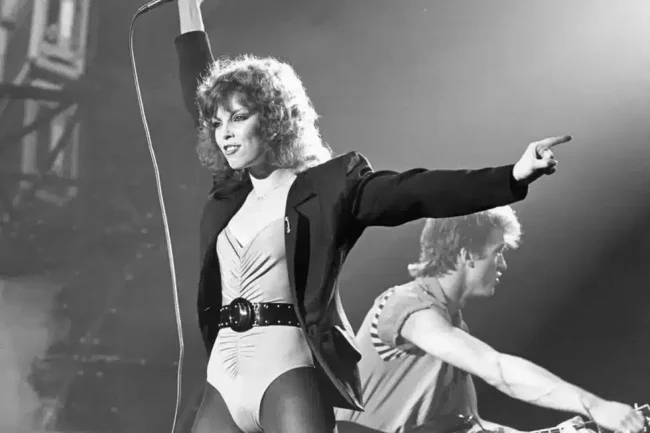
Photo: Hulton Archive, Getty Images
Quick Navigation
- Pat Benatar Before the Fame
- The Voice That Could Not Be Ignored
- Pat Benatar Meets Neil Giraldo
- In the Heat of the Night: A Career Begins
- Hit Me with Your Best Shot and What It Meant
- Pat Benatar’s Grammy Winning Streak
- Love Is a Battlefield and the MTV Revolution
- The Albums That Built an Empire
- What Separated Pat Benatar From the Rest
- The 1990s and Life Away from the Spotlight
- Pat Benatar Today: Still the Voice
- Social Media and Staying Connected with Fans
- Watch Pat Benatar and Neil Giraldo on American Idol 2026
- The Legacy That Will Not Fade
Pat Benatar Before the Fame
She was born Patricia Mae Andrzejewski on January 10, 1953, in Greenpoint, Brooklyn, and grew up in Lindenhurst, on Long Island, in a household where music was part of the furniture.
Her mother was a singer who performed in local productions, and the girl who would become Pat Benatar absorbed everything around her from childhood.
She studied classical voice and carried those techniques with her even after she decided that rock and roll was where she needed to be.
She attended the State University of New York at Stony Brook on a partial music scholarship before dropping out to pursue performing full time.
The years between that decision and her record deal were not glamorous: she worked as a bank teller and then as a waitress while performing at local venues and building her reputation one room at a time.
Every night in front of a small crowd was preparation for what came next, and she used every one of those nights.
Did You Know?
Pat Benatar’s birth name is Patricia Mae Andrzejewski. She took the last name Benatar from her first marriage to Dennis Benatar, a soldier she married at age nineteen. When the marriage ended, she kept the stage name because it was far easier for audiences and radio programmers to say — a practical decision that turned into one of rock’s most recognizable names.
The Voice That Could Not Be Ignored
The thing about hearing Pat Benatar for the first time is that the voice stops you cold before you even process what song it is.
It has an operatic authority at its foundation — full, controlled, and capable of the kind of power that most rock singers have to manufacture through distortion and volume.
She did not need any of that.
The control came from years of classical training, but the fire came from somewhere else entirely, from a desire to prove that a woman who had spent years being told she did not fit the mold of a rock act was going to fit anyway.
When she performed at Catch a Rising Star and caught the attention of Chrysalis Records executive Terry Ellis in 1978, she was not polished in the way that label signings usually are.
She was something more valuable: she was completely, specifically, irreducibly herself.
Ellis offered her a deal on the spot, and the recording industry made one of its smarter decisions of that decade.
Pat Benatar Meets Neil Giraldo
The person who would become the other half of everything was Neil Giraldo, a guitarist from Cleveland who arrived as her musical director and stayed as her husband, creative partner, and the person most responsible for the sound that made Pat Benatar’s records work.
Giraldo brought a layered, guitar-forward production approach that gave her voice room to live inside the arrangement without competing with it.
He understood instinctively that the voice was the instrument and that everything else was there to frame it.
Their creative partnership produced some of the sharpest rock records of the early 1980s, built on the combination of her vocal range and his ability to construct a track around it.
Their personal relationship developed alongside the professional one, and they married in 1982, building a life together that has now lasted more than four decades.
The music that came out of that partnership did not feel like collaboration in the clinical sense — it felt like a single vision being expressed through two people who could finish each other’s musical sentences.
Did You Know?
Pat Benatar and Neil Giraldo have two daughters together, Haley and Hana. The couple married on February 20, 1982, the same year they released Get Nervous, her fourth studio album. Their marriage is one of the longest-running in rock music, built on a foundation of both romantic partnership and creative collaboration that has never stopped producing music.
In the Heat of the Night: A Career Begins
The debut album from Pat Benatar, In the Heat of the Night, arrived in 1979 and went platinum.
That was not supposed to happen for a first record by an unknown artist on a mid-sized label.
It happened because the music was that good and because the voice on those tracks was unlike anything else on rock radio at the time.
Heartbreaker was the track that reached the widest initial audience, a song that showcased her range across four minutes that felt both completely controlled and completely abandoned at the same time.
The album also revealed the production philosophy that would carry through the records that followed: hard guitars underneath a vocal that never had to fight for space.
Radio responded, audiences responded, and the music industry began to understand that what it had here was not a novelty act but a force that was going to be around for a long time.
Hit Me with Your Best Shot and What It Meant
Crimes of Passion from Pat Benatar came out in 1980 and hit differently than the debut.
It was harder, more confident, and built on a chemistry between singer and production that had only deepened after a year of touring together.
Hit Me with Your Best Shot was the song that crossed the threshold from rock radio staple to genuine cultural landmark.
The track had a swagger to it that felt almost defiant, with a chorus built to be shouted by thousands of people in an arena setting, and it became exactly that within months of its release.
It peaked at number nine on the Billboard Hot 100, a chart position that reflected both rock and mainstream pop audiences responding to the same record simultaneously.
More than four decades on, the song still lands at sporting events, in film soundtracks, and on any playlist that needs exactly that particular combination of confidence and drive.
Crimes of Passion went four times platinum and established the commercial scale at which Pat Benatar’s career would now operate.
Pat Benatar’s Grammy Winning Streak
The Grammy Awards began recognizing Pat Benatar in 1980 with the award for Best Rock Vocal Performance, Female, and then did not stop for three more years.
Four consecutive wins in that category, from 1980 through 1983, covering the albums In the Heat of the Night, Crimes of Passion, Precious Time, and Get Nervous.
Each win was for a different album, which meant she was not coasting on a breakthrough record but producing at a level that the Academy recognized year after year.
The four-year run spoke to a consistency that the rock world does not often produce, and it came at the same time that she was touring relentlessly and maintaining a creative output that most artists would have found exhausting to attempt.
The Grammy recognition also changed how the industry perceived female rock artists: if the Academy was awarding this category four years running to the same person, it had to acknowledge that the category mattered and that it had real standards worth measuring against.
Did You Know?
Pat Benatar’s four consecutive Grammy Awards for Best Rock Vocal Performance, Female set a record in that category that has never been matched. Her win streak ran from the 23rd Grammy Awards in 1981 through the 26th in 1984, covering four different albums across four consecutive years. If you want to hear what won her those trophies, Crimes of Passion on Amazon is the place to start.
Love Is a Battlefield and the MTV Revolution
The Pat Benatar track that changed everything about how people thought about music videos arrived in 1983.
Love Is a Battlefield came with a video directed by Bob Giraldi that told a story — not just illustrated the music, but told an actual narrative about a young woman leaving home, surviving on the street, and finding solidarity with other women in an impossible situation.
MTV played it, and the response was immediate.
Audiences had not seen a video that used the format as actual filmmaking before, and the combination of the visual storytelling and the power of the song itself made this one of the most memorable entries in the entire MTV canon of the early 1980s.
The song peaked at number five on the Billboard Hot 100 and became one of the signature recordings of the decade.
It demonstrated that the video format could do something more than performance footage and effects, and it influenced how artists and directors approached the medium for years afterward.
The Albums That Built an Empire
The run of albums from 1979 through 1984 is one of the most consistent in the history of mainstream rock: In the Heat of the Night, Crimes of Passion, Precious Time, Get Nervous, and Live from Earth, followed by Tropico in 1984.
Each record found a different angle on the same core identity: a voice built for the dramatic, a production approach that emphasized the rock foundation without sacrificing the melody, and lyrics that engaged with emotional stakes that felt real rather than performed.
Precious Time debuted at number one on the Billboard 200 in 1981, making her the first female rock artist to achieve that position with a solo rock album.
That fact deserves a moment of consideration, because 1981 was not a moment of open doors for women in rock.
She walked through anyway and then held the position for two weeks.
The 80s Iconic Hits and Stories catalog from that era reads like a list of moments she defined, and her album run was the foundation of all of it.
What Separated Pat Benatar From the Rest
A lot of artists in the early 1980s could bring energy to a rock record.
What Pat Benatar brought was something more specific: dramatic intelligence.
She understood how to inhabit a lyric the way an actor inhabits a role, finding the emotional truth inside the words rather than just delivering them at volume.
That approach came from her classical training, which had taught her that a vocal performance is a communication, not just a display of range.
It also came from the fact that she was working with material that had something to say — love as conflict, identity under pressure, the cost of vulnerability — and she took that material seriously.
The result was music that held up under repeated listening in a way that pure energy-driven rock often does not, because the emotional content gave it a depth that outlasted the initial impact.
Pat Benatar also looked like no one else in rock at the time: the short hair, the dramatic stage presence, and the athleticism she brought to performance created a visual identity that was completely original and completely hers.
The 1990s and Life Away from the Spotlight
The commercial momentum that had carried Pat Benatar through the 1980s at full speed began to shift in the early 1990s as the industry and the listening public moved toward new sounds.
True Love by Pat Benatar, released in 1991, was a pop-oriented record that reflected a different direction, and Wide Awake in Dreamland in 1988 had already begun the exploration of territory beyond straight hard rock.
She stepped back from the major commercial machine during this period and made a deliberate choice to prioritize family alongside music rather than treating one as a distraction from the other.
She and Neil Giraldo spent time in Hawaii with their daughters, reconnecting with life outside the promotional cycle that had defined the previous decade.
The breaks were not retreats — they were the kind of pauses that a career needs to survive past its initial commercial peak, and Pat Benatar came back from each of them with something to say.
She released Innamorata in 1997, a covers album that showcased her voice outside the rock format, and continued performing and recording without the commercial infrastructure that major label support had previously provided.
Pat Benatar Today: Still the Voice
Pat Benatar has not stopped performing, and the voice has not stopped working.
She and Neil Giraldo continue to tour as a duo, bringing decades of material to audiences who saw her in the 1980s and to younger fans who have discovered the catalog through streaming and social media.
The live experience remains centered on the voice, which is the correct decision because the voice is still the most compelling thing in any room she performs in.
She was inducted into the Rock and Roll Hall of Fame in 2022, alongside Neil Giraldo, as a recognition of a career that had earned the tribute through forty-plus years of consistent work.
The Hall induction came with the full ceremony, the speeches, and the performance, and watching her sing that night it was immediately clear that the recognition was overdue.
If you want to see what that live energy looks like in the current era, you can find Pat Benatar’s 2026 tour dates and venue details and get yourself into a room where she is performing.
Social Media and Staying Connected with Fans
Pat Benatar and Neil Giraldo maintain an active presence across multiple platforms for fans who want to follow them between tours and albums.
Their Facebook page covers tour announcements, archival content, and personal updates from the couple.
On Instagram, the account mixes behind-the-scenes moments with performance content and the kind of genuine personality that has always distinguished them from artists who treat social media purely as marketing.
Their YouTube channel holds official video content, live recordings, and material that spans the full arc of the career.
The official Benatar Giraldo website remains the central hub for tour information, merchandise, and the most current news from the camp.
For anyone who wants to understand what the two of them have built together beyond the recordings, the About page on their site offers the clearest picture.
Watch Pat Benatar and Neil Giraldo on American Idol 2026
Their 2026 appearance on American Idol delivered exactly what the stage demanded: two people who have spent decades performing together, moving through Heartbreaker and Ring of Fire as if the songs had been written that morning.
The video below captures the performance in full.
Watching Pat Benatar perform now, what stands out is that the voice still carries the room.
No assistance, no production tricks, just the instrument that built everything doing exactly what it was always capable of doing.
The Legacy That Will Not Fade
What Pat Benatar built across the 1980s did not belong to its decade and did not stay in its decade.
She opened a door for every woman who picked up a microphone in front of a rock band and decided that commanding the room was a reasonable expectation.
The singers who came after her, across genres and eras, heard those albums and understood something about what a female voice at the center of hard rock music could do.
The four Grammy wins, the platinum albums, the Rock and Roll Hall of Fame induction — the record is there for anyone who wants to consult it.
But the legacy lives in the songs themselves, in the way Heartbreaker and Hit Me with Your Best Shot and Love Is a Battlefield still land when they come through a speaker, and in the audiences that still show up to hear them played by the person who recorded them.
Pat Benatar is still that person, still on stage, and still the most convincing argument that what she was doing in 1979 was not a moment but a standard.
Affiliate Disclosure: This post contains affiliate links. If you purchase through them, we may earn a small commission at no extra cost to you.
If you want the essential Pat Benatar in your collection, Pat Benatar greatest hits on Amazon is the place to start.